


Dinner Served
The sun breaks through the coastal fog,
Replacing damp-chill hidden mysteries
With warm-wrapped scented dialogue
Between the sand-surf and an offshore breeze.
From shoreline poles the eagles stare
To watch a squawking beach-blown seagull flap
Its upraised wings in proffered prayer
In hopes of pecking up a wave-washed scrap.
Where azured sky meets sea-steeled blue
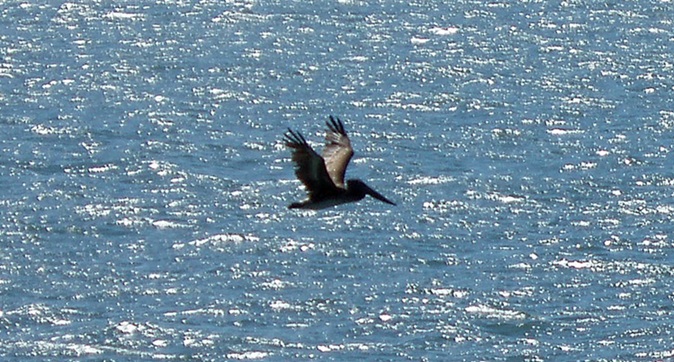
A soaring pelican abruptly stalls
With awkward, long-broad wings askew,
And with a fated fish in view, it falls.
A crashing splash as ocean spray,
Like crystal lava from a fissured cone,
Erupts, obscures, and blurs both prey
And predator. The drama’s end unknown,
Till phoenix-like, emerging, surging,
Wing-beat flailing, near-to-failing, rise!
Now airborne. Life and death converging.
Dinner served. An appetizing prize.
James A. Tweedie is a retired pastor living in Long Beach, Washington. He has written and published six novels, one collection of short stories, and four collections of poetry including Sidekicks, Mostly Sonnets, and Laughing Matters, all with Dunecrest Press. His poems have been published nationally and internationally in both print and online media. He was honored with being chosen as the winner of the 2021 SCP International Poetry Competition.


















An alliterative treat. I loved the ironic, yet fully valid comparison with the phoenix when the pelican emerges with his din-dins.
Thanks for the read, James.
Thanks, Paul.
The large brown pelicans drop like stones without the grace of lesser seabirds. They splash like large leaping off a diving board in a cannonball. Their size and weight makes it even more awkward, difficult, and sometimes near-impossible for them to rise out of the water, making the parallel to the phoenix an easy one to make.
James, I appreciate your poem’s beautiful ocean imagery and artistic interplay between the natural and physical worlds … very nicely done!
Thomas, I am glad that you felt the imagery was beautiful and artistic. More than usual, I consciously wove in as many visual, auditory images as possible. I smile at my apparent success!
The intertwining of tetrameter and pentameter lines is effective and smoothly done. Also, there is a deft use of past participle forms, which I think is deliberate. There’s “warm-wrapped scented,” “beach-blown,” “proffered,” “wave-washed,” and “fissured.” I believe they are deliberate because of the third quatrain. There we read
Where azured sky meets sea-steeled blue…
Since the poet has a past participle in the compound “sea-steeled,” he deliberately parallels it by changing the normally expected “azure” to the very unusual form “azured,” another past participle form. This is one of those small touches that show very careful attention in poetic composition.
Joseph (and note that this is the first time since first posting on this site in June of 2017 that I am addressing you by your first name),
I receive your kind and generous comments with great satisfaction. I cannot boast of being an intentional grammarian, but I know how the tenses sound and fit together like men and women on a dance floor, where my job is to keep them (both the words and the dancers) from tripping over each other’s feet! (And yes, the pun is intentional). So, in that sense, my subtle twists of grammar are quite intentional, if not being as well-versed as you, Margaret, Theresa and others who are able to put names to them!
I was about to make the same observation about “azured” and “sea-steeled”; plus the flipping of roles among the parts of speech: first the sky is color-modified, then the color is modified in the reflecting sea–a nifty poetic somersault. Also, I thought the crowding of rhyme and assonance in the last stanza conveys pretty well the climactic moment of desperate activity, which to human eyes is nothing but a blur.
Julian,
I appreciate your affirmation of my attempt to capture the “climactic moment of desperate activity” through rhyme and assonance. I thought through those phrases for quite a while trying to decide if I had overdone the use of hyphenated “kennings” but, in the end, decided the flapping, flopping image-effects (there I go again) best expressed what I was attempting to describe.
James, your excellent poem contains a hint of religious significance for me. Rising like the phoenix from what seemed like the clutches of death alludes to salvation and a regenerative life. The several inspired hyphenated alliterative words were a special treat to my senses as was the entire poem.
Roy,
Although the images in this poem were not intentionally religious, for me, the pelican would be the greater symbol since it has been referenced as a symbol for Christ’s sacrifice since at least the 4th century and possibly as early as the 2nd insofar as there is a legend that tells of a mother pelican pecking at her breast so as to draw blood with which she feeds her young. In the Middle Ages the image frequently appeared alongside depictions of the crucifixion in both paintings, frescoes and stained glass.
This is a marvellous treat indeed. I was mesmerised by your phrases: beach-blown, sea-steeled, long-broad… Thank you. Dinner was served dramatically
Thank you, Rohini, I’m glad you liked my word images.
I left a comment earlier, but it seems to have vanished… fortunately I saved it– here is is again:
Jim, I love your use of kennings in this poem: eight in 20 lines (nine if you count “near-to-failing”)! I think the juxtaposition of opposing (or even sometimes complimentary) terms really stretches the imagination– I can feel the “damp-chill” while smelling the “warm-wrapped” scented “sand-surf” meeting the ocean breeze… I envision the seagull being “beach-blown” while searching for his “wave-washed” scrap… I can see the color “sea-steeled” blue and the pelican’s “long-broad” wings, his “wing-beats” as he, “near-to-failing”, rises “phoenix-like.” Such a useful technique, and you have used it to produce beautiful and effective results! Your poem makes me realize how much I truly miss the ocean! Well done!
Theresa, As I commented earlier after your own poem, I am glad to identify my use of hyphenated words as being related to the early Medieval use of “kennings” in Saxon and early Scandinavian sagas. I am glad you noted them here. I have learned from Joseph not to sting phrases together with hyphens, but I still find that juxtaposing two carefully chosen words with a hyphen can be effective as a sort of shorthand conjuring.
James,
I thought I detected your touch in the photo. That is one proud (if hungry) pelican! Thanks for a lively, distinctive poem!
A whole lot of spectacular imagery here, and in the first stanza, nothing but. Ogden Nash knew what pelicans are worth, James, and you correctly advert to the lower station of scavenger sea gulls. I used to work for a man (an international banker) whose house was on a bluff next to the sea. Every July 3 he had a big party on his rooftop patio catered by a Chinese restaurant that provided much more food than the assembled company could possibly eat. In the morning he enlisted his house guests to carry the large aluminum pans down to the rocks below his seawall and dump the many pounds of leftovers. Soon, every sea gull in eastern Massachusetts participated in a huge food riot. Those wretches will eat anything. You are a keen observer of Nature, and you have learned (taught yourself) how to string together the right words to describe it and to bring out its more occult aspects.
C.B., as one who was raised near the Pacific Ocean just south of San Francisco, I have, perhaps, observed seagulls more than any other bird, including visits to their major nesting sites in Mono Lake in California and the Great Salt Lake basin in Utah (where it is the state bird and where I once lived for several years–in Logan). I also remember, as a college student, throwing a small chunk of broken concrete at a seagull sitting at the very end of the Aquatic Park Pier in San Francisco and hitting it full on, sending it frantically flapping and falling towards the water while shedding feathers in all directions. Fortunately, the poor bird recovered in time to fly off seemingly none the worse for my unexpected and unintended direct hit. I have never thrown anything at a bird since although if I had birding rifle at my side, I might well have taken a shot at the seagull that nicked a Cornish Pasty from out of my hand at St. Ives before I had a chance to sink my teeth into it. Despite their peckishness, they can be quite photogenic at times. When she was two, our oldest daughter chased after a flock of seagulls with bread in her hand at the beach near where we were living in Adelaide, South Australia. When the birds kept flying away, she decided that it was because they weren’t hungry! Ha!
James, your poem appearing on Sunday afternoon serves an appetizing feast of words to those of us who have been otherwise occupied most of the day, and are about to enjoy Sunday dinner. In addition to the kennings Theresa mentions, there are many compound words that wouldn’t strictly count as kennings, such as “shoreline,” “airborne,” and “seagull” itself. And you offer other sound effects like “crashing splash” in addition to the simple alliteration of “proffered prayer.” I do like that comparison of the bird with “upraised” wings to a worshipper with upraised hands. Your photo is a perfect illustration. Oh, there is the cute “pecking up” done by a bird as we might “pick up” beach treasures. And “sea-steeled” is a winner among words from my point of view, since whenever I get a chance, I love observing the varied colors of the ocean at different distances from shore. Thanks for the delicious hors d’oeuvres, and I’m off to dinner!
Thank you, Margaret, and I hope your dinner was a tasty as that enjoyed by my pelican!
Your sea-loving background is apparent here. I love the beautiful description you give of the seabirds diving — “crystal lava from a fissured cone” is brilliant. And the final verse (doubling as your title) — “dinner served” — so mundane, yet so appropriate, reminding us of what poetry is: the beauty we can glean from the everyday.
Thank you, Adam, your comments are always appreciated. Like many transient birds, pelicans are more “seasonal” than “everyday.” We look forward to seeing them each year for they are both striking in appearance and assert a powerful presence in flight and a kind of stoic dignity when standing on the beach. Ours are Brown pelicans (sometimes called California Browns) but we can occasionally see one of the even larger White pelicans along the nearby Columbia River although they historically prefer the inland lakes and rivers in the Eastern part of the state.
We have a large migratory Willapa Bay Wildlife Sanctuary nearby which hosts many birds, both seasonal and year-round.
I suppose if I lived in an urban setting I would find poetic inspiration there as I do here. But here is where I am and my poetry invariably reflects the sights, sounds, colors and moods of my beautiful corner of the Pacific Northwest.
This is a poem that engages the senses – I can see that pelican plunge. I can hear his splashing and thrashing. I can feel his hunger and triumph, and I am cheering at his success! I love the onomatopoeic language. This poem reminds me of one I wrote about an osprey a while back. I captured him gorging on his snatched-from-sea mullet lunch. Nature is such an inspiration, and your poem proves just that. Thank you, James.
Thank you for your appreciative comment. We have osprey here, too, along with swarms of cormorants. So many cormorants were breeding on Sand Island (near the mouth of the Columbia River), creating an environmental nuisance and being such a safety matter (since so many were being hit full on by cars on the nearby two-lane Megler-Astoria Bridge) that the state made plans to kill them off, leaving plenty of others who breed and nest in the cliffs at Cape Disappointment.