


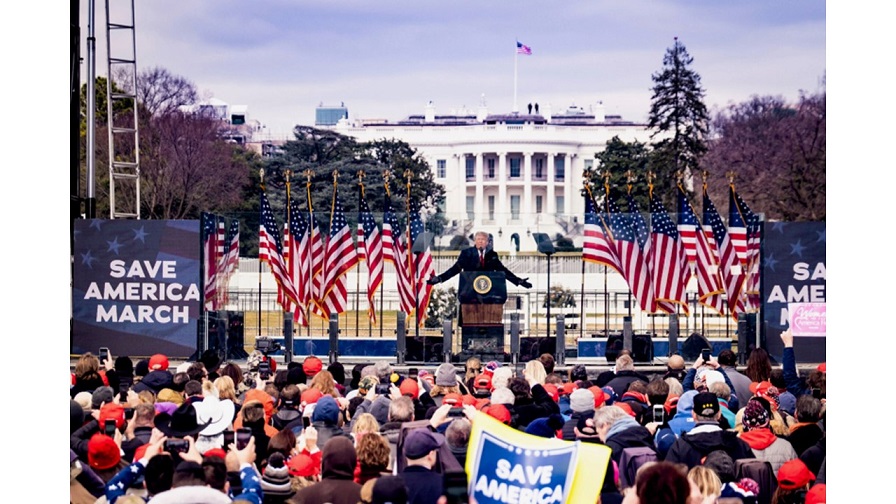
.
Annuary Stichs
Jamesian intricacies swarmed about the voter-counts;
a massive fraud had taken place beyond the lovely mounts.
Nobody had expected Apate and Dolos to
ubiquitously fake vote-counts in the Red-White-and-Blue.
And so, Americans across the land came to DC,
resenting the demonic rats and their false media.
Yes, patriots were angry, Achillean in their wrath;
so many came, o, tens of thousands, not undone by death.
Intelligence and law enforcement equally involved,
x-boxed good citizens who truly should have been absolved;
their witch hunts still proceeding after lengthy fibs and lies;
habeas corpus rights disbanded by the… FBI.
.
.
Bruce Dale Wise is a poet currently residing in Texas.














Chilling, and by all reliable accounts demonstrably true. What a set-up!
Chilling, indeed. Many historical, as well as, more recently, SCP, commenters have noted, the extreme bias of corporate/social media, and the extent of their viciousness, their corruption, and how far they go to gain power, and which are, as Mr. Anderson notes in his poem “Habeas Corpus”, “demonstrably true”.
In that poem, Mr. Anderson states he only “scratch[es] the surface”, with his list of “Extortion, threats, felonious assaults, And foul deceptions…”; but is, I believe, right on target with those claims.
Looks better with every reading, Bruce. Simple three-part structure, but very many words add special shades of meaning. And since I am looking at every word, I notice no rhyme in lines 5 and 6. What about “Americans came to the District of Columbia” for line 5?
Margaret, Bruce is using the very loose rhyme of the “C” in DC with the “Me” in media.
Thank you for the timely poem, Bruce.
Regards,
Evan
Mr. Mantyk has read and seen many of the techniques I use throughout my poetry, not necessarily agreeing with their usage, and this is one of them. What looks to be the lack of rhyme, for me—if not for anybody else in this generation—is the use of sim rhyme. Mr. Mantyk picked up on the sound used at the end of the two lines, though in slightly alternative pairings: the “D” with “me” and the “C” with “di”.
The placement here is not as radical as I frequently am in my use of sim rhyme, because here the end rhymes are both within the last three syllables: to-DC and medi-a.
I nearly always welcome and acknowledge the acute critiques of Ms. Coats, pertaining to my writing; because, although she may not appreciate my attitudes, my topics, or my techniques, she is closer to comprehending some of what I am attempting to do with the English language than any other poet or critic of this generation, at least that I am aware of. Part of what makes her so clear-headed is her humility and her magnanimity.
First off, she is absolutely right about the tri-partite division of this dodeca, which is, as she notes, “simple” but with “special shades of meaning”. Mozart, one of the key composers of the “classical moment” is my inspiration for just such a focus. Though, obviously, I work in a different art than he did, one of the many things I admire about his work is its simplicity, one of the ideals I am often striving for in my writing.
I have pointed out elsewhere @ SCP that the tennos, dodeca, and longer works of iambic heptameter are so linked to the openness of the ballad, ordinary, as well as extraordinary, readers naturally feel the desire to alter lines, phrases and words. It is for that reason, id est, its plasticity, despite other reasons as well, that makes me so glad I have given myself to the poetic possibilities of its form.
Her choice for L5 is a stroke of fine poetic insight; and I must admit, it took me some time to weigh it as a potential replacement. First off, and foremost, it satisfies the structure of the poem, which uses, as she did in her sonnet “The Erythraean Sybil”, the acrostic, an Old-Testament technique I frequently use in my poetry. Her suggestion fits. However, it loses two elements, the movement from S1 to S2, through the simple, but important “And, so”, and the panorama I am suggesting in the equally simple phrase “across the land”. But for those two points, I would have preferred her line.
Bruce, this time, before I forget, let me admire your title. The play on the sounds of the date is a perfect way not only to name your poem, but to suggest how “January 6” has, in the past year, become something else: an unsolved enigma with much that remains hidden, including political prisoners.
I’m glad you pointed out the acrostic, as I had missed it. I hope “Acrostic” will be added to the category line in the post, so that your example will appear when anyone is searching for this kind of poem.
Let me say here that I am NOT trying to get you to change line 5 by coming up with another suggestion. But, having looked at your good reasons for keeping what you wrote, I think the more important of them is the loss of “across the land.” And it occurred to me that I could change my suggestion to “America came to the District of Columbia.” That broadens the subject to include those with the authentic spirit of the nation, who might have wished to be there, as well as those who actually traveled to DC. Just a thought, though, and perhaps too abstract or allegorical.
I get most of what you mean by “sim rhyme,” which you say is not used by others in this generation, but has it been used or discussed by any previous generation? The “sim” part seems to me quite recent slang for “simulated” or “simulation.” The technique involves artistry, but I would not call it “rhyme,” just as I do not call assonance substituted for end rhyme “assonance rhyme.” This technique, well used by you in the final two lines of this poem is simply assonance, which can substitute for rhyme, but is not rhyme. Let’s not try to expand “rhyme” to cover every artistic method of treating line ends!
As you suggest, you sometimes use “sim rhyme” to substitute for internal rhyme as well as end rhyme (that’s my understanding of your remark on where you place it). It seems to me you would do best to come up with a good name for your rather complex technique (maybe, but not necessarily, a derivative of Latin “similis”). As I see it, it does not qualify to be called “imperfect rhyme.” But if “sim rhyme” is rhyme at all, it falls by definition into the broad category of “imperfect,” which includes mistakes as well as art.
Once again, I appreciate your work still better with the additional insights you and Evan offer. The date and the wide-ranging topics it suggests should certainly bring forward more poems about this still-developing portion of history.
As to the title, you are on target. Who else @ SCP would have noticed it? Like Coleridge, from whom my poetry takes many cues, I enjoy resuscitating dormant words; “and so” the choice of “annuary” was immediately inviting to my mind.
What I mean by rhyme is not easily defended against those who are obsessed with its purity; so that, after explaining it several times in comments @SCP (with no positive appreciation of my definition), I hardly care to go over it; and so, in an off-handed manner, I just gave it a name in response to your comment, as I am prone to neologisms, like Shakespeare, Milton and Browne were.
Last night, I wrote, rather cursorily, the following docupoem:
Near Murree, Pakistan
by Sawceeb Dureli
Around one-thousand vehicles near Murree, Pakistan,
were stranded in the heavy snow that trapped them in its path.
One-hundred-thousand vehicles appeared in recent days,
and people posted pics in social media displays.
But tourists, caught in Saturday’s wild winter wonderland,
were soon stuck in a nightmare, a disaster zone unplanned.
All routes were blocked; and the authorities were truly shocked,
as the death toll rose higher there north of Islamabad.
The Pakistani Army and civilian rescue teams
said people died of heater fumes, while they had gone to sleep.
Some rhyme pairs in the tennos, i. e., L3/L4 & L5/L6, are fairly obvious (though both are more intricate than they seem), it is the rhyme pairs of L1/L2, L7/L8, & L9/L10 that I am sure a purist could take offense…at. Anyway, “sim rhyme” seems a sufficient term, until I can come up with a better term. It’s like having to explain “sprung rhythm”. Accept it, or reject it. As an aside, Gerard Manley Hopkins too has had a profound influence on my poetic stance.
Instead of “sim rhyme”, I suppose those lines could be explained as “rhyme combined with baland verse”, a term I coined a few years back, in discussing “unrhymed iambic heptameters”; but though that is a possibility, it isn’t really how I would describe either the lines of “Annuary Stichs” or “Near Murree, Pakistan”.
Emily Dickinson is another writer whose poetry helped me to my present position. Take, for example, a concluding stanza of hers:
The blonde Assassin passes on—
The Sun proceeds unmoved
To measure off another Day
For an Approving God—
Rhyme rears its head and shows its power everywhere throughout that stanza; but what I most like is the rhyme triplet of “unmoved/Approving/God”. Of course there is much more to admire in her lines, not least of all, which I embrace, their metrical procession, but, as seems clear to me, Dickinson herself was striving for a more open definition of rhyme throughout her poetry.
as per B. S. Eliud Acrewe:
The first work of literature to sweep me away was not in poetry or the essay, two of my favourite forms of writing, nor even the short story, another well-liked genre. But in my teenage years, when I was in high school, the first work that carried me away with its language was Henry James’ novel “The American”. I had been throughout my junior and high school years a reader of history. And then, seemingly out of nowhere, here comes this novel, whose metaphoric power gripped me, like a gale, with its thoughtful pressing movement, its compound clauses, grand digressions, and expansive qualifications. His labyrinthine architecture, intricate indeed, seemed somehow to examine life with invigourated steam, especially that tale of Christopher Newman, who encounters both the beauty and the ugliness of the World. For me, then, James’ style seemed appropriate in describing the events surrounding November 3rd, 2019, and leading to the Insurrection (not corporate media’s false narrative) of January 6th, 2020.
as per Brice U. Lawseed:
You meant November 3rd, 2020, and the Insurrection, January 6th, 2021.
as per B. S. Eliud Acrewe:
An allusive, symbolic poetry encased within a simple, prosaic metric is difficult to disentangle but satisfying to write and understand, especially in a era of diffuse, dispersed, and cha/lle/nging scatterings.
BDW: A powerful write that trumpets truth to the extent that I pray each night for the second coming of Jesus. I keep asking, “When is enough, enough?”‘
What I fail to understand (regarding voter fraud) is there are many who are not willing to show ID when it comes to voting; yet, the same people have no objection to showing an ID when they want to buy cigarettes or alcohol. Go figure!
Thanks for sharing. 🙂