• Submit Poetry
  • Support SCP
  • About Us
  • Members
  • Join
Monday, September 7, 2026
Society of Classical Poets
  • Poems
    • Beauty
    • Culture
    • Satire
    • Humor
    • Children’s
    • Art
    • Ekphrastic
    • Epic
    • Epigrams and Proverbs
    • Human Rights in China
    • Music
    • Performing Arts
    • Riddles
    • Science
    • Song Lyrics
    • The Environment
    • The Raven
    • Found Poems
    • High School Poets
    • Terrorism
    • Covid-19
  • Poetry Forms
    • Sonnet
    • Haiku
    • Limerick
    • Villanelle
    • Rondeau
    • Pantoum
    • Sestina
    • Triolet
    • Acrostic
    • Alexandroid
    • Alliterative
    • Blank Verse
    • Chant Royal
    • Clerihew
    • Rhupunt
    • Rondeau Redoublé
    • Rondel
    • Rubaiyat
    • Sapphic Verse
    • Shape Poems
    • Terza Rima
  • Great Poets
    • Geoffrey Chaucer
    • Emily Dickinson
    • Homer
    • Henry Wadsworth Longfellow
    • Dante Alighieri
    • John Keats
    • John Milton
    • Edgar Allan Poe
    • William Shakespeare
    • William Wordsworth
    • William Blake
    • Robert Frost
  • Love Poems
  • Contests
  • SCP Academy
    • Educational
    • Teaching Classical Poetry—A Guide for Educators
    • Poetry Forms
    • The SCP Journal
    • Books
No Result
View All Result
Society of Classical Poets
  • Poems
    • Beauty
    • Culture
    • Satire
    • Humor
    • Children’s
    • Art
    • Ekphrastic
    • Epic
    • Epigrams and Proverbs
    • Human Rights in China
    • Music
    • Performing Arts
    • Riddles
    • Science
    • Song Lyrics
    • The Environment
    • The Raven
    • Found Poems
    • High School Poets
    • Terrorism
    • Covid-19
  • Poetry Forms
    • Sonnet
    • Haiku
    • Limerick
    • Villanelle
    • Rondeau
    • Pantoum
    • Sestina
    • Triolet
    • Acrostic
    • Alexandroid
    • Alliterative
    • Blank Verse
    • Chant Royal
    • Clerihew
    • Rhupunt
    • Rondeau Redoublé
    • Rondel
    • Rubaiyat
    • Sapphic Verse
    • Shape Poems
    • Terza Rima
  • Great Poets
    • Geoffrey Chaucer
    • Emily Dickinson
    • Homer
    • Henry Wadsworth Longfellow
    • Dante Alighieri
    • John Keats
    • John Milton
    • Edgar Allan Poe
    • William Shakespeare
    • William Wordsworth
    • William Blake
    • Robert Frost
  • Love Poems
  • Contests
  • SCP Academy
    • Educational
    • Teaching Classical Poetry—A Guide for Educators
    • Poetry Forms
    • The SCP Journal
    • Books
No Result
View All Result
Society of Classical Poets
No Result
View All Result
Home Poetry Beauty

‘Diners’: A Sonnet by Adam Wasem

November 16, 2024
in Beauty, Poetry, Sonnet
A A
20
poems 'Diners': A Sonnet by Adam Wasem

.

Diners

For single men alone, what impulse spurs us
To find them everywhere? –the burned-out lights,
the squat brick block, so many times repurposed,
the worn, clichéd inside, lit over-bright:
Plump rows of sticky pseudo-leather booths,
And dusty ferns suspended from the ceiling.
The waitress looms like Venus, sturdy with ruth
And beauty, as if to bear one’s weight of feeling.

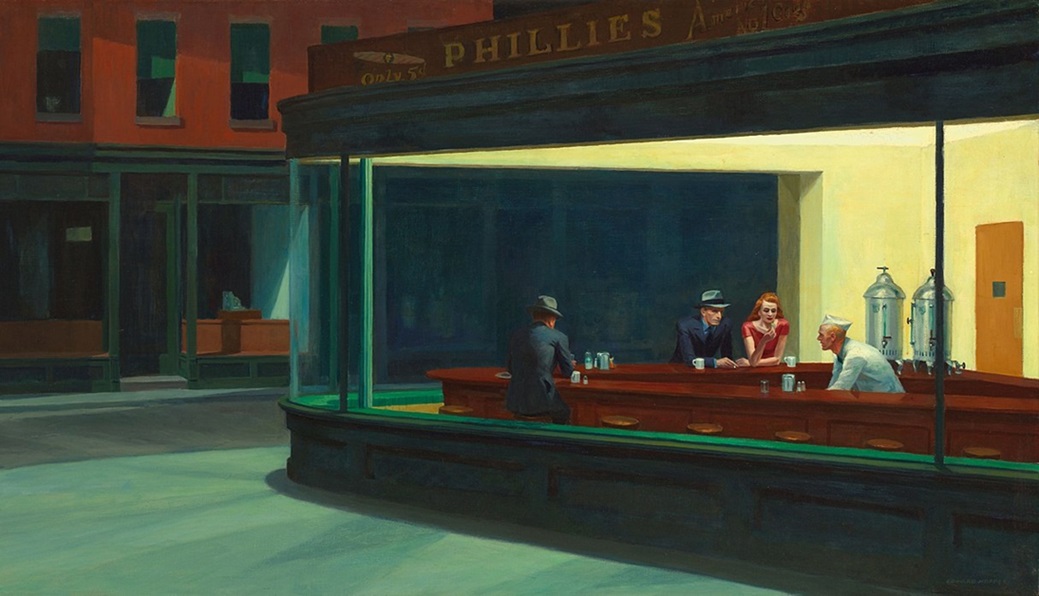
Like Hopper’s “Nighthawks,” in come the late-night men
who know that here’s a place as good as any
To be alone in. Ghosts, they stay till when
They know they’ve gone unseen, to show the many—
The teens, the drunks, the families attending—
How lives can fade so none will see their ending.

.

.

Adam Wasem is a writer and rare bookseller living in suburban Salt Lake City, Utah.

ShareTweetPin
The Society of Classical Poets does not endorse any views expressed in individual poems or commentary.
Read Our Comments Policy Here

RandomPoems

‘Four Rooms in Music’s Mansion’: A Poem by Mary Jane Myers
Music

‘Four Rooms in Music’s Mansion’: A Poem by Mary Jane Myers

December 4, 2025

  Four Rooms in Music’s Mansion   1 _The maestro grasps a complex score, conducts his orchestra without reserve. Connoisseurs...

A Review of James A. Tweedie’s Mostly Sonnets: Formal Poetry in an Informal World
Beauty

A Review of James A. Tweedie’s Mostly Sonnets: Formal Poetry in an Informal World

March 3, 2021

Reviewed Book: Mostly Sonnets: Formal Poetry in an Informal World by James A. Tweedie, Dunecrest Press, July 2019 by Theresa...

Next Post
‘Sailing to Illusium’ and Other Poems by James A. Tweedie

'Sailing to Illusium' and Other Poems by James A. Tweedie

‘Just Doin’ Our Job’: A Sonnet in Terza Rima by T.M. Moore

'Just Doin' Our Job': A Sonnet in Terza Rima by T.M. Moore

A Poem on Hot Flashes: ‘The Devil and the Hounds of Hell’ by Norma Pain

'Saint Andrew': A Poem by Robert Nachtegall

Comments 20

  1. Roy Eugene Peterson says:
    2 years ago

    1. Diners often serve the best dinners.
    2. Diners have meals that usually cost less and give more.
    3. Diners provide a place for conversation with strangers when on a stool.
    4. Diners are a safer choice than a bar.
    5. Despite all this, your observations ring true as though you have paid them an occasional visit.
    6. An interesting read with food for thought.

    Reply
    • Adam Wasem says:
      2 years ago

      Thank you, Roy, I’m glad you found it interesting. Indeed, diners can be many pleasant things to many people, but to the “single man alone,” of the poem, they have become wan, sad places where the late-night men go to disappear. Not enough poets write about the forgotten in our society, especially the forgotten men. I do.

      Reply
  2. Joseph S. Salemi says:
    2 years ago

    Diners are comfortable, unpretentious, not super-expansive, and usually have a wide menu. There used to be scores of them all over New York City but many were wiped out in the COVID farce, and others have been put out of business by over-regulation, health food freaks, and environmentalists.

    I think there is a problem with line 7. The word “sturdy” adds an unnecessary extra syllable that spoils the meter, and the rare word “ruth” (pity) is somewhat jarring. And a waitress “sturdy with ruth” is hard to picture — is she a strapping Amazon with an empathetic soul? If you want to keep “ruth,” perhaps you could write “flush with ruth,” or “filled with ruth.” This doesn’t over-masculinize her, and it saves the meter.

    Reply
    • Adam Wasem says:
      2 years ago

      Certainly, Joseph, viewed objectively, big-city diners can be all of those things, but not in the subjective view of the “single man alone” in the poem. The type I had in mind was the Chicago variety, of course, but I doubt there’s much difference.

      Regarding line 7, yes, I cheated with the meter, guilty as charged, but the waitress’ sturdy empathetic pity is meant to “bear one’s weight of feeling,” in the following line. If I could have thought of a better word, I would have, but “stout” implies squat or overweight, which Venus most certainly is not, and “filled” or “flush” wouldn’t quite flesh out the meaning of the metaphor I was going for. But poems are never finished, they just exhaust the poet working on them, as they say, so who knows, maybe one day a better term will come to me. Thanks for taking the time to critique it.

      Reply
      • Richard Craven says:
        2 years ago

        I don’t think you should worry too much about line 7’s metrical anomaly. Despite being myself fairly strict about restraining myself to iambic pentameter in my own sonnets, I still think that we shouldn’t be overly prescriptive about the rules and regulations for sonnetry. A poem can be judged on its own merits even if it doesn’t comply with all the strictures of one form or another, and your offering certainly succeeds in conveying the tone you intended it to convey.

        Reply
      • Adam Wasem says:
        2 years ago

        Thank you, Richard, for those kind words. I do my best to hew to the form, but I’ve always felt that the form should serve the function, so to speak. Certainly, there is great satisfaction in perfectly filling out a form, but when push comes to shove, I feel the form is there to serve, to heighten and emphasize the content in a memorable way.

        Reply
  3. jd says:
    2 years ago

    A very sad and empathetic poem. No one should have to eat alone but I know that many do. Thank you, Adam, for shining a light on the many “forgotten.”

    Reply
  4. Adam Wasem says:
    2 years ago

    Thank you, jd, I appreciate that. Having felt like one of the “forgotten” myself, for longer than I like to remember, the bones of the poem came naturally. To the forgotten!

    Reply
  5. Shamik Banerjee says:
    2 years ago

    The underlying essence of this poem, loneliness, is an epidemic that has been pervading every city and town of the 21st century. I think people from the older generations had a thriving and more successful life mentally and emotionally. A couple of days ago, I myself was standing near an Indian diner, and all it was occupied by were two job-disturbed men (separated by three tables). Your poem reminded me of that scene. Thanks for writing and sharing it with us, Mr. Wasem.

    Reply
    • Adam Wasem says:
      2 years ago

      Ironic, in such a connected age, that we’re more disconnected than ever, certainly more than when I was a kid in the 70s and 80s. In a way, we’re all like the late night men these days, imperceptibly fading into the ether of the internet. I wrote this poem some time ago, but a recent survey showing 2/3 of 18-30 year old men in the US were single inspired me to revisit it.

      Reply
  6. Susan Jarvis Bryant says:
    2 years ago

    Adam, your striking sonnet has conjured the very spirit of American “Diners” – and what a vivid and heart-touching picture you paint with exciting and inspirational word combinations that sing to me. I particularly like, “squat brick block” and “Plump rows of sticky pseudo-leather booths” – wow! I especially like the playful “ruth and beauty” and that closing couplet is haunting. This is the sort of poem that jolts my muse into action. Thank you!

    Reply
    • Adam Wasem says:
      2 years ago

      You’re very welcome, Susan, and thank you very much for your hearty praise. I got lucky with that final couplet—once I had the rhyme, the final line just came to me all at once. And your masterful has certainly inspired me and countless others over the past few years, so I’m humbled and grateful my own modest phrasifying efforts have similarly inspired you. Here’s to tongue-twisting and brain-teasing phrasemaking, forever!

      Reply
  7. Paul A. Freeman says:
    2 years ago

    Great stuff, with such a poignant last line.

    A diner such as the one in ‘Nighthawks’ is an essential setting in the film ‘The Equaliser’, with Denzel Washington, and is perhaps even modelled after it.

    Thanks for the read, Adam.

    Reply
    • Adam Wasem says:
      2 years ago

      Thanks, Paul, I was very pleased with that last line, also. It was a real gift. And yes, diners are an iconic representation of quotidian America, an ideal setting, it seemed to me, for everyman ruminations. A much more likely setting for such quotidian rumination, it seems to me, than, say, action movie shootouts— said action movies choosing such locales most often purely for the shock value of having such violence erupt in such a generally quiet and placid setting.

      Reply
      • Paul A. Freeman says:
        2 years ago

        The diner was created specifically for the film and is a sanctuary for Washington’s character and a Russian escort. Some of the most moving scenes of the film occur there, though there is one violent scene.

        Reply
      • Adam Wasem says:
        2 years ago

        Indeed, Paul, that’s good to know about the film, I suppose. I have to admit I don’t have much interest in commercial films–I find them cynically and tediously trope-heavy, with a puerile kneejerk recursion to violence to jerk the almost universally cliched plot along, and with little to no relatability to our everyday lived experience. As far as I recall the film was marketed as another reluctant tough-guy Denzel Washington role, which, frankly, doesn’t interest me. But I’m glad you enjoyed the film and found it moving.

        Reply
  8. Joseph S. Salemi says:
    2 years ago

    There’s an excellent film “Diner” from 1982, about a group of friends during the 1950s who meet in a Baltimore diner.

    Reply
  9. Adam Sedia says:
    2 years ago

    This is a well-crafted sonnet about a unique topic. Much more than the dead-on atmospheric description of a diner, though, it explores the topic of loneliness, of lives detached and ignored — “single men” “dissolving” into “ghosts.” It is a timely topic, yet the deft reference to Hopper’s painting eternalizes the problem. You explore an aspect of the human condition, exacerbated by current circumstances. I very much enjoyed this work.

    Reply
    • Adam Wasem says:
      2 years ago

      I appreciate your astute analysis, Adam, and I’m glad you appreciate its craft. I’m gratified you noted the exacerbating current circumstances. The topic of loneliness and disconnectedness seems to me to be one of the most pressing issues of our time post-Covid 19, when isolation and disconnectedness was forced on essentially the entire world, which disconnectedness was only deepened by a ubiquitous propaganda campaign that had a horribly divisive effect on the body politic, a propaganda campaign that is still ongoing as the perpetrators desperately try to distance themselves from the grievous harms and deaths they have caused so many. Relationships were destroyed, trust in institutions was destroyed, and a deeply ugly fascist impulse to control and punish the non-compliant was revealed in an alarmingly large part of the population. None of that is going to heal overnight, and I fear will continue to haunt us for decades to come.

      Reply
  10. David Whippman says:
    2 years ago

    Adam, thanks for this perceptive take on what it means to be alone. A very evocative sonnet.

    Reply

Leave a Reply Cancel reply

Your email address will not be published. Required fields are marked *


  1. Russel Winick on ‘Serenade’ and Other Poetry by Adam SediaSeptember 7, 2026

    It is a pleasure to read professional work like Adam’s, together with expert commentary such as that above. Thank you…

  2. Perica Dujmović on The Society of Classical Poets 2026 Haiku CompetitionSeptember 7, 2026

    Thank you, I appreciate it.

  3. Margaret Coats on ‘The Cristero Centennial’: A Poem by Margaret CoatsSeptember 7, 2026

    Thank you, Stephen. The poem and the events it recounts have two levels or perspectives, which gradually becomes apparent in…

  4. Margaret Coats on ‘The Ballad of Babi Yar’ by Theresa RodriguezSeptember 7, 2026

    Theresa, I think I was too horrified by the effect of this poem to comment when it first came out.…

  5. Margaret Coats on ‘A Prayer of Aristotle’: A Poem by Margaret CoatsSeptember 7, 2026

    Yes, pure act, or in your own other words, Bruce, "devoid of potency." Awe or wonder is the ultimate effect…

Subscribe to Daily Poems

Enter your email address to subscribe to this blog and receive notifications of new posts by email.

Join 1,638 other subscribers

Recent Poems

  • ‘On to Better Days’: A Poem by Bruce Dale Wise
  • ‘Serenade’ and Other Poetry by Adam Sedia
  • ‘Self-Exploration’ and Other Poems by Paul Millan
  • ‘Victory’: A Poem by Jonathan Graver
  • ‘The Cristero Centennial’: A Poem by Margaret Coats
  • ‘A Potpourri of Aphoristic Verses’ by C.B. Anderson
  • ‘The Estuary’: A Poem by Jeff Eardley
  • ‘A World Without the Wednesday Child’: A Poem by Kimberly Fore
  • The 2026 Society of Classical Poets International Poetry Competition
  • The 2026 SCP International High School Poetry Competition
  • ‘Realistic Reflections’ and Other Poetry by Anna J. Arredondo
  • ‘China Made’: A Poem by Theresa Werba
  • ‘The Savage Moon’ and Other Poetry by Brian Yapko
  • Poetry Book Review: Love Found, Yearned For, and Lost by James A. Tweedie
  • ‘When Opportunity Knocks’: A Poem by Roy E. Peterson
  • ‘Legend of the Griffin’: A Poem by Iryna Hall
  • ‘Government Issue’ and Other Poems by Joseph S. Salemi
  • ‘Chaucer Announces His Desire to Retire’: A Poem by Paul A. Freeman
  • ‘Advantages of Restaurants’ and Other Poems by Russel Winick
  • ‘Bone China’: A Poem by Mary Gardner
  • ‘On the Death of One Too Young to Die’: A Poem by Jeffrey Essmann
  • ‘This Too Shall Pass’ and Other Poetry by Justin Dasher
  • ‘Humdrum and Harum-Scarum’: A Lecture on Free Verse, by Robert Bridges (1922)
  • ‘Unrest On the Floodplain’: A Poem by Bhikkhu Nyanasobhano
  • ‘Latitude and Loss’: A Poem by Martin Briggs
  • ‘Act III’ and Other Poetry by C.B. Anderson
  • ‘God’s Funeral’: A Poem by James Sale
  • ‘Star Festival’: A Poem by Margaret Coats
  • ‘Song of the Frog Princess’: A Poem by Scharlie Meeuws
  • ‘The Odyssey: Nolan and Solot Compared’: An Essay by Michael Curtis

Categories

  • Acrostic
  • Alexandroid
  • Alliterative
  • Art
  • Best Poems
  • Blank Verse
  • Chant Royal
  • Classical Poets Live
  • Clerihew
  • Covid-19
  • Deconstructing Communism
  • Educational
  • Epic
  • Epigrams and Proverbs
  • Essays
    • Interviews with Poets
    • Poetry Reviews
  • Featured
  • From the Society
  • Great Poets
    • Dante Alighieri
    • Edgar Allan Poe
    • Emily Dickinson
    • Geoffrey Chaucer
    • Henry Wadsworth Longfellow
    • Homer
    • John Keats
    • John Milton
    • Robert Frost
    • William Blake
    • William Shakespeare
    • William Wordsworth
  • Human Rights in China
  • Limerick
  • Love Poems
  • Music
  • Pantoum
  • Performing Arts
  • Poetry
    • Beauty
    • Children's Poems
    • Culture
    • Ekphrastic
    • Found Poems
    • High School Poets
    • Humor
    • Riddles
  • Poetry Challenge
  • Poetry Contests
  • Poetry Forms
    • Curtal Sonnet
    • Haiku
  • Poetry Readings
  • Rhupunt
  • Rondeau
  • Rondeau Redoublé
  • Rondel
  • Rubaiyat
  • Sapphic Verse
  • Satire
  • Science
  • Sestina
  • Shape Poems
  • Short Stories
  • Song Lyrics
  • Sonnet
  • Symposium
  • Terrorism
  • Terza Rima
  • The Environment
  • Translation
  • Triolet
  • Video
  • Villanelle

Quick Links

  • About Us
  • Submit Poetry
  • Become a Member
  • Members List
  • Support the Society
  • Advertisement Placement
  • Comments Policy
  • Terms of Use

Welcome Back!

Login to your account below

Forgotten Password?

Retrieve your password

Please enter your username or email address to reset your password.

Log In
No Result
View All Result
  • Poems
    • Beauty
    • Culture
    • Satire
    • Humor
    • Children’s
    • Art
    • Ekphrastic
    • Epic
    • Epigrams and Proverbs
    • Human Rights in China
    • Music
    • Performing Arts
    • Riddles
    • Science
    • Song Lyrics
    • The Environment
    • The Raven
    • Found Poems
    • High School Poets
    • Terrorism
    • Covid-19
  • Poetry Forms
    • Sonnet
    • Haiku
    • Limerick
    • Villanelle
    • Rondeau
    • Pantoum
    • Sestina
    • Triolet
    • Acrostic
    • Alexandroid
    • Alliterative
    • Blank Verse
    • Chant Royal
    • Clerihew
    • Rhupunt
    • Rondeau Redoublé
    • Rondel
    • Rubaiyat
    • Sapphic Verse
    • Shape Poems
    • Terza Rima
  • Great Poets
    • Geoffrey Chaucer
    • Emily Dickinson
    • Homer
    • Henry Wadsworth Longfellow
    • Dante Alighieri
    • John Keats
    • John Milton
    • Edgar Allan Poe
    • William Shakespeare
    • William Wordsworth
    • William Blake
    • Robert Frost
  • Love Poems
  • Contests
  • SCP Academy
    • Educational
    • Teaching Classical Poetry—A Guide for Educators
    • Poetry Forms
    • The SCP Journal
    • Books

© 2025 SCP. WebDesign by CODEC Prime.