


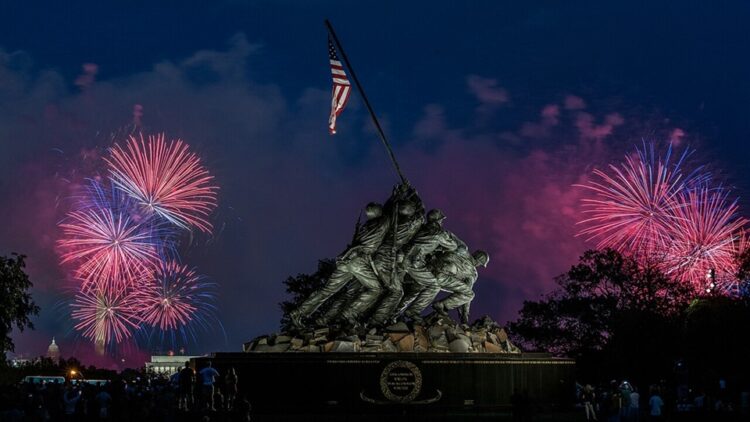
Americans Cross the Rubicon
1. Preamble
Be proud, be grateful that we’re here! We came
In pain from stifling lands which we outgrew,
And crossed the wildest seas that we might live.
It’s madness to assume a stance of shame.
We took vast risks and offered all we knew
To build a vital future which might give
This worn-out world of tyrants something new.
We came because we had to have a voice!
The Old World’s threats and wounds left us no choice.
Decry, as well, those fools who would defame
The pioneers and settlers. Yes, it’s true
That lives were lost. But history’s a sieve
Which sorts out what was destined from vain blame.
Just look at where we were and how we grew!
No, at this point there’s nothing to forgive.
America’s for me as much as you.
So pay no heed to slander or attack.
We’ve crossed the Rubicon. Do not turn back,
But rather celebrate our nation’s birth—
You’ll find no greater nation on this Earth!
2. The Rebel (1776)
Good morrow, John! I’m grateful for your time.
I’d like to share with you what I’ve been thinking.
“God Save the King?” My friend, I must say no.
Don’t think that I’m impulsive—short on rhyme
Or reason. But these Colonies are sinking,
And Independence offers room to grow.
You say taxation is a minor thing
But I must say I deeply disagree—
For London’s hostile acts impose great dangers.
Yet worse, we’re blocked from redress with our King!
The Crown would bleed us dry for stamps and tea,
While we are forced to quarter perfect strangers!
We are not serfs! These are not lands we’ve rented!
King George thinks he’s our master and inerrant;
But, John, it’s time the English leave our shore.
We won’t submit to live unrepresented!
The time comes when a child must act the parent,
Stand tall, speak sharply and insist, “No more.”
3. The Runaway (1842)
Please hear me, Lord. It’s Beulah. On my knees.
I worked their fields, Lord. Springtime through the sleet,
In Fall and Winter when I nearly freeze,
And Summer when I like to die from heat.
O Lord, now help me run! I got to leave!
The river’s low. Ohio’s straight ahead.
Ain’t no one knows I’m gone. Won’t no one grieve
When I am free or missing or plain dead.
Why stay? Them folks love cotton more than gold—
Enough to chain me down with heavy tears,
From cradle till these bones be bent and old.
I miss my children sold these seven years.
There’s folks think it will always be this way.
They wrong—so wrong as sure as wind blows wild!
I’m strong and fast. Can’t nothing make me stay.
But help me, Jesus. Teach them I’m Your child.
4. Gettysburg (1863)
My uniform was homespun Union blue—
The 24th from Michigan. My wife
Cried as she sewed me up a sash to wear.
I sacrificed a lot to fight this war
To make a better world, to free the slaves.
My friend, Elijah Pitt, lost his left leg.
Those Dixie rebels sure know how to fight—
They shoot and die believing that they’re right.
Well, goodness changes everywhere you go.
At Gettysburg, a gray-coat shot me dead.
They found my body face-down in a ditch
With Glory Hallelujah on my lips.
I heard Abe Lincoln speak right where I died.
He said we must be one. All must be free.
America, I tried. I did my best.
Will anyone at all remember me?
5. Chinatown (1869)
The Railroad Boss says with that final spike
My work is done. “Go China! You go back!”
He speaks in pidgin, loathing in his eyes.
He thinks I’m dumb. He mimes as if to strike,
So I nod “yes.” But—cash wage paid—I pack
For San Francisco where my future lies.
The year that I was born is called “the Horse”—
And this means I am luckier than most.
It’s true! For I survived the Yangtze’s flood
Though all my village drowned. And in due course
I sailed far, far away: the U.S. coast,
To build these railroad tracks the best I could.
The Boss was cruel. I groaned and cursed my life.
But when the night came, I conceived a scheme:
I’d save up all my cash to start a store.
I’d send away to Shanghai for a wife;
Our children would live out my cherished dream;
Prosperity and freedom. Who needs more?
I’ll build… the Boss will not believe how fast!
And he’ll see I’m American at last!
6. A Settler on the Chivington Massacre (1884)
I still remember 1864
And Colorado Territory’s pain.
Arapaho and also some Cheyenne
Were targeted by Colonel Chivington
Who used his cavalry to mow them down.
It didn’t matter that they posed no threat.
Though peaceful they had been born in the wrong
Locale and time. And so 600 killed,
With grim machines of death directed at
The elderly, the infants and the squaws.
When quoted, Chivington said ‘nits breed lice.’
A court-martial took place. He was acquitted.
The Colonel’s acts were criminally wrong,
But Justice has an arc which skews quite long
And there are monsters all of us despise.
How do we make things better? Let us rise
Together and seek truth with better eyes.
I’ve heard it said “Look back, but do not stare,”
For living in the past can be a snare.
Should we not salve the failures of our past
By standing as one nation meant to last?
7. Kitty Hawk (1903)
Hey, Orville. I just had an awful dream:
We launched our new contraption to the sky
And then we steered it up through clouds of steam;
We saw birds veer and squawk as we flew by;
But then we rose too closely to the sun
And our contraption melted; we fell fast!
The wings dropped off; the engine wouldn’t run,
And then we hit the ground with one hard blast.
I woke up with a scream. I’m shaking still.
I’m worried. Should men fly? Is it God’s will?
Come, Wilbur, never doubt our awesome dream:
To prove with this invention Man can fly!
There’s risk; some things will change; and it may seem
Our innocence is lost—perhaps we’ll sigh
That clouds should bear the stench of gasoline.
But think of this great marvel! We’ll be free
To sail through rainbows, lightning, sky! I’ve seen
A future where we soar and cross the sea!
My brother, our invention is a boon
Which soon will shrink the Earth and touch the Moon!
Be bold! All things seem fearsome from the air;
But we’re Americans. We dare to dare!
8. The Charleston (1927)
I’ll level with you, Earl, I’m just not meant
To be the kind of wife who cleans the house.
I’m bored and restless—maybe slightly bent.
I’m leaving. Find yourself a different spouse.
Screw Prohibition, Earl. Next week: New York!
My parents? They’ll just try to make me weak.
The past is dead; I’m going to pop the cork,
And roam like Valentino in “The Sheik.”
I’ll Bunny Hug and Charleston, bob my hair,
And nuts on any prudes that I make queasy.
I’ll be a flapper with a vampy flair;
I’ll smoke and sing hot jazz at some speakeasy.
I’ve come alive! America’s my stage!
My ties are cut, all inhibitions shed.
To hell with being held in some dull cage—
My days of being prim and bored are dead.
9. Awake The Sleeping Giant (1941)
Well, Eleanor, it’s done. The easy part.
“A Day of Infamy.” My speech went well.
Republicans and Democrats alike
Applauding not just me but our whole Nation.
And, hard as it will be, we can take heart:
We’re strong enough to give the Axis hell:
Avenge Pearl Harbor, level Hitler’s Reich
And chart out Mussolini’s ruination.
Oh, Eleanor, I tell you… when I stood
Before the Congress I felt strong. What’s more,
I had no polio, no crippled limbs!
My anger made me whole and primed to fight,
Convinced down to my marrow of the good
That we must do to win this crucial war
In both Atlantic and Pacific rims,
To put an end to brutal, fascist might.
God fixed me to this wheelchair so I’d learn
Some wisdom—how a president should lead.
We’ll fight this war to win and we will never
Allow our foes to break or breach or bust us.
Now, Eleanor, let’s pray the tide will turn
So that we see the Axis powers bleed.
Almighty God, please bless this great endeavor—
And help America bring them to justice!
10. Joseph McCarthy on the United Nations (1952)
You’re from the Times? I’m glad you asked me that.
I take my role as Senator to heart
As my Committee tries to note all threats
To our security and way of life.
The very mention of “united nations”
Bespeaks world government and our demise.
The U.N. is an immature idea
Which Wilson started with his League of Nations.
A pipe dream, a romantic fantasy
Which roundly failed to stop a second war.
Sure, World War II gave cover to the thought
Some type of world assembly might have value.
Most countries joined. The U.S. financed more
Than all the rest, plus prime Manhattan land.
The deed was done (we naysayers ignored),
And now our country hosts a brazen whore.
The U.N. is at heart a club for bullies
For anti-Western third world potentates,
Ascendant pashas and Red Communists
Who bolster hate and make our country weak.
The Times would like to know what I suggest?
Take notes. Here’s what I think is for the best:
We should withdraw from this farce institution
Which thrives on moral failure and corruption,
Which hates the West and wants its execution,
While it advances communist eruption.
The U.N. is the Mob. In fact, it’s worse
As it demands all Justice be erased.
Our membership just amplifies this curse:
As host and banker, we are much debased.
11. The Sound of Silence (1989)
Yo, Joy! Why are you marching with that sign?
You know that Vietnam is over, right?
It’s fourteen years, but you still shout (with spite)
“One World, One Love,” “Our Leaders Must Resign,”
And “No One—NO ONE—Should Endure Arrest.”
You look the same, Joy. Flowers in your hair
(Dyed blue to hide some gray,) a bitter stare,
And “Peace and Love” pinned boldly to your chest.
That you’re still here… It’s hard to comprehend.
I guess you see injustice everywhere.
No argument. The world is seldom fair,
But, I won’t join you. I’ve grown up, old friend.
Those songs we chanted while we passed the pipe
Like “All You Need Is Love,” “Give Peace a Chance”
Or “no more countries” in John Lennon’s rants,
Meant something then. But now they’re overripe.
You cherish “Hello, darkness, my old friend…”
But you, old friend cannot tell day from night.
If Darkness is your friend, then what is Light?
I think your love of victimhood should end.
Your morals, Joy, have grown a little blobby;
That tender, touchy heart? It’s sort of flaccid.
In fact, you don’t spread love—you just fling acid.
I think its time you find another hobby.
12. The Trojan Horse (2001)
Yes, I survived. It’s hard, though, to remember.
They found me underneath a damaged car.
The paramedic said he heard me moan.
My face was badly cut. A broken leg,
And largely deaf. I had a bad concussion.
He told me I was coated in gray dust.
I thought I’d die—part of the multitude,
But I was eight, nine blocks from the Twin Towers.
It’s three months since and it still hurts to breathe.
Yes, this was the eleventh of September.
I later learned about that day’s attacks:
Four planes were hijacked by Al Qaeda thugs;
The Towers fell, the Pentagon was hit;
Plus a United Airlines flight was crashed
When patriotic passengers rebelled
Against Islamic death-cult terrorists.
Will I recover? I suppose I will.
We all will if Americans stand firm
And recognize the enemy that’s here.
Have I been changed? Oh, yes. I’m changing still.
I’m one of those who thought that every nation
On Earth respected the United States.
We let them in… to change them into us.
But we were very innocent and smug
To think all cultures wanted what we want.
We never once considered how a world
With different values burned to see us fail.
I took for granted what it means to be
American. To stand up for what’s right.
And now I must admit what fools we were.
I hope this understanding’s not too late.
I still see bastards wring their hands, who say,
“America is arrogant and so
Deserved to be attacked, its people killed.”
These people hang themselves with their own rope.
What brainwashed fools they are if they can’t see
The U.S. as the world’s last, greatest hope.
Those handwringers—the treasonists as well…
I hope they join those terrorists in Hell.
13. The Second Civil War (2026)
I stand before you haunted by the voices
Of brave Americans—the ones who gave
All that they had in sacrifice, to save
This nation with courageous, fateful choices.
And now we celebrate our country’s birth!
I pray America will reach 300
Though half the country hopes to see it sundered—
As Lincoln feared, to “perish from the Earth.”
Dark foes embrace all manner of seditions
To ban our right to speak, to think, to arm,
To seek the truth, to not submit to harm…
To honor our American traditions.
I think one day our grandchildren will wonder
What steps we took to try to save our nation
For those to come, for the next generation,
As leftists tried to tear this land asunder.
Those future generations… What endeavor
Shall we say we engaged in to preserve
Our way of life? We must show strength and nerve
To stand up to our foes and tell them, “Never!”
Ye patriots, let’s vow to do our part
To save this land with muscle, mind and prayer;
To once more hail the rockets’ bright red glare
As Glory Hallelujah fills each heart!
And should harsh conflict come, so let it be
The final battle that sets all men free,
That Justice may erase all enmity.
God, heal this land from sea to shining sea.
Brian Yapko is a retired lawyer whose poetry has appeared in over fifty journals. He is the winner of the 2023 SCP International Poetry Competition. Brian is also the author of several short stories, the science fiction novel El Nuevo Mundo and the gothic archaeological novel Bleeding Stone. He lives in Bradenton, Florida.

















Amazing tour de force!
Thank you so much, Roy. And on this 250th birthday of our nation, thank you for your service to our country and for your steadfast patriotism!
Thanks, Brian, for the poetic and historical tour de force!! I learned so much. God Bless the US of A….
Thank you very much, Golan! I am so glad that you enjoyed this piece. I am especially grateful for your appreciation because the people of Israel know only too well the pain we Americans experienced on 9/11. Even as the USA and Israel are attacked and constantly defamed, both of our countries remain beacons of light — for those who have eyes to see along with a moral compass and even a rudimentary understanding of history.
Brian this is a striking and breathtaking achievement for this celebratory milestone in America’s history. I am in awe of its clarity and creativity and I love the portrayal of its remarkable array of competing and complementary voices from the complex tapestry of American history.
The title is the perfect anchor, and you describe beautifully those leaps into the unknown in oh-so-real voices that breathe life into characters and draw the reader in to vivid and symbolic moments. You show with heartfelt emotion, the Rubicon wasn’t crossed by generals alone, but by the downtrodden and the brave.
I especially like the final section. “The Second Civil War (2026)” speaks honestly and unflinchingly of the stark reality of the here and now, reminding us that freedom is never easily gained nor to be taken for granted – it comes at a price and must be defended. As we celebrate our independence, it is important that we NEVER forget the sacrifices of the past. “God, heal this land from sea to shining sea” is the perfect pitch on which to end this superb poem – a winning poem that has fired my mind, captured my heart, and made me better understand what it means to be American. Brian, thank you very much indeed!
Thank you so much, Susan! I am especially grateful for your fine eye on this piece since you are yourself from England and thus can see both sides of the War of Independence; and you can see what it is to be American in a way that native-borne either cannot or take for granted. Your fierce defense of the freedoms we enjoy in the USA have long-impressed me and, I think, have been fueled in part by personal knowledge of how precious and rare they actually are. All of the “progressives” who think bringing socialism and more government control into our country have a bitter lesson ahead.
Thank you for connecting the individual stories of my characters with the symbolism of the crossing of the Rubicon. It was a difficult title for me to arrive at, having gone through “America — A tapestry” — “America — an appreciation” “Voices of America” etc, etc. Finally, I realized that I was interested not in simply having characters announce who they are as if this were a Gilbert & Sullivan operetta. I wanted to have characters caught — almost like a photograph — at a moment of monumental decision. For, as I see it, the USA is the result of decision upon decision — each one unique in the all the world. And that ranged across every walk of life, from a desperate slave seeking freedom to the President of the United States choosing war over negotiation. I hoped to capture all of that within 13 pieces (one for each colony.)
And lastly, I’m very grateful for your discussion of The Second Civil War. These are fractious times and the freedom that we enjoy has come at a terrible price. We must honor it. I know you understand this as the granddaughter of someone who fought in World War II. But you are a child of history. Those who are not — those who either dismiss history or are content to understand history only through the lens of propaganda are now a source of great danger, for they will try to tear it all down. It is our job not to let that happen. It is thus that my very last stanza opens with the line “And should harsh conflict come, so let it be…” I was very intentional about letting that line be read to end there — at first — and without the qualifiers that come in the following two lines. We must not fear fighting for what is right. I know you don’t.
Brian, I have to thank Susan for so beautifully mirroring MY perspective on what you’ve accomplished here. I know how much time, work and research is required to produce pieces of this sort and could not be more impressed. You’re one of the very best at evoking high-resolution images with your intensely vivid exposés. It’s like having been there! Fantastic.
Thank you so much, Mark! I am grateful for your appreciation of the work that went into this piece. Yes, it did involve a fair amount of research as well as tough choices as to which voices to present. I had to limit myself to 13 parts — a) because I wanted the symbolism of the number 13 to reflect the original colonies; and b) because I realize I was on very thin ice in taxing the attention of the reader with a long poem focused on history. I also realized I was on very thin ice in presuming to write some of these voices, but the alternative would have been to not have them speak at all. And that struck me as worse. And, after all, are we not writers? Who write fiction? I can speak for anyone I choose, even if it’s not strictly P.C. In fact I would have loved to have included at least five more voices to reflect additional cultural contributions and experiences but it would have sunk an already heavily-laden ship. As for writing these and other characters in general, it’s not really that difficult. I just pretend that I’m a playwright.
Dear Brian, this is another piece that needs to accompany history classes, or better serve as their summary. History has indeed made weird circle within this quarter of millennium, with the world dominated by the savages in the UN and the youth seduced by communists and aged seditious flower children. Thank you for the holiday gift!
Thank you very much, Michael! Yes, I struggled to decide what voices to bring into the last half of the 20th Century. I knew my penultimate piece had to focus on 9 /11; and I knew I wanted an aging hippie (I still see them every day), but my current disgust with the United Nations made me look back at its history. Lo and behold, Senator Joe McCarthy was an opponent, as were a great many realists who recognized that “world government” was going in the wrong direction. Word on the street is that McCarthy was right about a lot of things he was reviled for at the time. Like the slow but steady infiltration of communism into normal thinking. Now, of course, we see that “world government” means domination of the strongest and most brutal. As things stand in the 2020s, we will either end up dominated by jihadist Islamists or Chinese communists. And given the way the demographics are playing out — especially in what we formerly, quaintly called “Europe” — I’m guessing the former. The only amusing thing is to see how these competing brutes try to use each other (with communists represented by woke proxies) pretending that they’re somehow going to coexist.
This is a truly panoramic poem — thirteen sections that are vivid clips of America’s history from the Revolution to today. I can barely imagine how difficult it must have been to conceive the idea and structure of this piece, and then actually execute it in such perfect detail.
And what it presents is not some ideological argument, but a sweeping picture of all the various strands of belief and struggle and energy that have gone into the multifaceted history of this nation in its 250 years of explosive and sometimes tortured growth and development. Every American will find something to argue about in this poem, and every American will find some section that rubs him wrong, but so what? This is WHAT WE WERE, AND WHAT WE ARE, warts and all.
The poem made me choke up and cry in some places. And I thought of that wonderful scene in the film “The Spirit of St. Louis,” about Lindbergh’s trans-Atlantic flight. When that plane landed at the airport in France, there was one simple camera take of the propeller coming to rest, and finally shutting down in silence. And my heart nearly burst with patriotic pride as I thought “That’s US! We DID IT! That American engine flew straight across the Atlantic without a problem, without a stop, without a hitch — we dared to do it, and we triumphed!”
Thank you, Brian, for making me feel the same way with this great poem.
Joe, I am thrilled to receive this appreciative and generous comment! Thank you. “Panoramic” is what I aimed for — a tapestry to represent various currents and contributions made by various people and characters in American history. Obviously a piece that was truly thorough was out of the question. There are 300,000,000 Americans alive right now and who knows how many historically. Every single one has a story. But at the same time, I wanted to present certain issues that were of great importance to me and to the current culture war that is consuming our country. I had to bring up both the existence of slavery as well as the fact that between 350,000 and 400,000 Union soldiers died trying to eradicate slavery. Why is their sacrifice not remembered? Why does some vile piece of propaganda like the 1619 Project completely rewrite not only history but the extraordinary efforts of white people to eradicate slavery? And why do the people who love this kind of victimhood porn directed at American white people refuse to look at the fact that England had slaves up until 1834; Cuba had slaves until 1886; Brazil had slaves until 1888. Slavery continued in Africa — imposed on black people by black people or Arabs — up until the late 20th Century. But somehow it is always the U.S. that is the whipping boy for the world’s evils. And somehow it is always the U.S.’s extraordinary contributions to political morality and cultural ethics that gets minimized.
New York’s mayor, Mamdani, sitting at the George Washington desk and lecturing the U.S. on what a shithole we are is the most disgusting thing I’ve seen yet in a world full of disgusting things. Because it’s so out-to-lunch and yet widely accepted by no-nothings who just want to follow the herd.
I had to address World War II because that may well have been America’s greatest hour. It was certainly America’s “greatest generation.” But the U.N.? The overripe protest movements? The extraordinarily self-sabotaging open-door immigration policies which helped pave the way to 9/11? All downhill. Yes, warts and all it was important, I think, to show these various currents in American thought.
And we needed a reminder with the Wright Brothers and FDR that Americans are capable of great things. I would have loved to write about the founding of Hollywood, the Einstein letter to FDR which led to creation of the Manhattan Project, the invention of the steamboat, a visit to Edison’s studio… but neither time nor swelling word-count permitted this. That being said, I’m thrilled with your reference to The Spirit of St. Louis and the feeling of patriotism that the reminders embedded in my historical poem help to inspire. I love America — warts and all — and I want to see this country find itself. And, as I conclude, if that requires “harsh conflict”… so let it be.
Absolutely overwhelming in its scope, and its insight into so many events and personalities. This is a beautiful, moving, and monumental work!
Thank you so much, Cynthia! I’m thrilled that you enjoyed this piece! And I’m especially glad that you found it moving. I shed more than one tear in the writing of it.
I mean, wow, Brian – WOW! Fascinating structure; like travel through a time machine.
Thank you so much, Cheryl! A time machine! As it happens, time travel stories are my favorite genre of science fiction and as it also happens, historical dramatic monologues are my favorite type of poem so this turned into a truly fun project for me. I’m glad you enjoyed it!
Brian, this is just wonderful, you really outdid yourself, and that is saying something!!! I also am working on a long poem with numbered sections, similar in some sentiments to what you have written here. I like to think great minds think alike! I honestly think my favorite of your sections is number 7, Kitty Hawk, with this incredible final couplet:
“Be bold! All things seem fearsome from the air;
But we’re Americans. We dare to dare!”
So true!!! I will keep “we dare to dare” in my mind as keep on through life, and not give in to defeat, fear, complacency, or nihilism!!! Thank you for your inspiring poem!!!
Thank you so much, Theresa! I’m so grateful for this kind comment and I can’t wait to see the poem you’ve been working on! I am particularly glad you zeroed in on my Wright Brothers poem. I am hopeful that people recognized that Wilbur’s nightmare was a direct retelling of the story of Icarus and Daedalus. Because Americans “dare to dare” we not only move forward in progress — we get to burst through the limitations imposed by the old myths!
I started my own long poem in January, it also has numbered sections, and I also make reference to “crossing the Rubicon”…. I do like to think that great minds think alike!!! I will be submitting it hopefully by the end of the summer or beginning of September!
Thanks for giving us a preview, Theresa! I can’t wait to read it — I know it’s going to be great! yes, great minds think alike! We often seem to be very much on the same page poetically. That’s a really nice thing.
Thank you Brian for writing an amazing parade of a poem for America’s 250th birthday. This country exists and was founded by a parade of individuals: good and bad, loose and upright, industrious and slothful, brilliant and dim. That is the nature of real people, as opposed to an ideological, collectivist dystopia being sold today. I pray that our Creator who made us individuals grant us some intestinal fortitude to fight for and protect this nation.
Thank you so much, Jerry, for this amazing comment. You got to see it before anyone and I’m grateful for your keen eye and sensitivity. Yes, this country is made up of the complete gamut of humanity. It’s time we started appreciating that fact and celebrated differences rather than trying to pretend they don’t exist. I fully agree regarding the “collective dystopia” which you describe in which people’s races, backgrounds, religions, history are being completely whitewashed and eliminated in the interests of creating “unity.” That is NOT unity. It is NOT respect. It is erasure. It’s turning a diverse people into the Borg and calling it virtue. People had better start thinking about what that erasure really means. And Amen to your prayer. We must not fear to fight and protect this great land. God bless you. And God bless the United States of America.
Especially love, the Sound of Silence: it’s all coming back to me! “If Darkness is your friend, then what is Light?” – indeed!
Thank you so much, James! I’m really glad you caught the full significance of my rhetorical question. I hope others do, too.
Brian, you are indeed the greatest ‘word weaver’ of all time. Each of your 13 sections hit like a car ramming a cliff at 100 m.p.h. I felt visceral (and intellectual) repulsion reading #3, “The Runaway” and #6, “Chivington’s Massacre”, recounting the horrors that were perpetrated on Native and African Americans.
In a response, you spoke of “a desperate slave seeking freedom”. I can only reflect with hope and gratitude that we’ve grown as a Nation, whereas other countries have not. India — largest estimated absolute number of people in modern slavery. China — large absolute numbers across forced labor and trafficking. North Korea — high prevalence driven by state‑imposed forced labor and severe restrictions on freedom. Pakistan, Russia, Indonesia — each reported among the countries with millions estimated in modern‑slavery conditions. They are continuing thorns in the side of humanity, and I believe that most Americans know right from wrong and will always stand up to defend those who are defenseless.
Your poem encompassed all that is good–and bad–about the United States, while so many others simply hate America, as they probably hate themselves. You forthrightly displayed our ability to grow from our mistakes and become a stronger country.
Thank you, Brian, for this epic piece. I hope you have the strength to visit another 13 magnificent moments. To paraphrase Dan Rather: “…Courage”. You are a proud and strong American.
Thank you for your detailed comment and appreciation, Laura. I did not feel I could represent what America has been through — and what America is going through now — without referencing the First Civil War and slavery as its root cause. Nor did I feel I could ignore the plight of Native Americans and, for that matter, the Chinese who arrived in the 19th Century were denied citizenship. The tapestry of U.S. history involves many injustices and many attempts to remedy injustice. But as I say in my Preamble: “… it’s true/That lives were lost. But history’s a sieve/Which sorts out what was destined from vain blame.” The real world is not always kind or fair but it’s what we have to work with. But the United States has done far more than any other country in world history to try to balance the scales.
Jeezuz, Brian! You sound like an American. You should live in Florida. Here in Massachusetts we only teach history when it’s convenient and suits ulterior purposes.
Hahaha. Yes, Kip. I understand about how history is ignored or redrafted in some of the, er, more progressive states. As for me (and most of my fellow Floridians), we believe history matters. The one that actually took place. I seem to recall hearing somewhere that those who do not learn about history are doomed to repeat it? Too true and happening now on a daily basis. Comrade.
I’m late to the party, but I finally got a chance to sit down and go through this monumental work. You provide an interesting selection of well-known (and lesser-known) but neglected events that capture the spirit of America. You’re not regurgitating another revisit of the Kennedy assassination or the Civil Rights Movement, but undeservedly neglected events that shaped who we are. You portray them in your trademark dramatic monologue, bringing each scene to life, almost reminiscent of film shorts. And the final episode seems to be your own voice, providing a word of courage and optimism.
Thank you very much indeed, Adam. The Civil War and Pearl Harbor were decisive enough. I wanted a full range of American experiences and Kennedy and the Civil Rights movement have been, I think, overrepresented.
Congratulations on your second place win on the America’s birthday contest. Your poem was beautiful, insightful and inspiring.
Brian, others have already rightly praised the panoramic scope of this poem, its vivid dramatic monologues, and its almost cinematic movement through American history. What especially strikes me is how completely the title governs the structure. The Rubicon is not crossed only once, by the nation collectively. Nearly every speaker stands at a point of irreversible personal decision.
The rebel rejects submission to the Crown; Beulah risks death rather than remain enslaved; the Chinese laborer answers rejection by resolving to build a life in America; the Wright brothers choose daring over fear; and the country, through Roosevelt, accepts the terrible necessity of war. Even the flapper’s comic rebellion belongs to this pattern: on a smaller and more morally ambiguous scale, she too cuts her ties with the past and refuses to turn back. America emerges here not simply as a territory or an abstraction, but as the accumulated result of people making consequential choices.
The poem’s thirteen-part design is more than an ingenious historical reference. Each section becomes a new founding. The nation is not created once in 1776 and then merely inherited; it must be repeatedly created, corrected, defended, and sometimes painfully redeemed by later generations. The movement among speakers also prevents American history from becoming a single, sanitized narrative.
I was also struck by how the sequence gradually changes in tone. The earlier speakers are largely occupied with action: escaping, fighting, inventing, building, transforming their lives. As the poem approaches the present, the voices become increasingly argumentative, anxious, and defensive. The historical pageant narrows into an urgent appeal to the reader. By the final section, the many individual voices seem to gather within the speaker’s consciousness: “I stand before you haunted by the voices.” The poem’s chorus has become an inheritance, and that inheritance demands a response.
Thus the final question is not merely what America has been, but what present-day Americans will choose to do with what they have received. The title implies that neutrality itself may no longer be possible. After portraying twelve earlier moments of decision, the poem places the thirteenth Rubicon before us.
Andrew, I cannot thank you enough for this extremely insightful comment. You are a very detail-oriented reader who has grasped every single bit of subtext that was intended for this work. Yes, the point of the title and the general theme of the poem is that Americans have always stood at the crossroads of consequential decisions, whether it meant breaking away from the British Crown to entering World War II or even to dare to talk back as adults to prevailing naive sentiments on things like liberal cause protests or the United Nations. And as you keenly observe, each section does indeed become a new founding, an entirely new aspect to a country which refuses to stagnate but which also faces great danger when the decisions are the wrong decisions. I did my best to build a tapestry of voices of various Americans who would indeed haunt the speaker — me — at the end of hte piece. I built it this way because I wanted readers to understand — gently reminded of things like the Civil War, World War II and 9/11 — what it is we have at stake and how thoroughly and subtly are freedoms are being taken away.
I am of the position — strongly — “that neutrality itself may no longer be possible.” He who is ignorant of history is bound to repeat it. Well, that’s why I remind readers of history so often. And those who stand by and do nothing while evil takes place are themselves complicit. As Edward Burke famously said three hundred years ago, “the only thing necessary for the triumph of evil is for good men to do nothing.”
Thank you again, Andrew. Your reading is amazing.