


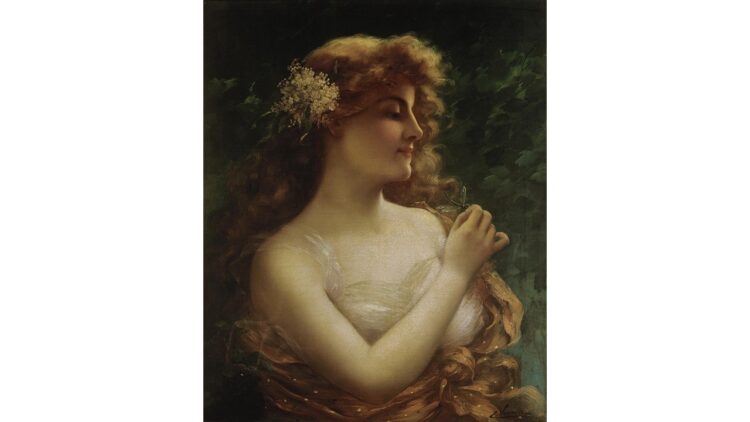
Ode to a Dragonfly
High in the torrid, torpid dog-day air
A shape, elusive, skeletal, darts by—
Yet elongated, elegant, sleek, fair—
A rarity that grabs the languid eye:
Delicate, opalescent, like etched glass,
Borne on four gossamer wings spanning wide,
Delicate lacework intricately spun.
Of all the swift-winged, airborne forms that pass
Through these bright skies—that flutter, flit, or glide—
Your beauty stands apart, alike to none.
So small, so fast, you lead the eye amiss,
Chasing your errant, flitting, aerial dance,
Stealing only the shortest awe-struck glimpse
As granted by the random wiles of chance.
Fragile, elaborate, ephemeral;
So easy to snuff out with fingertips,
So quickly fading, yielding to decay:
Intricate artwork, preternatural,
Flashing ghostlike before the shades eclipse
Eternally to whisk your grace away.
Yet though your fragile beauty evanesce
Inside the temporal and physical,
Neither its transience nor its tininess
Confine you: you are not material.
Your maze of intricate complexity
Shows craftsmanship of a divine command,
Art fashioned not in vain from carbon-chains;
It flashes in the eye and memory,
The prototype that guides the artist’s hand
And out of him eternally remains.
Rapture
On the Final Movement of Beethoven’s
Eighth Symphony
.
Quavering strains of purest joy,
First sparkling then exploding forth
As cosmic energies deploy,
Enlivening with light and warmth—
Ecstatic, dancing, loving life,
Yet straying, too, to reminisce
Or daydream, surge with inner strife,
And even face the dark abyss
Only to reel back with a laugh.
Bright, dark the driving rhythms course,
Give drunken ears sweet draughts to quaff,
Refreshed in floods of sonic force.
Joy! Boundless joy, forever captured
In form that holds me now enraptured.
Adam Sedia (b. 1984) lives in his native Northwest Indiana and practices law as a civil and appellate litigator. He has published four books of poetry and his poems, essays, and fiction have appeared in various literary journals. He is also a composer, and his musical works may be heard on his YouTube channel.








Adam, your “Ode to a Dragonfly” is exceedingly entrancing with highly descriptive imagery and captivating words. This may be one of the best of all your exceptional poems. “Rapture,” written with verve and energy about Beethoven’s Eighth
Symphony takes us intricately through the various movements of his majestic piece that, as you say, brings joy and leaves us enraptured. Enraptured is a brilliant ending for a poem thus titled, “Rapture.”
Thank you! I truly appreciate your appreciation for these poems.
These are both about the poet’s absolute delight in beauty — one visual, and one aural. The language in “Ode” is unabashedly elaborate and intricate, like fine embroidery, and it’s virtually a linguistic slap in the face to the modernist stricture against the use of adjectives. Notice also that Adam has many of them grouped — not singly, but in battalions, as Claudius said.
“Rapture,” on the other hand, uses verbs and verbal forms, but just as lavishly. It’s harder to describe a sound than it is to describe a tangible object, but this poem gives us a lot of movement and activity. I suppose that is to be expected, for as it has been noted somewhere, music is specifically directed to the human will, and impels the listener to action rather than just observation.
Adam’s work shows us that, despite all the propaganda of modernism, the love of lavish word choice and complexity is still a natural impulse in real poets.
Thank you! I always fear sounding too “purple,” but the intricacy and delicacy of the dragonfly, I think, demanded something ornate. And Beethoven’s 8th I think is one of the most underappreciated symphonic works — a shorter work stuck between the massive 7th and legendary 9th, it packs a punch that is rarely equaled, especially in its outer movements. I wanted to capture what I feel during the final movement, one of the finest moments in music.
It was a pleasure to read these. I especially admire how you’ve captured the dragonfly both in terms of its natural beauty and spiritual essence. Thank you for sharing your work.
Thank you, Adam, for bringing a poet’s attention to the wondrous dragonfly, a creature that seemingly violates the laws of physics by reversing flight so violently yet with ease, in jewel-like beauty. I notice the profusion of adjectives piling up in praise and suggesting a connection to the divine. There is no obvious need for beauty–witness the multitudes of grotesque bugs–yet there it is, speeding, dodging, flashing in the sunlight. Poets should never give up pointing out wonders. I’m glad to see you are enthusiastically carrying on the tradition.
Your “Ode to a Dragonfly,” Adam, develops as an authentic ode of much more than delight. You’re using a form recommended by Keats, though he himself left no ode of like stanza plan and rhyme scheme. The first stanza is the strophe setting forth the dragonfly’s beauty as theme. The second stanza is a classic antistrophe, focusing by contrast on the insect as small and ephemeral, but nonetheless precious. The epode goes beyond summary or integration of the two aspects of a dragonfly. It asserts the creature’s divine design. Even though you declare the dragonfly “not material,” you seem to be more in accord here with the science of intelligent design, than with the philosophy of platonic form, in which the pure essence of “dragonfly” doesn’t exist in physical reality. It is real art that “flashes in the eye and memory.” And though represented by a “prototype,” that very guide for the artist’s hand “out of him eternally remains.” It’s more than an idea in the mind of God; Adam Sedia too can observe, create, and glorify a dragonfly in the language of an ode, the stateliest lyric genre. And as a composer, you might set the ode to music as well.
You capture the essence of the poem excellently. And I do admit using Keats’s great odes as a loose model for the form, slightly sonnet-based. I think it works particularly well for an English ode. And yes, I do believe a proper ode should follow the classic strophe-antistrophe-epode.
The Giant, Yellow Dragonfly
by Earwic Beedles
He saw the giant yellow dragonfly aloft in flight,
belonging to Ordónata, eliciting sheer fright—
large, bulging eyes, upon a head, with slender body length,
transparent wings, appearing threatening, with insect strength.
The wingspan was ginormous, of about four inches long;
though intricate its netting, its speed showed its wings were strong.
Additionally, its wings were adjusted, quick on track,
for hovering like as a helicopter, forth or back.
This dragonfly was an efficient flier in the air;
at sixty-miles-per-hour, quite the deadly predator;
but it could also flee a threat, because it was so fast;
it’s there before you know it has appeared, and then has passed.
The lifespan of a dragonfly is only a few months.
It dines on flies, mosquitos, gnats, as well as bees and moths.
It uses pheromones when it is out attracting mates,
this creature that outlived the dinosaurs, for goodness sake.
And here in this hot weather it’s amazing to demur
this dragonfly is able to control its temp’rature.
Through thermoregulation it is able to maintain
a metabolic optimum in sunlight or in shade.
I particularly enjoyed your ‘Ode to a Dragonfly’, Adam. Here in the desert we get a couple of species of butterflies, and on occasion dragonflies. Your poem really captures their wonderful essence.
Thanks for the read.