• Submit Poetry
  • Support SCP
  • About Us
  • Members
  • Join
Monday, September 7, 2026
Society of Classical Poets
  • Poems
    • Beauty
    • Culture
    • Satire
    • Humor
    • Children’s
    • Art
    • Ekphrastic
    • Epic
    • Epigrams and Proverbs
    • Human Rights in China
    • Music
    • Performing Arts
    • Riddles
    • Science
    • Song Lyrics
    • The Environment
    • The Raven
    • Found Poems
    • High School Poets
    • Terrorism
    • Covid-19
  • Poetry Forms
    • Sonnet
    • Haiku
    • Limerick
    • Villanelle
    • Rondeau
    • Pantoum
    • Sestina
    • Triolet
    • Acrostic
    • Alexandroid
    • Alliterative
    • Blank Verse
    • Chant Royal
    • Clerihew
    • Rhupunt
    • Rondeau Redoublé
    • Rondel
    • Rubaiyat
    • Sapphic Verse
    • Shape Poems
    • Terza Rima
  • Great Poets
    • Geoffrey Chaucer
    • Emily Dickinson
    • Homer
    • Henry Wadsworth Longfellow
    • Dante Alighieri
    • John Keats
    • John Milton
    • Edgar Allan Poe
    • William Shakespeare
    • William Wordsworth
    • William Blake
    • Robert Frost
  • Love Poems
  • Contests
  • SCP Academy
    • Educational
    • Teaching Classical Poetry—A Guide for Educators
    • Poetry Forms
    • The SCP Journal
    • Books
No Result
View All Result
Society of Classical Poets
  • Poems
    • Beauty
    • Culture
    • Satire
    • Humor
    • Children’s
    • Art
    • Ekphrastic
    • Epic
    • Epigrams and Proverbs
    • Human Rights in China
    • Music
    • Performing Arts
    • Riddles
    • Science
    • Song Lyrics
    • The Environment
    • The Raven
    • Found Poems
    • High School Poets
    • Terrorism
    • Covid-19
  • Poetry Forms
    • Sonnet
    • Haiku
    • Limerick
    • Villanelle
    • Rondeau
    • Pantoum
    • Sestina
    • Triolet
    • Acrostic
    • Alexandroid
    • Alliterative
    • Blank Verse
    • Chant Royal
    • Clerihew
    • Rhupunt
    • Rondeau Redoublé
    • Rondel
    • Rubaiyat
    • Sapphic Verse
    • Shape Poems
    • Terza Rima
  • Great Poets
    • Geoffrey Chaucer
    • Emily Dickinson
    • Homer
    • Henry Wadsworth Longfellow
    • Dante Alighieri
    • John Keats
    • John Milton
    • Edgar Allan Poe
    • William Shakespeare
    • William Wordsworth
    • William Blake
    • Robert Frost
  • Love Poems
  • Contests
  • SCP Academy
    • Educational
    • Teaching Classical Poetry—A Guide for Educators
    • Poetry Forms
    • The SCP Journal
    • Books
No Result
View All Result
Society of Classical Poets
No Result
View All Result
Home Poetry Children's Poems

A Rhyme of the Cities

July 10, 2020
in Children's Poems, Culture, Humor, Poetry
A A
13
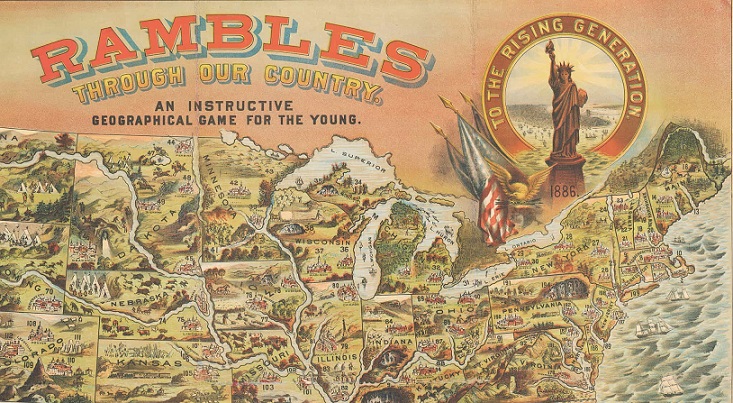
poems A Rhyme of the Cities


Editor’s Note: This poem was originally found in The Pebbles and Shells: A Book of Verses ,1909, edited by Donald Fraser. Another version was published in The Good Humor Book, by Robert Rango, 1944.

Edited by Beverly Stock

Said little Johnnie to the Owl;
“I’ve heard you’re wondrously wise,
And so I’d like to question you:
Now, please don’t tell me lies.

“The first thing, then, I’d have you tell,
My empty mind to fill,
Pray, what was that awful food,
That made Chicago, Ill.?

“I’ve heard it said, yet do not know—
In fact, it may be bosh–
Then, tell me is it lots of dirt,
That’s makes Seattle, Wash.?

“Another thing I wish I could
Inform my waiting class,
Is just how many priests it takes,
To say the Boston, Mass.?

“This the time of running debts,
As you must surely know;
The secret, then, impart to me:
How much does Cleveland OH?

“It takes great heat the gold to melt,
And iron takes much more;
Then is it true, that way out West,
The rain melts Portland’s OR?

“Some voices are so strong and full,
And some so still and small,
That I have wondered oftentimes
How loud can Denver Col.?”

The Owl scratched his feathered pate;
“I’m sorry, little man;
Ask someone else, I cannot tell,
Perhaps Topeka Kan.!


References:
The Good Humor Book, Rango, (Robert) ed., Good Humor Book. © July 11, 1944; A181729; Harvest House, New York 3891, Catalogue of Copyright Entries, published by Authority of the Acts of Congress of March 3, 1891, of June 30, 1906, and of March 4, 1909, Vol 41, No 7.

Pebbles and Shells: A Book of verses, Page 101, books.google.com>books>id+dP4wAQAAMAAJ
Donald Andrew Fraser-1909.

Beverly Stock is a Poet from the Midwest. Her first book of poetry, The Prayerful Poet, published by HarperCollins Christian Publishing, debuted May 12.  Find more of her poetry at BeverlyStockPoetry.com.
ShareTweetPin
The Society of Classical Poets does not endorse any views expressed in individual poems or commentary.
Read Our Comments Policy Here

RandomPoems

‘Insouciance’ and Other Poetry by C.B. Anderson
Beauty

‘Insouciance’ and Other Poetry by C.B. Anderson

December 2, 2023

. Insouciance When circumstances wear you down Consider this important fact: It’s easier to smile than frown. When autumn leaves...

‘The Knight of Monticello’: A Poem on Thomas Jefferson by Mary Jane Myers
Beauty

‘The Knight of Monticello’: A Poem on Thomas Jefferson by Mary Jane Myers

April 25, 2024

. The Knight of Monticello Everywhere and always, Jefferson read. His library stocked a sage’s daily bread. Four volumes, leather-bound,...

Next Post
‘Those Days and These’ and Other Poetry by Jane Blanchard

'The King' and Other Poetry by Michael Witcoff

Essay: ‘Frog-Marched Into the Prison of Poetry’

A Poem by a Currently Incarcerated Poet

COVID 19 historical perspective

Documentary on Pandemic Features The Iliad and SCP Member

Comments 13

  1. Leo Zoutewelle says:
    6 years ago

    I’m sorry, but I can’t help thinking that this, today, is rather delightful!

    Reply
    • Beverly says:
      6 years ago

      Thank you!

      Reply
  2. Joseph S. Salemi says:
    6 years ago

    This wonderful piece of humor is from a time when poetry was still part of the general public inheritance — when meter, rhyme, wit, clarity, and good diction were part of the intellectual atmosphere, and not something you have to fight for and argue for, as we have to do now.

    Reply
    • Beverly says:
      6 years ago

      Totally agree!

      Reply
  3. Monty says:
    6 years ago

    A simple and humorous play on states. I knew six of the seven cities listed, but had to look up Topeka. Upon doing so, it immediately became my favourite of the seven puns.

    I couldn’t help noticing the severe lack of a syllable in S2, L3. It could be simply rectified with the insertion of the word ‘then’:
    ‘Pray, what then was that awful food’.

    Reply
    • Joseph S. Salemi says:
      6 years ago

      The line in question is trochaic. It scans as follows:

      PRAY, what WAS that AWful FOOD

      As long as it has a tetrameter beat, it satisfies all requirements of the form.

      Reply
      • Beverly says:
        6 years ago
        Reply
  4. Susan Jarvis Bryant says:
    6 years ago

    A smile-inducing joy of a poem. Thank you for weaving your magic with it and bringing it to our attention, Beverly.

    Reply
    • Beverly says:
      6 years ago

      Thank you, Susan!

      Reply
  5. Joe Tessitore says:
    6 years ago

    Wonderful stuff!

    Reply
    • Beverly says:
      6 years ago

      Thank you, Joe!

      Reply
  6. Sultana Raza says:
    6 years ago

    This poem reminds one of a time when people actually wrote formal poems just for fun, while honing their skill at the same time. Agree with Dr Salemi that poetry was ‘public inheritance…’ in the good old days. Thanks for sharing it!

    Reply
  7. Monty says:
    6 years ago

    If it was your intention, Beverley, to render L7 as a trochee (as you did with L17) then of course you must disregard my initial comment. I realise that such substitutions are permissible in poetry, but that doesn’t stop me feeling that the only purpose they serve is to patently disrupt a reader’s flow – as evidenced by the fact that I came to a complete stop when I encountered that line, in what was an otherwise beautifully-flowing piece.

    I also feel that, in general, the merits for, and validity of, such usages are ambiguous, in the sense that if a reader encounters a 20-line poem, in which 19 lines are purely iambic and 1 line is a trochee, the reader is left thinking: ‘Was that 1 line intentional on the poet’s behalf (in which case it becomes a permissible substitution).. or was it unintentional (in which case it becomes a metrical error)’? I fail to see why a reader should be put in the position of having to guess whether the poet has made an intentional substitution or an unintentional metrical error! Also, if a poet DID use a trochee unintentionally and unwittingly (in which case it becomes a metrical error), it shouldn’t be the case that the poet is instead admired for their use of a substitution. Hence my use of the word ‘ambiguous’.

    For what it’s worth, my feeling is that when such substitutions are used in poetry, they could be done so more uniformly, as in . . in an otherwise 20-line iambic poem of five stanzas, if the last line of a stanza is a trochee, then the last line of EVERY stanza should be a trochee. That way, the reader would be in no doubt of the poet’s intentions.

    (Coincidentally, a couple of days after reading your piece there was a beautifully-written essay submitted to these pages by Adam Sedia [13th July: if you didn’t see it, you should], in which he makes a compelling case for the usage of substitutions in poetry, and cites some illustrious names in the field who were unashamed proponents of said usage. In which case, if your substitutions above WERE intentional, you’re certainly in good company.)

    Reply

Leave a Reply Cancel reply

Your email address will not be published. Required fields are marked *


  1. Perica Dujmović on The Society of Classical Poets 2026 Haiku CompetitionSeptember 7, 2026

    Thank you, I appreciate it.

  2. Margaret Coats on ‘The Cristero Centennial’: A Poem by Margaret CoatsSeptember 7, 2026

    Thank you, Stephen. The poem and the events it recounts have two levels or perspectives, which gradually becomes apparent in…

  3. Margaret Coats on ‘The Ballad of Babi Yar’ by Theresa RodriguezSeptember 7, 2026

    Theresa, I think I was too horrified by the effect of this poem to comment when it first came out.…

  4. Margaret Coats on ‘A Prayer of Aristotle’: A Poem by Margaret CoatsSeptember 7, 2026

    Yes, pure act, or in your own other words, Bruce, "devoid of potency." Awe or wonder is the ultimate effect…

  5. Margaret Coats on ‘The Cristero Centennial’: A Poem by Margaret CoatsSeptember 6, 2026

    Cynthia, thanks for your response. We need those cardinal virtues.

Subscribe to Daily Poems

Enter your email address to subscribe to this blog and receive notifications of new posts by email.

Join 1,638 other subscribers

Recent Poems

  • ‘On to Better Days’: A Poem by Bruce Dale Wise
  • ‘Serenade’ and Other Poetry by Adam Sedia
  • ‘Self-Exploration’ and Other Poems by Paul Millan
  • ‘Victory’: A Poem by Jonathan Graver
  • ‘The Cristero Centennial’: A Poem by Margaret Coats
  • ‘A Potpourri of Aphoristic Verses’ by C.B. Anderson
  • ‘The Estuary’: A Poem by Jeff Eardley
  • ‘A World Without the Wednesday Child’: A Poem by Kimberly Fore
  • The 2026 Society of Classical Poets International Poetry Competition
  • The 2026 SCP International High School Poetry Competition
  • ‘Realistic Reflections’ and Other Poetry by Anna J. Arredondo
  • ‘China Made’: A Poem by Theresa Werba
  • ‘The Savage Moon’ and Other Poetry by Brian Yapko
  • Poetry Book Review: Love Found, Yearned For, and Lost by James A. Tweedie
  • ‘When Opportunity Knocks’: A Poem by Roy E. Peterson
  • ‘Legend of the Griffin’: A Poem by Iryna Hall
  • ‘Government Issue’ and Other Poems by Joseph S. Salemi
  • ‘Chaucer Announces His Desire to Retire’: A Poem by Paul A. Freeman
  • ‘Advantages of Restaurants’ and Other Poems by Russel Winick
  • ‘Bone China’: A Poem by Mary Gardner
  • ‘On the Death of One Too Young to Die’: A Poem by Jeffrey Essmann
  • ‘This Too Shall Pass’ and Other Poetry by Justin Dasher
  • ‘Humdrum and Harum-Scarum’: A Lecture on Free Verse, by Robert Bridges (1922)
  • ‘Unrest On the Floodplain’: A Poem by Bhikkhu Nyanasobhano
  • ‘Latitude and Loss’: A Poem by Martin Briggs
  • ‘Act III’ and Other Poetry by C.B. Anderson
  • ‘God’s Funeral’: A Poem by James Sale
  • ‘Star Festival’: A Poem by Margaret Coats
  • ‘Song of the Frog Princess’: A Poem by Scharlie Meeuws
  • ‘The Odyssey: Nolan and Solot Compared’: An Essay by Michael Curtis

Categories

  • Acrostic
  • Alexandroid
  • Alliterative
  • Art
  • Best Poems
  • Blank Verse
  • Chant Royal
  • Classical Poets Live
  • Clerihew
  • Covid-19
  • Deconstructing Communism
  • Educational
  • Epic
  • Epigrams and Proverbs
  • Essays
    • Interviews with Poets
    • Poetry Reviews
  • Featured
  • From the Society
  • Great Poets
    • Dante Alighieri
    • Edgar Allan Poe
    • Emily Dickinson
    • Geoffrey Chaucer
    • Henry Wadsworth Longfellow
    • Homer
    • John Keats
    • John Milton
    • Robert Frost
    • William Blake
    • William Shakespeare
    • William Wordsworth
  • Human Rights in China
  • Limerick
  • Love Poems
  • Music
  • Pantoum
  • Performing Arts
  • Poetry
    • Beauty
    • Children's Poems
    • Culture
    • Ekphrastic
    • Found Poems
    • High School Poets
    • Humor
    • Riddles
  • Poetry Challenge
  • Poetry Contests
  • Poetry Forms
    • Curtal Sonnet
    • Haiku
  • Poetry Readings
  • Rhupunt
  • Rondeau
  • Rondeau Redoublé
  • Rondel
  • Rubaiyat
  • Sapphic Verse
  • Satire
  • Science
  • Sestina
  • Shape Poems
  • Short Stories
  • Song Lyrics
  • Sonnet
  • Symposium
  • Terrorism
  • Terza Rima
  • The Environment
  • Translation
  • Triolet
  • Video
  • Villanelle

Quick Links

  • About Us
  • Submit Poetry
  • Become a Member
  • Members List
  • Support the Society
  • Advertisement Placement
  • Comments Policy
  • Terms of Use

Welcome Back!

Login to your account below

Forgotten Password?

Retrieve your password

Please enter your username or email address to reset your password.

Log In
No Result
View All Result
  • Poems
    • Beauty
    • Culture
    • Satire
    • Humor
    • Children’s
    • Art
    • Ekphrastic
    • Epic
    • Epigrams and Proverbs
    • Human Rights in China
    • Music
    • Performing Arts
    • Riddles
    • Science
    • Song Lyrics
    • The Environment
    • The Raven
    • Found Poems
    • High School Poets
    • Terrorism
    • Covid-19
  • Poetry Forms
    • Sonnet
    • Haiku
    • Limerick
    • Villanelle
    • Rondeau
    • Pantoum
    • Sestina
    • Triolet
    • Acrostic
    • Alexandroid
    • Alliterative
    • Blank Verse
    • Chant Royal
    • Clerihew
    • Rhupunt
    • Rondeau Redoublé
    • Rondel
    • Rubaiyat
    • Sapphic Verse
    • Shape Poems
    • Terza Rima
  • Great Poets
    • Geoffrey Chaucer
    • Emily Dickinson
    • Homer
    • Henry Wadsworth Longfellow
    • Dante Alighieri
    • John Keats
    • John Milton
    • Edgar Allan Poe
    • William Shakespeare
    • William Wordsworth
    • William Blake
    • Robert Frost
  • Love Poems
  • Contests
  • SCP Academy
    • Educational
    • Teaching Classical Poetry—A Guide for Educators
    • Poetry Forms
    • The SCP Journal
    • Books

© 2025 SCP. WebDesign by CODEC Prime.