


All Flesh Is Grass
“When the ungodly are green as the grass, and when all the
workers of wickedness do flourish, then shall they be destroyed
forever; but thou, Lord, art the most highest for evermore.”
—Psalm 92:7
When haughty lawless scoundrels with their boorish
Intrigues appear, like morning’s grass, to neither
Be sickly nor in scarcity, but flourish
In brightest greens, while humble people wither
Like faded blades cut down and left to feed
Rogues’ evil schemes—compost upon their vice—
One thinks perhaps to trade the Christian creed
For, “Some by virtue fall, and others rise
By sin.” Malignant overgrowth of weeds
Appears to suffocate, with strong-willed roots,
The fairest fields and flowers, and all seeds
Except seeds of frustration, fear and doubt—
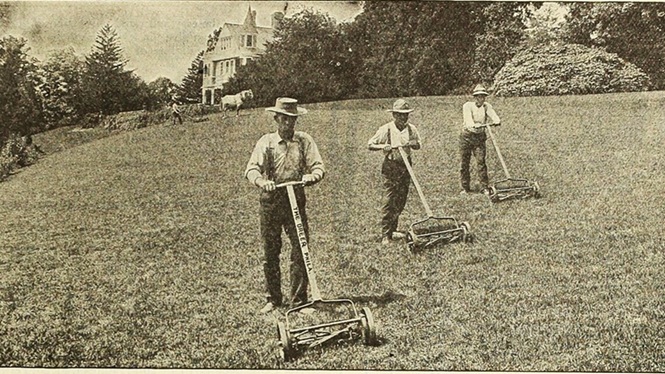
Until the evening mowers intervene,
Cut down the proud, and leave God’s people green.
First published in First Things
Cynthia Erlandson is a poet and fitness professional living in Michigan. Her third collection of poems, Foundations of the Cross and Other Bible Stories, was released in July, 2024 by Wipf and Stock Publishers. Her other collections are These Holy Mysteries and Notes on Time. Her poems have also appeared in First Things, Modern Age, The North American Anglican, The Orchards Poetry Review, The Book of Common Praise hymnal, The Catholic Poetry Room, and elsewhere.










I knew I would like it before I read it Cynthia. Such an apt poem,
aptly written. Thank you.
Thank you so much, jd!
Cynthia — I love this! And I’m keeping my eyes out for the mowers. Great job!
Thank you, Russel! Yes, watch out for those mowers!
An optimistic and affirmative final couplet, Cynthia: the universal come-uppance. Well written.
I’m so pleased that you like it, Martin! Thank you!
Cynthia, I love to see such wonderful use of scripture in writing poetry. Your treatment of this Psalm is well-taken and brings it to the present with mowers instead of scythes.
Thank you, Roy! The Psalmist provided the wonderful simile, and I couldn’t resist just running with it.
Cynthia, As a fellow Michigander I always long for the green grass of spring. Thanks for a lovely poem with vivid imagery. The form had me going through it more than once and seeing more with each read.
I’m honored, Robert, that you saw fit to read it more than once, finding new things each time. Thank you for this encouragement! We in southeast Michigan have been blessed lately with lots of rain and consequent very green grass — unlike some areas of the country which are drought-stricken.
Beautiful – Job-ian – why do the wicked flourish: such a profound question and at the very heart of human life. Love the development of the poem and its ideas.
Thank you much, James — ah, yes, dear Job speaks here, as well as the Psalmist, expressing something that I imagine every human being wonders, and is frustrated, about.
You’re the flower of the field, Cynthia, seeing sense in it all, understanding the psalm verse as prophecy, and even imagining a false proverb growing from those malignant seeds of frustration, fear and doubt. I like your description of weed roots as “strong-willed”; we know how tough the “haughty lawless scoundrels” consider themselves, despite being “morning grass” destined to meet “evening mowers.”
Your comments mean a great deal to me, Margaret. Thank you for them, and for your insightful reading.
What a well-told, thought-provoking set of ideas you’ve handled with your usual deftness, Cynthis.
I’m so glad for your encouraging comments, Paul— thank you!
I can remember, back in the day, when we used to say to each other about sad consequences to come, that your ass is grass. We didn’t know what we were talking about back then, but we got it exactly right.
Thanks for that connection, C.B. I don’t recall that saying, but my husband does.
Thank you, Miss Erlandson… I was very encouraged and uplifted by your poem! This is the Truth
I’m grateful that it is encouraging to you, Peg. Thank you for letting me know.
I agree with the others’ praise of how you elaborate the subject/simile. I also want to recognize your deft use of enjambment in this sonnet. What a lovely effect!
Thank you so much, Samuel!
Like the prophet Nathan confronting David, Cynthia, you point a strong and confident finger at the machinations of the rogues and scoundrels who dominate our world. The emphatic final lines tell us that they will not win in the end. The meek shall inherit the earth. A reminder to keep the faith.
Thank you so much, Gerard. Sometimes it’s hard to remember that the rogues will not win.
Cynthia, I’m sorry to be late in reading this powerful poem. It is descriptive of a war between humility and arrogance (not quite good and evil, though the argument can be made) set in pastoral terms which expand upon its biblical source material with subtlety and grace rather than with stridency. It offers no orders or instructions but, rather, simply observes with the simple suggestion of holding on despite temptation. It’s beautiful, well-crafted and — most difficult to achieve — both thought-provoking and comforting at the same time. This is beautiful work.
I’m very grateful for your lovely comments, Brian. Thank you so much for adding them here. I’m glad you find the poem both thought-provoking and comforting.
Cynthia,
I enjoyed this poem very much. So much vivid imagery — I especially like the faded blades of the humble being “like compost” upon the voice of the wicked… You build and build the frustration and despair until it finally finds relief in the closing couplet. I read it to my daughter, who also enjoyed it.
Thank you so much, Anna! So much of biblical imagery just lends itself to expanding upon it and extending the profound metaphors it sets forth. I’m so happy that both you and your daughter enjoyed it!
Very finely crafted. I love how you weave the Psalm into the parable of the wheat and cockle at the end. Your technique is exquisite, as well; your rhymes “neither/wither” and “boorish/flourish” are particularly skillful. But what stands out most is the discursive nature of the sonnet without sounding “preachy” or prosaic. This is truly the best kind of poetry, offering a clear lesson that is also a delight to read.
Oh, my, I’m overwhelmed with gratitude to read your comments, Adam, especially since I admire you poetry so much. (I didn’t comment on your recent mathematical one, only because I’m weak in my understanding of math — I let my husband do that one. :)) I really do try to avoid preachiness, since something about it rubs me the wrong way. Anyway, thank you so much!