• Submit Poetry
  • Support SCP
  • About Us
  • Members
  • Join
Saturday, July 18, 2026
Society of Classical Poets
  • Poems
    • Beauty
    • Culture
    • Satire
    • Humor
    • Children’s
    • Art
    • Ekphrastic
    • Epic
    • Epigrams and Proverbs
    • Human Rights in China
    • Music
    • Performing Arts
    • Riddles
    • Science
    • Song Lyrics
    • The Environment
    • The Raven
    • Found Poems
    • High School Poets
    • Terrorism
    • Covid-19
  • Poetry Forms
    • Sonnet
    • Haiku
    • Limerick
    • Villanelle
    • Rondeau
    • Pantoum
    • Sestina
    • Triolet
    • Acrostic
    • Alexandroid
    • Alliterative
    • Blank Verse
    • Chant Royal
    • Clerihew
    • Rhupunt
    • Rondeau Redoublé
    • Rondel
    • Rubaiyat
    • Sapphic Verse
    • Shape Poems
    • Terza Rima
  • Great Poets
    • Geoffrey Chaucer
    • Emily Dickinson
    • Homer
    • Henry Wadsworth Longfellow
    • Dante Alighieri
    • John Keats
    • John Milton
    • Edgar Allan Poe
    • William Shakespeare
    • William Wordsworth
    • William Blake
    • Robert Frost
  • Love Poems
  • Contests
  • SCP Academy
    • Educational
    • Teaching Classical Poetry—A Guide for Educators
    • Poetry Forms
    • The SCP Journal
    • Books
No Result
View All Result
Society of Classical Poets
  • Poems
    • Beauty
    • Culture
    • Satire
    • Humor
    • Children’s
    • Art
    • Ekphrastic
    • Epic
    • Epigrams and Proverbs
    • Human Rights in China
    • Music
    • Performing Arts
    • Riddles
    • Science
    • Song Lyrics
    • The Environment
    • The Raven
    • Found Poems
    • High School Poets
    • Terrorism
    • Covid-19
  • Poetry Forms
    • Sonnet
    • Haiku
    • Limerick
    • Villanelle
    • Rondeau
    • Pantoum
    • Sestina
    • Triolet
    • Acrostic
    • Alexandroid
    • Alliterative
    • Blank Verse
    • Chant Royal
    • Clerihew
    • Rhupunt
    • Rondeau Redoublé
    • Rondel
    • Rubaiyat
    • Sapphic Verse
    • Shape Poems
    • Terza Rima
  • Great Poets
    • Geoffrey Chaucer
    • Emily Dickinson
    • Homer
    • Henry Wadsworth Longfellow
    • Dante Alighieri
    • John Keats
    • John Milton
    • Edgar Allan Poe
    • William Shakespeare
    • William Wordsworth
    • William Blake
    • Robert Frost
  • Love Poems
  • Contests
  • SCP Academy
    • Educational
    • Teaching Classical Poetry—A Guide for Educators
    • Poetry Forms
    • The SCP Journal
    • Books
No Result
View All Result
Society of Classical Poets
No Result
View All Result
Home Poetry Culture

‘Ba’al’: A Poem on Abortion by Michael Vanyukov

June 30, 2024
in Culture, Poetry
A A
6
poem/graham/culture

.

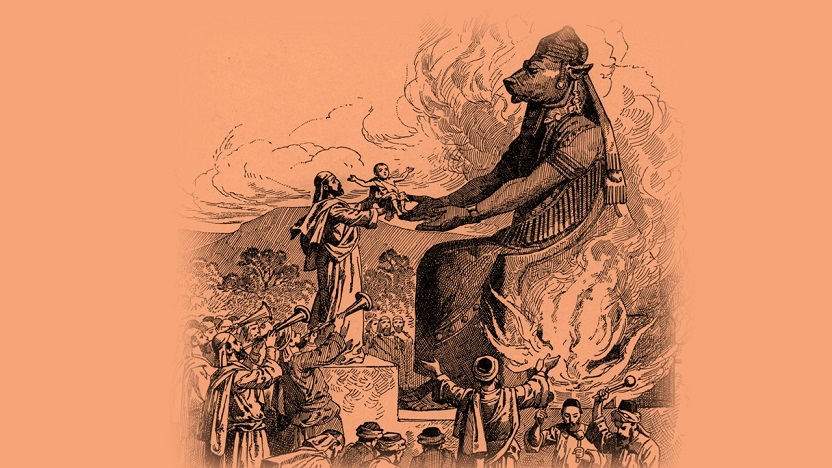
Ba’al

“And they built the high places of Ba’al to burn their
children with fire as burnt offerings to Ba’al, which I did
not command, neither did I speak nor did it enter
My mind.”
— Yirmiyahu (Jeremiah) 19:5
 
“Destroy another fetus now
We don’t like children anyhow”
—Leonard Cohen, “The Future”

Here is an altar of Ba’al.
Decipher this hieroglyphic—
it says, for fruit to be prolific,
you’ll burn your child or break his skull.
When satisfied, Ba’al provides
you with his benefits aplenty—
for instance, with your soup of lentils.
All you can eat to your delight.

The war on kindness is afoot,
and lips of wise ones drip with venom.
And sacrifices in Gehinnom—
they’ve moved away but they’re not moot.
They are to other idols—they
are to the vagaries and whimsy.
Who cares much that the reason’s flimsy—
the child’s unwanted, good to slay,
to be plucked out, this hated seed.
A surplus piece of mother’s body.
She does not want him, he’s a burden—
it’s only fair, her chosen deed.

The tophet’s full with crimson waste
but ne’er enough to sate the fire—
it moans for more. It’s never tired,
and feeding it is in good taste.
It has to follow that one’s life
is only worth exactly nothing.
Ba’al is happy. He is laughing.
He’s never lived but hard’s his laugh.

.

Gehinnom: originally known biblically as the accursed Valley of Hinnom (Heb. gei hinom) and the Valley of the Son of Hinnom (gei ben hinom), later corrupted into Gehenna, attaining the meaning of hell: a valley on the west-southwest of Jerusalem, where children were sacrificed to Ba’al and Moloch.

Tophet: the place of sacrifice.

.

.

Michael Vanyukov is a Professor of Pharmaceutical Sciences, Psychiatry, and Human Genetics at the University of Pittsburgh. He immigrated to the United States 30 years ago as a refugee from the Soviet Union.

ShareTweetPin
The Society of Classical Poets does not endorse any views expressed in individual poems or commentary.
Read Our Comments Policy Here

RandomPoems

‘Damon and Pythias’ and Other Poetry on Friendship, by Margaret Coats
Beauty

‘Damon and Pythias’ and Other Poetry on Friendship, by Margaret Coats

March 21, 2026

  Damon and Pythias The two spoke number lore with every breath, Disciples of Pythagoras and friends, But one was...

poem/bryant/valentine
Love Poems

‘The Pilgrimage’: A Love Poem by Paul Martin Freeman

August 30, 2023

. The Pilgrimage The lover takes leave of his mistress's mouth And starts on his pilgrimage, travelling south. Each stop...

Next Post
A Formalist Poet at the Open Mic, Part I of An Essay Series by Daniel Kemper

'Becoming a Poet Laureate': A Formalist Poet at the Open Mic Part IV, by Daniel Kemper

‘The Rise of Washington’: Excerpt from the Mock Epic Poem by Andrew Benson Brown

'The Rise of Washington': Excerpt from the Mock Epic Poem by Andrew Benson Brown

‘Militant Books’ and Other Poetry by Skye Campbell

'Militant Books' and Other Poetry by Skye Campbell

Comments 6

  1. Roy Eugene Peterson says:
    2 years ago

    Michael, not only do you depict the abominations of Ba-al and expose the modern cruel counterpart, you exhibit an educated knowledge of significant religious facts and ability to put it into wonderful classic poetry. I did not know Gehenna was a linguistic corruption of another word and was educated on Tophet as the place of sacrifice. I value the thought and work you put into this vivid poem of tragedies foisted upon the people.

    Reply
    • Michael Vanyukov says:
      2 years ago

      Thank you, Roy, for your kind words. Tragedies indeed. Worse yet, unnecessary and avoidable ones. Rationalized by the idea that is wrong both scientifically and morally.

      Reply
  2. Brian A. Yapko says:
    2 years ago

    This is an extremely powerful poem, Michael, on a subject which inspires passions like few others. Relating abortion to Baal worship is not only daring but, in some ways, frighteningly accurate. I’ve seen many stories of pro-abortion activists who treat their right to kill the baby in the womb as a pseudo-religion. I saw a psychotic woman on a news show recently who had tattoos, piercings, pink hair and who was dead behind the eyes loudly screaming that she was proud of her multiple abortions — in double digits. Perversely, I’m sure she was. That human souls can be twisted into such amoral contortions is so disturbing. Your rage-infused poem captures that disturbing, pagan-worshiping quality perfectly.

    Reply
    • Michael Vanyukov says:
      2 years ago

      Thank you, Brian. You are perfectly correct. Worshiping false deities, including deified humans, is an old and tenacious human fallacy, leading to nothing but death – both physical and spiritual. “Dead behind the eyes” captures that – in abortion worship, in Allah worship, in Obama worship, you name it. Ba’al is laughing.

      Reply
  3. Margaret Coats says:
    2 years ago

    Michael, how many reasons or excuses or justifications you pack into this poem! When we hear of child sacrifice in ancient times, we often wonder why, but you show that the faulty reasoning, contrary to divine will, is similar to what is heard at present. We have a tophet to the convenience of what seems a better life, just as ancients might have felt more secure in their “soup of lentils” after a hideous sacrifice to Ba’al. One striking line here: “feeding it is in good taste,” as if the imaginary benefits one gains from human sacrifice improve even base sensual satisfaction. That shows flimsy reasoning! And you present a good conclusion: Ba’al has never lived, but he can laugh hard at those who try to please his non-existence. I suppose you mean the false god, who may be a devil, has no real life because (if he is a fallen angel) he abandoned life received in creation. The idea works just as well with modern disbelief in pagan deities as non-existent.

    Reply
    • Michael Vanyukov says:
      2 years ago

      Dear Margaret, as usual, you penetrate all the layers of the eternal inhuman/infernal phenomenon in humans I tried to touch. Thank you.

      Reply

Leave a Reply Cancel reply

Your email address will not be published. Required fields are marked *

  1. Marguerite on ‘When the Phone Rings’ and Other Short Poems by Russel WinickJuly 18, 2026

    Amen on "Apologies!"

  2. Susan Jarvis Bryant on ‘My Pyjamas!’ and Other Poems by Susan Jarvis BryantJuly 18, 2026

    Jan, thank you very much for your encouraging comment. I'm so glad you enjoyed the poems and especially glad they…

  3. James Sale on ‘The 51st State’: A Poem by James SaleJuly 18, 2026

    Not quite a win, Theresa, but thank you for the thought, and congratulations yourself on your "Finalist' status for your…

  4. Susan Jarvis Bryant on National Poetry Month Limerick ChallengeJuly 18, 2026

    Beautifully written and hilarious, Jan! You have inspired me to have a go. Thank you!

  5. Jan Mennite on ‘My Pyjamas!’ and Other Poems by Susan Jarvis BryantJuly 18, 2026

    Susan, I always feel that my poetic intelligence increases while I read your work. I laughed and learned and felt…

Subscribe to Daily Poems

Enter your email address to subscribe to this blog and receive notifications of new posts by email.

Join 1,594 other subscribers

Recent Poems

  • Winners and Rankings of The Great American Poetry Competition
  • ‘The Gold Star Mother’: A Poem by Gerard Maritato
  • ‘An American Dash’: A Poem by Linda Ellis
  • ‘The Anonymous Soldier’: A Poem by Lucy Lind
  • ‘For Those We Never Meet’: A Poem by Aneesh Agarwal
  • ‘Ben Franklin’s Copper Fugio Cent’: A Poem by Geoffrey Smagacz
  • Three Brief Poems by Luxorius, Translated by Joseph S. Salemi
  • ‘The American Spirit’: A Poem by Dusty Grein
  • ‘The Ballad of Zebulon Pike’: A Poem by M.D. Skeen
  • ‘We Are the Ones’ and Other Poetry by Cheryl Corey
  • ‘My Pyjamas!’ and Other Poems by Susan Jarvis Bryant
  • ‘A Snowy Egret’: A Poem by Bruce Dale Wise
  • ‘The Swearing-in of Calvin Coolidge’: A Sonnet by Robert W. Crawford
  • ‘Ballad of the Sequoia’: A Poem by Lauren V. Leon
  • ‘The 51st State’: A Poem by James Sale
  • ‘La Uva’ (The Grape): A Poem by Michael Pietrack
  • ‘There’s Blood that Flows Within the Stripes’: A Poem by Lauren V. Leon
  • ‘Birdsong’: A Poem by Jeffrey Essmann
  • ‘The Melody That Lingers On’ and Other Poetry by John McPherson
  • ‘American Dreams’: A Poem by Adam Sedia
  • ‘An American Fabius’: A Poem by John Hernandez
  • ‘Vernal Clinic’ and Other Poetry by C.B. Anderson
  • ‘Omaha Beach’ and Other Poetry by Bradford Skow
  • ‘Music to Part the Veil’: A Poem by T.M. Moore
  • ‘A Gentleman’s Guide to Losing a War’ and Other Poetry by Arnon Peterson
  • ‘Black Shuck’: A Poem by Martin Briggs
  • ‘When the Last World War II Veteran Passes Away’: A Poem by N.S. Boone
  • ‘A Fallow Year at Worthy Farm’: A Poem by Paul A. Freeman
  • ‘Outstanding in Afghanistan’: A Poem by Jared S. Chang
  • ‘250 More’: A Poem by Miguel Moreno

Categories

  • Acrostic
  • Alexandroid
  • Alliterative
  • Art
  • Best Poems
  • Blank Verse
  • Chant Royal
  • Classical Poets Live
  • Clerihew
  • Covid-19
  • Deconstructing Communism
  • Educational
  • Epic
  • Epigrams and Proverbs
  • Essays
    • Interviews with Poets
    • Poetry Reviews
  • Featured
  • From the Society
  • Great Poets
    • Dante Alighieri
    • Edgar Allan Poe
    • Emily Dickinson
    • Geoffrey Chaucer
    • Henry Wadsworth Longfellow
    • Homer
    • John Keats
    • John Milton
    • Robert Frost
    • William Blake
    • William Shakespeare
    • William Wordsworth
  • Human Rights in China
  • Limerick
  • Love Poems
  • Music
  • Pantoum
  • Performing Arts
  • Poetry
    • Beauty
    • Children's Poems
    • Culture
    • Ekphrastic
    • Found Poems
    • High School Poets
    • Humor
    • Riddles
  • Poetry Challenge
  • Poetry Contests
  • Poetry Forms
    • Curtal Sonnet
    • Haiku
  • Poetry Readings
  • Rhupunt
  • Rondeau
  • Rondeau Redoublé
  • Rondel
  • Rubaiyat
  • Sapphic Verse
  • Satire
  • Science
  • Sestina
  • Shape Poems
  • Short Stories
  • Song Lyrics
  • Sonnet
  • Symposium
  • Terrorism
  • Terza Rima
  • The Environment
  • Translation
  • Triolet
  • Video
  • Villanelle

Quick Links

  • About Us
  • Submit Poetry
  • Become a Member
  • Members List
  • Support the Society
  • Advertisement Placement
  • Comments Policy
  • Terms of Use

Welcome Back!

Login to your account below

Forgotten Password?

Retrieve your password

Please enter your username or email address to reset your password.

Log In
No Result
View All Result
  • Poems
    • Beauty
    • Culture
    • Satire
    • Humor
    • Children’s
    • Art
    • Ekphrastic
    • Epic
    • Epigrams and Proverbs
    • Human Rights in China
    • Music
    • Performing Arts
    • Riddles
    • Science
    • Song Lyrics
    • The Environment
    • The Raven
    • Found Poems
    • High School Poets
    • Terrorism
    • Covid-19
  • Poetry Forms
    • Sonnet
    • Haiku
    • Limerick
    • Villanelle
    • Rondeau
    • Pantoum
    • Sestina
    • Triolet
    • Acrostic
    • Alexandroid
    • Alliterative
    • Blank Verse
    • Chant Royal
    • Clerihew
    • Rhupunt
    • Rondeau Redoublé
    • Rondel
    • Rubaiyat
    • Sapphic Verse
    • Shape Poems
    • Terza Rima
  • Great Poets
    • Geoffrey Chaucer
    • Emily Dickinson
    • Homer
    • Henry Wadsworth Longfellow
    • Dante Alighieri
    • John Keats
    • John Milton
    • Edgar Allan Poe
    • William Shakespeare
    • William Wordsworth
    • William Blake
    • Robert Frost
  • Love Poems
  • Contests
  • SCP Academy
    • Educational
    • Teaching Classical Poetry—A Guide for Educators
    • Poetry Forms
    • The SCP Journal
    • Books

© 2025 SCP. WebDesign by CODEC Prime.