• Submit Poetry
  • Support SCP
  • About Us
  • Members
  • Join
Sunday, September 6, 2026
Society of Classical Poets
  • Poems
    • Beauty
    • Culture
    • Satire
    • Humor
    • Children’s
    • Art
    • Ekphrastic
    • Epic
    • Epigrams and Proverbs
    • Human Rights in China
    • Music
    • Performing Arts
    • Riddles
    • Science
    • Song Lyrics
    • The Environment
    • The Raven
    • Found Poems
    • High School Poets
    • Terrorism
    • Covid-19
  • Poetry Forms
    • Sonnet
    • Haiku
    • Limerick
    • Villanelle
    • Rondeau
    • Pantoum
    • Sestina
    • Triolet
    • Acrostic
    • Alexandroid
    • Alliterative
    • Blank Verse
    • Chant Royal
    • Clerihew
    • Rhupunt
    • Rondeau Redoublé
    • Rondel
    • Rubaiyat
    • Sapphic Verse
    • Shape Poems
    • Terza Rima
  • Great Poets
    • Geoffrey Chaucer
    • Emily Dickinson
    • Homer
    • Henry Wadsworth Longfellow
    • Dante Alighieri
    • John Keats
    • John Milton
    • Edgar Allan Poe
    • William Shakespeare
    • William Wordsworth
    • William Blake
    • Robert Frost
  • Love Poems
  • Contests
  • SCP Academy
    • Educational
    • Teaching Classical Poetry—A Guide for Educators
    • Poetry Forms
    • The SCP Journal
    • Books
No Result
View All Result
Society of Classical Poets
  • Poems
    • Beauty
    • Culture
    • Satire
    • Humor
    • Children’s
    • Art
    • Ekphrastic
    • Epic
    • Epigrams and Proverbs
    • Human Rights in China
    • Music
    • Performing Arts
    • Riddles
    • Science
    • Song Lyrics
    • The Environment
    • The Raven
    • Found Poems
    • High School Poets
    • Terrorism
    • Covid-19
  • Poetry Forms
    • Sonnet
    • Haiku
    • Limerick
    • Villanelle
    • Rondeau
    • Pantoum
    • Sestina
    • Triolet
    • Acrostic
    • Alexandroid
    • Alliterative
    • Blank Verse
    • Chant Royal
    • Clerihew
    • Rhupunt
    • Rondeau Redoublé
    • Rondel
    • Rubaiyat
    • Sapphic Verse
    • Shape Poems
    • Terza Rima
  • Great Poets
    • Geoffrey Chaucer
    • Emily Dickinson
    • Homer
    • Henry Wadsworth Longfellow
    • Dante Alighieri
    • John Keats
    • John Milton
    • Edgar Allan Poe
    • William Shakespeare
    • William Wordsworth
    • William Blake
    • Robert Frost
  • Love Poems
  • Contests
  • SCP Academy
    • Educational
    • Teaching Classical Poetry—A Guide for Educators
    • Poetry Forms
    • The SCP Journal
    • Books
No Result
View All Result
Society of Classical Poets
No Result
View All Result
Home Poetry

Book Review: Seven Poems by Jacob Balde, Translated by Karl Maurer

May 20, 2023
in Poetry, Poetry Reviews, Translation
A A
6
poetry/cooper/reviews

.

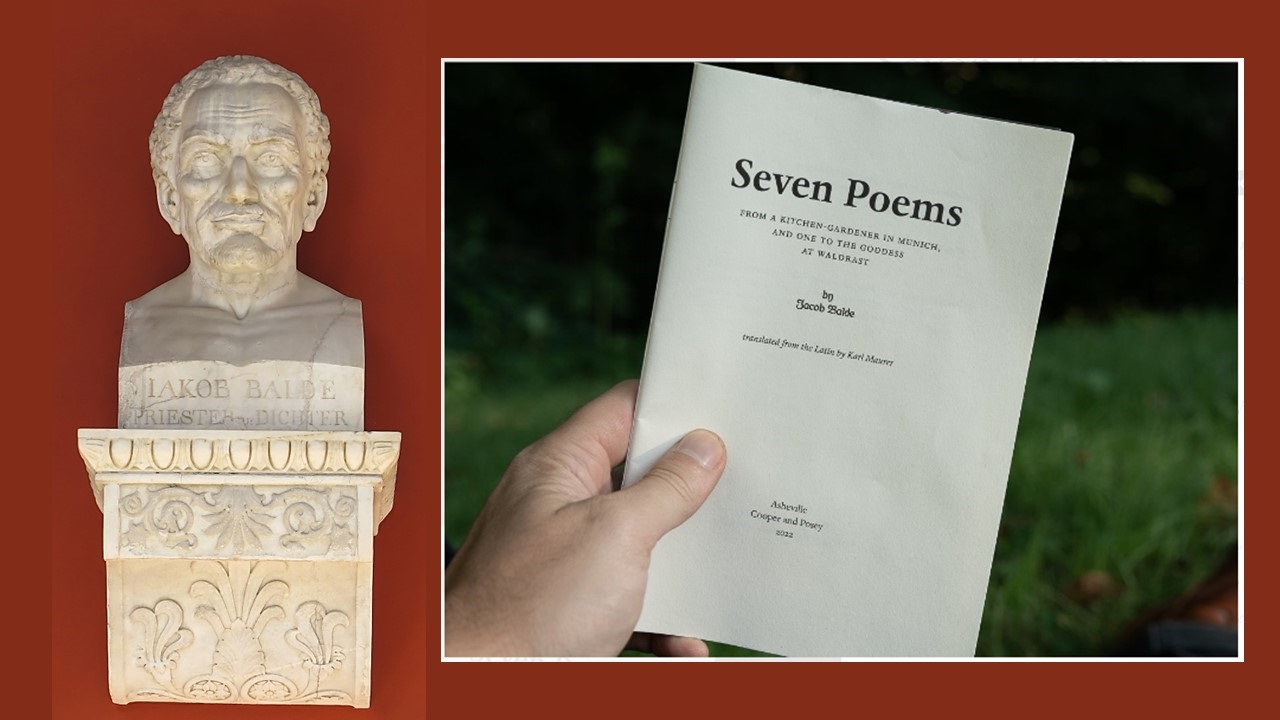
Reviewed Book: Seven Poems by Jacob Balde (Translated by Karl Maurer)
Cooper and Posey, 2023

by Monika Cooper

In 2022, a small and brand-new press launched a paper ship, full of herbs and poppies from Bavaria…

That’s the story behind Cooper and Posey’s publication of a little book called Seven Poems from a Kitchen-gardener in Munich, and One to the Goddess at Waldrast, translated from the 17th century Latin of Jacob Balde (1604-1668) by the late Dr. Karl Maurer.

King Arthur, my father observed recently, was raised by peasants “as every king should be.” Perhaps Sir Ector was not quite a peasant but the principle (or proverb) is a sound and beautiful one. This collection of Seven Poems begins as a celebration of the rustic and simple life, with a kind of eudaimonistic asceticism, and moves from there to a fully rounded but concisely compressed comment on leadership. Then it overflows itself in a meditation on Bethlehem and a resolution in supreme Quiet.

Dr. Karl Maurer, a teacher of mine and even more a teacher of my brothers, appreciated Greek and Latin poetry as few can (full disclosure: the Cooper in Cooper and Posey comes from my brother Adam Cooper). I don’t have the capacity to draw Dr. Maurer’s portrait for you here but I will say that, raised by the greatest voices of Classical times, his standards for poetry were fiercely demanding. He was like Dickinson’s tiger; he would get skeletal from fasting before he’d settle for something less than a “Berry of Domingo” in a poem. And, among neo-Latin poets, he loved and translated Balde. Maurer had the same uncompromising standards for the translations he made that he did for the poems he loved. Now seven of his Balde translations, in his exquisite English meter and rhyme, have been made available to poem-lovers everywhere.

The first poem, “To Leonard Creder – on Adam Holle, Gardener of the College of Munich (A Lyrico-bucolic Panegyric on the very Saturnalia, 1645),” is a portrait of a man, a gardener, both larger than life and totally real, at once heroic and anti-heroic. It’s a vision of his body and his mind, his outstanding deeds and his daily life, his quirks and his adherence to universal morals. He is what he eats and he eats “the greens he sowed, plus sausage”: “Brains and nectar he’ll ship back to the gods.” He is what he loves and he loves “rustic prayer”:

.

No terror of a stormcloud. Thunderbolts
he admires: he likes the tumult.

.

In praising his gardener, a particular and individual man, Balde also gives us a rough, robust, and humorous sketch of a certain ideal of manhood. Every line is packed, with something: the whole teems with energy and meaning.

The second poem, in a slightly differing mode, is its own “Commendation of a Frugal Life & a Quiet Heart.” It contrasts the poisoned pleasures of luxury and power with the carefree joys of poverty and obscurity. There is something for everyone in its gentle and spirited manifesto. For me, it’s the way the speaker curves his hand “in a live cup” and takes a drink straight from a wild brooklet. The poem celebrates not just simplicity but renunciation. It’s addressed to a man quitting public life and aspiring to “sacred leisure.”

The theme of the third poem is given as “know thyself.” It opens with the proclamation, at first discordant, to Leontius Crinallus: “I’d have you a great Consul.” But it is Leontius Crinallus himself that the speaker wants his chosen addressee to rule. And, to rule himself, he must know himself: become “Watchman of your own night.” There’s a warning, or at least admonishing, tone here, sweetened throughout with flashes of respect. That the poet thought his subject worth advising to know his own evil in this way is itself a mark of honor.

Poems 4 and 5 have the themes “that life is prolonged by deeds, not by years” and “Happy Poverty.” In poem four, “To Arisius Moschus,” Balde, playing on his theme of little things, examines its implications for time: how a short span of time fully lived, with virtue and intelligence, is more to be desired than many years. The “oyster’s stone” compresses in itself greater worth than “whole big crags.” History’s epochs are reduced, refined, and reflected in the moment of the pearl:

.

Thus one day of a sage’s life surpasses
a thousand years of stupid people’s . . .

.

The fifth poem is another little piece of wisdom writing, which balances its universal statements with arresting homely details, much as the Biblical book of Proverbs itself. It ends with a miniature of a plowman working as he eats. You taste the goodness of the simple lunch he enjoys with the sauce of hunger: “the crust of wheaten bread, the onions, the pulse.”

The last two poems, plus the bonus eighth to the “goddess at Waldrast,” crown the collection. I don’t want to say anything here that might spoil them for the reader. But the shortest poem of the entire booklet, “To Prince Sigmund Albrecht, Duke of both Bavarias – even the smallest things must be attended to,” reconciles in its eight long lines the contrasts the foregoing poems built up and constructed. To be a good ruler, one must, in some sense, be raised by peasants. A leader who aspires to greatness must understand, intimately, the worth and promise of small things. Renouncing his greed for power and riches precedes grasping them with understanding and employing them with justice. Only the deep appreciation for poverty and obscurity that comes from a willing experience of them allows a man to assume power and step forward as a leader worthily: that is, in the spirit of sacrifice. Becoming a public figure, he knows the goodness of the quiet life he renounces in its turn. He gives it up for a higher good, more for his people than for himself.

The poems in this book, with many Classical allusions and chewy place and person names, will offer resistance to even the learned readers of our time. But the challenge is worth taking up. I will leave for your discovery the Bethlehem ode (with only a hint that, it too, in its own very tender way, reconciles poverty and kingship) and the one to the “goddess at Waldrast.” In the end, the book whispers of a nest to be made in solitude, of a sleep—numinous and terrible—that initiates the sleeper into fullest and sweetest “Forest Quiet.”

.

.

.

ShareTweetPin
The Society of Classical Poets does not endorse any views expressed in individual poems or commentary.
Read Our Comments Policy Here

RandomPoems

‘Victimhood Diet’: A Poem Inspired by Jordan Peterson, by Warren Bonham
Culture

‘Victimhood Diet’: A Poem Inspired by Jordan Peterson, by Warren Bonham

December 1, 2025

  Victimhood Diet “You can’t hold on to your victimhood and get on with your life. You have to choose...

‘My 2020 Christmas List’ by Susan Jarvis Bryant
Love Poems

‘Christmas 2010’: A Poem by Mike Bryant

December 25, 2023

. Christmas 2010 "Love isn't something you find.  Love is something that finds you." ---Loretta Young I hadn't given up...

Next Post
‘Rhyme to Me’ by Lee Nyary

'A Poetic Heretic’s Poetry Tips' and Other Poetry on Poetry, by Susan Jarvis Bryant

poem/steinle/translation

Poems from 'The Still Beloved' by Amado Nervo, Translated by Alan Steinle

‘The Devil’s New Mission’ and Other Poetry by Troy Camplin

'Abyss': A Poem by Tom Woodliff

Comments 6

  1. Roy Eugene Peterson says:
    3 years ago

    As one who lived in Bavaria )Garmisch-Partenkirchen and Munich) for five years while serving in the Army in military intelligence, this review was fascinating.

    Reply
    • Monika Cooper says:
      3 years ago

      It sounds like you’ve led a fascinating life, Roy!

      You might be interested to know that Dr. Maurer was very intense formalist. He once looked over a batch of my, ahem, less formal poems and called them “d—-d free verse” (yes, he nicely didn’t spell the word out). But he didn’t dismiss them entirely either: he was strict but more than fair. Another time he criticized a rhymed poem I showed him because the rhymes weren’t closely spaced enough. He liked every line to rhyme with some other line in a scheme. He looked in verse for what he called “rhyme crystals.”

      He had a way of expressing himself. I remember him calling us students “you swine,” really bitter but affectionate too. He lived in a kind of obscurity himself and a degree of poverty. I would see him waiting for the bus in the afternoons in the Texas sun, with his light wide-brimmed hat, a Panama hat I think. I don’t believe he owned a car. I hope future ages will bring him the recognition he deserves, if only for the sake of those future ages.

      If you choose to take up and read his translations, I think you and he will get along well.

      Reply
      • Roy Eugene Peterson says:
        3 years ago

        Thank you for the insights of Dr. Maurer. I also look for the rhyme first in classical poetry. The idea of “rhyme crystals” is a wonderful thought!

        Reply
  2. Joseph S. Salemi says:
    3 years ago

    How about letting us know how we can get a copy?

    Reply
    • Monika Cooper says:
      3 years ago

      Here’s a link: https://www.cooperandposey.com/store/p/seven-poems.

      Reply
  3. brooks says:
    2 years ago

    Hello,
    I am looking for a poem or story retold [13th c] by Jakob Balde, The Pearl.
    Though it could be under a different title.

    Do you have any more information regarding this 17th c poet or anyone who might keep an archive of his works?

    The story is about a poor maiden who finds a treasure and her 5 brothers want to give her something in exchange for this treasure.

    If you have any idea where I might find this poem or story I would appreciate the information.
    Thank you

    Reply

Leave a Reply Cancel reply

Your email address will not be published. Required fields are marked *


  1. Jonathan Graver on ‘Victory’: A Poem by Jonathan GraverSeptember 5, 2026

    Paul, thank you! - JG

  2. Jonathan Graver on ‘Victory’: A Poem by Jonathan GraverSeptember 5, 2026

    Roy, I am honored and humbled. Thank you. - JG

  3. Maria Guia Lopez de Leon on The Society of Classical Poets 2026 Haiku CompetitionSeptember 5, 2026

    tin basin at night moonlight quivers on the wash hands wait in the dark ~~~ soft belly of spring gold-threaded…

  4. C.B. Anderson on ‘The Estuary’: A Poem by Jeff EardleySeptember 5, 2026

    Joe is right. As it stands, the sentence is run-on.

  5. C.B. Anderson on ‘Legend of the Griffin’: A Poem by Iryna HallSeptember 5, 2026

    Exquisite diction, superb control of meter, and a resonant theme. Who could ask for more?

Subscribe to Daily Poems

Enter your email address to subscribe to this blog and receive notifications of new posts by email.

Join 1,636 other subscribers

Recent Poems

  • ‘Victory’: A Poem by Jonathan Graver
  • ‘The Cristero Centennial’: A Poem by Margaret Coats
  • ‘A Potpourri of Aphoristic Verses’ by C.B. Anderson
  • ‘The Estuary’: A Poem by Jeff Eardley
  • ‘A World Without the Wednesday Child’: A Poem by Kimberly Fore
  • The 2026 Society of Classical Poets International Poetry Competition
  • The 2026 SCP International High School Poetry Competition
  • ‘Realistic Reflections’ and Other Poetry by Anna J. Arredondo
  • ‘China Made’: A Poem by Theresa Werba
  • ‘The Savage Moon’ and Other Poetry by Brian Yapko
  • Poetry Book Review: Love Found, Yearned For, and Lost by James A. Tweedie
  • ‘When Opportunity Knocks’: A Poem by Roy E. Peterson
  • ‘Legend of the Griffin’: A Poem by Iryna Hall
  • ‘Government Issue’ and Other Poems by Joseph S. Salemi
  • ‘Chaucer Announces His Desire to Retire’: A Poem by Paul A. Freeman
  • ‘Advantages of Restaurants’ and Other Poems by Russel Winick
  • ‘Bone China’: A Poem by Mary Gardner
  • ‘On the Death of One Too Young to Die’: A Poem by Jeffrey Essmann
  • ‘This Too Shall Pass’ and Other Poetry by Justin Dasher
  • ‘Humdrum and Harum-Scarum’: A Lecture on Free Verse, by Robert Bridges (1922)
  • ‘Unrest On the Floodplain’: A Poem by Bhikkhu Nyanasobhano
  • ‘Latitude and Loss’: A Poem by Martin Briggs
  • ‘Act III’ and Other Poetry by C.B. Anderson
  • ‘God’s Funeral’: A Poem by James Sale
  • ‘Star Festival’: A Poem by Margaret Coats
  • ‘Song of the Frog Princess’: A Poem by Scharlie Meeuws
  • ‘The Odyssey: Nolan and Solot Compared’: An Essay by Michael Curtis
  • ‘Solitude’ and Other Poems by Mary Jane Myers
  • ‘The River Not Taken’ and Other Poetry by Brian Yapko
  • ‘Totentanz’: A Poem by James A. Tweedie

Categories

  • Acrostic
  • Alexandroid
  • Alliterative
  • Art
  • Best Poems
  • Blank Verse
  • Chant Royal
  • Classical Poets Live
  • Clerihew
  • Covid-19
  • Deconstructing Communism
  • Educational
  • Epic
  • Epigrams and Proverbs
  • Essays
    • Interviews with Poets
    • Poetry Reviews
  • Featured
  • From the Society
  • Great Poets
    • Dante Alighieri
    • Edgar Allan Poe
    • Emily Dickinson
    • Geoffrey Chaucer
    • Henry Wadsworth Longfellow
    • Homer
    • John Keats
    • John Milton
    • Robert Frost
    • William Blake
    • William Shakespeare
    • William Wordsworth
  • Human Rights in China
  • Limerick
  • Love Poems
  • Music
  • Pantoum
  • Performing Arts
  • Poetry
    • Beauty
    • Children's Poems
    • Culture
    • Ekphrastic
    • Found Poems
    • High School Poets
    • Humor
    • Riddles
  • Poetry Challenge
  • Poetry Contests
  • Poetry Forms
    • Curtal Sonnet
    • Haiku
  • Poetry Readings
  • Rhupunt
  • Rondeau
  • Rondeau Redoublé
  • Rondel
  • Rubaiyat
  • Sapphic Verse
  • Satire
  • Science
  • Sestina
  • Shape Poems
  • Short Stories
  • Song Lyrics
  • Sonnet
  • Symposium
  • Terrorism
  • Terza Rima
  • The Environment
  • Translation
  • Triolet
  • Video
  • Villanelle

Quick Links

  • About Us
  • Submit Poetry
  • Become a Member
  • Members List
  • Support the Society
  • Advertisement Placement
  • Comments Policy
  • Terms of Use

Welcome Back!

Login to your account below

Forgotten Password?

Retrieve your password

Please enter your username or email address to reset your password.

Log In
No Result
View All Result
  • Poems
    • Beauty
    • Culture
    • Satire
    • Humor
    • Children’s
    • Art
    • Ekphrastic
    • Epic
    • Epigrams and Proverbs
    • Human Rights in China
    • Music
    • Performing Arts
    • Riddles
    • Science
    • Song Lyrics
    • The Environment
    • The Raven
    • Found Poems
    • High School Poets
    • Terrorism
    • Covid-19
  • Poetry Forms
    • Sonnet
    • Haiku
    • Limerick
    • Villanelle
    • Rondeau
    • Pantoum
    • Sestina
    • Triolet
    • Acrostic
    • Alexandroid
    • Alliterative
    • Blank Verse
    • Chant Royal
    • Clerihew
    • Rhupunt
    • Rondeau Redoublé
    • Rondel
    • Rubaiyat
    • Sapphic Verse
    • Shape Poems
    • Terza Rima
  • Great Poets
    • Geoffrey Chaucer
    • Emily Dickinson
    • Homer
    • Henry Wadsworth Longfellow
    • Dante Alighieri
    • John Keats
    • John Milton
    • Edgar Allan Poe
    • William Shakespeare
    • William Wordsworth
    • William Blake
    • Robert Frost
  • Love Poems
  • Contests
  • SCP Academy
    • Educational
    • Teaching Classical Poetry—A Guide for Educators
    • Poetry Forms
    • The SCP Journal
    • Books

© 2025 SCP. WebDesign by CODEC Prime.