• Submit Poetry
  • Support SCP
  • About Us
  • Members
  • Join
Saturday, July 18, 2026
Society of Classical Poets
  • Poems
    • Beauty
    • Culture
    • Satire
    • Humor
    • Children’s
    • Art
    • Ekphrastic
    • Epic
    • Epigrams and Proverbs
    • Human Rights in China
    • Music
    • Performing Arts
    • Riddles
    • Science
    • Song Lyrics
    • The Environment
    • The Raven
    • Found Poems
    • High School Poets
    • Terrorism
    • Covid-19
  • Poetry Forms
    • Sonnet
    • Haiku
    • Limerick
    • Villanelle
    • Rondeau
    • Pantoum
    • Sestina
    • Triolet
    • Acrostic
    • Alexandroid
    • Alliterative
    • Blank Verse
    • Chant Royal
    • Clerihew
    • Rhupunt
    • Rondeau Redoublé
    • Rondel
    • Rubaiyat
    • Sapphic Verse
    • Shape Poems
    • Terza Rima
  • Great Poets
    • Geoffrey Chaucer
    • Emily Dickinson
    • Homer
    • Henry Wadsworth Longfellow
    • Dante Alighieri
    • John Keats
    • John Milton
    • Edgar Allan Poe
    • William Shakespeare
    • William Wordsworth
    • William Blake
    • Robert Frost
  • Love Poems
  • Contests
  • SCP Academy
    • Educational
    • Teaching Classical Poetry—A Guide for Educators
    • Poetry Forms
    • The SCP Journal
    • Books
No Result
View All Result
Society of Classical Poets
  • Poems
    • Beauty
    • Culture
    • Satire
    • Humor
    • Children’s
    • Art
    • Ekphrastic
    • Epic
    • Epigrams and Proverbs
    • Human Rights in China
    • Music
    • Performing Arts
    • Riddles
    • Science
    • Song Lyrics
    • The Environment
    • The Raven
    • Found Poems
    • High School Poets
    • Terrorism
    • Covid-19
  • Poetry Forms
    • Sonnet
    • Haiku
    • Limerick
    • Villanelle
    • Rondeau
    • Pantoum
    • Sestina
    • Triolet
    • Acrostic
    • Alexandroid
    • Alliterative
    • Blank Verse
    • Chant Royal
    • Clerihew
    • Rhupunt
    • Rondeau Redoublé
    • Rondel
    • Rubaiyat
    • Sapphic Verse
    • Shape Poems
    • Terza Rima
  • Great Poets
    • Geoffrey Chaucer
    • Emily Dickinson
    • Homer
    • Henry Wadsworth Longfellow
    • Dante Alighieri
    • John Keats
    • John Milton
    • Edgar Allan Poe
    • William Shakespeare
    • William Wordsworth
    • William Blake
    • Robert Frost
  • Love Poems
  • Contests
  • SCP Academy
    • Educational
    • Teaching Classical Poetry—A Guide for Educators
    • Poetry Forms
    • The SCP Journal
    • Books
No Result
View All Result
Society of Classical Poets
No Result
View All Result
Home Poetry Culture

Dogs, Cats, Nursery Rhymes & Mother Goose: Three Poems by James A. Tweedie

April 29, 2023
in Culture, Humor, Poetry
A A
13
poem/tweedie/culture

.

Why Children Like Nursery Rhymes

A story to be told, a tale to tell
Of things that do not matter much at all.
Who cares about the farmer in the dell?
Or Humpty-Dumpty falling off a wall?

The pickled peppers Peter Piper Picked?
Jack Horner in the corner eating pie?
Such nursery rhymes seem written to inflict
A grownup’s mind with plots both thin and dry.

And yet most children seem to be amused
To hear them read again “just one more time!”
Which leaves the literary types bemused,
While missing the whole point of pointless rhyme.

It’s not the plot that tickles children’s hearing,
The rhythmic rhyme itself is what’s endearing.

.

.

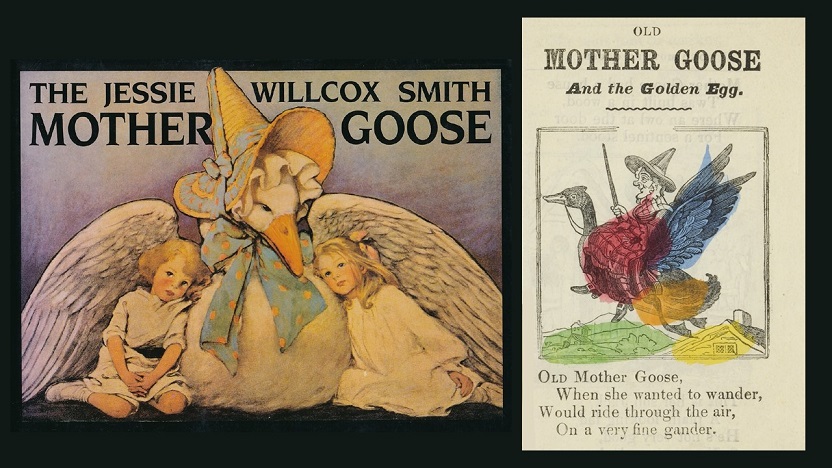
Mother Goose

Old Mother Goose is noted for
__Her story-telling fame.
But something we should not ignore
__Is how she got her name.

The source was Charles Perrault’s patois.
__Instead of “Madam Peahen,”
He published tales by Mère l’Oye
__In sixteen-ninety-seven.

Red Riding Hood, is one he wrote
__With Puss and Boots’ debut.
With Cinderella worth a note,
__And Sleeping Beauty, too.

The stories are a tour de force,
__Infused with moral candor,
He mentions Mother Goose,” of course . . .
__But leaves out Father Gander.

__

Note: The full title is, Histoires ou Contes du Temps passé, avec des moralités—Les Contes de ma Mère l’Oye or Tales and Stories of the Past with Morals—Tales of Mother Goose.

.

.

Where Do Cats & Dogs Go
When They Die?

Where do cats go when they die?
To heaven? Hell? Or outer space?
No one really knows, but I
Am sure it is a purr-fect place.

Where do dogs go when they die?
Purr-haps to those same habitats.
There, with dripping tongues awry,
They chase, but never catch, the cats.

.

.

James A. Tweedie is a retired pastor living in Long Beach, Washington. He has written and published six novels, one collection of short stories, and three collections of poetry including Mostly Sonnets, all with Dunecrest Press. His poems have been published nationally and internationally in The Lyric, Poetry Salzburg (Austria) Review, California Quarterly, Asses of Parnassus, Lighten Up Online, Better than Starbucks, Dwell Time, Light, Deronda Review, The Road Not Taken, Fevers of the Mind, Sparks of Calliope, Dancing Poetry, WestWard Quarterly, Society of Classical Poets, and The Chained Muse. He was honored with being chosen as the winner of the 2021 SCP International Poetry Competition.


ShareTweetPin
The Society of Classical Poets does not endorse any views expressed in individual poems or commentary.
Read Our Comments Policy Here

RandomPoems

A Poem on the Equality Act: ‘Second-Place Sue’ by Julian Woodruff
Culture

A Poetic Call to Action Regarding Transgenderism and Fairness in School Athletics

April 27, 2023

. Let Us Lift Our Voices Higher by Mark F. Stone Don’t let leaders make their choices never having heard...

Inspiring Muse Poetry Challenge
Love Poems

Inspiring Muse Poetry Challenge

August 22, 2025

. This poetry challenge comes from poet Roy E. Peterson: Provide a poem about your inspiring Muse. If you name...

Next Post
poem/peterson/masks

'Who Is Behind Your Mask': A Poem by Roy E. Peterson

poem/gardner/culture

A Recipe and a Poem: 'Chicken and Andouille Gumbo' and Other Poetry by Mary Gardner

poem/essmann/beauty

'The Sonogram' and Other Poetry by Jeffrey Essmann

Comments 13

  1. Joseph S. Salemi says:
    3 years ago

    These three poems are really great, and they confirm what many persons have argued — that the best way to introduce children to poetry is via Mother Goose rhymes. They are delightful, unforgettable, and provide a child with a solid basis in the older, non-iambic pentameter rhythms.

    They also do something vitally important. They show that what matters in a poem is NOT its “meaning” or “message” or “moral” (the “three miseries”), but the linguistic pleasure that is provided by sheer playfulness, and ingenuity in words, images, and strange situations. Jack Sprat, Simple Simon, Elsie Marley, “Ride a cock horse to Banbury Cross”… these are priceless treasures.

    One minor point — some have argued that the original source of the Mother Goose character was the Frankish queen Bertrada of Laon, who was Charlemagne’s mother. She was called “the queen with the goose-foot,” (regina pede aucae), perhaps because of some physical deformity.

    Reply
  2. Tonia Kalouria says:
    3 years ago

    These are charming! Liked the line about Father Gander being ignored. Early Feminism?

    Reply
  3. Joshua C. Frank says:
    3 years ago

    Love these! I remember Mother Goose and Perrault’s fairy tales from as far back as I can remember. I second the idea that both need to be taught to children! The rhymes themselves in your poems are well-chosen.

    Father Gander made me smile as well. Being Catholic, I imagined a gander dressed as a priest. Perhaps there could be Fr. Gander’s Catholic Nursery Rhymes?

    Regarding another comment, I don’t think of noticing Father Gander being ignored as feminism; if anything, it’s anti-feminism, since feminism is all about women taking over men’s roles and having all the power, and men, especially fathers, having no more power than a slave. (Anyone who disagrees can read the Seneca Falls Declaration of Sentiments and any historical source of the lives of Elizabeth Cady Stanton and Susan B. Anthony.) Feminism has done more to destroy the family than anything else.

    Reply
  4. Joseph S. Salemi says:
    3 years ago

    About Mother Goose’s male counterpart, he is alluded to in one of the nursery rhymes:

    Old Mother Goose, when she wanted to wander,
    Would ride through the air on a very fine gander.

    Not a perfect rhyme in American English, but probably OK in Middle English.

    Reply
    • James A. Tweedie says:
      3 years ago

      Nice catch! I had forgotten that old couplet.

      Reply
  5. Roy Eugene Peterson says:
    3 years ago

    My mother read Mother Goose nursery rhymes to me when I was a child and that was my initiation into words that rhyme. That became my motivation in later life to return to the world of poems and begin writing. I have written a lot of children’s poems that I consider to have meaning, messages, and morals attached to them, but I never thought of them, nor will I ever consider them to be miseries, but rather teaching vehicles in a fun form. There is a more proximate supposition in the U.S. that the original Mother Goose was Elizabeth, the Bostonian wife of Isaac Goose. Elizabeth went to live with her eldest daughter, who had married publisher Thomas Fleet. Rumor was “her son-in-law gathered her jingles together and printed them. No evidence of such printing has been found, and historians believe this story was concocted by Fleet’s great-grandson John Fleet Eliot in 1860.” (Source: Wikipedia) In any event, the collection has so many nursery rhymes that had to have originated in England, such as “Tom, Tom, the Piper’s Son,” “London Bridge is Falling Down,” and “Humpty Dumpty,” with meaning traced back to the King of England. I enjoyed these poems, James, and am glad they were published here.

    Reply
    • Joseph S. Salemi says:
      3 years ago

      The problem is the dating. Charles Perrault’s “Contes de ma mere l’Oye” (Tales of my Mother Goose) came out in 1697, before anything like it happened in New England. Of course, if there was a real Elizabeth Goose, it may well have been a serendipitous coincidence.

      I don’t say that meanings, messages, and morals are always bad in poetry. There’s a place for everything, like castor oil and enemas. But a great many nursery rhymes or stories from Mother Goose deal with cynical, unpleasant, or dicey types like Georgie Porgie, the Jolly Miller on the River Dee, the Knave of Hearts, Tom, the Piper’s Son, and a lot of other rascals. There’s mischief and troublemaking in much of that material, which is why kids love them.

      Reply
  6. C.B. Anderson says:
    3 years ago

    It’s curious that so many of the nursery rhymes read to me had something to do with food. There’s Jack Sprat, Peter the pumpkin eater, Little Miss Moffet, the four-and-twenty blackbirds, peas porridge hot, and, I’m sure, many others.

    Reply
  7. Jeff Eardley says:
    3 years ago

    James, a delightful trio. I read them accompanied by Ravel’s equally delightful “Mother Goose suite”
    Thank you for a bit of fun today.

    Reply
  8. Paul Freeman says:
    3 years ago

    Your poems bring a lot of ideas into focus with regards to nursery rhymes and how they capture the child’s imagination.

    You’ve left me with a lot to think about, and a fair bit of writing, perhaps.

    Thanks for the reads, James.

    Reply
  9. Cheryl Corey says:
    3 years ago

    All are delightful. I note that in the line “He mentions Mother Goose,” of course . . .” there’s no beginning quotation mark.

    Reply
    • James A. Tweedie says:
      3 years ago

      Oops

      Reply
  10. Norma Pain says:
    3 years ago

    Delightfully fun to read these three poems James. I have heard nursery rhymes called nonsense rhymes and perhaps they are, but as children I think we all loved them. Thank you for these.

    Reply

Leave a Reply Cancel reply

Your email address will not be published. Required fields are marked *

  1. Theresa Werba on ‘American Dreams’: A Poem by Adam SediaJuly 18, 2026

    Congrats on your Finalist win Adam, such an excellently-wrought and powerful poem!

  2. Theresa Werba on ‘The 51st State’: A Poem by James SaleJuly 18, 2026

    Congrats James on your Finalist win!!!

  3. Brian Yapko on ‘Americans Cross the Rubicon’: A July 4th Poem by Brian YapkoJuly 18, 2026

    Thank you very much indeed, Adam. The Civil War and Pearl Harbor were decisive enough. I wanted a full range…

  4. Theresa Werba on ‘Two Fateful American Coin Flips’: A Poem by James A. TweedieJuly 18, 2026

    Jim, congrats on your win!!!

  5. BDW on ‘For Those We Never Meet’: A Poem by Aneesh AgarwalJuly 18, 2026

    Mr. Agawal has generalized the largest labour insurrection in America from the early 20th century—1921, that cost the lives of…

Subscribe to Daily Poems

Enter your email address to subscribe to this blog and receive notifications of new posts by email.

Join 1,595 other subscribers

Recent Poems

  • Winners and Rankings of The Great American Poetry Competition
  • ‘The Gold Star Mother’: A Poem by Gerard Maritato
  • ‘An American Dash’: A Poem by Linda Ellis
  • ‘The Anonymous Soldier’: A Poem by Lucy Lind
  • ‘For Those We Never Meet’: A Poem by Aneesh Agarwal
  • ‘Ben Franklin’s Copper Fugio Cent’: A Poem by Geoffrey Smagacz
  • Three Brief Poems by Luxorius, Translated by Joseph S. Salemi
  • ‘The American Spirit’: A Poem by Dusty Grein
  • ‘The Ballad of Zebulon Pike’: A Poem by M.D. Skeen
  • ‘We Are the Ones’ and Other Poetry by Cheryl Corey
  • ‘My Pyjamas!’ and Other Poems by Susan Jarvis Bryant
  • ‘A Snowy Egret’: A Poem by Bruce Dale Wise
  • ‘The Swearing-in of Calvin Coolidge’: A Sonnet by Robert W. Crawford
  • ‘Ballad of the Sequoia’: A Poem by Lauren V. Leon
  • ‘The 51st State’: A Poem by James Sale
  • ‘La Uva’ (The Grape): A Poem by Michael Pietrack
  • ‘There’s Blood that Flows Within the Stripes’: A Poem by Lauren V. Leon
  • ‘Birdsong’: A Poem by Jeffrey Essmann
  • ‘The Melody That Lingers On’ and Other Poetry by John McPherson
  • ‘American Dreams’: A Poem by Adam Sedia
  • ‘An American Fabius’: A Poem by John Hernandez
  • ‘Vernal Clinic’ and Other Poetry by C.B. Anderson
  • ‘Omaha Beach’ and Other Poetry by Bradford Skow
  • ‘Music to Part the Veil’: A Poem by T.M. Moore
  • ‘A Gentleman’s Guide to Losing a War’ and Other Poetry by Arnon Peterson
  • ‘Black Shuck’: A Poem by Martin Briggs
  • ‘When the Last World War II Veteran Passes Away’: A Poem by N.S. Boone
  • ‘A Fallow Year at Worthy Farm’: A Poem by Paul A. Freeman
  • ‘Outstanding in Afghanistan’: A Poem by Jared S. Chang
  • ‘250 More’: A Poem by Miguel Moreno

Categories

  • Acrostic
  • Alexandroid
  • Alliterative
  • Art
  • Best Poems
  • Blank Verse
  • Chant Royal
  • Classical Poets Live
  • Clerihew
  • Covid-19
  • Deconstructing Communism
  • Educational
  • Epic
  • Epigrams and Proverbs
  • Essays
    • Interviews with Poets
    • Poetry Reviews
  • Featured
  • From the Society
  • Great Poets
    • Dante Alighieri
    • Edgar Allan Poe
    • Emily Dickinson
    • Geoffrey Chaucer
    • Henry Wadsworth Longfellow
    • Homer
    • John Keats
    • John Milton
    • Robert Frost
    • William Blake
    • William Shakespeare
    • William Wordsworth
  • Human Rights in China
  • Limerick
  • Love Poems
  • Music
  • Pantoum
  • Performing Arts
  • Poetry
    • Beauty
    • Children's Poems
    • Culture
    • Ekphrastic
    • Found Poems
    • High School Poets
    • Humor
    • Riddles
  • Poetry Challenge
  • Poetry Contests
  • Poetry Forms
    • Curtal Sonnet
    • Haiku
  • Poetry Readings
  • Rhupunt
  • Rondeau
  • Rondeau Redoublé
  • Rondel
  • Rubaiyat
  • Sapphic Verse
  • Satire
  • Science
  • Sestina
  • Shape Poems
  • Short Stories
  • Song Lyrics
  • Sonnet
  • Symposium
  • Terrorism
  • Terza Rima
  • The Environment
  • Translation
  • Triolet
  • Video
  • Villanelle

Quick Links

  • About Us
  • Submit Poetry
  • Become a Member
  • Members List
  • Support the Society
  • Advertisement Placement
  • Comments Policy
  • Terms of Use

Welcome Back!

Login to your account below

Forgotten Password?

Retrieve your password

Please enter your username or email address to reset your password.

Log In
No Result
View All Result
  • Poems
    • Beauty
    • Culture
    • Satire
    • Humor
    • Children’s
    • Art
    • Ekphrastic
    • Epic
    • Epigrams and Proverbs
    • Human Rights in China
    • Music
    • Performing Arts
    • Riddles
    • Science
    • Song Lyrics
    • The Environment
    • The Raven
    • Found Poems
    • High School Poets
    • Terrorism
    • Covid-19
  • Poetry Forms
    • Sonnet
    • Haiku
    • Limerick
    • Villanelle
    • Rondeau
    • Pantoum
    • Sestina
    • Triolet
    • Acrostic
    • Alexandroid
    • Alliterative
    • Blank Verse
    • Chant Royal
    • Clerihew
    • Rhupunt
    • Rondeau Redoublé
    • Rondel
    • Rubaiyat
    • Sapphic Verse
    • Shape Poems
    • Terza Rima
  • Great Poets
    • Geoffrey Chaucer
    • Emily Dickinson
    • Homer
    • Henry Wadsworth Longfellow
    • Dante Alighieri
    • John Keats
    • John Milton
    • Edgar Allan Poe
    • William Shakespeare
    • William Wordsworth
    • William Blake
    • Robert Frost
  • Love Poems
  • Contests
  • SCP Academy
    • Educational
    • Teaching Classical Poetry—A Guide for Educators
    • Poetry Forms
    • The SCP Journal
    • Books

© 2025 SCP. WebDesign by CODEC Prime.