


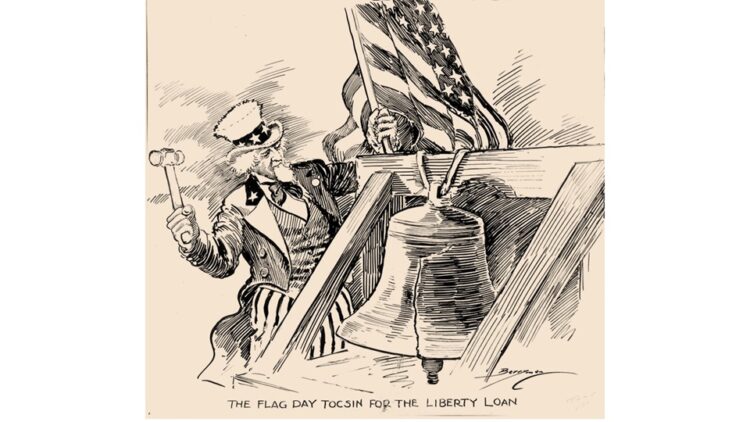
Freedom’s Wring
_When God seems to fail
_The world starts to wail,
And saints go marching home
Like Sprites on ocean foam.
_When children die
_And none know why,
They blame a chromosome,
Or cite a dusty tome.
_And folks accept.
_The most inept
Enablers of them all
Are eager to stand tall
_And tell the throng
_They can’t go wrong
By eating Quaker Oats
And giving them their votes.
_The Earth demands
_What sweaty hands
Impart: their share of toil
In shops, on native soil
_Or at a school.
_This is a rule
That everyone should know,
Above as here below.
_Plan well, forgive
_All those who live
As if the land owed them.
Prepare a requiem,
_And now and then
_Remove these men;
Extract them root and stem,
Consider Bethlehem
_And let them start,
_From brain to heart,
Anew. Then we shall see
How Yahweh’s charity
_Allows a fool
_A quick renewal,
By which his past mistakes
Are drowned in Heaven’s lakes.
C.B. Anderson was the longtime gardener for the PBS television series, The Victory Garden. Hundreds of his poems have appeared in scores of print and electronic journals out of North America, Great Britain, Ireland, Austria, Australia and India. His collection, Mortal Soup and the Blue Yonder was published in 2013 by White Violet Press.











Thank you, Kip. This reminds me of the corruption of our democracy—something always on my mind when I teach Julius Caesar.
The freedom I was thinking about, Evan, was that “perfect freedom” mentioned in the old Anglican liturgy, but the decline of American democracy is not completely unrelated. Freedom isn’t free.
BTW, did anyone else receive this post?
Kip, I’m certain we all got the post. It’s just this: for me, the poem’s meaning was difficult to follow, and this may have been the case for other readers. So we weren’t really sure what to say.
The best I could do was with the first section, which I felt pretty sure dealt with the idea that evil happenings are explained away differently by different folks, but none of the explanations really seem satisfactory.
You’re probably right, Joseph. I seem to have wandered from idea to new idea with insufficient tangible connective tissue, as if the poem were an ill-wrought collection of epigrams. Sprites on ocean foam are more at home with turbulence than most saints are, and they reek of paganism. My internal mental connections are of no moment if they are not expressed, or at least suggested, in the text.
Nothing is really free, including freedom, which has cost many, including the very young, their lives. Toil and sweat and blood pay for everything, including for those who don’t work and were brought in solely for votes. This is especially reprehensible when it involves election corruption, and wringing from those who work, large chunks of their earnings, and delivering them to those who haven’t worked for them and those who have no legal right to them.
In the last three stanzas, correction of the wrongs, compassion, forgiveness, and ultimately renewal, follow extraction from the delusive utopia, if having learned from it, those involved appropriately change course.
I of course don’t know for sure your full intent, C.B., and these are just some of my own reflections on your thoughtful work.
I agree wholeheartedly, Jan, with the tenor of your response. And, surprisingly, your estimation of my intent is pretty much on track. Thoughts rule!
I first enjoyed the form of your poem — the consistent two dimeter, two trimeter combinations of lines. I did need to read it more than once before I started to grasp (I think) some of its meaning. It seems to me that Jan has some good insights about it. Oh — I love your clever rhyme fool/renewal.
Lately, Cynthia, all I seem able to to is invent new forms. Meaning is malleable and ultimately indeterminant, so whatever meaning you give to this poem is the last word. The fool/renewal rhyme was an act of desperation and an exercise in elision.
Just managed to fit in some time to comment – writing deadlines.
From the title, I liked this piece, CD. To ring a bell takes no effort, but to ‘wring’ freedom out of a system that’s actively trying to reduce that commodity takes effort and patience.
It’s a universal truth, as the first stanza states, that we feel lost and frustrated when we feel impotent to change the ills of the world and resort to blaming our gods. The same is especially true when children die. The tragedy could be an inherent illness, or maybe the parents’ behavioural genes. Alternatively, God come in for blame, but with a ‘dusty tome’ being cited, the irony is that in a godless society, perhaps it is hypercritical to blame God.
Stanza 2, I read as false prophets and those dealing in snake oil promising anything as long as we buy their product, or give ‘them their votes’.
In stanza 3, I’m looking at ‘Earth’ as meaning an earthy life where hard work is rewarded.
In the fourth stanza, since we’re looking at wringing out freedom, we’re removing those (politicians) who ask only what the world can do for them, if I can paraphrase JFK, ‘root and stem’ and teach them what you require of them, or find someone new.
The final stanza seems to say that if we forgive someone’s (a politician’s) on account of him saying ‘I am who I am’, he will be back in power in a flash, his mistakes count for nothing, he carries on like before (starting ‘from brain and heart anew’ but not having changed in heart and mind), and in the long run the people and freedom is the loser.
Well, that’s how I read it CD, though parts were a bit tricky to navigate.
No matter what your political views, this poem is a warning that freedom hard won can easily be compromised by bad actors.
Thanks for the read – and five times re-read!
The only good thing, Paul, about being a loser is that people don’t expect you to fight back. Your five-time reread, I hope, was time well spent. But I should inform you that what you got out of it was more than I put into it.
Kip, this is a poem I’ve been wanting to comment on largely because it’s so fascinating and I can’t quite put my finger on why. You’ve set up an interesting dichotomy between those are foolish and fatuous and those who are wise and responsible, the “inept enablers” versus the practical ones who work hard and who live with narcissistic entitlement; and those who are the inept ones appear to be the ones who hunt desperately for answers in spun data versus the wise who know that the only answer that means anything in the end is faith. Charity. Forgive the entitled ones who think the Earth owes them. Well, Kip, I suppose we are supposed to leave judgment to God. You just never know.