


.
Stones for My Parents
I didn’t want to come. How sad it sounded
To kneel beneath a hazy sun surrounded
By strangers’ graves—grim watchmen for the bones
Of those who’ve crossed the Bridge. The ghosts outnumber
The living—I can’t even count the stones.
But somewhere in these rows I know you slumber.
My breath grows still. I whisper names and dates
And gather countless epitaphs and fates.
This earth sees life meet death yet never flinches
As it supports us. From its stolid view
Mere inches—only negligible inches—
Divide flesh from decay. Only a few.
I could not buy you flowers as a token.
I come ashamed for I am poor and broken
In ragged clothes. But here are stones I’ve brought—
Two pebbles which I picked up off the street—
A piece of me to stay with you. I thought
Despite my failures that I should complete
Our circle, try to follow our traditions
And maybe heal the harsh words and omissions
I let occur. These stones won’t thirst or fade.
They face death and eternity with trust.
Though mountain-borne, they weather and degrade
As I some day will crumble into dust.
I speak in murmurs. “You who raised me, know
I did my best. I tried to not let go.”
You hear me without ears, see without eyes.
Cloaked in the fragrant mantle of fresh grass
You do not judge my worn-out jeans, my sighs,
How far I fell. I hear your voices pass
Through wind, you hint of better futures through
The beating of my heart. You ease my rue
And soothe the tears I shed, tears too long stored.
I leave them with you, and I also give
These tokens. They’re the best I can afford,
These two small pebbles from near where I live.
.
.
Once the Regrets Have Fallen
I think most were vermilion. Some were amber-gold like sheaves.
__But now the pulse of life has slowed. There’s little left
__Of color in this clearing. Branches hang bereft
Of autumn life. The cold earth’s strewn with crumbling parchment leaves.
Here untold longings fade away to gray; there’s but a hush,
__A whisper of the empty promises I made—
__Commitments broken hoping memories might fade.
They’re blunted now by time. Old shame seems scarcely worth a blush.
Ah, the decisive plans I made but never could achieve…
__In this forgotten place determination scatters—
__This spot of “no, not quite” and “what is it that matters?”
This frigid home of “it’s too late” and “why do I still grieve?”
My thoughts are muted, brushed upon the poplar bark like moss;
__They’re phantom mists which permeate the soul like air.
__I count regrets which seem to gather everywhere
Such that this place of winter sadness fairly aches with loss.
There’s subtle tyranny in broken thoughts and dangling dreams,
__The harsh constraints on life that growing old imposes.
__But in these forlorn woods I still remember roses
And how in Summer greens and reds collide and Nature gleams.
Have reverence for this sleeping place! Do not commit the sin
__Of wasting breath on old regrets when beauty beckons.
__So let your harsh self-judgments go. It’s God who reckons
How lives are weighed. There’s goodness here. Be still and breathe it in.
__
__
Brian Yapko is a retired lawyer whose poetry has appeared in over fifty journals. He is the winner of the 2023 SCP International Poetry Competition. Brian is also the author of several short stories, the science fiction novel El Nuevo Mundo and the gothic archaeological novel Bleeding Stone. He lives in Wimauma, Florida.














Two excellent pieces, Brian.
Having lost my remaining parent a couple months ago, you capture well the sense of loss and the taking of stock of one’s own life in the wake.
I also appreciate the almost narrative effect of the two together, acknowledging the (real and true) regrets in the first and then putting those regrets in the proper perspective in the second.
On a technical level, I think you use enjambment very effectively.
Thank you very much, Kyle. I’m glad these poems came out at a time that is meaningful for you. You have my deepest condolences on the loss of your parent.
These melancholy masterpieces are moving. What a great idea of a pair of long-lasting stones replacing quickly fading flowers. The concept that a poor person can so meaningfully cope with thoughts and deeds is precious. Regrets? We all have our own and can relate to the message in your poem. I especially relate to the phrase, “the decisive plans I made but never could achieve…” The worst part is I could have achieved them.
An incredibly generous comment, Roy. Thank you. As Dr. Salemi notes in a comment below, the tradition of leaving stones on graves is an ancient Jewish custom which is said to go back to the days when the Temple was still standing in Jerusalem. There is a particularly moving scene in Schindler’s List near the end when the still-living Jews that he saved visit Oskar Schindler’s grave. Each leaves a stone as a token of their visit — and their respect.
As for regrets… Not everything is meant to be. “The best laid plans of mice and men” and all that. But to be able to at least articulate the regret and make something useful of it through poetry is a great blessing.
Both poems are achingly beautiful, Brian.
Thank you for them.
Thank you so much for this beautiful comment, jd!
Both are quite impressive, Brian, and inventively invested with emotional weight. The 2nd especially impressed me, with its naturalness of its rhyme and the rhetorical-rhythmic variety with which you’ve structured the 7-foot lines.
Thank you very much indeed, Julian. If there’s emotional weight here it’s because they were truly written from the heart. Thank you also for your kind words about the poem’s technique.
Brian’s first poem alludes to the Jewish custom of placing a small stone on the monument of a loved one’s grave, every time you visit it. He has made the speaker of the poem a poor man in shabby clothing, who cannot afford any other material offering (such as a wreath or flowers), so the small stones also become symbols of his humility, as well as his respect for his dead parents.
The last stanza of the poem is very powerful, with an intense release of emotions: grief, loss, regret, anxiety, and a deep love for his parents that he wishes had been more fully expressed in their lifetime. It reveals deeply personal feelings that are difficult to confess openly.
The second poem is more craft-conscious, in the sense that its ABBA rhyme scheme for the quatrains is reinforced by the heptameter-hexameter parallel structure of the lines. Also, this piece is more introspective, for it is focused on the speaker’s retrospective meditation of what he has not achieved (despite plans and hopes), “empty promises” and “commitments broken,” “harsh constraints” and “old shame.” These are the torments that assail anyone who has reached a certain advanced age.
The last two quatrains give two possible sources of consolation: the eternal rebirth of summer in its greens and reds (Nature); and the judgment that God makes on every human life, independent of that human’s personal opinion (Religion).
They are moving poems, and they strike me as funereal but still hopeful.
Thank you very much indeed, Joe. I feel you’ve seen everything in both poems that I hoped a reader would see and your reaction is very gratifying. You accurately identify the Jewish tradition that is the central image of “Stones” and, yes, there are deeply personal feelings here which, though not fully authobiographical, are definitely informed by personal experience. Poetry is a gift which allows us to express indirectly what we might never be able to say openly.
The structure of “Regrets” feels perfectly suited for the meditative mood. The final stanza reads like something a Buddhist monk might say – zen-like advice to dispense with your regret, let it go, and live in the moment.
Thank you so much, Cheryl. I love your description of “zen-like advice” which came to me rather intuitively. I have come to think of regrets as a waste of time, I’ve heard them described as “the past crippling us in the present.”
Roy Peterson is right. These two poems are masterpieces. I hope they live to become classics, still cherished and anthologized when these lean days have passed and true poetry is honored again.
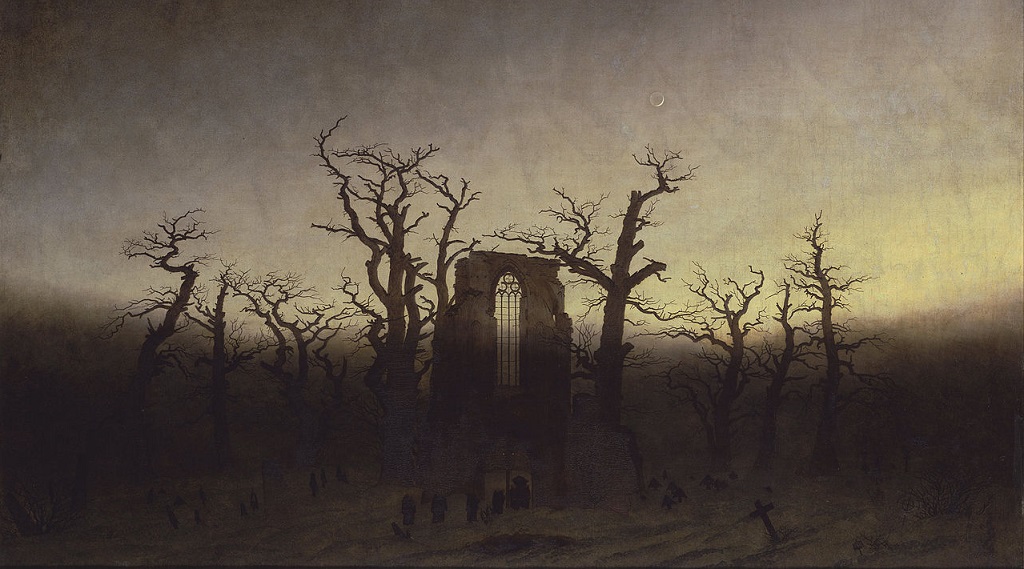
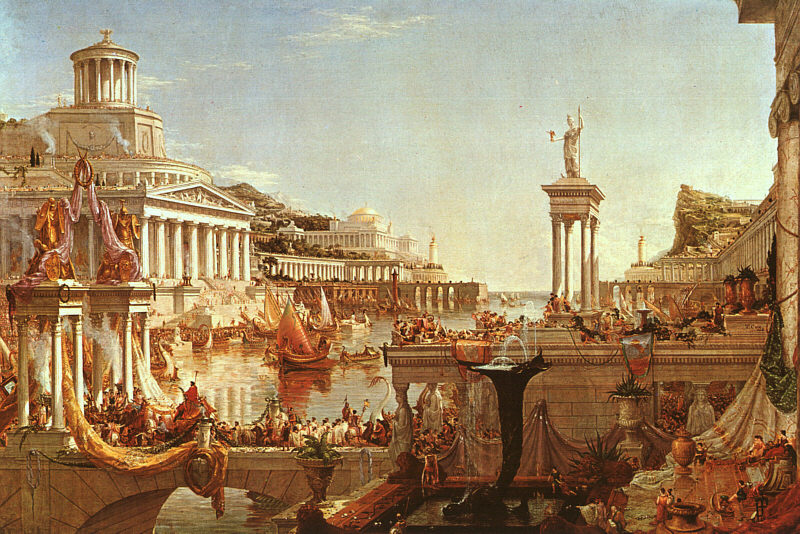
I am also increasingly impressed with the selections of paintings that accompany the poems on this site. Whoever does them has uncanny taste for the magnetic, and also has access to more little-known but wonderful paintings than I would ever have dreamed there could be. Selections of the originals could be made into a “Midwest Museum of Paintings That Grab You.”
Thank you so much, Dan, for an incredibly generous comment! I cannot tell you how grateful I am to receive such encouragement!
I fully agree regarding the selection of paintings for the poems. SCP’s fearless publisher and editor, Evan Mantyk, is responsible for these selections. He has a fine eye and a gift for insightful poetry-painting couplings.
Well, Mantyk’s just the man to found the Midwest Museum of Paintings that Grab You and Don’t Let Go.
“Stones for My Parents” is a sobering poem that beautifully captures the regrets of an adult child that can be even greater than the pain of loss. How I have often wished I had loved, listened, and honored my parents better.
I have never considered stones in lieu of flowers. “A piece of me to stay with you” – a piece that will not fade as flowers do. I will be finding a way to employ this token of love.
Gigi
Thank you very much indeed, Gigi! Sobering is true, though I hope the love that accompanies it comes through. I, too, wish I had loved, listened and honored my parents better. As for the stones themselves, as I’ve mentioned above (and with confirmation to Dr. Salemi), the custom of leaving stones on a gravestone is a Jewish tradition which dates back to the days when the Temple still stood in Jerusalem. I don’t know the precise reasons why, but if you visit a cemetary in Israel (or any Jewish cemetary) you’ll see stones piled up on graves instead of flowers. I’m sure it is in part due to the permanence that stones represent in lieu of the transient nature of flowers.
Excellent pieces, both, Brian. Each triggering retrospection (as intended), to the point where, for me, it got tricky to see clearly. Darn you! You’re an extremely talented poet, and one of the SCP’s finest and most prolific. PS: You owe me a box of Kleenex!
Thank you so much, Mark! I’m very grateful for your kind words and I’m also deeply touched that my poems actually inspired an emotional reaction. I am quite sure I shed a tear or two in the writing of “Stones for my Parents.” I’ll get that box of Kleenex to you one of these days!
“Stones for my Parents” has many clearly expressed lines of heartfelt grief, all the more poignant because the speaker grieves for severely disappointing his parents, as much as for their deaths. The ones that outshine the others, in my opinion, are, “you hint of better futures through/The beating of my heart.” This says so much. The “futures” are plural in belonging to both mother and father. They have apparently become a single shared future belonging to the child who may be an only child. He is at least the only mourner heard in this poem. His life, as disappointing and unfortunate as it may have been, is still life given by both parents and manifested in the beating of his living heart. That heartbeat began when his parents were looking forward to the future of the child to be born months later. In the poem’s perspective, however, it represents the future now shared by all three members of this family. Therefore it is all the more significant that the final words of the poem are “I live.”
“Once the Regrets have Fallen” is a more complex poem, and from my point of view, more difficult. The third-person omniscient title suggests that this may be a poem displaying the contemporary commonplace view that regrets are bad. That is, the prideful “no regrets” attitude. You, Brian, seem to be searching for a middle ground between that and an idea that regrets necessarily happen, but should be limited. They can be destructive. Your speaker experiences them for four stanzas, but then turns away from them as “tyranny” and “constraints on life” in the fifth stanza. The sixth stanza either changes speakers to some unknown guardian spirit, or if the speaker remains the same, he abruptly accuses himself of “harsh self-judgment” and demands that he give up regret and leave judgment to God. He comes to the common “no regrets” position after having passed through regret–or the new speaker requires him to do so. There is a desire for quiet and the perception of goodness–but this demands a falling off of regret as autumn leaves fall. Without directly criticizing the concept of eternal regret, you see danger in it. This separates you, Brian, from poets with a salvific view of perpetual earthly penitence. This can be expressed either in relation to the self (as Petrarch) or in fictional tales. There are many such, but I think specifically of several by 19th-century Scottish poet Thomas Campbell. You are exploring profound depths that manifest themselves in grief–and presenting them within a context where beauty is manifest in the poetic scene. This must have taken profound effort on your part!
Thank you so much, Margaret, for your very perceptive reading of these two sad poems. You are quite right to see double sadness in “Stones” — grief for the parents, grief for the disappointment the speaker feels he may have been to them. In the end, even though the speaker is reluctant to make this difficult visit, he ends feeling comforted somehow knowing that he has achieved a sort of communion with them, that he is able to look back — to look without staring — and hopefully now to move on. I am so glad you noted the last two words of the poem “I live” for that was intended as a very deliberate affirmation.
Your thoughts regarding “Regrets” are also insightful. My speaker here is indeed searching for a middle ground between crippling “tyranny” (as subjectively perceived) and the insouciance of the shallow. That middle ground is found by pulling out of one’s self-obsession to find some modicum of objectivity — and forgiveness. As Joe noted above, Nature can help. God, even moreso. But ultimately the idea for me here is the regrets can indeed by crippling. On the other hand remorse (an entirely separate thing) is critical to spiritual growth. So, once again, searching for that elusive space where one can look back and learn from the past — especially the things one may wish had been done differently. Look at the past. Look, but don’t stare.
Brian, both poems are beautifully written (as ever) – I love the chosen forms. The words in each flow smoothly and eloquently to paint filmic images that took this reader straight to each vivid linguistic scene you paint. Each is so rich in emotion and so detailed in delivery, I have read them through more than once… and I am called back to read them again. I relate to both, and they have touched my heart with their depth.
In “Stones for My Parents”, these words are striking: “You hear me without ears, see without eyes. / Cloaked in the fragrant mantle of fresh grass / You do not judge…” – a heart-touching turning point in a poem of love, regret, and healing. Those priceless gifts of two local pebbles (steeped in faith and tradition) and tears from the troubled soul are so meaningful and so special, I can feel their warmth and significance emanate from your words – such is the power of your writing.
I particularly like “Once the Regrets Have Fallen” for its glorious message – a message that sings to me in exquisite poetry at a time I most need it. Brian, this is an instant favorite, especially for its closing stanza – my new, go-to ray of sunshine during dark days. Brian, Thank you!
Susan, I am deeply grateful for this beautiful comment — one which I will treasure for it tells me that the emotional catharsis I sought in both of these pieces resonated with you — and that makes me hope that perhaps other readers might feel the same way. The lines you mention in “Stones” are among my favorite as they metaphorically confirm the ongoing existence and vitality of the deceased parents. They may be dead but they still hear, they see, they are garbed. They are simply changed. What comes to mind for me here is Ariel’s song from The Tempest, “Full Fathom Five,” which addresses the assumed death of Ferdinand’s father with reassurance hat he has not drowned. “Nothing of him that doth fade/but doth suffer a sea change/into something rich and strange…”
I’m glad that you mentioned the forms of both “Stones” and “Regrets”, both of which are nonce forms which somehow felt right. “Regrets” in particular felt like it needed the weight of seven foot lines but it felt too ponderous that way and so I made the two middle lines six feet to impart a little lessening of gravity and also an unexpected sense of incompletion which felt suitable to a subject which includes unfinished business. I am over-the-moon pleased that you’ve made this one an instant favorite and that it has inspired rather than saddened you.
Thank you again for this generous comment, Susan. It made me feel that I did not share only sadness but also the resolve necessary to overcome it.
Re: Stones for My Parents. I really like this one. I was raised a Catholic, so it seems that we were always at a funeral and the cemetery. There were always flowers, tons of flowers and in the funeral home too. When I became interested in Judaism, then I learned the process about stones at a cemetery. I was very impressed when Isaw Schindler’s List. That is probably my favorite movie of all time. I temember remaining survivors, putting stones on the graves. I prefer them to flowers. As far as I know, remembering the dead, is very important in Judaism.
There is a blessing to say every time you use the name of the deceased. I like the process of davening also. A beautiful write from a beautiful soul!
Hugs, Patricia x
Patricia, thank you so much for these kind words and your personal story. I, too, was deeply impressed by Schindler’s List and the end scene in the cemetery. Yes, remembering the dead is INCREDIBLY important to Judaism. I’m glad what resonated with me has also resonated with you. And I so appreciate your generosity!