• Submit Poetry
  • Support SCP
  • About Us
  • Members
  • Join
Tuesday, May 12, 2026
Society of Classical Poets
  • Poems
    • Beauty
    • Culture
    • Satire
    • Humor
    • Children’s
    • Art
    • Ekphrastic
    • Epic
    • Epigrams and Proverbs
    • Human Rights in China
    • Music
    • Performing Arts
    • Riddles
    • Science
    • Song Lyrics
    • The Environment
    • The Raven
    • Found Poems
    • High School Poets
    • Terrorism
    • Covid-19
  • Poetry Forms
    • Sonnet
    • Haiku
    • Limerick
    • Villanelle
    • Rondeau
    • Pantoum
    • Sestina
    • Triolet
    • Acrostic
    • Alexandroid
    • Alliterative
    • Blank Verse
    • Chant Royal
    • Clerihew
    • Rhupunt
    • Rondeau Redoublé
    • Rondel
    • Rubaiyat
    • Sapphic Verse
    • Shape Poems
    • Terza Rima
  • Great Poets
    • Geoffrey Chaucer
    • Emily Dickinson
    • Homer
    • Henry Wadsworth Longfellow
    • Dante Alighieri
    • John Keats
    • John Milton
    • Edgar Allan Poe
    • William Shakespeare
    • William Wordsworth
    • William Blake
    • Robert Frost
  • Love Poems
  • Contests
  • SCP Academy
    • Educational
    • Teaching Classical Poetry—A Guide for Educators
    • Poetry Forms
    • The SCP Journal
    • Books
No Result
View All Result
Society of Classical Poets
  • Poems
    • Beauty
    • Culture
    • Satire
    • Humor
    • Children’s
    • Art
    • Ekphrastic
    • Epic
    • Epigrams and Proverbs
    • Human Rights in China
    • Music
    • Performing Arts
    • Riddles
    • Science
    • Song Lyrics
    • The Environment
    • The Raven
    • Found Poems
    • High School Poets
    • Terrorism
    • Covid-19
  • Poetry Forms
    • Sonnet
    • Haiku
    • Limerick
    • Villanelle
    • Rondeau
    • Pantoum
    • Sestina
    • Triolet
    • Acrostic
    • Alexandroid
    • Alliterative
    • Blank Verse
    • Chant Royal
    • Clerihew
    • Rhupunt
    • Rondeau Redoublé
    • Rondel
    • Rubaiyat
    • Sapphic Verse
    • Shape Poems
    • Terza Rima
  • Great Poets
    • Geoffrey Chaucer
    • Emily Dickinson
    • Homer
    • Henry Wadsworth Longfellow
    • Dante Alighieri
    • John Keats
    • John Milton
    • Edgar Allan Poe
    • William Shakespeare
    • William Wordsworth
    • William Blake
    • Robert Frost
  • Love Poems
  • Contests
  • SCP Academy
    • Educational
    • Teaching Classical Poetry—A Guide for Educators
    • Poetry Forms
    • The SCP Journal
    • Books
No Result
View All Result
Society of Classical Poets
No Result
View All Result
Home Poetry Beauty

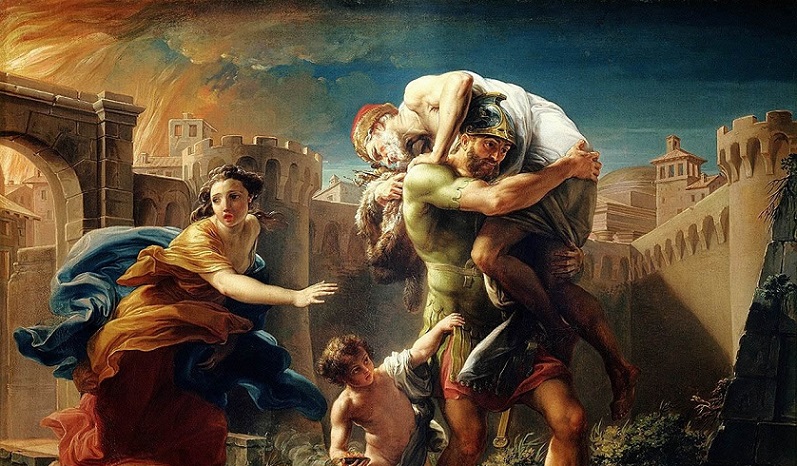
The Aeneid, Book I, Lines 1-50: A Rhyming Translation by Len Krisak

November 8, 2020
in Beauty, Culture, Epic, Poetry, Translation
A A
3
poems The Aeneid, Book I, Lines 1-50: A Rhyming Translation by Len Krisak

The complete new translation can found from Hackett Publishing here.

My poem sings of one man forced from Troy by war.
Fate harried him to find a home on Latium’s shore—
On some Lavinian littoral. By land and sea,
Driven by loss, by gods who would not let him be,
By unrelenting Juno’s lack of any pity, [5]
He made his gods a home at last, founding the city
Of ancient Alba, then the battlements of Rome.

Speak, Muse. Speak out, and say where Juno’s rage came from.
Tell me why great heaven’s queen hounded this man
So marked by righteousness through such hard labors. Can [10]
Such savage indignation grip a deity?

There was an ancient city, far from Italy
And Tiber’s mouth, called Carthage. Colonized by Tyre,
It was resourceful, rich, and storied in war’s dire
Arts. They say that Juno loved it even more [15]
Than Samos. Here was her armor (she set such store
By Carthage); here, her chariot. Even now, she aimed,
If fate allowed, to make this city feared and famed,
Ruling the world. But she had heard Troy’s progeny
Would one day topple Punic towers. Supremacy [20]
World-wide would come from this, a war-proud people winning
Libya’s ruin (that’s how the Parcae planned their spinning).

Anxious, and mindful of the war she once had waged
For her belovèd Argos, Juno—still enraged
By what began that war, and bitter in her soul [25]
Still; nursing hate at just the thought of Paris’ role
In judging her, and of her beauty meanly spurned,
And of that race, and stolen Ganymede’s unearned
Honors—burned hotter still, and shook the storm-whipped main
For men the Greeks and cruel Achilles had not slain. [30]
She kept them out of Latium for so long that they
Despaired the fates would ever let them find their way.
Such massive effort: that’s what founding Rome entailed.

Now sanguine on the sea, the ships had scarcely sailed
From Sicily, their brazen bowsprits ploughing spume, [35]
When Juno, nursing endless hate, began to fume:
“Am I to give in now? Give up my cherished plan,
Thwarted in turning back a Teucrian king—one man—
From Italy? No doubt the Fates say so! But she
Could burn the Argive fleet or drown it in the sea, [40]
Could Pallas, just because one guilty man went mad—
Ajax. She pitched Jove’s lightning from the rack, and bade
The whipped-up winds rip through the sails and shrouds to maim
That man who while his breast still billowed smoke and flame,
Found out a jagged rock that spiked him all his life. [45]
But I, the queen of gods, Jove’s sister and his wife,
Must all these many years wage war against one race.
Who then will worship Juno’s godhead? Who will place
Their little sacrificial offerings on my altars?”

So Juno’s furious fire flares and never falters. [50]


Original Latin

Arma virumque canō, Trōiae quī prīmus ab ōrīs
Ītaliam, fātō profugus, Lāvīniaque vēnit
lītora, multum ille et terrīs iactātus et altō
vī superum saevae memorem Iūnōnis ob īram;
multa quoque et bellō passūs, dum conderet urbem, [5]
inferretque deōs Latiō, genus unde Latīnum,
Albānīque patrēs, atque altae moenia Rōmae.

Mūsa, mihī causās memorā, quō nūmine laesō,
quidve dolēns, rēgīna deum tot volvere cāsūs
īnsīgnem pietāte virum, tot adīre labōrēs [10]
impulerit. Tantaene animīs caelestibus īrae?

Urbs antīqua fuit, Tyriī tenuēre colōnī,
Karthāgō, Ītaliam contrā Tiberīnaque longē
ōstia, dīves opum studiīsque asperrima bellī,
quam Iūnō fertur terrīs magis omnibus ūnam [15]
posthabitā coluisse Samō; hīc illius arma,
hīc currus fuit; hōc rēgnum dea gentibus esse,
sī quā Fāta sinant, iam tum tenditque fovetque.
Prōgeniem sed enim Trōiānō ā sanguine dūcī
audierat, Tyriās olim quae verteret arcēs; [20]
hinc populum lātē regem bellōque superbum
ventūrum excidiō Libyae: sīc volvere Parcās.
Id metuēns, veterisque memor Sāturnia bellī,
prīma quod ad Trōiam prō cārīs gesserat Argīs—
necdum etiam causae īrārum saevīque dolōrēs[ 25
exciderant animō: manet altā mente repostum
iūdicium Paridis sprētaeque iniūria fōrmae,
et genus invīsum, et raptī Ganymēdis honōrēs.
Hīs accēnsa super, iactātōs aequore tōtō
Trōas, rēliquiās Danaum atque immītis Achillī, [30]
arcēbat longē Latiō, multōsque per annōs
errābant, āctī Fātīs, maria omnia circum.
Tantae mōlis erat Rōmānam condere gentem!

Vix e conspectu Siculae telluris in altum
vela dabant laeti, et spumas salis aere ruebant, [35]
cum Iuno, aeternum servans sub pectore volnus,
haec secum: ‘Mene incepto desistere victam,
nec posse Italia Teucrorum avertere regem?
Quippe vetor fatis. Pallasne exurere classem
Argivom atque ipsos potuit submergere ponto, [40]
unius ob noxam et furias Aiacis Oilei?
Ipsa, Iovis rapidum iaculata e nubibus ignem,
disiecitque rates evertitque aequora ventis,
illum expirantem transfixo pectore flammas
turbine corripuit scopuloque infixit acuto. [45]
Ast ego, quae divom incedo regina, Iovisque
et soror et coniunx, una cum gente tot annos
bella gero! Et quisquam numen Iunonis adoret
praeterea, aut supplex aris imponet honorem?’

Talia flammato secum dea corde volutans [50]


Len Krisak has translated Horace’s Odes (2006), Virgil’s Eclogues (2010), and Prudentius’ Crown of Martyrs (2019). Among other honors, he is the recipient of the Robert Penn Warren Prize, the Richard Wilbur Award, and the Robert Frost Prize. He taught at Brandeis University, Northeastern University, and Stonehill College.
ShareTweetPin
The Society of Classical Poets does not endorse any views expressed in individual poems or commentary.
Read Our Comments Policy Here

RandomPoems

‘An Idyll at the Local Diner’ and Other Poems by Sally Cook
Beauty

‘An Idyll at the Local Diner’ and Other Poems by Sally Cook

February 26, 2024

. An Idyll at the Local Diner There is this place where you can get a fill And top your...

Poetry

‘The Dark Knight Rises in Colorado’ and Other Poetry by Betsy M. Hughes

December 20, 2012

Current Events 2012   I.  The Dark Knight Rises in Colorado A silhouette is forming in the door. From reel...

Next Post
‘Shooting Star’ and Other Poetry by Shari Jo LeKane

'Shooting Star' and Other Poetry by Shari Jo LeKane

Poems for Remembrance Day 2020

Poems for Remembrance Day 2020

‘Mary Le Cuisinier’ by Beverly Stock

'Mary Le Cuisinier' by Beverly Stock

Comments 3

  1. Court Reinland says:
    6 years ago

    It reads so well in rhyme
    I should say – it’s about time!

    Reply
  2. C.B. Anderson says:
    6 years ago

    Thank the gods! A classical translation that flows and can be read with pleasure in English. Somehow you have avoided stilted phrasing that infects many such similar endeavors. Of course, we can have little idea of how the original must have sounded to contemporary readers, unless there exists a record of such observations and opinions, but Anglophones are in for a good yarn.

    Reply
  3. BDW says:
    6 years ago

    As per Aedile Cwebus:

    I always appreciate the Latin of Vergil, whose works are the ultimate emblem of the classic. Every time I read the first lines of the “Aeneid”, I am more than impressed at what he accomplished, I am awestruck.

    Arma virumque canō, Trōiae quī prīmus ab ōrīs
    Ītaliam, fātō profugus, Lāvīniaque vēnit
    lītora, multum ille et terrīs iactātus et altō
    vī superum saevae memorem Iūnōnis ob īram;
    multa quoque et bellō passūs, dum conderet urbem,
    inferretque deōs Latiō, genus unde Latīnum,
    Albānīque patrēs, atque altae moenia Rōmae.

    From the radical break from Homer in the first words, while at the same time holding tenaciously to the tradition, the condensation is breathtaking. If Milton’s “Paradise Lost” seems barbarous in comparison, Milton’s attempt is still the most Herculean in English. Of course, for those longing for a “rhymed Aeneid”, Dryden’s translation is an interesting place to begin; however, each generation has to work out its own Zeitgeist. It would be interesting to know what it is Mr. Krisak is trying to achieve.

    In times like these, the verses of Vergil and Horace are invaluable.

    Reply

Leave a Reply Cancel reply

Your email address will not be published. Required fields are marked *

  1. Susan Jarvis Bryant on ‘Spontaneous Conjugal Combustion’ and Other Poems by Susan Jarvis BryantMay 12, 2026

    Awww, what a beautiful comment, Mark. It's lovely to hear of the joys of marital bliss after 53 years. Congratulations!…

  2. Susan Jarvis Bryant on ‘Spontaneous Conjugal Combustion’ and Other Poems by Susan Jarvis BryantMay 12, 2026

    C.B., it's always interesting to read your take on my poems, and I've got to say I agree with you…

  3. Roy Eugene Peterson on A Poem on Coach “Black Mike” Castronis from Athens Y Camp, by Alec ReamMay 12, 2026

    Alec, this is a touching tribute to a camp coach/counselor. I had my own at Camp Paisano near Alpine, Texas.…

  4. Roy Eugene Peterson on ‘Creation of Mom’: A Mother’s Day Poem by Roy E. PetersonMay 12, 2026

    Margaret, I was thinking about the vast variety of Moms when I wrote it. Thank you for pointing that out…

  5. Alec Ream on A Poem on Coach “Black Mike” Castronis from Athens Y Camp, by Alec ReamMay 12, 2026

    Margaret, thank you for the read and remarks. First Presbyterian is still there. As is Emmanuel Episcopal, which started at…

Subscribe to Daily Poems

Enter your email address to subscribe to this blog and receive notifications of new posts by email.

Join 1,593 other subscribers

Recent Poems

  • A Poem on Coach “Black Mike” Castronis from Athens Y Camp, by Alec Ream
  • A Poem on the Zambian National Park Mosi-oa-Tunya, by Paul A. Freeman
  • ‘Creation of Mom’: A Mother’s Day Poem by Roy E. Peterson
  • ‘Spontaneous Conjugal Combustion’ and Other Poems by Susan Jarvis Bryant
  • ‘The Man in the Moon Was a Very Round Man’: A Poem by Lauren V. Leon
  • ‘Fibromytrauma’: A Poem by Golan Shahar
  • ‘A Lonely Sliver’: A Poem by Katie Tencza
  • ‘Higher Gas Prices Are a Small Price to Pay’: An Iran War Poem by Mark F. Stone
  • ‘Always Ahead’: A Poem by Scharlie Meeuws
  • ‘Hamlet’s Lawyer’ and Other Poetry by Brian Yapko
  • ‘On An Old Photograph’: A Poem by Joseph S. Salemi
  • ‘Faust Foresees His End’: A Poem by Martin Briggs
  • ‘À la Carte’ and Other Poetry by C.B. Anderson
  • ‘Where the Sweet Bluebonnets Bloom’: A Poem by Roy E. Peterson
  • ‘The Waters’: A Poem by Margaret Brinton
  • ‘The Pinnacle of Poetry’ and Other Poems by Russel Winick
  • The First American Sonnets: An Essay on David Humphreys, by Margaret Coats
  • ‘The Holy Rollers on Poetry’: A Poem by Joseph S. Salemi
  • Sappho’s ‘Poem 1’ Translated by Bruce Phenix
  • ‘The Cautionary Tale of Phone Addicted Mimi’: A Poem by Paul A. Freeman
  • ‘Look Away’: A Poem for America’s 250th Anniversary, by Roger Crane
  • ‘Sunday Morning in Canada’: A Poem by Jeffrey Essmann
  • ‘Bean’: A Poem by Jan Mennite
  • ‘The Swan’s Song ’: A Poem for Shakespeare’s Birthday, by Susan Jarvis Bryant
  • ‘The Gravedigger’: A Poem by Marie Burdett
  • ‘Waiting for the Perfect Man’: A Poem by Janice Canerdy
  • ‘The George-A-Saurus’ and Other Poetry by Brian Yapko
  • ‘When Asked: What’s Your Favorite Season?’: A Poem by Paul Millan  
  • ‘The Last At-Bat of Lyndon Braun’: A Poem by Michael Pietrack
  • ‘The Perpetual Battle’ and Other Poetry by Adam Sedia

Categories

  • Acrostic
  • Alexandroid
  • Alliterative
  • Art
  • Best Poems
  • Blank Verse
  • Chant Royal
  • Classical Poets Live
  • Clerihew
  • Covid-19
  • Deconstructing Communism
  • Educational
  • Epic
  • Epigrams and Proverbs
  • Essays
    • Interviews with Poets
    • Poetry Reviews
  • Featured
  • From the Society
  • Great Poets
    • Dante Alighieri
    • Edgar Allan Poe
    • Emily Dickinson
    • Geoffrey Chaucer
    • Henry Wadsworth Longfellow
    • Homer
    • John Keats
    • John Milton
    • Robert Frost
    • William Blake
    • William Shakespeare
    • William Wordsworth
  • Human Rights in China
  • Limerick
  • Love Poems
  • Music
  • Pantoum
  • Performing Arts
  • Poetry
    • Beauty
    • Children's Poems
    • Culture
    • Ekphrastic
    • Found Poems
    • High School Poets
    • Humor
    • Riddles
  • Poetry Challenge
  • Poetry Contests
  • Poetry Forms
    • Curtal Sonnet
    • Haiku
  • Poetry Readings
  • Rhupunt
  • Rondeau
  • Rondeau Redoublé
  • Rondel
  • Rubaiyat
  • Sapphic Verse
  • Satire
  • Science
  • Sestina
  • Shape Poems
  • Short Stories
  • Song Lyrics
  • Sonnet
  • Symposium
  • Terrorism
  • Terza Rima
  • The Environment
  • Translation
  • Triolet
  • Video
  • Villanelle

Quick Links

  • About Us
  • Submit Poetry
  • Become a Member
  • Members List
  • Support the Society
  • Advertisement Placement
  • Comments Policy
  • Terms of Use

Welcome Back!

Login to your account below

Forgotten Password?

Retrieve your password

Please enter your username or email address to reset your password.

Log In
No Result
View All Result
  • Poems
    • Beauty
    • Culture
    • Satire
    • Humor
    • Children’s
    • Art
    • Ekphrastic
    • Epic
    • Epigrams and Proverbs
    • Human Rights in China
    • Music
    • Performing Arts
    • Riddles
    • Science
    • Song Lyrics
    • The Environment
    • The Raven
    • Found Poems
    • High School Poets
    • Terrorism
    • Covid-19
  • Poetry Forms
    • Sonnet
    • Haiku
    • Limerick
    • Villanelle
    • Rondeau
    • Pantoum
    • Sestina
    • Triolet
    • Acrostic
    • Alexandroid
    • Alliterative
    • Blank Verse
    • Chant Royal
    • Clerihew
    • Rhupunt
    • Rondeau Redoublé
    • Rondel
    • Rubaiyat
    • Sapphic Verse
    • Shape Poems
    • Terza Rima
  • Great Poets
    • Geoffrey Chaucer
    • Emily Dickinson
    • Homer
    • Henry Wadsworth Longfellow
    • Dante Alighieri
    • John Keats
    • John Milton
    • Edgar Allan Poe
    • William Shakespeare
    • William Wordsworth
    • William Blake
    • Robert Frost
  • Love Poems
  • Contests
  • SCP Academy
    • Educational
    • Teaching Classical Poetry—A Guide for Educators
    • Poetry Forms
    • The SCP Journal
    • Books

© 2025 SCP. WebDesign by CODEC Prime.