


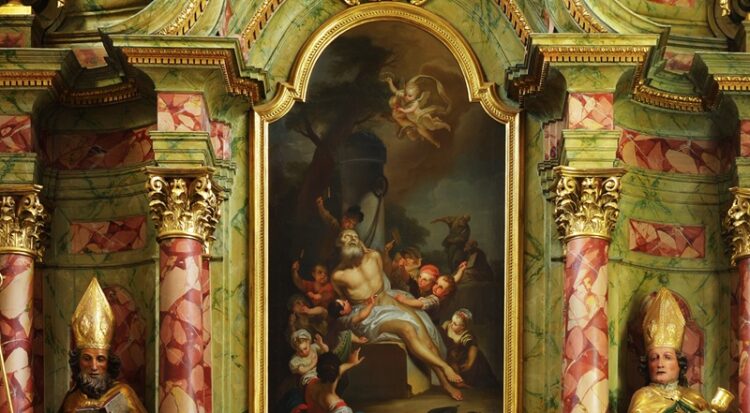
The Martyrdom of Saint Cassian
St. Cassian of Imola (Forum Cornelii) was a schoolteacher
killed by his own pupils during one of the anti-Christian
persecutions carried out by imperial Rome. His young
students were encouraged to stab him to death slowly with
their writing styli. (cf. Prudentius, Peristephanon IX)
They never liked him, with his birchen switch—
Its stinging terror made poor students twitch.
They loathed it when he called them to recite,
Or made them take their styli up and write
A verbal conjugation in all tenses
Or how one word had several different senses.
It irked them when declension of a noun,
Mismanaged, summoned up his scowling frown—
Cassian at his lectern held full sway:
Grammaticus severus, verbum Dei.
Yes, he was a Christian, that they knew—
It hardly eased the tasks they had to do.
Rhetoric and grammar, syntax, rules…
All the minutiae of Roman schools
Lay as a heavy sentence on the boys
Who, like all children, lusted for the noise
Of play, diversion, frolics, games, and fun
They’d turn to when the dreary lesson’s done.
And so, when persecution raised its head,
The boys resolved to strike their teacher dead.
The Emperor’s edict set their anger free:
The Christians are our targets! With pure glee
They took their styli not to write, but pierce
The flesh of Cassian with a fury fierce.
But they were children, and without the strength
That grown men have—their styli went the length
Of a bare inch, and not enough to kill.
These baby stabs, though shallow, served to spill
His blood in trickles rather than a flow,
And death was long, excruciating, slow.
The plethora of methods Hell affords!
Pen-pricks make martyrs just as well as swords.
St. Cassian: the patron saint of the Italian city of Imola. His statue is always that of a scholar tied to a stone pillar, his body pierced with dozens of small styli, just as St. Sebastian is similarly shown at a pillar, but pierced with arrows. I once suggested that Cassian’s statue should be set up in every single teachers’ lounge, as a warning.
Grammaticus severus, verbum Dei: a strict teacher is the word of God.
When persecution raised its head: Cassian was killed some time in the latter half of the fourth century, probably in one of the persecutions by the Emperor Julian.
Joseph S. Salemi has published five books of poetry, and his poems, translations and scholarly articles have appeared in over one hundred publications world-wide. He is the editor of the literary magazine TRINACRIA and writes for Expansive Poetry On-line. He teaches in the Department of Humanities at New York University and in the Department of Classical Languages at Hunter College.








Joseph, what a great poem! I never could have imagined such a macabre scene with the slow death of a teacher by student torture, or that I would be fascinated by such an awful tale. Having said that, how perfectly you established the situation and circumstances with brilliant knowledge of ancient educational tools and lessons; everything from conjugation to declension.
Many thanks, Roy. I had a feeling that you would like this poem, and that’s what made me dig it out of my files.
I do think a statue of St. Cassian should be in every teachers’ lounge, as a monitory device against being unreasonably harsh with one’s students. I haven’t been able to find one yet, and I suspect the only place where such a statue can be located is somewhere in the religious shops of the city of Imola. He’s not a well-known saint.
Joe, this is a fascinating (albeit horrifying) poem on a most unique form of martyrdom – murdered by a group of civilized schoolboys who have been given state-sanctioned permission to fully express their resentments and become murderous monsters. A terrible betrayal of someone who was put in a position of educating them and yet instilled a resentment so visceral that once murder became approved rather than condemned, they engaged in it. With glee, at that.
You make strong choices as poet in order to a) evoke the Classical world; b) move the narrative along efficiently and lucidly; and c) highlight the dreadful contrast between civil order and vicious murder. More specifically, your use of iambic pentameter couplets is exactly the right choice to evoke the symmetry and order of a Roman world built upon reason, the logic of Aristotle, the legal acumen of Cicero. I don’t believe the Romans actually used couplets in their poetry, but an English literary tradition has certainly given this form a venerability which echoes the marble columns of ancient Rome – along these lines I’m thinking of Alexander Pope’s translations. The further benefit to the use of iambic pentameter here is the freedom and propulsive motion that it imparts to a narrative which climaxes in a most dreadful murder. And finally, the use of heroic couplets affords an irony that is deep: there is nothing heroic about these little savage boys murdering their teacher. To describe this barbaric act in such civilized, stylized terms compounds the horror tremendously.
And then, as Roy rightly observes, the various details of a Classical education in the late 3rd Century offer amazing verisimilitude to the narrative. Murder by stylus, which is essentially like murder by pen. After incurring resentment for teaching grammar, rhetoric, syntax. Talk about the banality of evil.
I cannot help but ponder the extent to which a great many young people in our own century feel that they have been given state-sanctioned permission to act with extreme savagery – and, all too often, to do so in a school setting whether in the classroom itself or in encampments which block the innocent from access to classes. You, as a professor, have no doubt seen a thing or two. Cassian’s story must be the stuff of academic nightmares.
Your poem may be ancient history, but it evokes a modern world in which murderers are hailed as heroes even as their victims are either forgotten or wrongfully disgraced, whether it’s the murder of Charlie Kirk, a woman strangling her three children or a man shooting an insurance executive – all horrific events which a substantial and deeply disturbed segment of society yet hails with cheers. A ghoulish quality has been unleashed in modern society which St. Cassian demonstrates has always been there just below the surface. As suggested by books like “The Lord of the Flies” and “Heart of Darkness” — it does not take a lot to turn civilized people into barbarians. Civilization is a thin veneer.
Metaphorically, this reminds me of teaching in Saudi Arabia, where the saying goes, ‘my brother before my cousin; my cousin before a stranger’. Basically, if you had an altercation with a student, the whole class would get behind him. No matter the rights and wrongs, I was the stranger.
Fortunately, the students usually had left their pens at home.
Good job, Joseph, especially in bringing a little known story to the fore so vividly.
Fantastic poem! It’s humbling to admit that we poor grammar teachers might be the cause of such animosity even without the religious element. Also, I misread “styli” as “styles” in the opening inscription — “stab him to death slowly with their writing styles” — and thought “I can relate!” before realizing the mistake.
To both Rachel and Paul —
Thank you for your comments. Paul, I assume that many places in the word are still very tribal and clannish, and people stick with and stand up for their own. Rachel, as teachers of composition I guess we both know that there can be a real cloud of resentment from students when they are compelled to learn stuff.
The Latin stylus (writing implement) did give us our word “style” (manner of expression), by metaphorical transfer. Your writing style was how you handled your pen, by which your compositions could be recognized as yours.
Brian, thank you for this very perceptive analysis. You are right to notice that that I was very focused on the narrative flow, which I wanted to be crisp, and quick.
About using the stylus as a weapon — when Julius Caesar was murdered in the Roman Senate, he managed to strike back at one of his assailants with the iron stylus that he was carrying to jot down notes on his waxen tablets. But Caesar was a grown man and a tough combat veteran, and his blow inflicted a massive wound on the guy. I wrote a poem about the incident that is somewhere in the SCP archives.
This poem was written years ago, before the sick developments that you describe in your last two paragraphs. Yes, I have seen and heard them: the macabre celebration of Charlie Kirk’s murder; the mass killing of Jews on October 7, 2023; the calls for Trump’s assassination; the public championing of Lindsay Clancy’s strangulation of her three kids; the lionization of Luigi Mangione. With my own ears I have heard students in the streets of New York scream “From the river to the sea, Palestine will be Jew-free!” That term Jew-free is a direct translation of the German “Judenrein” as shouted by S.A. thugs in the streets of Nazi Germany. Yes, civilization is only a thin veneer.
The source behind these sick and vicious acts is the intellectual permission that many faculty give to their classes — the rhetorical and argumentative license to think of a political enemy as a legitimate target. In Cassian’s case, it was a persecuting government that gave students permission to kill. Today, the permission comes from Legacy Media, and most intensely, from academia.
I was always nettled more by incompetent science teachers than I ever was by demanding English teachers. I trust that you encourage your own students to leave their stylish styli at home, lest they tangle with a genuine olive-consuming Sicilian. Academics needn’t subserve the Gymnasium, nor be without adequate defenses.
Well Kip, we were both excellent students of English, so we could handle the English professors. Since I was a terrible student in science, I just kept my head down and tried not to get called on.
How easy it must be to indoctrinate children to be killers. We see it throughout history but especially in the 20th and 21st centuries, as aptly described in the above comments. Missionaries in Africa are trying to reorient child soldiers who were forced to fight in tribal conflicts. Is there anything more frightening than a ten year old holding an automatic weapon? Your poem, Joseph, skillfully evokes theses horrid realities of our time. Especially now that social media has become Imperial Rome, fomenting and celebrating the murder of modern Saint Cassians. .
The moral compass of many children is weak, even after they have reached the age of reason. And all children are profoundly influenced by what their parents and other adults in authority tell them. This makes them subject to groupthink and the herd mentality. The excuse “Everybody else was doing it too!” is frequently heard from a child when he is upbraided for some bad deed.
An informative and impeccably rendered poem relating a gruesome event. I just love your final couplet, with its oblique allusion to the well known saying about the pen and the sword!
Thank you for your kind comments. I was hoping that someone would notice that allusion!
You show us a different (yet not so different) side of your verse here. Given the subject matter, I was expecting a more satirical treatment, but your treatment of the martyrdom is entirely serious, yet still packs your characteristic bite. No doubt the martyr’s story strikes a very personal note with you (as your footnote indicates). And the story conjures up very real analogies within living memory: the Cultural Revolution, most strikingly. Your versification of the martyrology is a sobering reminder that even children can make martyrs.
Thank you, Adam. Yes, I suppose that Cassian’s martyrdom made a personal connection with me, as a life-long teacher. In any kind of revolution or social upheaval, teachers tend to be targets if they are perceived as defenders of the status quo, or apologists for the rulers of the hated regime.
In Cassian’s case, he may have been a hard-nosed pedagogue who was tough on his charges, but that was very often the case with teachers in the ancient world. His little students may have disliked him for this rather than for his religion, and therefore simply took advantage of imperial persecution to take out their anger on the guy. We don’t know the truth, but I took poetic advantage of the possibility when writing this piece.
Hi, Joe
I enjoyed the poem. Damn bloody poem. What might become of us? Email me please.
[email protected]