


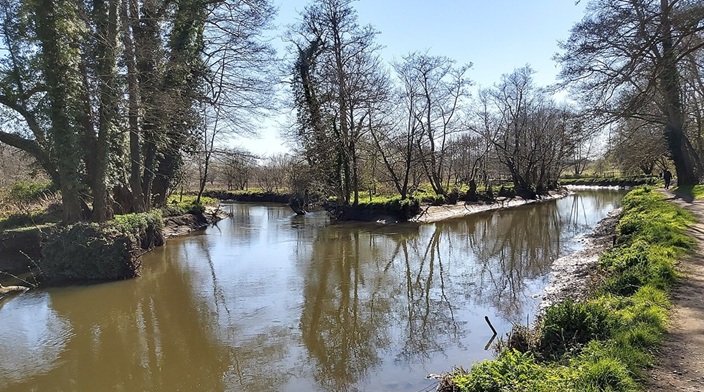
The River Not Taken
—after Robert Frost
The sloop’s main sail was hoisted tight
But in the fog I now was lost;
I reached where half the stream veered right
The other left. Encroaching night
Meant I must choose; but at what cost?
I had no time and so chose West
To where I knew the sun would set;
That Eastward might yet still be best—
Was something which I could not test
And left me with a vague regret.
What can you do? You choose, then go;
The past is narrowed to a strait
And what you chose three leagues ago
Determines all you think and know
And somehow navigates your fate.
Your world view—drawn from all you learn—
Is such a river. Where you start
Means less than how you trim and turn,
For from this choosing you’ll discern
Your own lived truth and moral chart.
Your sails catch wind and now you’re caught
From now until you breathe your last;
Each prejudice and hope and thought,
Each fact that you have learned and taught—
Is borne from choices past and passed.
Joseph Weighs His Brothers’ Fates
—a rondeau
If I forgive them, then they’ve won—
They profit from the web they spun
Convinced they are both skilled and smart
As each one plays his cunning part.
They’re not my brothers! No, not one!
Should I seek vengeance? Shall I shun
And mock, assault, enslave and stun?
I’d have to sheathe each poisoned dart
__If I forgive…
Yet, once my rage-filled acts are done
Might not the violence I’ve begun
Just rip my tattered soul apart?
Would it not salve my wounded heart
To see each as my father’s son
__If I forgive?
Brian Yapko is a retired lawyer whose poetry has appeared in over fifty journals. He is the winner of the 2023 SCP International Poetry Competition. Brian is also the author of several short stories, the science fiction novel El Nuevo Mundo and the gothic archaeological novel Bleeding Stone. He lives in Bradenton, Florida.

















As a person who has had many “vague” (and not so vague) regrets about the many choices I made at various forks in the river of life, your poem “The River Not Taken” really speaks to me, especially the last phrase, “choices past and passed.” Couldn’t be said better or more succinctly!!! I have often thought about writing a “forks in the river” book where various alternate histories would play out in how the story enfolds and ultimately ends. And I like your “Joseph” rondeau– it gives us insight into Joseph’s internal workings and cogitations of his mind as he comes to the ultimate decision to forgive his brothers. Well done as always, Brian!
Brian,
It is the endings of both poems that linger in my mind, each marked by a creative brilliance that raises words from one level to a higher one.
Rare for truth to be stated so succinctly and with such finality as this:
From now until you breathe your last;
Each prejudice and hope and thought,
Each fact that you have learned and taught—
Is borne from choices past and passed.
But the best of all is the clever and inspired twist in ending your insightful rondeau as a question.
Brian, that – “which should I choose” – dilemma is something so many of us have to contend with when we reach the point where that decision has to be made, but every now and then, luckily or not, ‘Fate’ steps in to make it for us.
I don’t believe one – at least not I, can adequately sooth their (my) soul through ‘Forgiveness’ alone – depending on the grievance – without appropriate restitution to some degree, but I definitely know how stubborn a conscience can be.
Both excellent renderings –
Fabulous, especially The River Not Taken – a great conceit and allusion in itself: roads have one set of connotations, but a rivers others. And in this case that sense almost of the life force, chi or prana on which we all have to hoist up our sail (or ‘sale’ in my case of course!) and as you pointedly comment: every thing counts, ‘each fact’, nothing is unimportant as we reach, respectively, our final destinations. Great writing.
“The River Not Taken” uses an epigraph that alludes to Frost’s famous poem, but Yapko’s poem is in fact much more intellectually serious than Frost’s. It is more philosophically and psychologically penetrating, since it makes the speaker’s choice much more consequential in terms of his worldview, his prejudices, his beliefs, his knowledge, and future actions. This is especially clear in the last three quintains, which are seriously discursive rather than just impressionistic. Frost is a great poet, but his tendency was to affect a clipped New-England taciturnity at times. His last words that “…and that has made all the difference” seem very weak compared to Yapko’s ending.
The poem in the voice of Joseph show how a small fixed form like the rondeau can have a major effect on how well a poem tells a story. If this had been written as an ordinary dramatic monologue in blank verse or rhyming couplets, we would not have the intensity that we have here. But the rondeau’s tripartite rigid form and fixed rhyme scheme allow us to see Joseph’s natural resentment, his desire for vengeance, and his final choice to forgive — all intensely focused in each section. Everything is clear and exact. This gives a real backbone to the scriptural story.
Let me add this — in both poems we can see the basic argument that those of us in the movement to revitalize the traditional practice of English verse are making. We want the clarity, the discursiveness, the intellectual seriousness of metrical verse. Brian Yapko is giving those things to us.
Frost admits his poem is whimsical,
but it is intellectually serious too,
very, “a tricky tricky poem” indeed.
[apologies for the walled link–
I’ll see how to share the full thing]
https://www.jstor.org/stable/1559684
Good poems Brian. A nice take on Frost’s famous work, and then your take on the Bible story. In a way, the second poem asks the same question asked in the Iliad about the wrath of Achilles: is forgiveness best? Joseph chose forgiveness in the end, proving himself wiser than the Greek hero.
Both poems offer food for thought in dramatic form. “Now you’re caught” is indeed the current on which you’re borne. Nautical terms like “league” and “trim” add so much to the fix we are in. If I could return to my former state, I often wonder what would have been my fate. Thinking of brothers’ dirty laundry, certainly left Joseph in a quandary. Forgiving others is never easy, especially if they have been so sleazy.
Kudos Brian! I enjoyed both poems very much. Choice is a gnawing topic that I see in the clinic all the time. It also what makes us human. There is no way around the pain of choosing. I really loved the second poem about Joseph and his brothers. To forgive or not forgive? That is the question. I have no answer.
I love the way you reflect the thoughts of Frost’s poem; and I love the way you get inside of Joseph’s mind. You’ve made both poems about the turns and twists of decisions.
In the first poem Yapko is flexing his muscles, possibly beating Frost at his own game: tennis with a net. Salemi (above) got it just right. Brian’s flights always end with a KO.
An excellent poem. I found that each stanza of the poem speaks to the struggle to forgive another person for wrongs suffered because of them, showing the progression of thought that one goes through in deciding to forgive.
In the first stanza, you understand the desire that another person not feel satisfied in the pain they have caused another, and also the desire within the person who was hurt to completely reject any connection with the offender. “They’re not my brothers! No, not one!”
Then the second stanza gets practical. What form would a lack of forgiveness take in action? “Shun and mock, assault, enslave, and stun?” Who among us has not, at one time or another, felt the desire to retaliate against another person for a perceived – or actual – hurt of offense? You show that forgiveness would mean “sheathing” each of his retributive “darts” should he choose to forgive.
With the third stanza, I relate to your understanding that forgiveness is as much about settling our own soul as it is about an action or attitude toward another person. Rather than viewing the offender as an enemy, “would it not salve my wounded heart to see each as my father’s son.” Here you understand that strife within families can be the most bitter, acknowledging that to not forgive the offending family member would “rip my tattered soul apart.”
Thank you for this insighful work!