


The Zingers of Adam Sedia
A Review Sedia’s New Work The Opening
of the Mouth and Other Books
by Theresa Werba
I have had the pleasure of reading the poetry of Adam Sedia for many years, and additionally had the pleasure of a face-to-face meeting at the SCP Symposium in New York in 2019. I have always been impressed with him as an uncommonly good poet. Sedia was the 2019 First Place winner of the Society of Classical Poets annual competition, having placed 2nd in 2018. He has been long recognized and appreciated within the formal poetry community, and deserves to be more widely known.
Sedia has the unique gift of employing what I call zingers—an interplay or juxtaposition of words which are so unique and unusual (and unusually good) that they just pop out at you. Not only is Sedia a careful, measured poet with extremely fine and precise diction, but he manages to combine commonly-used words in uncommon ways in addition to the zingers, which elevate his writing to a whole new level. Although his zingers are appreciated more powerfully and potently in their poetic context, you can take them out and enjoy them as a microcosm of great creativity and innovation on their own merit.
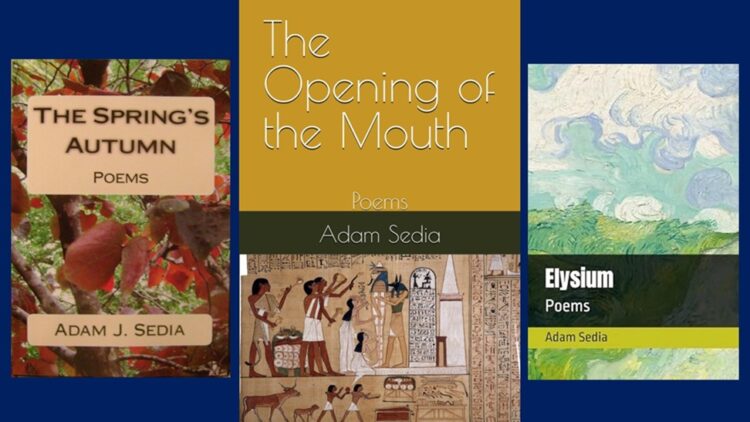
In his first publication, the 2013 The Spring’s Autumn, Sedia begins with “Convocation,” a prayer for poetic inspiration:
Let me bring order from chaos;
Let me shine light through the haze;
Let me build towering castles
To capture the wandering gaze.
Just as the smith hammers metal,
Just as the sculptor hews stone,
Just as the carpenter dresses,
I fashion a form of my own.
Give me my tools, my material:
Sound upon trembling lips,
Phantoms that dart though the mind-paths,
And serpentine contours of script.
Give them to me! I shall mold them
Not into mad disarray,
But into a dulcet gold clarion
That beautifies what I must say.
Thou, who first fashioned the cosmos
From the primeval abyss,
Gave it both order and meaning,
May I do likewise with this!
This poem certainly would resonate with anyone writing formal poetry, for Sedia gives homage to “order and meaning” while eschewing “mad disarray,” an indictment of much of the vomitus and detritus that passes for contemporary “free verse” poetry today (I say this as a poet who writes both formal poetry and free verse). The zingers in this poem that resonate with me are: “Phantoms that dart though the mind-paths,” “serpentine contours of script,” and my musical favorite, “a dulcet gold clarion.”
The Spring’s Autumn contains many more as well. In “Death of Leviathan” we have the zinger “As its effusions ooze and churn;” while in “Two Volcanos” we have “a raging pyroclastic hell;” in “February Snowfall” we have “opalescent fog;” and in “Peonies” we have “roseate orbs.”
Although I find Sedia’s poetry outstanding across the board, when he shares more of his personal, internal feelings, it is rendered very powerful by its restraint. No sloppy mush or saccharine, trite or maudlin sentimentality here! In the villanelle “Remembrance” we have a fine zinger in “screaming gales of passion”:
Remembrance haunts, persisting like a ghost;
It drains the soul and gnaws upon the heart,
For always we destroy what we love most.
We countenance too late, too late we boast
The lover in whose love we wished no part—
Remembrance haunts, persisting like a ghost.
The idol we adored, abject, engrossed,
Our screaming gales of passion tore apart,
For always we destroy what we love most.
The land we fled for a less hostile coast,
We pine for now, long since we dared depart—
Remembrance haunts, persisting like a ghost.
The gentle lamb we slaughter, carve and roast
Was yesterday our dearest counterpart,
For always we destroy what we love most.
And never can we resurrect the host
Of victims in our trail, despite our art;
Remembrance haunts, persisting like a ghost;
For always we destroy what we love most.
Sedia’s 2025 Elysium is a collection of nature-oriented observations of sunsets, herons, sunrise, trees, plants, and even mushrooms. It is a careful observation of nature and a work which verily loves and honors it. It is especially rich in zingers: “soft denouement of day” in the opening “Elysium;” “Shroud of all the simulacra/masking the world to come” in “Incense;” and probably my favorite, “Botryoidal puffs shining white” in “Love and Vipers.”
My favorite poem in the collection is “The Poet’s Spirit,” a sonnet in memory to a distant ancestral relative, the Italian poet Alceste De Lollis:
Across two centuries’ and an ocean’s span,
You born to Dante’s, I to Shakespeare’s tongue,
Our blood unites us, scions of one clan,
Whose forebears Horace entertained in song.
But more than blood spans distance, tongue, and time:
The flame, the spirit that all poets share—
The ear attuned to music, rhythm, and rhyme;
The eye aware of beauty everywhere.
And in it Truth, eternal, changeless, clear;
The mind that can extract the hidden good.
These unseen bonds of spirit draw us near—
More than mere blood and surname ever could.
Through blood will perish, spirit never dies,
And thus is where our truest kinship lies.
If I myself were related to any great poet of the past, I could not imagine having captured my reverence, sentiment, and sense of connection to a poet across history and time better than this sonnet of Adam Sedia.
Adam Sedia’s latest collection The Opening of the Mouth surprises me and delights me in still being Adam Sedia but his presenting himself through an innovative approach through a novel idiom. In this collection of love poems and hymns, he has reached back to Ancient Egypt for inspiration. “It started as an experiment,” Sedia explains in the book’s Preface, “to see how well a contemporary American mind could express itself in a voice so far removed its experience.” That we still write sonnets from Italy, villanelles from France, pantoums from Malaysia and haikus from Japan is testament to the versatility and resilience of poetic forms engendered in other countries and cultures. It was so satisfying to see what Sedia can do with such a challenge before him—he has come through with flying colors. He captures what he calls the “strange beauty” of the idiom, particularly in how simple and yet how powerful it is.
In referencing the 1920s work Ancient Egyptian Poetry and Prose by Adolf Erman, Sedia explains that Egyptian poetry makes particular used of “parallelism of its members.” This involves stating an idea and then restating it a different way in the following line. This technique has “parallels” in ancient Babylonian and even Hebrew poetry—the psalms are replete with parallelisms. The poetry is structured by 2-4 short lines of unrhymed verse in a stanza, with 2-4 accented syllables per line. Stanzas may repeat lines from previous stanzas. The lines will have the characteristic parallelisms, along with the use of alliteration. Sedia also made the choice to employ English archaisms such as thy, thee, and thine; he states that this “conveyed a wonderfully otherworldly sense of the antiquity of the style and the elevated language used for poetry in the ancient world.” Though Ancient Egyptian poetry employs the use of “paronomasia,” the use of puns on the names of objects, Sedia did not choose to use paronomasia in this collection, citing translation difficulties. He did find English well-suited to the alliterative nature of Egyptian poetry, noting that this has been a feature of English poetry since the dawn of our language.
He also establishes at the outset that although he is Catholic, he seeks to write in a “thoroughly pagan voice” while avoiding “sacrificing either personal devotion or sincerity.” What he claims to sacrifice, however, is “some faithfulness” to the original style. His goal is to “seek a common humanity” in his use of this idiom, feeling that “the poems lose nothing” by his choice to omit overt references to pagan gods. In its stead, he does reference Duat (the Egyptian netherworld) and the gods, but does not offer praise to them, noting that many Egyptian texts are not “overtly religious” to begin with. He then provides us with a collection of love poems, along with a shorter collection of “hymns” which “mourn for the dead in a borrowed voice from that long-vanished world.” I have a lot of respect for any writer or poet who nonetheless is open to expression and revelation in forms or styles outside his or her tradition or comfort zone.
I found Sedia’s love poems in this collection to be among the most exquisite I have ever read. There is definitely an echo of the past which permeates the reading experience—I felt like I had a window into a world very different from my own, and yet being surprised at how similar the emotions and observations expressed were to my own today. I truly felt transported to sand and sun, the Nile and the Sphinx and the pyramids, while at the same time feeling a surprising resonance of truth within the memories of my own experiences.
Take, for example, love poem “II”:
Thy flesh is of glimmering gold,
Gleaming like the morning sun.
And thy hair is of lapis lazuli,
Lustrous, of heavenly hue.
Thy lips are of polished carnelian;
They are red like hills of jasper.
Thy teeth are of whitest ivory,
Of silver glowing like the moon.
How precious thou art, O exalted one!
How precious, delight of mine eye!
Established forever among the holy ones,
Enduring like the gods of Duat.
We immediately see the alliterations in “glimmering gold,/Gleaming”, “lapis lazuli,/Lustrous,” “heavenly hue”, along with the parallelisms of “glimmering/gleaming” (words doing double duty!), “whitest ivory / silver glowing like the moon.” While not “Zingers” in the sense which he employs them in his more traditional poetry, he nevertheless provokes us with imagery—the use of earthly elements—gold, lapis lazuli, carnelian, ivory, silver, to give us an unusual mental image of his colorfully rendered “exalted one.” I also find the reference to Duat to provide that echo from the past which for me, brings ancient Egypt right to the forefront of my mind.
What also strikes me as particularly arresting in this form is the lack of rhyme. We expect this absence from free verse, or blank verse—but here is unrhymed poetry, in a very ancient style, held together through other structural elements. For me, it gives the poems an eerie quality, a sense of something old and far away, like the sound in the echo of a memory. Somehow the absence of rhyme only causes the ear to draw even more fully to the alliteration and parallelisms inherent in this form. Moreover, what we are given in these poems in the Ancient Egyptian style are not the zingers of Sedia’s traditional poetry, but something like the difference between an oil painting and a watercolor: the oils are zingers; the Egyptian love poems are rendered in a quieter, almost softer register, much as watercolors are subtle, reflective, and often very tenderly rendered.
I found that it is best to savor each of Adam’s poems in The Opening of the Mouth as one would a dessert of rich fudge or mousse, paired with a fine espresso, best enjoyed slowly, and mindfully, letting the unfolding of the reading experience also be an end unto itself. It is in the measured and almost otherworldly approach to this collection that one begins to see in the mind’s eye the Nile, Sphynx, and pyramids, and the universality of human experience across the aeons.
I have given the reader a glimpse of the treasures in the poetry of Adam Sedia, from his first collection to his latest collection. In between, there is Heights and Depths (2024), Visions Beyond (2018) and Inquietude (2016). Many volumes to choose from, and I encourage any lover of excellent poetry to download or get a hard copy of at least one of his works. I have endeavored to give an overview of Sedia’s range and capabilities. He brings novel innovation combined with careful diction and a measured form of passion that it is truly the mark of a virtuoso poet. Sedia deserves to be more widely known and fully appreciated for the truly great American poet that he is. I hope you will join me and others who have been treated to his zingers, and his mysteries inspired by the ancient Land of the Nile!
Books Reviewed
The Opening of the Mouth, April 2026
Theresa Werba (formerly known to the SCP community as Theresa Rodriguez) is the author of eight books, including What Was and Is: Formal Poetry and Free Verse, and Sonnets, a collection of sixty-five Shakespearean, Spenserian, and Petrarchan sonnets. Her work appears in numerous journals, websites, and online publications, including the SCP Journal. She has been featured on Classical Poets Live where she discusses musicality and elocution in formal poetry. She is a contributing writer for Classical Singer Magazine. Werba’s background as a Classical singer informs her dramatic poetry readings which are available on Youtube @thesonnetqueen. Her website is www.theresawerba.com.


















So glad to see that readers will get to know Adam’s work better!!!
Theresa,
I am glad to see Adam getting “zinged” (in a positive way) through the exposure your review brings to (as you put it) his virtuosity. While rhyme and rhythm characterize the trajectory of Western Classical poetry, its foundational roots knew nothing of the former and a measured looseness with the latter. Alliteration, parallelism and wordplay (i.e. “paronomasia,” a word I had not heard before) form the core of what shapes biblical Hebrew poetry as well as that of other ancient poetry as Adam demonstrates in his Egyptian-inspired poetry. While such is a far cry from “free verse” it is also a misdirected cultural mistake for us to refer to it as blank verse, either, since it simply “is what it is” independent of our own poetic tradition.
Greek, of course, added the rhythmic element, primarily so as to adapt the poetry for singing. In both ancient and contemporary Middle Eastern music, however, there is less interest poetic rhythm since the verses are sung in a stylized form akin to chant, where the words are made to fit the melodic structure and not the other way around. It would, for example, be easier to fit Adam’s “Egyptian verse’ to the form of a chant than to something akin to a metrical tune found in a church hymnal.
Relative to this, I find one of your most significant comments to be where you say, “That we still write sonnets from Italy, villanelles from France, pantoums from Malaysia and haikus from Japan is testament to the versatility and resilience of poetic forms engendered in other countries and cultures.” To which I reply with a loud “Amen!”
Your praise, enthusiasm and cogent analysis of and for Adam’s work is well-earned and well-deserved.
I couldn’t agree more, Jim!!! I am glad I can raise greater awareness of his various poetry collections and his creative scope!!!
Thanks, Theresa, for bringing more of Adam Sedia’s poetry and its history to our attention. Not to mention the fascinating features of style you summarize. I’m much interested by that first poem in his first collection–as solemn an invocation to the source of inspiration as any classic poet could make, yet one that sounds like the particular poet Adam we have come to know over years.
Your selection of poems to showcase shines in its variety, each with its zingers. Good global review!
Sorry Margaret, I meant for your reply to be here! It’s a normal post!
Margaret, I am happy to introduce Adam’s collections, especially his newest, to SCP readers who may not be familiar with his work, his poetry volumes, or who are new to the SCP! I am grateful to Evan to be able to have this website to share my thoughts and inform the readership about so many great poets here!!!
Thank you so incredibly much, Theresa, for this wonderful and eloquently written review. It is beyond satisfying and humbling to see that my work has made an impression strong enough to inspire a review by a poet I admire and respect. It is also interesting to see my own work analyzed — your idea of “zingers” provides an insight into my work that I had not considered before.
I’ve been without power or Internet for the last few days due to a terrible storm, so this is the first I could comment on the SCP’s page.
Thank you again!
Adam, I do not exaggerate to say that it gives great pleasure to make reviews about poets like yourself, that I feel deserve recognition, and perhaps have poetry volumes published that the SCP or other readership may not be aware of. I had the idea to write about your work over a year ago, and then my youngest daughter Sophia was stricken with leukemia just as I was getting started, so I was in Arizona for many months helping facilitate her care. I am happy to say that she is cancer-free! And one benefit, now that things are getting back to “normal,” was that I finally had the head space to devote to your long-awaited review. It was a joy to take the time to truly revel in your words!!! I do find it a very special experience to write such a review, and I am very grateful for Evan and the SCP website that has given me a wonderful venue for the dissemination of my thoughts and perspectives!!! I look forward very much to your future work!!!
Adam is a great talent, and we are lucky to have him. Thank you, Theresa, for the lovely essay.
Yes he is, Russel. I consider the camaraderie among the SCP poets to be one of the great treasures of my life!!!
Theresa Werba brings thoughtful receipts: “Convocation” suggests Edward Taylor; “Remembrance”, reads, like a Shakespearean rag; “The Poet’s Spirit”, perhaps too abstract for its intriguing subject; and “Love Poem II”, an anti-Modernist indulging in H.D.
Werba is correct, Sedia is expanding his horizon.
I agree, Bruce, that Adam is expanding his horizon!!! I hope many readers unfamiliar with his work (or even familiar with his work) will get a couple of his collections and savor them as I and others have!!!
What a splendid review, Theresa—generous, perceptive and full of your own infectious enthusiasm for poetry. Your idea of Adam’s characteristic “zingers” is exactly right: those startling combinations of words reveal not merely verbal ingenuity, but a poet’s capacity to make language—and therefore the world—new again. The passages quoted here display Adam’s remarkable formal mastery, imaginative range and spiritual seriousness. Most fascinating is the movement from the “dulcet gold clarion” of his earlier work to the quieter, stranger music of The Opening of the Mouth. To enter an ancient idiom without surrendering one’s own voice is a rare achievement; to discover within it our common humanity is rarer still. I have long admired Adam’s work which does deserve to be read more widely—and your fine review makes an eloquent case for why. Actually, well done both of you!
I also want to say that I might have an “infectious enthusiasm” for “good” poetry, but not for all that calls itself “poetry”!
Thank you James! Your perspective is exactly what I was trying to capture in this review!!!