


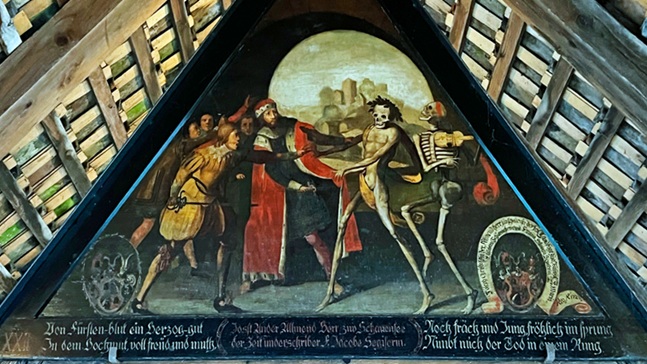
Totentanz
—verse inspired by the 17th century death-cycle paintings
preserved on the Spreuerbrüch Bridge in Lucerne, Switzerland.
Death falls upon us like a rain from hell;
Its smirking lurking shadow sparing none.
For neither cleric, king nor serf can tell
If life shall last or end ere day is done.
The plowman turns his field and plants his seed;
The grain in turn sustains both lord and knave.
With honeyed pot they revel in their mead
And stagger blindly blithely to their grave.
The cradled infant cold and lifeless lies;
The king abed expires his final breath;
The knight in battle pierced and broken, dies;
The newly-bedded bride embraces death.
Awhile the reaper harvests with his scythe;
His fleshless outstretched bony finger taunts
As spinning, grinning, mocking demons writhe
Their endless danse macabre: Totentanz.
Totentanz: Dance of Death
James A. Tweedie is a retired pastor living in Long Beach, Washington. He has written and published six novels, one collection of short stories, and four collections of poetry including Sidekicks, Mostly Sonnets, and Laughing Matters, all with Dunecrest Press. His poems have been published nationally and internationally in both print and online media. He was honored with being chosen as the winner of the 2021 SCP International Poetry Competition.

















James, this would make a great poem for “The Day of the Dead” in Latin culture. Very descriptive and chilling.
This is a nice set of quatrains — clear diction, perfect meter, solid rhyming. I like the use of the antique form “Awhile” as the starting adverb in the last quatrain. Also, the use of monosyllabic words (in the first and fourth lines of the first quatrain) adds a heaviness and finality that suit the subject matter.
The Dance of Death doesn’t become a prominent part of European iconography until the coming of the Black Death pandemic in the 14th century. After that, it dominates much of pictorial art.
I love this poem, Jim. The operative words here for me are “taunts” and “mocking”– some kind of schadenfraude over our sufferings and loss as demons “writhe” their Dance of Death?? A powerful and haunting poem indeed, well done!!!
I love this poem. It sounds very musical to my ear: from “smirking lurking” to “blindly blithely” to “spinning, grinning, mocking”. I also love the line “If life shall last or end ere day is done.”
James
This poem is a delight: four stanzas of clever cross-rhymed lines of perfect iambic pentameter that “catch” the feeling of these paintings: macabre (and scary!) yet “cheeky”—as if human beings (from every age group and in all walks of life) of course are terrified of death (and specifically of Hell) and yet shrug the fear off by fabricating images of cartoonish carefree skeletons frenetically dancing. After all, what else can we humans do? I can imagine this poem set to jaunty music, a set piece in perhaps in a Broadway musical!
My favorite image of death (that vibrant reaper!) from Stanza 4: ‘His fleshless outstretched bony finger taunts As spinning, grinning, mocking demons writhe…’ I also enjoy the description of the lighthearted strategy employed by revelers: ‘With honeyed pot they revel in their mead And stagger blindly blithely to their grave.’
Sincerely
Mary Jane (Myers)
Mary Jane,
Off-Broadway might have some potential as a 16th century parody but I’m afraid a Tony is probably out of reach! Thanks for the fun comment.
James, the depth of your tone seems to outweigh the picture we see. I take it there are additional pictures on the bridge. These could supplement the universality you describe so expansively in your middle stanzas. But when I speak of the tone, you set it with that first line: “Death falls upon us like a rain from hell.” And you conclude just as diabolically with demons writhing in danse macabre. I cannot help but hear Dame Edith Sitwell, “Still falls the rain” on the London Blitz with its Faustian echoes. Marvelous effect to produce in sixteen simple lines.
Margaret,
On an early morning shortly before sunrise when all was quiet, the streets of Lucerne were empty and I had the bridge to myself I took pictures of 40 paintings on the bridge from which I chose one to accompany my poem. The images in my poem are, in fact, drawn from images in the paintings, many of which represent then-contemporary, named persons who had died recently at the time and were subsequently memorialized in a bridge painting.
It’s fascinating to know that the bridge was, for some time, a memorial to Lucerne’s recently deceased. Sounds like a specialized equivalent of our freeway wall painting. I did see quite a bit of text at the base of the picture you chose for post illustration. Obituaries, maybe, along with memento mori portraits.
Every painting has a rhymed verse of two couplets in high Germanic script at the bottom giving a brief moral warning and exhortation in the style of a proverb relating to life and death. I may be wrong about the named deceased since the cycle appears to have been scripted in advance with local patrons choosing one of the themes with their names (and figures) incorporated into the finished scene. Scenes include death appearing before bloodletters, grocers, tramps, soldiers, young men, weddings, astronomers, barkers of medicinal elixirs, etc. the cycle ends with a scene of the resurrection of the dead followed by the last judgment overseen by Christ Sovereign and Triumphant—having defeated Death at last. Similar, earlier cycles, were commissioned for the existing Chapel Bridge (much of which was destroyed in a 1993 fire) and a third bridge which was demolished several hundred years ago.
Glad to hear about the painting-plus-poetry cycle as a whole–and the fact that it was a cultural phenomenon, not just a one-time masterpiece. Somewhat similar to the resurrection and judgment scenes concluding the Lucerne cycles, Edith Sitwell’s “Still Falls the Rain” concerning 1940 London air raids builds on Gospel accounts of the Crucifixion. “The Starved Man hung upon the Cross . . . bears in His Heart all wounds.” You’ve motivated me, James, to put Lucerne on my list of places to go if and when I have the stamina for Europe again.
A vivid expression of the personification of Death, in this poem the internal rhyme and alliteration gives it a musical feel and accentuates the feeling of foreboding.
The third stanza was especially poignant, I felt, making us aware of the high infant mortality of the Middle Ages, the fact that even a monarch one day breathes his last, that being a knight carried certain occupational hazards, and in the last line I got the idea that the newly-bedded bride was fated to die in childbirth.
Thanks for the read.
This is a truly excellent poem, for reasons including those Salemi notes above. John Barleycorn must die — no getting around it.