• Submit Poetry
  • Support SCP
  • About Us
  • Members
  • Join
Friday, September 4, 2026
Society of Classical Poets
  • Poems
    • Beauty
    • Culture
    • Satire
    • Humor
    • Children’s
    • Art
    • Ekphrastic
    • Epic
    • Epigrams and Proverbs
    • Human Rights in China
    • Music
    • Performing Arts
    • Riddles
    • Science
    • Song Lyrics
    • The Environment
    • The Raven
    • Found Poems
    • High School Poets
    • Terrorism
    • Covid-19
  • Poetry Forms
    • Sonnet
    • Haiku
    • Limerick
    • Villanelle
    • Rondeau
    • Pantoum
    • Sestina
    • Triolet
    • Acrostic
    • Alexandroid
    • Alliterative
    • Blank Verse
    • Chant Royal
    • Clerihew
    • Rhupunt
    • Rondeau Redoublé
    • Rondel
    • Rubaiyat
    • Sapphic Verse
    • Shape Poems
    • Terza Rima
  • Great Poets
    • Geoffrey Chaucer
    • Emily Dickinson
    • Homer
    • Henry Wadsworth Longfellow
    • Dante Alighieri
    • John Keats
    • John Milton
    • Edgar Allan Poe
    • William Shakespeare
    • William Wordsworth
    • William Blake
    • Robert Frost
  • Love Poems
  • Contests
  • SCP Academy
    • Educational
    • Teaching Classical Poetry—A Guide for Educators
    • Poetry Forms
    • The SCP Journal
    • Books
No Result
View All Result
Society of Classical Poets
  • Poems
    • Beauty
    • Culture
    • Satire
    • Humor
    • Children’s
    • Art
    • Ekphrastic
    • Epic
    • Epigrams and Proverbs
    • Human Rights in China
    • Music
    • Performing Arts
    • Riddles
    • Science
    • Song Lyrics
    • The Environment
    • The Raven
    • Found Poems
    • High School Poets
    • Terrorism
    • Covid-19
  • Poetry Forms
    • Sonnet
    • Haiku
    • Limerick
    • Villanelle
    • Rondeau
    • Pantoum
    • Sestina
    • Triolet
    • Acrostic
    • Alexandroid
    • Alliterative
    • Blank Verse
    • Chant Royal
    • Clerihew
    • Rhupunt
    • Rondeau Redoublé
    • Rondel
    • Rubaiyat
    • Sapphic Verse
    • Shape Poems
    • Terza Rima
  • Great Poets
    • Geoffrey Chaucer
    • Emily Dickinson
    • Homer
    • Henry Wadsworth Longfellow
    • Dante Alighieri
    • John Keats
    • John Milton
    • Edgar Allan Poe
    • William Shakespeare
    • William Wordsworth
    • William Blake
    • Robert Frost
  • Love Poems
  • Contests
  • SCP Academy
    • Educational
    • Teaching Classical Poetry—A Guide for Educators
    • Poetry Forms
    • The SCP Journal
    • Books
No Result
View All Result
Society of Classical Poets
No Result
View All Result
Home Poetry Culture

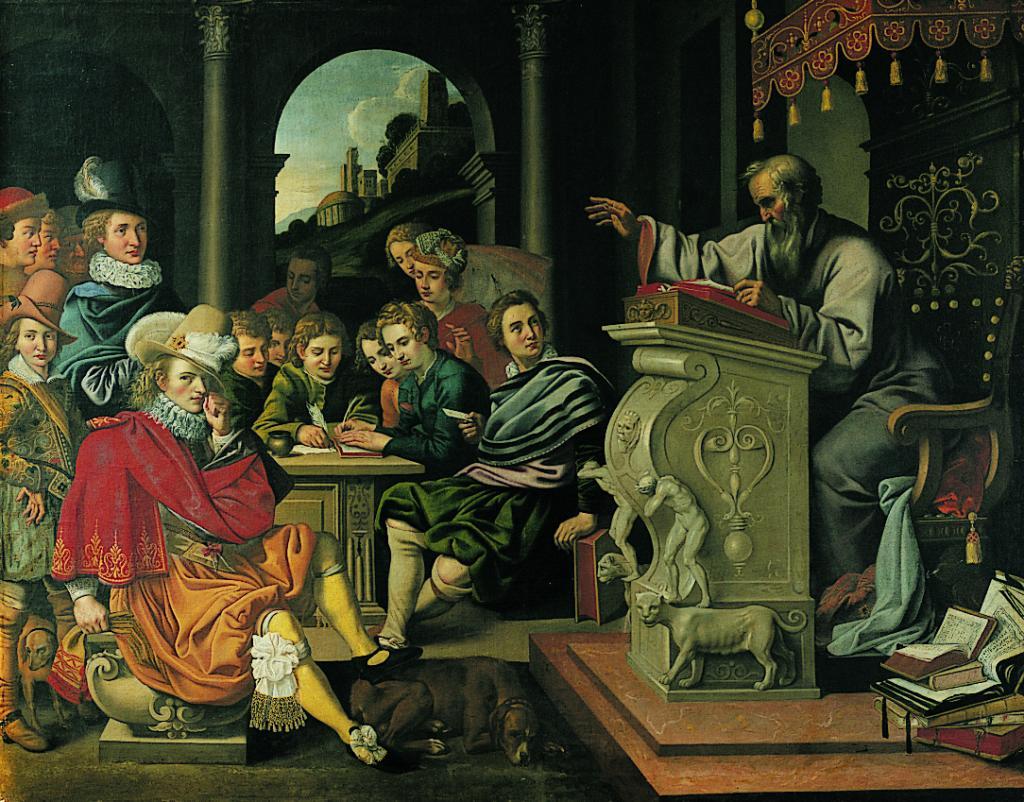
‘The Composition Teacher Addresses His Class’ by Joseph S. Salemi

May 6, 2018
in Culture, Educational, Poetry
A A
13
poems 'The Composition Teacher Addresses His Class' by Joseph S. Salemi


When naming things, you have to use a noun;
A verb shows action or a state of being.
An adjective describes—that is, marks down
The qualities of objects that you’re seeing.

An adverb tells you how, or else how soon
A deed is done—say, “painfully” or “fast.”
When placed with adjectives they help fine-tune
Descriptive force, like “absolutely gassed.”

A pronoun takes the place of proper names
Or else alludes to antecedent things.
A preposition points, and always frames
The noun or noun-linked phrase to which it clings.

A participle emanates from verbs
And functions as a hybrid in good diction.
It can take past or present form, and serves
To add a tense-based nuance to depiction.

Conjunctions tie together words and clauses;
They also can disjoin by act of scission.
Like plus and minus signs, they marshal forces
For union, separation, or division.

An article is just an honorific
You put before some nouns so we’ll discern
Whether your focus on them is specific
Or just a passing glance of unconcern.

An interjection is a mere effusion—
A word you blurt out from your guts or heart
In rage, joy, spite, emotional confusion…
It stands alone, syntactically apart.

These are the parts of speech that make up discourse,
At least for folks in literacy’s fold.
So if you’re hoping to get by in this course
Don’t give me any backtalk—learn them cold.


Joseph S. Salemi has published five books of poetry, and his poems, translations and scholarly articles have appeared in over one hundred publications world-wide.  He is the editor of the literary magazine Trinacria. He teaches in the Department of Humanities at New York University and in the Department of Classical Languages at Hunter College.
ShareTweetPin
The Society of Classical Poets does not endorse any views expressed in individual poems or commentary.
Read Our Comments Policy Here

RandomPoems

‘The Three Democrats of the 2020 Election’ by Phil S. Rogers, after Macbeth
Covid-19

‘The Three Democrats of the 2020 Election’ by Phil S. Rogers, after Macbeth

October 29, 2022

. The Three Democrats of the 2020 Election after Shakespeare's Macbeth, Act 4, Scene 1 Scene: Thunder illuminates a 2020...

‘And Our Paths Through Flowers’ by David Whippman
Beauty

‘Who Knew’ and Other Poetry by Áine Mae

March 4, 2021

. . Who Knew How often I crushed autumn leaves Until I saw a robin drink From one that cupped...

Next Post
‘A Snowy Day in Spring’ by Yuan Xi

'A Snowy Day in Spring' by Yuan Xi

‘The Warrior’s Song at Dusk’ by Ramón Rodriguez, LC

'The Warrior’s Song at Dusk' by Ramón Rodriguez, LC

‘Am-air-ica’ and Other Poetry by Bruce Dale Wise

'Am-air-ica' and Other Poetry by Bruce Dale Wise

Comments 13

  1. Joe Tessitore says:
    8 years ago

    Excellent Joe, and as funny as can be!

    Reply
  2. Amy Foreman says:
    8 years ago

    Fantastic, delightful, clever, witty, and many other adjectives to mark “down
    the qualities of objects” I just saw! I hope you are making your students memorize this, or that, at least, you are posting it in your classroom!

    “Don’t give me any backtalk—learn them cold.”– Perfect!

    Reply
  3. Rohini Sunderam says:
    8 years ago

    It’s superb! And the humor is so controlled! Thank you for such classic fun.

    Reply
  4. Leo Yankevich says:
    8 years ago

    Masterful, witty and truthful as usual.

    Reply
  5. David Paul Behrens says:
    8 years ago

    It must be magnificent to be a literary scholar, a fine teacher and a great poet, as well.
    Outstanding!

    Reply
  6. Fr. Richard Libby says:
    8 years ago

    I enjoyed this very much, Mr. Salemi, and I agree with Mrs. Foreman: students should have to learn this poem. If a student memorizes and understands this poem, there’s no reason for him not to do well in English class!

    Reply
    • James A. Tweedie says:
      8 years ago

      How I wish I had been fortunate to have had a teacher like Dr. Salemi. I am sorely tempted to move to the east coast and register for one of his classes at Hunter College. I learned more of grammar from this poem than I learned in all my years of education combined. A poem able to teach something as mundane as English grammar while managing to be entertaining is quite an accomplishment. The poem led me to consider how a student might respond to such instruction:

      What Came Next

      “Wow!” declared the student, interjecting.
      “Grammar has so many dots that need connecting.”
      “You mention dots,” replied the course professor.
      “Like diamonds on the crown of Edward the Confessor
      Iotas, jots and tittles frame the text
      And keep the reader from being overly perplexed.
      The smallest dots when properly employed
      Re-frame and shape the words so they can be enjoyed.
      They steer the reader to that sacred spot
      Where he or she can comprehend the author’s thought.
      Periods, commas, colons, and the rest
      Can give prosaic phrases literary zest.
      But if misused, one dot most miniscule
      Can earn an author well-deserved ridicule.
      A dash, quotation marks, parentheses
      Ellipsis, hyphens, and (of course) apostrophes
      Are often used, and useful when used fairly
      But exclamation marks should only be used rarely.
      So, if you want a world-class education,
      You first must learn to master proper punctuation.”

      Reply
  7. C.B. Anderson says:
    8 years ago

    I was going to ask for a follow-up poem about punctuation, but Mr. Tweedie anticipated me. Far too much poetry is infected with wrenched diction and improper punctuation, two things that should have been left behind in grammar school composition assignments. One thing that I admire about you, Joe, is that you always practice what you preach. And it’s pretty clear that you don’t believe in participation trophies.

    Reply
    • Amy Foreman says:
      8 years ago

      No participation trophies, but I’ll bet he gives out an occasional participle trophy! 😉

      Reply
  8. David Hollywood says:
    8 years ago

    Very enjoyable.Thank you.

    Reply
  9. David Watt says:
    8 years ago

    I wish we had instruction this entertaining when I learnt English grammar!
    Deserving of a permanent place in the curriculum.

    Reply
  10. James Sale says:
    8 years ago

    There always seems to be with Joseph Salemi a certain clarity of thought that arises from his poetical disquisitions; which is impressive, as poetry can too easily (though sometimes, rightly) be ambiguous, and worse, incoherent. Here, truly, is someone who says what they mean and means what they say. Very good indeed.

    Reply
  11. Joseph S. Salemi says:
    8 years ago

    Thank you all for your kind comments. They are deeply appreciated.

    Reply

Leave a Reply Cancel reply

Your email address will not be published. Required fields are marked *


  1. Jeff Eardley on ‘The Estuary’: A Poem by Jeff EardleySeptember 4, 2026

    Margaret, thank you for taking the time to comment. Your work and your analytic contributions are a huge part of…

  2. Jeff Eardley on ‘The Estuary’: A Poem by Jeff EardleySeptember 4, 2026

    Norma, so did I. I recall heading for the sea in an amphibious vehicle called a DUKW. Happy .days indeed.

  3. Margaret Coats on ‘A Prayer of Aristotle’: A Poem by Margaret CoatsSeptember 4, 2026

    Thanks, Bruce, you offer luxurious appreciation of valuable prose which is mostly Greek to us, even when we've learned to…

  4. Margaret Coats on ‘Humdrum and Harum-Scarum’: A Lecture on Free Verse, by Robert Bridges (1922)September 4, 2026

    Thank you, Phillip Whidden, for recommending this essay. It's worthwhile comprehending the issues as an intelligent poet and critic understood…

  5. BDW on ‘A Prayer of Aristotle’: A Poem by Margaret CoatsSeptember 3, 2026

    The Prose Apartments by Esiad L Werecub Along the highway of communication, one can find the prose apartment paragraphs conveniently…

Subscribe to Daily Poems

Enter your email address to subscribe to this blog and receive notifications of new posts by email.

Join 1,634 other subscribers

Recent Poems

  • ‘The Cristero Centennial’: A Poem by Margaret Coats
  • ‘A Potpourri of Aphoristic Verses’ by C.B. Anderson
  • ‘The Estuary’: A Poem by Jeff Eardley
  • ‘A World Without the Wednesday Child’: A Poem by Kimberly Fore
  • The 2026 Society of Classical Poets International Poetry Competition
  • The 2026 SCP International High School Poetry Competition
  • ‘Realistic Reflections’ and Other Poetry by Anna J. Arredondo
  • ‘China Made’: A Poem by Theresa Werba
  • ‘The Savage Moon’ and Other Poetry by Brian Yapko
  • Poetry Book Review: Love Found, Yearned For, and Lost by James A. Tweedie
  • ‘When Opportunity Knocks’: A Poem by Roy E. Peterson
  • ‘Legend of the Griffin’: A Poem by Iryna Hall
  • ‘Government Issue’ and Other Poems by Joseph S. Salemi
  • ‘Chaucer Announces His Desire to Retire’: A Poem by Paul A. Freeman
  • ‘Advantages of Restaurants’ and Other Poems by Russel Winick
  • ‘Bone China’: A Poem by Mary Gardner
  • ‘On the Death of One Too Young to Die’: A Poem by Jeffrey Essmann
  • ‘This Too Shall Pass’ and Other Poetry by Justin Dasher
  • ‘Humdrum and Harum-Scarum’: A Lecture on Free Verse, by Robert Bridges (1922)
  • ‘Unrest On the Floodplain’: A Poem by Bhikkhu Nyanasobhano
  • ‘Latitude and Loss’: A Poem by Martin Briggs
  • ‘Act III’ and Other Poetry by C.B. Anderson
  • ‘God’s Funeral’: A Poem by James Sale
  • ‘Star Festival’: A Poem by Margaret Coats
  • ‘Song of the Frog Princess’: A Poem by Scharlie Meeuws
  • ‘The Odyssey: Nolan and Solot Compared’: An Essay by Michael Curtis
  • ‘Solitude’ and Other Poems by Mary Jane Myers
  • ‘The River Not Taken’ and Other Poetry by Brian Yapko
  • ‘Totentanz’: A Poem by James A. Tweedie
  • ‘In God Is Our Trust’: A Poem by Roy E. Peterson

Categories

  • Acrostic
  • Alexandroid
  • Alliterative
  • Art
  • Best Poems
  • Blank Verse
  • Chant Royal
  • Classical Poets Live
  • Clerihew
  • Covid-19
  • Deconstructing Communism
  • Educational
  • Epic
  • Epigrams and Proverbs
  • Essays
    • Interviews with Poets
    • Poetry Reviews
  • Featured
  • From the Society
  • Great Poets
    • Dante Alighieri
    • Edgar Allan Poe
    • Emily Dickinson
    • Geoffrey Chaucer
    • Henry Wadsworth Longfellow
    • Homer
    • John Keats
    • John Milton
    • Robert Frost
    • William Blake
    • William Shakespeare
    • William Wordsworth
  • Human Rights in China
  • Limerick
  • Love Poems
  • Music
  • Pantoum
  • Performing Arts
  • Poetry
    • Beauty
    • Children's Poems
    • Culture
    • Ekphrastic
    • Found Poems
    • High School Poets
    • Humor
    • Riddles
  • Poetry Challenge
  • Poetry Contests
  • Poetry Forms
    • Curtal Sonnet
    • Haiku
  • Poetry Readings
  • Rhupunt
  • Rondeau
  • Rondeau Redoublé
  • Rondel
  • Rubaiyat
  • Sapphic Verse
  • Satire
  • Science
  • Sestina
  • Shape Poems
  • Short Stories
  • Song Lyrics
  • Sonnet
  • Symposium
  • Terrorism
  • Terza Rima
  • The Environment
  • Translation
  • Triolet
  • Video
  • Villanelle

Quick Links

  • About Us
  • Submit Poetry
  • Become a Member
  • Members List
  • Support the Society
  • Advertisement Placement
  • Comments Policy
  • Terms of Use

Welcome Back!

Login to your account below

Forgotten Password?

Retrieve your password

Please enter your username or email address to reset your password.

Log In
No Result
View All Result
  • Poems
    • Beauty
    • Culture
    • Satire
    • Humor
    • Children’s
    • Art
    • Ekphrastic
    • Epic
    • Epigrams and Proverbs
    • Human Rights in China
    • Music
    • Performing Arts
    • Riddles
    • Science
    • Song Lyrics
    • The Environment
    • The Raven
    • Found Poems
    • High School Poets
    • Terrorism
    • Covid-19
  • Poetry Forms
    • Sonnet
    • Haiku
    • Limerick
    • Villanelle
    • Rondeau
    • Pantoum
    • Sestina
    • Triolet
    • Acrostic
    • Alexandroid
    • Alliterative
    • Blank Verse
    • Chant Royal
    • Clerihew
    • Rhupunt
    • Rondeau Redoublé
    • Rondel
    • Rubaiyat
    • Sapphic Verse
    • Shape Poems
    • Terza Rima
  • Great Poets
    • Geoffrey Chaucer
    • Emily Dickinson
    • Homer
    • Henry Wadsworth Longfellow
    • Dante Alighieri
    • John Keats
    • John Milton
    • Edgar Allan Poe
    • William Shakespeare
    • William Wordsworth
    • William Blake
    • Robert Frost
  • Love Poems
  • Contests
  • SCP Academy
    • Educational
    • Teaching Classical Poetry—A Guide for Educators
    • Poetry Forms
    • The SCP Journal
    • Books

© 2025 SCP. WebDesign by CODEC Prime.