


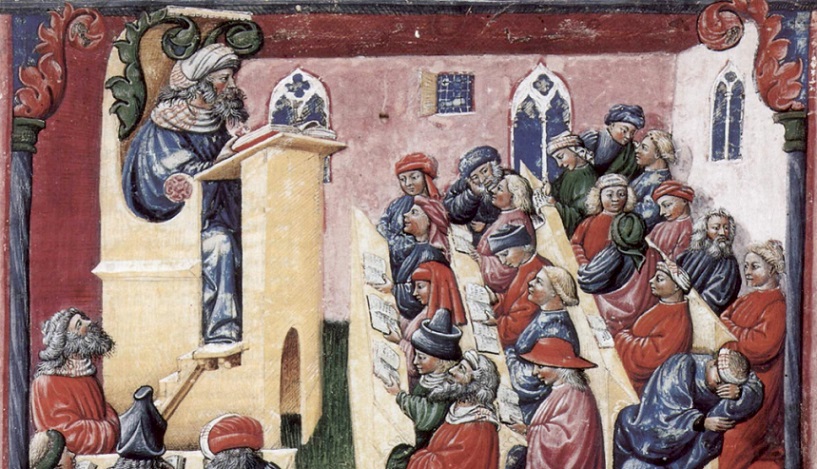
Why are many young persons so bad at writing formal poetry? Why do they struggle and labor and twist and turn when trying to compose formal verse? OK, I’ll grant you this: every beginning poet has to master his trade, and that takes time and practice. You can’t learn tennis in two weeks, and neither can you crank out a respectable sonnet if you are new to the game.
But these days, something else is going on. I’ve been a teacher for more than half a century, and taught thousands of students. I’ve seen certain trends develop. In the past many students were bad at literary composition because of a simple lack of motivation, or a compelling interest in non-humanistic STEM subjects. Others were non-native speakers of English. Still others disliked school in general, and were only present because of their parents and the truancy laws.
Many students today are non-plussed by traditional college teaching methods (straightforward lecture, brief questions, and rigorous testing on assigned material). None of this corresponds to the posturing touchy-feely interaction that they are used to in the lower grades. But this momentary discomfort could be overcome easily, had they not also been propagandized into a rigid ideological conformism on all political, cultural, and social issues. In fact, most of these new students have come to associate the mere act of attending a class with the requirement to be left-liberal in thought, speech, and action (at least as long as the class is in session). They associate (usually with good reason) academic activity with mandatory progressivist opinions. Part of my personal popularity with undergraduates comes from the rush of surprised relief they experience when they find out that my class isn’t like that, and they can say or ask anything they please. On the other hand, of course, there are some ferociously ideologized leftist students who drop my class in a snit. We’re all glad to see them leave.
This generalized homogenization of thought and attitudes has a crippling effect on creativity, especially in language. If one is constantly second-guessing what one may or may not say, linguistic fluency will never develop, and such fluency is crucial in serious poetry. Yes, I know—sometimes poets labor over lines. But in general good poets have a knack for producing verse easily and directly, with only minor touch-ups and revision later on.
What does such a knack entail? Well, the first thing is a very thorough command of vocabulary and idiom, from all the different levels of speech use. No word, phrase, stylistic point, or turn of expression can be taboo to you. You have to know them all, and be willing to use them all whenever they are required in composition. Persons who are deeply ideologized can’t do this. Their self-image depends crucially on a constant policing of their thoughts and their language. And when that happens, your engine is perpetually stalled or disengaged, to use an automotive metaphor. Fluency in composition becomes impossible.
I recall a jerk in one of my literature classes who happened to be the editor of the school paper. Students in such a position are usually arrogant little popinjays, and he was no different. He was used to sucking up to professors, which today means spouting left-liberal pieties and badmouthing and browbeating any expressed conservative opposition. In my class he found that such a procedure didn’t work, and I made it clear to him, by gestures and remarks, that I considered him an obnoxious toady. I recall the look of helpless bafflement on his face when it finally dawned on him that boilerplate political correctness was going to be counterproductive with me. He was frightened, and—at a loss as to what else to do—he simply threw himself into the assigned work and kept his mouth shut. Since there is minimal discussion in my lecture classes, this was convenient for him. But he just couldn’t compose intelligent English prose. Every sentence that he penned was infected with idiotic dogwhistle words like “sexism,” “racism,” “colonialism,” “white supremacy,” “Western hegemony,” and all the other jargon of the Liberal Church. It was psychologically impossible for him to write a dispassionate literary critique or commentary. The literary composition mechanism in his brain had been irreparably damaged.
Well, consider: why would it be any different if a mentally disabled student of this sort tried to write serious formal poetry? Would he be capable of putting together a coherent line, or a creditable quatrain? One of the catastrophic effects of political correctness in the American educationalist establishment is that not only has it prevented students from thinking clearly, but it has also deprived them of the ability to compose prose and poetry. Any creative act presupposes what I call “interior freedom,” which is one’s liberty to think unconsciously and unreflectively on whatever you like, with complete disregard of any external controls or internal moral strictures. A Latin maxim encapsulates my idea: Dic quodcumque vis, ruat caelum (“Say whatever you like, even if the sky falls.”)
It’s a torment teaching courses that introduce students to the writing of verse, because practically no one accepts the validity of interior freedom anymore. You can explain it to them, but it simply doesn’t compute. It isn’t a part of their experience. The K-12 sequence, along with social media and public culture, are completely dominated by a soft left-liberalism that considers virtue-signaling self-censorship to be one of the required social graces, like table manners and good grooming. Trying to break the mental lockdown of this imposed etiquette is a Herculean task. Even when you explicitly tell your students that they have the freedom to speak without being attacked or shouted down by leftist thugs or feminist bitches, they remain circumspect and hesitant.
To add to the problem, those students who have had some connection with “poetry” in the earlier grades and high school have frequently been spoiled by their teachers. These instructors have almost always indoctrinated them with free-verse attitudes and habits, and trained them to be contemptuous of rhyme, meter, genre, fixed forms, and any language usages that are not part of contemporary life. This often creates an unbreakable prejudice that blocks any possibility of developing skill in formal techniques.
I often think of the many years of effort I wasted in writing free verse, simply because I had been told in school that this was the only acceptable and proper method of composing poetry at the current time. If it hadn’t been for the blessings of my grandfather, my mother, and a house full of wonderful books, I probably would have known nothing or little about the great traditions of English poetry. When I finally saw that free verse was an aesthetic dead end, thank God that I could fall back upon an older and richer tradition that is natural and satisfying and creatively fruitful. For this is the honest truth about modernism and the free-verse garbage art that it champions: it is a sick and unnatural excrescence, no more satisfying to real human beings than Jackson Pollock’s “paintings” or John Cage’s “music” or Frank Gehry’s “architecture.”
This doesn’t mean that young people today can’t produce good formal verse. But they have to realize that making the attempt is analogous to being a revolutionary who is committed to the overthrow of a stifling hegemonic dictatorship. Writing formal poetry isn’t a mere choice. It is a declaration of war. And if you want to do it well you have to be prepared not just to learn about metrics and techniques, but to push back hard and violently when anyone tells you that you ought to be doing something else, or censoring yourself.
Joseph S. Salemi has published five books of poetry, and his poems, translations and scholarly articles have appeared in over one hundred publications world-wide. He is the editor of the literary magazine Trinacria and writes for Expansive Poetry On-line. He teaches in the Department of Humanities at New York University and in the Department of Classical Languages at Hunter College.

















Mr. Gosselin’s argument on what is classic is excellent. He is alerting us to the poetic power of Homer through Dante and others. It’s just not enough for me. Here in this New Millennium, against the traditionalists @ SCP, I embrace the Realists, the Modernists, and Postmodernists. And in case anyone hasn’t noticed, Poetry is having a hard time. That is why we should be grateful for figures, like Mr. MacKenzie and Mr. Salemi, as well as Mr. Gosselin. And though I disagree with some of Shelley’s examples in his “A Defense of Poetry”, its spirit is amazing. Yes, it is brilliant. I love his colourful language. But is it a brilliant dissertation? No, not in my mind.
When I think of the phrase brilliant dissertation what immediately comes to my mind is the 19th century “On the Hypotheses which lie at the Basis of Geometry” by Bernhard Riemann. It transformed my mind and how I look at the universe. Like Plato, I embrace mathematics; like Aristotle, I embrace science; and in short, I embrace the entire Western canon in poetry and philosophy and mathematics and…
So when it comes to what is a classic, I think T. S. Eliot’s essay “What is a Classic” is the best (not second best) definition to that question at this time on planet Earth.
[Of the hundreds of poems I have written this year, I am grateful Mr. Mantyk prints some of my political poems, but a poem this week which draws on Shelley would not be the type he would be interested in.]
Though everyone @ SCP will object vociferously at my example of Riemann, and I could give so many more examples, it’s because I wish the people @SCP would get their heads out of their gases and look at the World.
But, as Mark Twain could have put it, I ain’t holdin’ m’ breath.