


After-Action Report
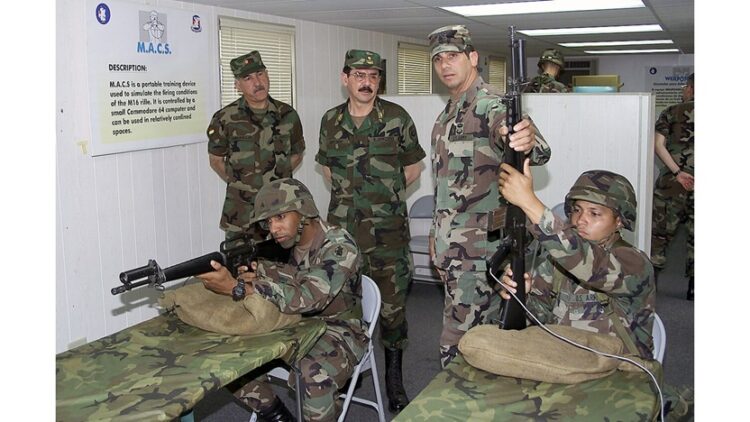
“Bolivians do wet-work well,”
Lieutenant-Colonel Shenton said.
“They shot that campsite all to hell,
And every single rebel’s dead.”
I sighed, and checked the little box
With Expedited next to it.
“These leftist scum are like the pox…
Why the damned hell won’t they quit?”
The Colonel took a heavy drag
From his stogie, hitched his pants.
“Beats me, sister. There’s a lag
Between intel and field. This dance
Of diplomats and Langley spooks
Is no sane way to run a war.”
I answered “Stupid dorks and pukes…
But they’re in charge.” And then a roar
Of throaty triumph filled the camp.
Bolivians with heavy gear
Came marching in, their ODs damp.
They croaked (in Spanish) “Where’s the beer?”
Some non-coms gestured. Soldiers ran
And dragged up tubs of clinking glass.
Hot elation filled each man—
A cheeky private grabbed my ass!
The Colonel barked, but I said “Shen,
He’s got the right to celebrate.
My butt can take it now and then.
Let’s hear about their heavy date.”
The Bolos’ mouths were all a-run
But Shenton made them cut the squawk.
A young lieutenant named Ramon
Gave the after-action talk.
“We caught them sitting in a group
Harangued by some young Marxist yap—
Can you believe the whole damned troop
Would be detailed to hear that crap?
We listened briefly to his spiel:
Self-criticism by each man,
Explaining what he thinks and feels
And how it fits the Party’s plan.
I saw no sentries anywhere—
No guards, no lookouts, not a ghost.
Perhaps they didn’t know or care.
In any case, we made the most
Of our advantage, lobbing in
A dozen mortars. It was brief—
The M-2s raked them chin to shin;
We chewed them like a coca leaf!”
Shenton grunted. “Well, let’s see…
I guess that wraps it for today.
Melissa, these guys have to pee,
So would you look the other way?”
I smiled and walked off. As I did
I heard a score of zippers yanked.
And then one Bolo, just a kid,
Shouted loudly “God be thanked!
Today it was their day to burn—
We gave the Marxists one hard smack.
Quien sabe, chicos? They’ll return
When they grow their cojones back.”
Notes
The story behind this poem was given to me by a friend, Melissa Peralta-Hovejos (a pseudonym), who worked for many years as an operative and later an agent of the CIA. A woman of Spanish birth and culture, she served mostly as a field advisor, translator, and military aide in Central and South America. Her missions were mostly clandestine, and involved supply, transport, and intel work for Guatemalan, Bolivian, and other military units that were tasked with wiping out terrorists and Communist rebels. I have written the poem in her voice, and in the voices of those military officers with whom she worked.
wet-work: Intelligence agency term for killing.
Lieutenant-Colonel Shenton: Melissa’s American military liaison on this mission in Bolivia. “Shenton” is a pseudonym.
Langley spooks: Langley, Virginia is where the CIA has its main headquarters. The term “spooks” is often used contemptuously by American military personnel for stateside CIA agents and spies, who are frequently out of touch with harsh realities on the ground where a mission is being carried out.
ODs: Olive-drab field uniforms. At that time the Bolivian military received its uniforms from United States Army quartermasters’ sources, where olive-drab was still the standard color for military garments.
Non-coms: Non-commissioned officers (sergeants, corporals, and some other grades) who served for training, organization, and administrative matters, and as a general liaison between officers and enlisted men.
Bolos: American slang for “Bolivians.”
M-2: The Browning .50-caliber M-2 heavy machine gun, a very powerful weapon.
Quien sabe, chicos?: Spanish for “Who knows, guys?”
cojones: Spanish for “testicles,” understood figuratively as “courage, nerve, guts.”
Joseph S. Salemi has published five books of poetry, and his poems, translations and scholarly articles have appeared in over one hundred publications world-wide. He is the editor of the literary magazine TRINACRIA and writes for Expansive Poetry On-line. He teaches in the Department of Humanities at New York University and in the Department of Classical Languages at Hunter College.








Wow! This well written poem truly spells out the brutality and the comradery of war. It put this reader right in the moment! An excellent poem, I must say!