• Submit Poetry
  • Support SCP
  • About Us
  • Members
  • Join
Thursday, September 3, 2026
Society of Classical Poets
  • Poems
    • Beauty
    • Culture
    • Satire
    • Humor
    • Children’s
    • Art
    • Ekphrastic
    • Epic
    • Epigrams and Proverbs
    • Human Rights in China
    • Music
    • Performing Arts
    • Riddles
    • Science
    • Song Lyrics
    • The Environment
    • The Raven
    • Found Poems
    • High School Poets
    • Terrorism
    • Covid-19
  • Poetry Forms
    • Sonnet
    • Haiku
    • Limerick
    • Villanelle
    • Rondeau
    • Pantoum
    • Sestina
    • Triolet
    • Acrostic
    • Alexandroid
    • Alliterative
    • Blank Verse
    • Chant Royal
    • Clerihew
    • Rhupunt
    • Rondeau Redoublé
    • Rondel
    • Rubaiyat
    • Sapphic Verse
    • Shape Poems
    • Terza Rima
  • Great Poets
    • Geoffrey Chaucer
    • Emily Dickinson
    • Homer
    • Henry Wadsworth Longfellow
    • Dante Alighieri
    • John Keats
    • John Milton
    • Edgar Allan Poe
    • William Shakespeare
    • William Wordsworth
    • William Blake
    • Robert Frost
  • Love Poems
  • Contests
  • SCP Academy
    • Educational
    • Teaching Classical Poetry—A Guide for Educators
    • Poetry Forms
    • The SCP Journal
    • Books
No Result
View All Result
Society of Classical Poets
  • Poems
    • Beauty
    • Culture
    • Satire
    • Humor
    • Children’s
    • Art
    • Ekphrastic
    • Epic
    • Epigrams and Proverbs
    • Human Rights in China
    • Music
    • Performing Arts
    • Riddles
    • Science
    • Song Lyrics
    • The Environment
    • The Raven
    • Found Poems
    • High School Poets
    • Terrorism
    • Covid-19
  • Poetry Forms
    • Sonnet
    • Haiku
    • Limerick
    • Villanelle
    • Rondeau
    • Pantoum
    • Sestina
    • Triolet
    • Acrostic
    • Alexandroid
    • Alliterative
    • Blank Verse
    • Chant Royal
    • Clerihew
    • Rhupunt
    • Rondeau Redoublé
    • Rondel
    • Rubaiyat
    • Sapphic Verse
    • Shape Poems
    • Terza Rima
  • Great Poets
    • Geoffrey Chaucer
    • Emily Dickinson
    • Homer
    • Henry Wadsworth Longfellow
    • Dante Alighieri
    • John Keats
    • John Milton
    • Edgar Allan Poe
    • William Shakespeare
    • William Wordsworth
    • William Blake
    • Robert Frost
  • Love Poems
  • Contests
  • SCP Academy
    • Educational
    • Teaching Classical Poetry—A Guide for Educators
    • Poetry Forms
    • The SCP Journal
    • Books
No Result
View All Result
Society of Classical Poets
No Result
View All Result
Home Poetry Culture

‘Gravitas’ by Andrew Benson Brown: On the Sack of Rome, 390 B.C.

June 6, 2022
in Culture, Poetry
A A
11
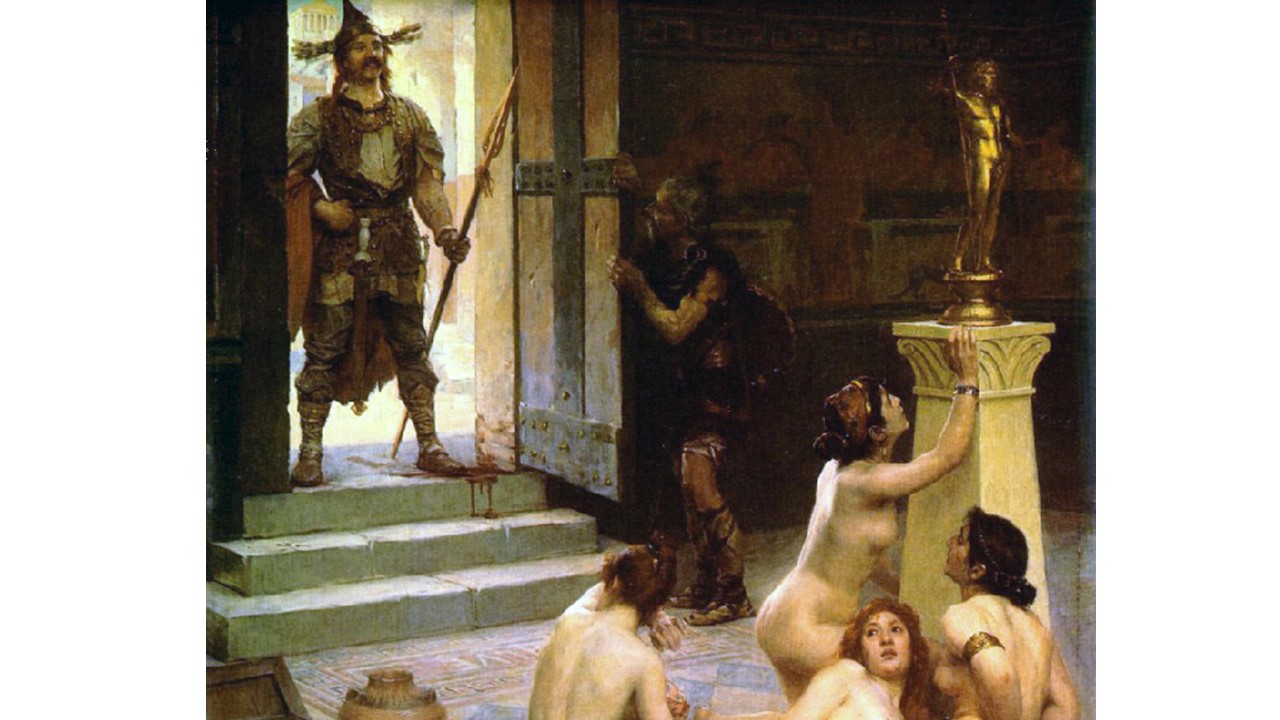
poems 'Gravitas' by Andrew Benson Brown: On the Sack of Rome, 390 B.C.

.

“Gravitas”

On the Sack of Rome by the Gauls in 390 B.C.

adapted from Livy’s “Ab Urbe Condita,” Book V, Chapters 38-42

The sunset torched the summer sky,
__The spectral moon rose round
When a shadow passed the city gates
__And staggered to the ground.

Some rushed to help the soldier up—
__He swatted them, annoyed.
He spat up blood and bitter news:
__Rome’s legions were destroyed.

“We took no auspices,” he said.
__“We did not stake our odds
Upon the ashes of our fathers
__Or the temples of our gods.

“This folly augured our defeat;
__This negligence, our doom.
For when we met the Gallic spears,
__That plain became our tomb.

“We stretched our wings, avoiding flank—
__Their front was longer, still.
The Gauls unleashed their battle cry
__And then attacked our hill.

“We were not Romans on this day.
__Our center did not hold.
We turned and blocked each other’s paths
__In panic. None were bold.

“We fled across the Tiber’s bank
__But armor weighed us down,
And in that swirling river bed
__We struggled and we drowned.

“Disorder ruled. Their javelins
__Pelted our backs in flight.
I cast my armor off and ran—
__The coward’s load is light.”

The soldier clutched his heavy heart;
__A heavy breath was drawn.
His shadow soaked the dusty earth,
__His conscience rattled on:

“The Gauls are marching on us now,
__Their force is very near.
They’re camping near the Anio—
__Tomorrow, they’ll be here.

“Cruel Brennus is their army’s chief,
__If an army’s what they are.
A locust swarm, more like, that plagues
__Our country from afar.

They’ve come for olives, figs, and grapes.
__They’ve come to starve our pride.
Against cruel Brennus, there’s no hope…”
__This said, the soldier died.

Laments rose up to fill the night,
__But grief soon turned to fear.
The howls of the barbarian
__Were heard on the frontier.

The Vestal Virgins fled to keep
__The sacred relics safe,
The peasants to the wilderness
__Where rocks and brambles chafe.

Those few who could bear arms prepared,
__With children and loud wives,
To fortify the citadel
__And fight there for their lives.

The city’s elders scorned all flight.
__Though they could not bear arms,
They would be Romans to the end,
__In spite of wild alarms.

These generals and consuls who—
__For country, family, friend—
Had won the laurels in their day,
__Knew not how knees could bend.

They clasped each younger shoulder, firm,
__And said reserved goodbyes,
Then led them to the citadel
__Amidst the women’s cries.

No speeches flowed with purple prose.
__These old patricians, calm,
Bade all remember fortune lay
__In youth’s unwrinkled palm.

These past three hundred-sixty years
__Since Rome, in sacred lore,
Was built upon the Palatine,
__It never lost a war.

Their wives did not want them to go,
__These warriors gone gray.
But guiding love to wipe wet cheeks,
__Their husbands walked away.

They donned their faded purple robes,
__These old patricians few.
With victory’s insignias,
__They held their honor true.

Instated in their noble homes
__They sat on ivory chairs,
August as thunderous Jupiter,
__Unweathered to their hairs.

Their statures hardened to the scene:
__Receding, then, to blend
With effigies of ancestors,
__They waited for the end.

The Gauls approached. The city gates
__Invited them, unbarred.
There were no shields standing watch,
__No sentinels on guard.

They gazed upon the temples, bare,
__And walked through empty streets.
Where were the soldiers who had fled?
__Where were the town elites?

The doors of plebeians were locked;
__Of nobles, open wide.
It seemed a trap. Too quiet. Then
__Bold Brennus went inside.

He marveled at mosaic glints
__That patterned every wall,
And from a verdant garden, speechless,
__Entered a marble hall.

He walked along the sculpted heads,
__Then stopping, seemed to see
A bust more lifelike than the rest—
__In kind, and not degree.

Was this the statue of a god?
__Or just a god, in plain?
It seemed, with all its gravity,
__Set down on earth to reign.

He reached out, touched its chiseled beard,
__And then received a ‘whack’—
An ivory staff came down on him
__And gave his head a crack.

The statue’s eyes, in a slow crawl,
__Met Brennus’s rude leer.
The corner of the statue’s lip
__Curled upwards in a sneer.

The Gaul’s face flushed; he plunged his blade
__In the phantom’s cool white skin.
Its graven features glazed. It dropped
__Like broken porcelain.

“Men only!” simple Brennus cried.
__“Not deities at all.”
He signaled that the rest be slain
__And watched each idol fall.

The elders’ deaths unfettered chaos:
__Plunder knew no shame.
Each house was pillaged, none were spared,
__The temples set aflame.

The citadel looked on and mourned
__Its crying, crackling land.
Nails tore at hair, fists gripped their swords
__To make a final stand.

And when youth triumphed and rebuilt,
__For ages, none would stray
From the example of their elders
__And the lesson of that day.

That citadel is long since razed,
__Its wardens dead and gone,
And few now living can recall
__Those elders, that red dawn.

Such ancient virtue, though, still lives
__In Livy’s dusty tome,
A state of worth all hearts should know:
__The dignity of Rome.

.

.

Andrew Benson Brown has had poems and reviews published in a few journals. His epic-in-progress, Legends of Liberty, will chronicle the major events of the American Revolution if he lives to complete it. Though he writes history articles for American Essence magazine, he lists his primary occupation on official forms as ‘poet.’ He is, in other words, a vagabond.
ShareTweetPin
The Society of Classical Poets does not endorse any views expressed in individual poems or commentary.
Read Our Comments Policy Here

RandomPoems

‘Death in the Desert’ by Michael Glassman
Poetry

‘Death in the Desert’ by Michael Glassman

February 23, 2017

  Heat waves frolic along the desert’s endless edge I hear the shuffling of camel’s toes The soft landing of...

‘Sonnet on the Death of a Friend’ and Other Poetry by Pete Dashwood
Beauty

‘Sonnet on the Death of a Friend’ and Other Poetry by Pete Dashwood

February 23, 2015

  Sonnet on the Death of a Friend Throughout our lives we have the love of some Our family, our...

Next Post
‘A Tribune to Mrs. Malaprop’ by Brian Yapko

'A Tribune to Mrs. Malaprop' by Brian Yapko

‘Nature at Peace’ and Other Poems by James A. Tweedie

'Nature at Peace' and Other Poems by James A. Tweedie

Two Sonnets on the Epstein-Maxwell Case, by Shaun C. Duncan

Two Sonnets on the Epstein-Maxwell Case, by Shaun C. Duncan

Comments 11

  1. James Sale says:
    4 years ago

    Fabulous Andrew – the style even recalls Macaulay’s The Lays of Ancient Rome. What a topic in this our very uneven times when the Western empire seems fraught, frayed and if we are not careful likely to fall. Reminding ourselves of why empires – usually from within so that someone from without has an easy ride – fall is important. I love the line of ‘broken porcelain’ – exactly. The gesture of the elders seemed pointless – and of course worse was to come.

    Reply
    • AB Brown says:
      4 years ago

      Thanks, James—yes, Macaulay was the clear inspiration. One of the most famous poets of the 19th C, read by generations of schoolchildren, and now nobody’s ever heard of him. Gotta keep the tradition alive!
      Of course, many things that are pointless in the moment take on value for the future—some of the poetry on this site, for instance! And vice versa…the boor with his mind rooted in the immediately practical, who thinks that art, philosophy, etc. are just “air,” has no future at all. Maybe he’ll go to heaven, but not sure why God would want him there since there are no light bulbs to fix.

      Reply
  2. Shaun C. Duncan says:
    4 years ago

    This is an extremely compelling narrative which also features some stunning imagery. You’ve used the ballad form to its full propulsive advantage and have managed to craft a story which is almost cinematic in the telling. Outstanding work.

    Reply
    • AB Brown says:
      4 years ago

      Thank you, Shaun. Your abilities of poetical analysis seem rather considerable. The ballad form is a simple but powerful vehicle for narrative verse. Because of its simplicity and lack of overt sophistication, I think it has often been looked down upon by some highbrows because of its popular connotations—the work of the Fireside Poets being good examples. The only ballad I can think of that has not fallen out of the Canon is the Rime of the Ancient Mariner.

      Reply
  3. Michael Pietrack says:
    4 years ago

    Excellent with many brilliant lines. The construction reveals the mastery as the reader can read without a pausing glitch. It’s like a quarterback who throws an easy ball to catch. World-class toss ABB!

    My favorite line:
    “A coward’s load is light”

    Favorite stanza:
    Their wives did not want them to go,
    __These warriors gone gray.
    But guiding love to wipe wet cheeks,
    Their husbands walked away.

    Reply
    • ABB says:
      4 years ago

      MP—you are the Travis Kelce to my Mahomes. I may need to purchase a KC Chiefs Kelce jersey on your behalf, and we can attend formal literary events in them.

      While the coward’s load is light, I tried to emphasize in the next few lines that his physiological state undermined his own statement.

      Reply
  4. Margaret Coats says:
    4 years ago

    A splendid story, Andrew. The focal portion is symphonically slow and weighty, showing Brennus in awe of the material scene he sees in Rome, along with the surprising defiance of the courageous elder he meets. This long stretch prepares the ultimate message of the piece, attributing later victory and rebuilding, and centuries of the city’s invincibility, to the memory of the aged patricians’ valor at this moment. Maybe they were gods, after all.

    Reply
    • ABB says:
      4 years ago

      Appreciate you as always, Margaret. This is my favorite episode from the first 10 books of Livy, which is filled with great episodes. Livy and his super-patriotism played a huge role in transmitting the glory of Rome to future generations, though at this point they were still one city-state among others. Though the (original) Eternal City has fallen, there will always be movies about it, at least.

      Reply
  5. The Society says:
    4 years ago

    An inspiring piece in dark times. Thank you for this, Andrew.

    Evan

    Reply
    • ABB says:
      4 years ago

      Glad to inspire. But don’t go making a martyr of yourself just yet! …I say this because you seem to possess a number of saintlike qualities…

      Reply
  6. themindflayer says:
    4 years ago

    A rousing poem of phenomenal control despite its ruinous and military dimensions. I agree with Michael Pietrack that my favourite line is “A coward’s load is light”. However, my favourite stanza would have to be:

    These generals and consuls who—
    __For country, family, friend—
    Had won the laurels in their day,
    __Knew not how knees could bend.

    Such an invocation of heroism!

    I also love the theme of idolatry and false gods running throughout the poem: the soldier claims they did not correctly honour the gods, which explains why ruin is coming to Rome. Yet at the end, the patricians themselves are mistaken for gods, and it is almost enough to hold back their demise. A fascinating commentary on empire, self-aggrandising civilisations, and of course the power of story itself. As always, Benson-Brown delivers exquisite poetry!

    Reply

Leave a Reply Cancel reply

Your email address will not be published. Required fields are marked *


  1. Joseph S. Salemi on ‘A Potpourri of Aphoristic Verses’ by C.B. AndersonSeptember 3, 2026

    These are perfect gnomic verses. They follow the tradition of ancient gnomic poetry-- short, concise, and pithy, while packed with…

  2. Roy Eugene Peterson on ‘A Potpourri of Aphoristic Verses’ by C.B. AndersonSeptember 3, 2026

    C.B., these are all award-winning couplets of wisdom with humorous presentation. These are all relatable with sound advice in the…

  3. Margaret Coats on ‘The Estuary’: A Poem by Jeff EardleySeptember 3, 2026

    "We ran to seek it every day," in the first half of the poem, gives the child's point of view…

  4. Josh Olson on ‘A World Without the Wednesday Child’: A Poem by Kimberly ForeSeptember 3, 2026

    This is a truly lovely poem—technically accomplished, fluent, flowing, and delightfully unstrained in use of rhyme (a real accomplishment in…

  5. Peter Pindar on The Society of Classical Poets 2026 Haiku CompetitionSeptember 3, 2026

    I would like to resubmit if it is not too late: There is much to do And no peace to…

Subscribe to Daily Poems

Enter your email address to subscribe to this blog and receive notifications of new posts by email.

Join 1,634 other subscribers

Recent Poems

  • ‘A Potpourri of Aphoristic Verses’ by C.B. Anderson
  • ‘The Estuary’: A Poem by Jeff Eardley
  • ‘A World Without the Wednesday Child’: A Poem by Kimberly Fore
  • The 2026 Society of Classical Poets International Poetry Competition
  • The 2026 SCP International High School Poetry Competition
  • ‘Realistic Reflections’ and Other Poetry by Anna J. Arredondo
  • ‘China Made’: A Poem by Theresa Werba
  • ‘The Savage Moon’ and Other Poetry by Brian Yapko
  • Poetry Book Review: Love Found, Yearned For, and Lost by James A. Tweedie
  • ‘When Opportunity Knocks’: A Poem by Roy E. Peterson
  • ‘Legend of the Griffin’: A Poem by Iryna Hall
  • ‘Government Issue’ and Other Poems by Joseph S. Salemi
  • ‘Chaucer Announces His Desire to Retire’: A Poem by Paul A. Freeman
  • ‘Advantages of Restaurants’ and Other Poems by Russel Winick
  • ‘Bone China’: A Poem by Mary Gardner
  • ‘On the Death of One Too Young to Die’: A Poem by Jeffrey Essmann
  • ‘This Too Shall Pass’ and Other Poetry by Justin Dasher
  • ‘Humdrum and Harum-Scarum’: A Lecture on Free Verse, by Robert Bridges (1922)
  • ‘Unrest On the Floodplain’: A Poem by Bhikkhu Nyanasobhano
  • ‘Latitude and Loss’: A Poem by Martin Briggs
  • ‘Act III’ and Other Poetry by C.B. Anderson
  • ‘God’s Funeral’: A Poem by James Sale
  • ‘Star Festival’: A Poem by Margaret Coats
  • ‘Song of the Frog Princess’: A Poem by Scharlie Meeuws
  • ‘The Odyssey: Nolan and Solot Compared’: An Essay by Michael Curtis
  • ‘Solitude’ and Other Poems by Mary Jane Myers
  • ‘The River Not Taken’ and Other Poetry by Brian Yapko
  • ‘Totentanz’: A Poem by James A. Tweedie
  • ‘In God Is Our Trust’: A Poem by Roy E. Peterson
  • ‘Confession’: A Poem by Jeffrey Essmann

Categories

  • Acrostic
  • Alexandroid
  • Alliterative
  • Art
  • Best Poems
  • Blank Verse
  • Chant Royal
  • Classical Poets Live
  • Clerihew
  • Covid-19
  • Deconstructing Communism
  • Educational
  • Epic
  • Epigrams and Proverbs
  • Essays
    • Interviews with Poets
    • Poetry Reviews
  • Featured
  • From the Society
  • Great Poets
    • Dante Alighieri
    • Edgar Allan Poe
    • Emily Dickinson
    • Geoffrey Chaucer
    • Henry Wadsworth Longfellow
    • Homer
    • John Keats
    • John Milton
    • Robert Frost
    • William Blake
    • William Shakespeare
    • William Wordsworth
  • Human Rights in China
  • Limerick
  • Love Poems
  • Music
  • Pantoum
  • Performing Arts
  • Poetry
    • Beauty
    • Children's Poems
    • Culture
    • Ekphrastic
    • Found Poems
    • High School Poets
    • Humor
    • Riddles
  • Poetry Challenge
  • Poetry Contests
  • Poetry Forms
    • Curtal Sonnet
    • Haiku
  • Poetry Readings
  • Rhupunt
  • Rondeau
  • Rondeau Redoublé
  • Rondel
  • Rubaiyat
  • Sapphic Verse
  • Satire
  • Science
  • Sestina
  • Shape Poems
  • Short Stories
  • Song Lyrics
  • Sonnet
  • Symposium
  • Terrorism
  • Terza Rima
  • The Environment
  • Translation
  • Triolet
  • Video
  • Villanelle

Quick Links

  • About Us
  • Submit Poetry
  • Become a Member
  • Members List
  • Support the Society
  • Advertisement Placement
  • Comments Policy
  • Terms of Use

Welcome Back!

Login to your account below

Forgotten Password?

Retrieve your password

Please enter your username or email address to reset your password.

Log In
No Result
View All Result
  • Poems
    • Beauty
    • Culture
    • Satire
    • Humor
    • Children’s
    • Art
    • Ekphrastic
    • Epic
    • Epigrams and Proverbs
    • Human Rights in China
    • Music
    • Performing Arts
    • Riddles
    • Science
    • Song Lyrics
    • The Environment
    • The Raven
    • Found Poems
    • High School Poets
    • Terrorism
    • Covid-19
  • Poetry Forms
    • Sonnet
    • Haiku
    • Limerick
    • Villanelle
    • Rondeau
    • Pantoum
    • Sestina
    • Triolet
    • Acrostic
    • Alexandroid
    • Alliterative
    • Blank Verse
    • Chant Royal
    • Clerihew
    • Rhupunt
    • Rondeau Redoublé
    • Rondel
    • Rubaiyat
    • Sapphic Verse
    • Shape Poems
    • Terza Rima
  • Great Poets
    • Geoffrey Chaucer
    • Emily Dickinson
    • Homer
    • Henry Wadsworth Longfellow
    • Dante Alighieri
    • John Keats
    • John Milton
    • Edgar Allan Poe
    • William Shakespeare
    • William Wordsworth
    • William Blake
    • Robert Frost
  • Love Poems
  • Contests
  • SCP Academy
    • Educational
    • Teaching Classical Poetry—A Guide for Educators
    • Poetry Forms
    • The SCP Journal
    • Books

© 2025 SCP. WebDesign by CODEC Prime.