• Submit Poetry
  • Support SCP
  • About Us
  • Members
  • Join
Friday, September 4, 2026
Society of Classical Poets
  • Poems
    • Beauty
    • Culture
    • Satire
    • Humor
    • Children’s
    • Art
    • Ekphrastic
    • Epic
    • Epigrams and Proverbs
    • Human Rights in China
    • Music
    • Performing Arts
    • Riddles
    • Science
    • Song Lyrics
    • The Environment
    • The Raven
    • Found Poems
    • High School Poets
    • Terrorism
    • Covid-19
  • Poetry Forms
    • Sonnet
    • Haiku
    • Limerick
    • Villanelle
    • Rondeau
    • Pantoum
    • Sestina
    • Triolet
    • Acrostic
    • Alexandroid
    • Alliterative
    • Blank Verse
    • Chant Royal
    • Clerihew
    • Rhupunt
    • Rondeau Redoublé
    • Rondel
    • Rubaiyat
    • Sapphic Verse
    • Shape Poems
    • Terza Rima
  • Great Poets
    • Geoffrey Chaucer
    • Emily Dickinson
    • Homer
    • Henry Wadsworth Longfellow
    • Dante Alighieri
    • John Keats
    • John Milton
    • Edgar Allan Poe
    • William Shakespeare
    • William Wordsworth
    • William Blake
    • Robert Frost
  • Love Poems
  • Contests
  • SCP Academy
    • Educational
    • Teaching Classical Poetry—A Guide for Educators
    • Poetry Forms
    • The SCP Journal
    • Books
No Result
View All Result
Society of Classical Poets
  • Poems
    • Beauty
    • Culture
    • Satire
    • Humor
    • Children’s
    • Art
    • Ekphrastic
    • Epic
    • Epigrams and Proverbs
    • Human Rights in China
    • Music
    • Performing Arts
    • Riddles
    • Science
    • Song Lyrics
    • The Environment
    • The Raven
    • Found Poems
    • High School Poets
    • Terrorism
    • Covid-19
  • Poetry Forms
    • Sonnet
    • Haiku
    • Limerick
    • Villanelle
    • Rondeau
    • Pantoum
    • Sestina
    • Triolet
    • Acrostic
    • Alexandroid
    • Alliterative
    • Blank Verse
    • Chant Royal
    • Clerihew
    • Rhupunt
    • Rondeau Redoublé
    • Rondel
    • Rubaiyat
    • Sapphic Verse
    • Shape Poems
    • Terza Rima
  • Great Poets
    • Geoffrey Chaucer
    • Emily Dickinson
    • Homer
    • Henry Wadsworth Longfellow
    • Dante Alighieri
    • John Keats
    • John Milton
    • Edgar Allan Poe
    • William Shakespeare
    • William Wordsworth
    • William Blake
    • Robert Frost
  • Love Poems
  • Contests
  • SCP Academy
    • Educational
    • Teaching Classical Poetry—A Guide for Educators
    • Poetry Forms
    • The SCP Journal
    • Books
No Result
View All Result
Society of Classical Poets
No Result
View All Result
Home Poetry Culture

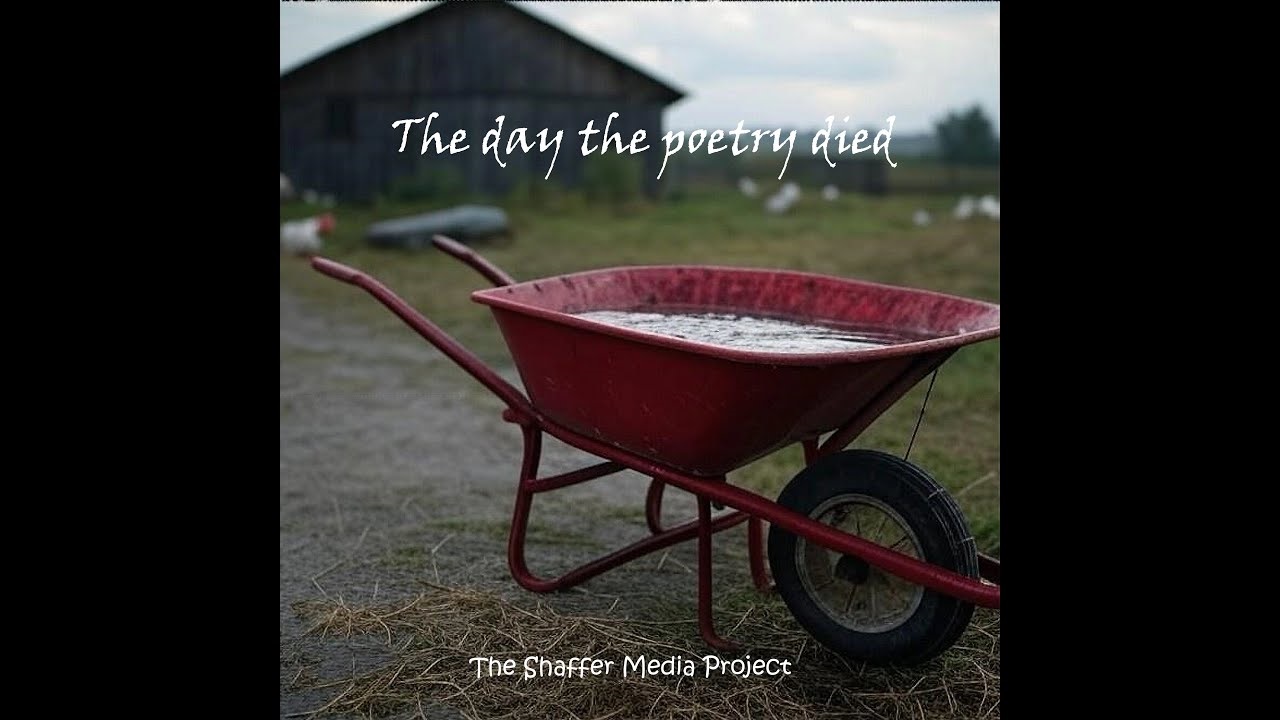
Song Version of ‘The Day the Poetry Died’ by Steve Shaffer

January 16, 2025
in Culture, Music, Poetry
A A
23
poems Song Version of 'The Day the Poetry Died' by Steve Shaffer

.

.

This is song was originally a poem published by the Society of Classical Poets in March, 2018.

.

The Day the Poetry Died

Wonder why poetry is in decline,
While not ever writing one lyric line?
There is no experience more perverse,
Than self-indulgent poems in free verse.
Your pain, your angst, and existential doubt,
Pretension endured day in and day out.
Deep thoughts, believed you’re the first to discern,
Which all human-kind must now be concerned.
Substance, once required in days gone by,
Now regurgitated thoughts do qualify.
Banal pabulums we already know,
If you can’t be deep, at least have a flow!
Dryden and Pope are cut to the marrow,
When we’re taught to adore “The red wheelbarrow.”
Free verse, written without breaking a sweat,
It’s “like playing tennis without a net.”

.

.

Steven C. Shaffer is on the faculty of Penn State (University Park) and is the writer/director of the multi-award winning film “Appealing” and the award-winning “The Ultimate Question.” His recent passion is turning classical poetry into contemporary music. More information is available at ShafferMediaEnterprises.com 
ShareTweetPin
The Society of Classical Poets does not endorse any views expressed in individual poems or commentary.
Read Our Comments Policy Here

RandomPoems

‘Coastal Shingle’ and Other Poetry by Len Krisak
Beauty

‘Coastal Shingle’ and Other Poetry by Len Krisak

May 27, 2014

Coastal Shingle There, totem-stacked in paratactic charm, The words cascade: Hay.Shavings.Piglets.Straw. I had not sought a sign from Salt Marsh...

On Robert Frost’s ‘The Pasture’ and William Carlos Williams’ ‘The Red Wheelbarrow’
Essays

On Robert Frost’s ‘The Pasture’ and William Carlos Williams’ ‘The Red Wheelbarrow’

March 7, 2017

By Wilbur Dee Case One of the most unlikely poems of the Modernist period is that by Robert Frost: "The...

Next Post
‘Elusive Illusive Art’ and Other Poetry by Mike Ruskovich

'Elusive Illusive Art' and Other Poetry by Mike Ruskovich

‘Best of the Windy City’: A Poem on Chicago and Other Poems by Russel Winick

'Best of the Windy City': A Poem on Chicago and Other Poems by Russel Winick

‘Pearls or Swine?’: A Rondeau Redoublé and a Villanelle by Susan Jarvis Bryant

'Pearls or Swine?': A Rondeau Redoublé and a Villanelle by Susan Jarvis Bryant

Comments 23

  1. Mark Stellinga says:
    2 years ago

    Couldn’t agree with you more, Steven, as this little diddy clearly expresses –

    I write a little ‘touchy-feelie’ poetry now and then, in keeping with the trend on which the genre’s long been based,
    But far more often whip up works for which the ‘schooled’ patrons — those ingrained with ‘Modernism’ — tend to have no taste!

    Adhering to ‘convention’ – for an author – is a nightmare… stifling creativity – especially for the bard –
    And I refuse to fall in line with those who’ve fled the fold of we who pen in metered rhyme — just because it’s hard!

    So, if an’ when you get to where you’ve fin’ly grasped the concept — understand explicitly what millions clearly favor —
    Take a stab at whippin’ up a — ‘metered-rhyme’ desert — then find yourself a critic who can scrutinize its flavor —

    (Someone who’s been penning ‘Verse’ religiously for years. Someone like myself — which anymore is tough to find —
    Who’s chosen, unrelentingly, to stoke the hungry fires in those who feel deprived of what they claim’s their – ‘favorite kind’) —

    And see if they agree or not with what my queries yield — the very same statistics I come up with every year —
    That… while the FINEST ‘prose’ is oft preferred to NOVICE ‘verse’… it’s rarely what the patrons that I quiz are keen to hear!

    I’m praying that the day will come when someone builds a refuge set aside exclusively for works of ‘metered rhyme’,
    And does so fairly soon because the genre’s awfully weak… and — while I’m here to do my part — we’re running out of time!

    Super job on an issue of ‘ART’ now more important than ever to ‘authentic’ poets –

    Reply
  2. jd says:
    2 years ago

    Well done, Peter, and passionate, both
    the poem and its musical rendition.

    Reply
  3. Roy E. Peterson says:
    2 years ago

    As I have often said, “a poem without rhyme is a waste of time.” You used the perfect word, “self-indulgent,” for those who write free verse lacking in talent and ability to use meter and rhyme while focusing on the “banal.” These pretenders with “pretensions” pander to those with pain, angst, and existential doubt. Your poem is sweepingly on target. By the way, your tenor voice is excellent and on pitch.

    Reply
    • Joseph S. Salemi says:
      2 years ago

      Rhyme is wonderful and pleasant, but let’s all keep in mind that blank verse is an old and honored part of our English tradition, and ancient verse in Greek and Latin did not rhyme at all. And some serious subjects in a poem would be absurd if expressed in rhyme.

      Reply
  4. C.B. Anderson says:
    2 years ago

    Good sentiments, a fair analysis, and a great production.

    Reply
  5. Russel Winick says:
    2 years ago

    99% of what I write is in metered rhyme, and most free verse out there does little for me too. But the following well known poem by Langston Hughes contains scant rhyme or meter, yet it inspired me tremendously at the age of 14, and was greatly responsible for my deciding to take up poetry 50 years later. Thus, I would very much appreciate hearing what folks like Joseph, Margaret, Susan, Brian, etc., who are far more knowledgeable than I, think of the poetic worthiness of a work like this. Thanks in advance to anyone who cares to reply.

    MOTHER TO SON
    By Langston Hughes

    Well, son, I’ll tell you:
    Life for me ain’t been no crystal stair.
    It’s had tacks in it,
    And splinters,
    And boards torn up,
    And places with no carpet on the floor—
    Bare.
    But all the time
    I’se been a-climbin’ on,
    And reachin’ landin’s,
    And turnin’ corners,
    And sometimes goin’ in the dark
    Where there ain’t been no light.
    So boy, don’t you turn back.
    Don’t you set down on the steps
    ’Cause you finds it’s kinder hard.
    Don’t you fall now—
    For I’se still goin’, honey,
    I’se still climbin’,
    And life for me ain’t been no crystal stair.

    Reply
    • Joseph S. Salemi says:
      2 years ago

      Hughes often wrote in lower-class Black dialect, though of course he could also compose in perfect standard English. Believe it or not, this was sometimes held against him by snobbish middle-class members of his race who felt that the lower-class Black dialect was degrading and insulting, and should be eliminated or ignored.

      But Hughes knew that he couldn’t give a genuine voice to some characters without using their actual language. This free-verse poem of a mother’s advice to her son is excellent work, and it would have never succeeded if it had been put into standard English, with regularized meter.

      Hatred of dialect, I have discovered, is a marker of upper middle-class attitudes all over the world.

      Reply
      • Russel Winick says:
        2 years ago

        Thanks for your insights, Professor!

        Reply
    • Susan Jarvis Bryant says:
      2 years ago

      Russel, I have a great appreciation for Langston Hughes’ poetry whose collection has a place on my bookshelf. I’ve read Dr. Salemi’s comment with great interest. For me, it is most certainly the “lower-class Black dialect” that makes this poem so successful – it gives it a depth that touches the heart. It touched me twenty years ago when I gave it to my son in the hope the poem would encourage a wayward teenager to grab life with confidence, take responsibility, and to achieve greater success than his mother… It worked.

      Reply
      • Russel Winick says:
        2 years ago

        That’s a great story, Susan. Here’s another. Last year I made a special trip to where Langston Hughes’ ashes are buried in Harlem (inside the former “colored” public library where he spent much time as a young man a century ago), got down on one knee, and thanked him for his immense contribution to my life.

        Reply
      • Susan Jarvis Bryant says:
        2 years ago

        How wonderful, Russel! The power of words is incredible, which is why we poets love words so very much. Langston Hughes was a remarkable poet and a remarkable man. His legacy is all important as your beautiful story proves.

        Reply
    • Brian A. Yapko says:
      2 years ago

      Russel, I have an appreciation for contemporary verse that stemmed from my encounters with Sylvia Plath as an undergrad literature major. In my view there are a great many aspects of human experience which cannot and perhaps should not be shoe-horned into meter or rhyme. This moving Langston Hughes poem is one of them. However, I think “Mother to Son” is actually a hybrid of free verse and classical since I perceive significant echoes of classicism in the meter of some (not all!) of the long lines (LIFE for ME aint BEEN no CRYStal STAIR) and the faded echo between “stair” and “bare.” This poem, though written in a Harlem idiom, is a dramatic monologue with a powerful and evocative voice which would sound inauthentic if the speaker were forced to speak in more formal meter. For me, dramatic monologues must always be true to the speaker — their education level, their social status, their ability to articulate emotion. And that may necessarily include the use of dialect.

      It may surprise you to know that the vast majority of the poetry journals I’ve been published in present poems I’ve written in free verse. I respect free verse — to a point. There MUST be craft behind it and not just navel-gazing. It must not be prose with arbitrary line-breaks. If we are to give up rhyme and meter than every choice a free-verse poet makes must be non-random and defensible. And even with that caveat, my heart is in classical poetry. This may change, but for almost two years now it’s the only kind of poetry I’ve been interested in writing. As between free verse and classical poetry, I believe it’s classical poetry which is more likely to endure.

      Reply
      • Russel Winick says:
        2 years ago

        Thanks Brian – I’m in complete agreement with you, and also have written and published a number of free verse poems, where metered rhyme absolutely wouldn’t work.

        Reply
    • Brian A. Yapko says:
      2 years ago

      Russel, please see my reply below.

      Reply
  6. Steven Shaffer says:
    2 years ago

    Thanks, all, for the comments.
    Russel, certainly there can be exceptions!

    Anyone who enjoyed this song might also enjoy
    “Where Angels Fear to Tread” at https://youtu.be/EXmrH-Zvd-o
    — yes, I turned Alexander Pope into a rock song 😮

    These songs and 8 others are available on Spotify at
    https://open.spotify.com/album/56XEb5SmfK7AKMsCby6R8x

    Or see the videos at OpenHeartSurgeryAlbum.com

    I hope you enjoy them!

    Steve Shaffer

    Reply
  7. Susan Jarvis Bryant says:
    2 years ago

    How did I miss this? I’ve enjoyed every line, but especially the closing four and the musical production takes the message to eagle-soaring heights. Thank you, Steve!

    Reply
    • Steven Shaffer says:
      2 years ago

      Wow! Thanks for that. I hope you enjoy the others as well.

      Reply
  8. Brian A. Yapko says:
    2 years ago

    Steven, I very much enjoyed the poem and the musical treatment! The song is magnificent and proves an important point — music could not have been comfortably written to a free verse poem. But a classical poem with meter and rhyme is a natural at receiving a musical setting. Well done!

    Reply
    • Steven Shaffer says:
      2 years ago

      Thanks! I’m glad you liked it 🙂

      Reply
  9. Steven Shaffer says:
    2 years ago

    I’m not trying to extend the conversation too much, but I just posted a haunting musical version of “The Tiger” by William Blake to the web site, in case anyone is interested.

    Reply
  10. Steven Shaffer says:
    2 years ago

    Hi again all —

    I created a web page called ClassicalPoetryRules.com where you can find an ever-increasing set up examples of good music made from great (classic/famous) poetry. The songs from the original album remain at OpenHeartSurgeryAlbum.com — check them out, I think you’ll enjoy it!

    Steve Shaffer

    Reply
  11. Michael Pendragon says:
    1 year ago

    I love this poem, Steven. I first discovered it a few months ago when the co-runner of my poetry group posted a link to the youtube video.

    The Red Wheelbarrow has long been the butt of a running joke in my house, as the quintessential example of bad modern poetry. My children (now adults) each had to learn it in high school and hate it with a passion.

    I’m trying to lure talented traditional poets to our poetry group at https://www.facebook.com/groups/184972343500393/ and would love to see you there.

    We publish a monthly e-zine and a yearly print anthology, to showcase the work of our members. Hope to see you there soon.

    Reply
    • Steven Shaffer says:
      1 year ago

      Hi — I just signed up for the group — thanks for the invite!

      Reply

Leave a Reply Cancel reply

Your email address will not be published. Required fields are marked *


  1. Roy Eugene Peterson on ‘The Cristero Centennial’: A Poem by Margaret CoatsSeptember 4, 2026

    This is a fantastic preview of what could happen here! What a great treatment of classical historical proportions. I remember…

  2. BDW on ‘A Prayer of Aristotle’: A Poem by Margaret CoatsSeptember 4, 2026

    Eternal Laws by Esiad L Werecub “The Sun proceeds unmoved…” —Emily Dickinson This figure is not a creator, this self-thinking…

  3. Jeff Eardley on ‘The Estuary’: A Poem by Jeff EardleySeptember 4, 2026

    Margaret, thank you for taking the time to comment. Your work and your analytic contributions are a huge part of…

  4. Jeff Eardley on ‘The Estuary’: A Poem by Jeff EardleySeptember 4, 2026

    Norma, so did I. I recall heading for the sea in an amphibious vehicle called a DUKW. Happy .days indeed.

  5. Margaret Coats on ‘A Prayer of Aristotle’: A Poem by Margaret CoatsSeptember 4, 2026

    Thanks, Bruce, you offer luxurious appreciation of valuable prose which is mostly Greek to us, even when we've learned to…

Subscribe to Daily Poems

Enter your email address to subscribe to this blog and receive notifications of new posts by email.

Join 1,634 other subscribers

Recent Poems

  • ‘The Cristero Centennial’: A Poem by Margaret Coats
  • ‘A Potpourri of Aphoristic Verses’ by C.B. Anderson
  • ‘The Estuary’: A Poem by Jeff Eardley
  • ‘A World Without the Wednesday Child’: A Poem by Kimberly Fore
  • The 2026 Society of Classical Poets International Poetry Competition
  • The 2026 SCP International High School Poetry Competition
  • ‘Realistic Reflections’ and Other Poetry by Anna J. Arredondo
  • ‘China Made’: A Poem by Theresa Werba
  • ‘The Savage Moon’ and Other Poetry by Brian Yapko
  • Poetry Book Review: Love Found, Yearned For, and Lost by James A. Tweedie
  • ‘When Opportunity Knocks’: A Poem by Roy E. Peterson
  • ‘Legend of the Griffin’: A Poem by Iryna Hall
  • ‘Government Issue’ and Other Poems by Joseph S. Salemi
  • ‘Chaucer Announces His Desire to Retire’: A Poem by Paul A. Freeman
  • ‘Advantages of Restaurants’ and Other Poems by Russel Winick
  • ‘Bone China’: A Poem by Mary Gardner
  • ‘On the Death of One Too Young to Die’: A Poem by Jeffrey Essmann
  • ‘This Too Shall Pass’ and Other Poetry by Justin Dasher
  • ‘Humdrum and Harum-Scarum’: A Lecture on Free Verse, by Robert Bridges (1922)
  • ‘Unrest On the Floodplain’: A Poem by Bhikkhu Nyanasobhano
  • ‘Latitude and Loss’: A Poem by Martin Briggs
  • ‘Act III’ and Other Poetry by C.B. Anderson
  • ‘God’s Funeral’: A Poem by James Sale
  • ‘Star Festival’: A Poem by Margaret Coats
  • ‘Song of the Frog Princess’: A Poem by Scharlie Meeuws
  • ‘The Odyssey: Nolan and Solot Compared’: An Essay by Michael Curtis
  • ‘Solitude’ and Other Poems by Mary Jane Myers
  • ‘The River Not Taken’ and Other Poetry by Brian Yapko
  • ‘Totentanz’: A Poem by James A. Tweedie
  • ‘In God Is Our Trust’: A Poem by Roy E. Peterson

Categories

  • Acrostic
  • Alexandroid
  • Alliterative
  • Art
  • Best Poems
  • Blank Verse
  • Chant Royal
  • Classical Poets Live
  • Clerihew
  • Covid-19
  • Deconstructing Communism
  • Educational
  • Epic
  • Epigrams and Proverbs
  • Essays
    • Interviews with Poets
    • Poetry Reviews
  • Featured
  • From the Society
  • Great Poets
    • Dante Alighieri
    • Edgar Allan Poe
    • Emily Dickinson
    • Geoffrey Chaucer
    • Henry Wadsworth Longfellow
    • Homer
    • John Keats
    • John Milton
    • Robert Frost
    • William Blake
    • William Shakespeare
    • William Wordsworth
  • Human Rights in China
  • Limerick
  • Love Poems
  • Music
  • Pantoum
  • Performing Arts
  • Poetry
    • Beauty
    • Children's Poems
    • Culture
    • Ekphrastic
    • Found Poems
    • High School Poets
    • Humor
    • Riddles
  • Poetry Challenge
  • Poetry Contests
  • Poetry Forms
    • Curtal Sonnet
    • Haiku
  • Poetry Readings
  • Rhupunt
  • Rondeau
  • Rondeau Redoublé
  • Rondel
  • Rubaiyat
  • Sapphic Verse
  • Satire
  • Science
  • Sestina
  • Shape Poems
  • Short Stories
  • Song Lyrics
  • Sonnet
  • Symposium
  • Terrorism
  • Terza Rima
  • The Environment
  • Translation
  • Triolet
  • Video
  • Villanelle

Quick Links

  • About Us
  • Submit Poetry
  • Become a Member
  • Members List
  • Support the Society
  • Advertisement Placement
  • Comments Policy
  • Terms of Use

Welcome Back!

Login to your account below

Forgotten Password?

Retrieve your password

Please enter your username or email address to reset your password.

Log In
No Result
View All Result
  • Poems
    • Beauty
    • Culture
    • Satire
    • Humor
    • Children’s
    • Art
    • Ekphrastic
    • Epic
    • Epigrams and Proverbs
    • Human Rights in China
    • Music
    • Performing Arts
    • Riddles
    • Science
    • Song Lyrics
    • The Environment
    • The Raven
    • Found Poems
    • High School Poets
    • Terrorism
    • Covid-19
  • Poetry Forms
    • Sonnet
    • Haiku
    • Limerick
    • Villanelle
    • Rondeau
    • Pantoum
    • Sestina
    • Triolet
    • Acrostic
    • Alexandroid
    • Alliterative
    • Blank Verse
    • Chant Royal
    • Clerihew
    • Rhupunt
    • Rondeau Redoublé
    • Rondel
    • Rubaiyat
    • Sapphic Verse
    • Shape Poems
    • Terza Rima
  • Great Poets
    • Geoffrey Chaucer
    • Emily Dickinson
    • Homer
    • Henry Wadsworth Longfellow
    • Dante Alighieri
    • John Keats
    • John Milton
    • Edgar Allan Poe
    • William Shakespeare
    • William Wordsworth
    • William Blake
    • Robert Frost
  • Love Poems
  • Contests
  • SCP Academy
    • Educational
    • Teaching Classical Poetry—A Guide for Educators
    • Poetry Forms
    • The SCP Journal
    • Books

© 2025 SCP. WebDesign by CODEC Prime.