• Submit Poetry
  • Support SCP
  • About Us
  • Members
  • Join
Saturday, September 5, 2026
Society of Classical Poets
  • Poems
    • Beauty
    • Culture
    • Satire
    • Humor
    • Children’s
    • Art
    • Ekphrastic
    • Epic
    • Epigrams and Proverbs
    • Human Rights in China
    • Music
    • Performing Arts
    • Riddles
    • Science
    • Song Lyrics
    • The Environment
    • The Raven
    • Found Poems
    • High School Poets
    • Terrorism
    • Covid-19
  • Poetry Forms
    • Sonnet
    • Haiku
    • Limerick
    • Villanelle
    • Rondeau
    • Pantoum
    • Sestina
    • Triolet
    • Acrostic
    • Alexandroid
    • Alliterative
    • Blank Verse
    • Chant Royal
    • Clerihew
    • Rhupunt
    • Rondeau Redoublé
    • Rondel
    • Rubaiyat
    • Sapphic Verse
    • Shape Poems
    • Terza Rima
  • Great Poets
    • Geoffrey Chaucer
    • Emily Dickinson
    • Homer
    • Henry Wadsworth Longfellow
    • Dante Alighieri
    • John Keats
    • John Milton
    • Edgar Allan Poe
    • William Shakespeare
    • William Wordsworth
    • William Blake
    • Robert Frost
  • Love Poems
  • Contests
  • SCP Academy
    • Educational
    • Teaching Classical Poetry—A Guide for Educators
    • Poetry Forms
    • The SCP Journal
    • Books
No Result
View All Result
Society of Classical Poets
  • Poems
    • Beauty
    • Culture
    • Satire
    • Humor
    • Children’s
    • Art
    • Ekphrastic
    • Epic
    • Epigrams and Proverbs
    • Human Rights in China
    • Music
    • Performing Arts
    • Riddles
    • Science
    • Song Lyrics
    • The Environment
    • The Raven
    • Found Poems
    • High School Poets
    • Terrorism
    • Covid-19
  • Poetry Forms
    • Sonnet
    • Haiku
    • Limerick
    • Villanelle
    • Rondeau
    • Pantoum
    • Sestina
    • Triolet
    • Acrostic
    • Alexandroid
    • Alliterative
    • Blank Verse
    • Chant Royal
    • Clerihew
    • Rhupunt
    • Rondeau Redoublé
    • Rondel
    • Rubaiyat
    • Sapphic Verse
    • Shape Poems
    • Terza Rima
  • Great Poets
    • Geoffrey Chaucer
    • Emily Dickinson
    • Homer
    • Henry Wadsworth Longfellow
    • Dante Alighieri
    • John Keats
    • John Milton
    • Edgar Allan Poe
    • William Shakespeare
    • William Wordsworth
    • William Blake
    • Robert Frost
  • Love Poems
  • Contests
  • SCP Academy
    • Educational
    • Teaching Classical Poetry—A Guide for Educators
    • Poetry Forms
    • The SCP Journal
    • Books
No Result
View All Result
Society of Classical Poets
No Result
View All Result
Home Poetry Beauty

‘Nearly Home’: A Poem by Martin Rizley

September 21, 2025
in Beauty, Poetry
A A
25
poems 'Nearly Home': A Poem by Martin Rizley

.

Nearly Home

The storm now past, the dark clouds drift away,
Unveiling tranquil skies at end of day,
Whose cheering beams imbue the gathering gloam
And my own heart with peace, as I walk home.

The hours of labor fled, I heave a sigh,
And give a nod to all who pass me by:
The bobby strolling on his evening beat
At easy pace along the lamp-lit street,

The workmen as they leave the noisy pub,
The women toting groceries home for grub,
The children playing hopscotch in the park,
Whose parents watch them in the growing dark.

I hear their giddy voices fill the air
And note the scent of ash is everywhere,
As plumes of smoke from chimney pots arise,
Swept by a cooling breeze into the skies.

There, evening swallows silently fly by
In graceful arcs that span the dimming sky,
While down below, in puddles that I pass,
The twilight gleams in sheets of shattered glass.

The priceless quiet of this peaceful dusk,
More rare than jade or any ivory tusk,
Will live on, with its power to spellbind,
Ïn memory’s eye, forever there enshrined.

And when, upon a sweet, idyllic eve,
I hear God call, I’ll gladly take my leave,
Content to know I’ve reached my journey’s end,
And home awaits me, just around the bend.

.

.

Martin Rizley grew up in Oklahoma and in Texas, and has served in pastoral ministry both in the United States and in Europe. He is currently serving as the pastor of a small evangelical church in the city of Málaga on the southern coast of Spain, where he lives with his wife and daughter. 

ShareTweetPin
The Society of Classical Poets does not endorse any views expressed in individual poems or commentary.
Read Our Comments Policy Here

RandomPoems

Re-imagining Spenser: A Review of ‘Virtue’s End’ by Joseph Sale
Poetry

Re-imagining Spenser: A Review of ‘Virtue’s End’ by Joseph Sale

May 10, 2022

. Reviewed Book: Virtue’s End by Joseph Sale by James Sale In writing this review I have to come clean...

‘The Parkland, Florida, School Shooting’ by Bruce Dale Wise
Culture

‘The Parkland, Florida, School Shooting’ by Bruce Dale Wise

February 20, 2018

This life—O, how much more of it remains? The night is brief. Toward those short trees, we saw a bird,...

Next Post
‘Utilization’ and Other Poems by Russel Winick

'Utilization' and Other Poems by Russel Winick

‘We Love You Charlie’: A Poem for Charlie Kirk by Richard Lackman

'We Love You Charlie': A Poem for Charlie Kirk by Richard Lackman

‘A Reverie’ and Other Poetry by Sally Cook

'Impermanence': A Poem by Bhikkhu Nyanasobhano

Comments 25

  1. Daniel Howard says:
    12 months ago

    Charming alliteration on ‘l’ in:

    “And when, upon a sweet, idyllic eve,
    I hear God call, I’ll gladly take my leave […]”

    Reply
    • Martin Rizley says:
      12 months ago

      Thanks for your feedback, Daniel. I hadn´t realized that the “i” in idyllic can be pronounced with a long “i”; but several dictionaries I consulted agreed that both pronunciations are permissible. So if I ever read it aloud on some occasion, I will pronounce “idyllic” with a long “i”, which as you point out, creates a nice alliterative effect.

      Reply
  2. Brian Yapko says:
    12 months ago

    This is a truly lovely and moving poem, Martin, about strolling through the November of life. It isn’t necessarily a period piece but the language and images subtly evoke an earlier age which somehow feels fitting to the subject. The lamp-lit streets and the chimney pots, for example. The gloam, the bobby, the playing of hopscotch, the jade, the ivory tusk. It all feels like a distant memory of the past and I found myself reading this as if it were a Victorian-era poem. The poem’s brevity serves it well and it’s “out of time” feel gives the piece a certain universality. I love the observations, the sentiment and the cheerful stroll towards the last of this earthly life knowing that God awaits. It is truly a wonderful poem.

    Reply
    • Martin Rizley says:
      12 months ago

      Thank you so much, Brian, for your appreciative comments. The decidedly British imagery in the poem– with bobbies, chimney pots, pubs, etc.– is owing to the fact that I was moved to write the poem in response to a lovely painting of the same name by a British painter named Craig Everett. You can see that painting here: https://www.facebook.com/profile/100064499777898/search/?q=Craig%20Everett
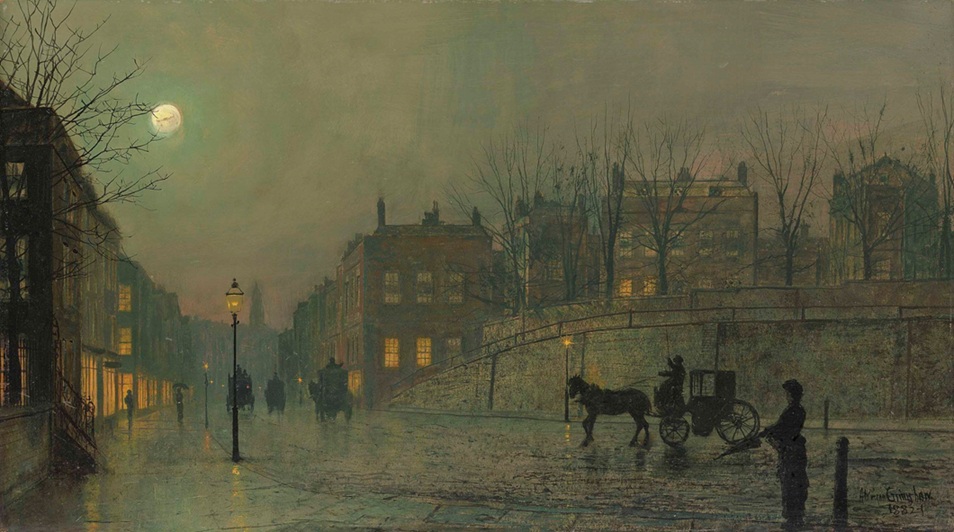
      The paintings of the Victorian era landscape artist, John Atkinson Grimshaw, may also have been in my mind´s eye as I wrote the poem, which would explain its “out of time” feel. Grimshaw even has a painting entitled “Going Home at Dusk.”

      Reply
  3. Paul A. Freeman says:
    12 months ago

    An interesting mix of imagery, Martin. I recall as a boy running up the road to see when the chimney sweep’s brush popped out the top of the chimney being swept (The chimney sweep wasn’t Dick Van Dyke!). I also recall the last beat policeman in the town I lived in as a boy, and the village bobby in the village I lived in in the 80s.

    I get a Wordsworth, ‘Daffodils’ vibe from the last two stanzas. It works very well as a wrap to your poem that brings back vivid memories.

    Thanks for the read.

    Reply
    • Martin Rizley says:
      12 months ago

      Thank you, Paul, for your comments. It was very encouraging to me to hear that the poem brought back vivid memories of your boyhood. I did not grow up in England, but images of England have fired my imagination since I fell in love with the country as a boy reading picture books, studying maps and watching movies set in London and in the English countryside. Finally, around the age of thirty, I was able to make a bicycle tour of Oxfordshire and the Cotswolds and have made several trips since then to London and its environs. I would love to know more of the country some day and visit places which, until now, I know only as an armchair traveller.

      Reply
  4. Martin Briggs says:
    12 months ago

    I really enjoyed this, Martin, and it repays repeated readings. Brian (above) has already used the term “period piece”, which is exactly how it strikes me. The third and (particularly) fourth stanzas evoke for me the industrial north of England where I mostly grew up. The whole breathes tranquillity and a calm resignation. Thank you.

    Reply
    • Martin Rizley says:
      12 months ago

      Thank you, Martin, for your feedback. I am glad that you enjoyed the poem and that the descriptive language triggered memories of very specific places and experiences you had growing up. That´s one thing I love about poetry– the power of words to awaken feelings of nostalgia by transporting us in our thoughts to another time and place. I like your reference “tranquility and calm resignation” for that is precisely the atmosphere and the outlook I wished to convey in the poem.

      Reply
  5. Paulette Calasibetta says:
    12 months ago

    Martin, your cinematic imagery imbues a deep sense of appreciation for the small things that create a fulfilled life. Your powerful last stanza reflects the sense of serenity, as the last chapter of life is so eloquently written.

    Reply
    • Martin Rizley says:
      12 months ago

      Paulette, thanks for sharing your thoughts on the poem. I love your phrase “a deep sense of appreciation for the small things that create a fulfilled life.” That is what I would like to have always, for it truly is the case that appreciating the “small things,” savoring the little enjoyments along life´s way, not only delivers us to some extent from the hectic pace of modern life, but can also serve as grist for the mill for future poetic creations.

      Reply
  6. Roy Eugene Peterson says:
    12 months ago

    Martin, you imbued this poem with heartfelt tranquility and serenity that is imbibed by the soul. By extension the peacefulness professed at the end of a day should be the that felt at the end of our years when we hear the phrase “well done thou good and faithful servant.”

    Reply
    • Martin Rizley says:
      12 months ago

      I appreciate your words, Roy, and the connection you draw between the peace felt at the end of a long day and at the end of this mortal life, when the believer can draw near to his departure from this present mortal life assured of a blessed homegoing.

      Reply
  7. Cynthia L Erlandson says:
    12 months ago

    I love your portrayal of twilight gleaming in puddles’ “sheets of shattered glass”.

    Reply
    • Martin Rizley says:
      12 months ago

      Thanks for your feedback, Cynthia!

      Reply
  8. C.B. Anderson says:
    12 months ago

    It doesn’t get much more lyrical than this. Rizley is the master of his niche.

    Reply
    • Martin Rizley says:
      12 months ago

      C.B.,
      Thank you for your words of appreciation for the poem; they mean a lot!

      Reply
  9. Karen says:
    12 months ago

    In your poem, the evening walk becomes a quiet farewell, and its wistful nostalgia drifts like a soft memory of days gone by—through lamp-lit streets, children at play, and the gentle hush of twilight. Every image lingers, turning ordinary moments into a tender reflection on home, life, and the eternal peace that waits just around the bend.

    Reply
    • Martin Rizley says:
      12 months ago

      Karen,
      Your description of the poem is a poem in itself! You have expressed beautifully what the poem is all about and what I was seeking to convey. Thank you for sharing these reflections.

      Reply
  10. Gigi Ryan says:
    12 months ago

    Dear Martin,
    It would be a different world if more people walked with their senses as receptive as yours are in this peaceful poem. The current trend of bodies walking with bent heads to ensure they miss nothing on their devices actually causes them to miss everything.

    The “scent of ash” makes me want to take a deep breath while walking where the speaker has walked.
    Gigi

    Reply
    • Martin Rizley says:
      12 months ago

      Thank you, Gigi, for your response. Alas! It comes all too easy for us in this modern age to walk down the street, as you say, “with heads bent to ensure we miss nothing on our devices.” I´ve been guilty of doing that far too often. But in my saner moments, I have managed to break free of the hypnotic attraction of my Android, and looking over the top of my tombstone-shaped cell phone, have discovered a vibrant world around me full of life and breath-taking beauty, in things both little and small. We pay far too much attention to the electronic time-robbing bandits that we carry about. And in doing so, we miss out on so much.

      Reply
    • Martin Rizley says:
      12 months ago

      Thank you so much, Gigi, for your remarks. It is so true that in our modern world, we find it all too easy to walk around, as you say, “with bent heads to ensure we miss nothing on our devices.” Alas! I have walked around “nose in screen” too often, but I find that when I succeed in breaking free of the hypnotic pull of my Android screen, and look over the top of my tombstone-shaped cell phone, I discover once again around me a world, so full of life and breath-taking beauty that it serves as an inexhaustible source of poetic inspiration.

      Reply
  11. Margaret Coats says:
    12 months ago

    Finely structured, Martin. Your works, whether they feature description or narration, usually have a coda with recognition of the divine in the scene or the story. In this poem, you move gradually toward that coda. In the first stanza, “my own heart at peace” defines the atmosphere described in painstaking detail during the first five stanzas. This is mood-setting anticipation, describing the emotional place to put the details. “Twilight gleams in sheets of shattered glass” breaks it, but breaks the peace by introducing more of the “cheering beams” that opened this account of a walk home. Rare beautiful objects in the sixth stanza proceed from there, turning more to meditation rather than description. Finally, in the last stanza, the walk and the thought conclude in unified and explicitly transcendent concert. Well planned spiritual development, allowing each reader to wish for an equally tranquil excursion home!

    Reply
    • Martin Rizley says:
      12 months ago

      Thank you, Margaret, for your valued reflections on my poem. I think any poet feels greatly encouraged when something he has written receives such careful analysis as your own, highlighting various features such as structure, thematic development, word choices– all of which goes to show that the poem has been well understood, enjoyed, and appreciated, and that one heart has successfully conveyed through words his inner thoughts and feelings to another.

      Reply
  12. Russel Winick says:
    11 months ago

    This lovely poem is just a joy to read and re-read.

    Reply
    • Martin Rizley says:
      11 months ago

      Thank you for your feedback, Russell!

      Reply

Leave a Reply Cancel reply

Your email address will not be published. Required fields are marked *


  1. Theresa Werba on ‘The Cristero Centennial’: A Poem by Margaret CoatsSeptember 5, 2026

    Thank you Margaret for sharing this piece of history with us. I very much identify with the tone of your…

  2. Roy Eugene Peterson on ‘Victory’: A Poem by Jonathan GraverSeptember 5, 2026

    Johnathan, I find this a stirring poem so fitting for our 250th anniversary with great depictions of the past and…

  3. Paul Freeman on ‘Victory’: A Poem by Jonathan GraverSeptember 5, 2026

    I recall the 200th anniversary when I made and painted a models of an English soldier and a rebel soldier…

  4. Jessica Vara on The Society of Classical Poets 2026 Haiku CompetitionSeptember 5, 2026

    (Reposting as the formatting didn't work in the last attempt, sorry!) -- see the idle wind fidget with the crisping…

  5. BDW on ‘Humdrum and Harum-Scarum’: A Lecture on Free Verse, by Robert Bridges (1922)September 5, 2026

    First off, I would like to note that Margaret Coats' literary criticism, though not as deep as Poe’s, outshines his…

Subscribe to Daily Poems

Enter your email address to subscribe to this blog and receive notifications of new posts by email.

Join 1,635 other subscribers

Recent Poems

  • ‘Victory’: A Poem by Jonathan Graver
  • ‘The Cristero Centennial’: A Poem by Margaret Coats
  • ‘A Potpourri of Aphoristic Verses’ by C.B. Anderson
  • ‘The Estuary’: A Poem by Jeff Eardley
  • ‘A World Without the Wednesday Child’: A Poem by Kimberly Fore
  • The 2026 Society of Classical Poets International Poetry Competition
  • The 2026 SCP International High School Poetry Competition
  • ‘Realistic Reflections’ and Other Poetry by Anna J. Arredondo
  • ‘China Made’: A Poem by Theresa Werba
  • ‘The Savage Moon’ and Other Poetry by Brian Yapko
  • Poetry Book Review: Love Found, Yearned For, and Lost by James A. Tweedie
  • ‘When Opportunity Knocks’: A Poem by Roy E. Peterson
  • ‘Legend of the Griffin’: A Poem by Iryna Hall
  • ‘Government Issue’ and Other Poems by Joseph S. Salemi
  • ‘Chaucer Announces His Desire to Retire’: A Poem by Paul A. Freeman
  • ‘Advantages of Restaurants’ and Other Poems by Russel Winick
  • ‘Bone China’: A Poem by Mary Gardner
  • ‘On the Death of One Too Young to Die’: A Poem by Jeffrey Essmann
  • ‘This Too Shall Pass’ and Other Poetry by Justin Dasher
  • ‘Humdrum and Harum-Scarum’: A Lecture on Free Verse, by Robert Bridges (1922)
  • ‘Unrest On the Floodplain’: A Poem by Bhikkhu Nyanasobhano
  • ‘Latitude and Loss’: A Poem by Martin Briggs
  • ‘Act III’ and Other Poetry by C.B. Anderson
  • ‘God’s Funeral’: A Poem by James Sale
  • ‘Star Festival’: A Poem by Margaret Coats
  • ‘Song of the Frog Princess’: A Poem by Scharlie Meeuws
  • ‘The Odyssey: Nolan and Solot Compared’: An Essay by Michael Curtis
  • ‘Solitude’ and Other Poems by Mary Jane Myers
  • ‘The River Not Taken’ and Other Poetry by Brian Yapko
  • ‘Totentanz’: A Poem by James A. Tweedie

Categories

  • Acrostic
  • Alexandroid
  • Alliterative
  • Art
  • Best Poems
  • Blank Verse
  • Chant Royal
  • Classical Poets Live
  • Clerihew
  • Covid-19
  • Deconstructing Communism
  • Educational
  • Epic
  • Epigrams and Proverbs
  • Essays
    • Interviews with Poets
    • Poetry Reviews
  • Featured
  • From the Society
  • Great Poets
    • Dante Alighieri
    • Edgar Allan Poe
    • Emily Dickinson
    • Geoffrey Chaucer
    • Henry Wadsworth Longfellow
    • Homer
    • John Keats
    • John Milton
    • Robert Frost
    • William Blake
    • William Shakespeare
    • William Wordsworth
  • Human Rights in China
  • Limerick
  • Love Poems
  • Music
  • Pantoum
  • Performing Arts
  • Poetry
    • Beauty
    • Children's Poems
    • Culture
    • Ekphrastic
    • Found Poems
    • High School Poets
    • Humor
    • Riddles
  • Poetry Challenge
  • Poetry Contests
  • Poetry Forms
    • Curtal Sonnet
    • Haiku
  • Poetry Readings
  • Rhupunt
  • Rondeau
  • Rondeau Redoublé
  • Rondel
  • Rubaiyat
  • Sapphic Verse
  • Satire
  • Science
  • Sestina
  • Shape Poems
  • Short Stories
  • Song Lyrics
  • Sonnet
  • Symposium
  • Terrorism
  • Terza Rima
  • The Environment
  • Translation
  • Triolet
  • Video
  • Villanelle

Quick Links

  • About Us
  • Submit Poetry
  • Become a Member
  • Members List
  • Support the Society
  • Advertisement Placement
  • Comments Policy
  • Terms of Use

Welcome Back!

Login to your account below

Forgotten Password?

Retrieve your password

Please enter your username or email address to reset your password.

Log In
No Result
View All Result
  • Poems
    • Beauty
    • Culture
    • Satire
    • Humor
    • Children’s
    • Art
    • Ekphrastic
    • Epic
    • Epigrams and Proverbs
    • Human Rights in China
    • Music
    • Performing Arts
    • Riddles
    • Science
    • Song Lyrics
    • The Environment
    • The Raven
    • Found Poems
    • High School Poets
    • Terrorism
    • Covid-19
  • Poetry Forms
    • Sonnet
    • Haiku
    • Limerick
    • Villanelle
    • Rondeau
    • Pantoum
    • Sestina
    • Triolet
    • Acrostic
    • Alexandroid
    • Alliterative
    • Blank Verse
    • Chant Royal
    • Clerihew
    • Rhupunt
    • Rondeau Redoublé
    • Rondel
    • Rubaiyat
    • Sapphic Verse
    • Shape Poems
    • Terza Rima
  • Great Poets
    • Geoffrey Chaucer
    • Emily Dickinson
    • Homer
    • Henry Wadsworth Longfellow
    • Dante Alighieri
    • John Keats
    • John Milton
    • Edgar Allan Poe
    • William Shakespeare
    • William Wordsworth
    • William Blake
    • Robert Frost
  • Love Poems
  • Contests
  • SCP Academy
    • Educational
    • Teaching Classical Poetry—A Guide for Educators
    • Poetry Forms
    • The SCP Journal
    • Books

© 2025 SCP. WebDesign by CODEC Prime.