• Submit Poetry
  • Support SCP
  • About Us
  • Members
  • Join
Monday, September 14, 2026
Society of Classical Poets
  • Poems
    • Beauty
    • Culture
    • Satire
    • Humor
    • Children’s
    • Art
    • Ekphrastic
    • Epic
    • Epigrams and Proverbs
    • Human Rights in China
    • Music
    • Performing Arts
    • Riddles
    • Science
    • Song Lyrics
    • The Environment
    • The Raven
    • Found Poems
    • High School Poets
    • Terrorism
    • Covid-19
  • Poetry Forms
    • Sonnet
    • Haiku
    • Limerick
    • Villanelle
    • Rondeau
    • Pantoum
    • Sestina
    • Triolet
    • Acrostic
    • Alexandroid
    • Alliterative
    • Blank Verse
    • Chant Royal
    • Clerihew
    • Rhupunt
    • Rondeau Redoublé
    • Rondel
    • Rubaiyat
    • Sapphic Verse
    • Shape Poems
    • Terza Rima
  • Great Poets
    • Geoffrey Chaucer
    • Emily Dickinson
    • Homer
    • Henry Wadsworth Longfellow
    • Dante Alighieri
    • John Keats
    • John Milton
    • Edgar Allan Poe
    • William Shakespeare
    • William Wordsworth
    • William Blake
    • Robert Frost
  • Love Poems
  • Contests
  • SCP Academy
    • Educational
    • Teaching Classical Poetry—A Guide for Educators
    • Poetry Forms
    • The SCP Journal
    • Books
No Result
View All Result
Society of Classical Poets
  • Poems
    • Beauty
    • Culture
    • Satire
    • Humor
    • Children’s
    • Art
    • Ekphrastic
    • Epic
    • Epigrams and Proverbs
    • Human Rights in China
    • Music
    • Performing Arts
    • Riddles
    • Science
    • Song Lyrics
    • The Environment
    • The Raven
    • Found Poems
    • High School Poets
    • Terrorism
    • Covid-19
  • Poetry Forms
    • Sonnet
    • Haiku
    • Limerick
    • Villanelle
    • Rondeau
    • Pantoum
    • Sestina
    • Triolet
    • Acrostic
    • Alexandroid
    • Alliterative
    • Blank Verse
    • Chant Royal
    • Clerihew
    • Rhupunt
    • Rondeau Redoublé
    • Rondel
    • Rubaiyat
    • Sapphic Verse
    • Shape Poems
    • Terza Rima
  • Great Poets
    • Geoffrey Chaucer
    • Emily Dickinson
    • Homer
    • Henry Wadsworth Longfellow
    • Dante Alighieri
    • John Keats
    • John Milton
    • Edgar Allan Poe
    • William Shakespeare
    • William Wordsworth
    • William Blake
    • Robert Frost
  • Love Poems
  • Contests
  • SCP Academy
    • Educational
    • Teaching Classical Poetry—A Guide for Educators
    • Poetry Forms
    • The SCP Journal
    • Books
No Result
View All Result
Society of Classical Poets
No Result
View All Result
Home Poetry

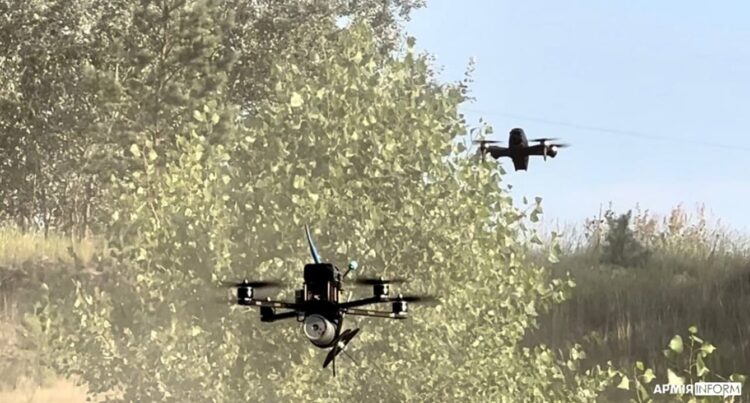
‘Warfare by Remote Control’: A Poem by Paul A. Freeman

July 30, 2026
in Poetry, Culture
A A
19
Ukrainian military drones (public domain)

Ukrainian military drones (public domain)


Warfare by Remote Control

Babies are screaming from the night time sky,
preventing sleep amidst the blasted homes;
twenty-four seven, there’s a buzz on high,
dipping and diving when a person roams.

Leaflets, like litter from an autumn tree,
fluttering groundward, strewing pockmarked roads,
tell dispossessed folk, “Again, you must flee,
abandoning once more your pulverised abodes.”

Drones firing missiles and disgorging bombs,
quadcopters gunning—who knows for whom?
For children? The elderly? Dads and moms?
This war-torn land’s an unquenchable tomb.

What manner of person can take such delight,
unleashing on others implacable spite?


Paul A. Freeman is the author of Rumours of Ophir, a crime novel which was taught in Zimbabwean high schools and has been translated into German. In addition to having two novels, a children’s book and an 18,000-word narrative poem (Robin Hood and Friar Tuck: Zombie Killers!) commercially published, Paul is the author of hundreds of published short stories, poems and articles.

Tags: Military and WarPaul A. Freeman
ShareTweetPin
The Society of Classical Poets does not endorse any views expressed in individual poems or commentary.
Read Our Comments Policy Here

RandomPoems

Two Ballads on Abortion
Culture

Two Ballads on Abortion

June 20, 2019

Planned Parenthood's a Euphemism upon reading March for Life's annual report by Roy E. Peterson Planned Parenthood’s a euphemism __Covering...

poem/tweedie/culture
Culture

‘But What of Us?’: A Poem on Rich People by James A. Tweedie

September 12, 2023

. But What of Us? They have it all,The richest men on earth.No calculator can compute their worth.Yet doomed to...

Next Post
‘Rasputina Confers with Her Cohorts’: A Poem by Joseph S. Salemi

'Rasputina Confers with Her Cohorts': A Poem by Joseph S. Salemi

Four Love Sonnets by Adam Sedia

Four Love Sonnets by Adam Sedia

The Society of Classical Poets 2026 Haiku Competition

The Society of Classical Poets 2026 Haiku Competition

Comments 19

  1. Eugenio Cappuccio says:
    2 months ago

    WHEN CYCLOPES TOOK OVER ITHACA

    Nessun maggior dolore che ricordarsi del tempo felice ne la miseria.
    Dante. Inferno.

    With ripped-out roots you’ll weep pain, yearn for long,
    now the Cyclopes have soiled Ithaca’s soil
    and cast you and yours from coasts once all bliss ;

    you’ll write homesick poems as an alien song,
    your pen bleeding from the trauma and toil
    of both Scylla’s and Charybdis’ hiss

    you rafted adrift on the restless sea,
    roaming desperate for a civilised life,
    your childhood joy buried in dreamt-of times

    when everyone prospered in homeland harmony;
    friends, family, landscape lost to one-eyed strife.
    Let woeful rhapsodes wail the lyre’s rhymes :

    You’ll miss blest Ithaca forevermore
    distant, acrid smoke from a vanished shore.

    Reply
  2. Eugenio Cappuccio says:
    2 months ago

    Great rendering of what abuse many are suffering today, Paul . Violent governments are the main cause of migration and exiles today, which reminded me of this poem I wrote above.

    Reply
    • Paul Freeman says:
      1 month ago

      I lived in Zimbabwe under the Mugabe regime until being forced out. The diaspora are just as you imagine, nostalgic for a verdant land that still feels like home.

      Reply
  3. Roy Eugene Peterson says:
    2 months ago

    They remind me of the plague of “locusts” mentioned in “Revelation” in the “Bible.”

    Reply
    • Paul Freeman says:
      1 month ago

      There’s a not very good film (though it’s one I’ll put on to veg out and be entertained) called Angel has Fallen, which is I believe may be the first film to envisage a mass drone attack. Meanwhile, an episode of Elementary with Johnnie Miller from years ago featured a micro-drone that sounded like a mosquito and injected a lethal dose of poison. This seems to be where we’re at.

      With all the other problems around, like AI eliminating jobs and creativity, and (if you’re as convinced as I am) global warming (I worked July in England and it was a scorcher – again), it does indeed feel like we’re headed in the wrong direction.

      Reply
  4. Gerard Maritato says:
    2 months ago

    Also from revelation when the seventh angel pours out the bowl of wrath on the land…rumblings, peals of thunder, lightening and a great earthquake…from the sky huge hailstones fell on people…
    By “remote control” makes it all the more chilling; the safety of the drone operator many miles away with no risk of his own danger. Very timely Paul. What are we to do?

    Reply
    • Paul Freeman says:
      1 month ago

      We need to grow a conscience, Gerard. Poets, especially, I find, are only complete if they have a streak of compassion for their fellow man in them.

      Reply
  5. Joseph S. Salemi says:
    2 months ago

    The science of warfare is a perpetually ongoing study, since the ability to wage effective war is a crucial necessity for any nation or people that wants to survive. For this reason, no one can be “behind the curve” when it comes to the latest developments in weaponry or equipment.

    And yet moralists have always managed to wail and moan about any new discovery or improvement in offensive force that gives an edge to those who have it. Clerics in the middle ages raised objections to the crossbow as “unfair” and “immoral,” gunpowder was deemed “a tool of the devil,” the matchlock gun was thought an infernal invention, the submarine was damned as a coward’s tool, the machine gun was seen as a horrendous violation of the gentlemanly art of war, and our left-liberals went into a holy shit-fit about “evil” nuclear weapons after 1945.

    Now unmanned drones, being both effective and cheap, have changed the rules of conventional warfare. But the moral whining still goes on.

    Reply
    • Paul Freeman says:
      1 month ago

      Poison gas, military aircraft used as missiles, civilian aircraft used as missiles, vehicles used to mow people down, now drones. I wouldn’t characterise those who find such unconventional weapons and weaponisation as morally reprehensible as wailers, moaners and whiners.

      Reply
      • Joseph S. Salemi says:
        1 month ago

        It’s a matter of practicality, Paul. If your enemy has a new and effective weapon, you have to have it too. Otherwise you will be defeated. The American Indians found out real fast that they had better drop the bows and arrows and get flintlock muskets when the Europeans showed up with them.

        In World War I, the Germans introduced poison gas to the battlefield, with tremendous effect. It broke open a huge gap in the British line. Of course the politicians and the newspapers and the pulpits condemned it as morally outrageous, uncivilized, barbaric, and against the laws of honorable warfare. Wailing, moaning , and whining ad nauseam! And yet the British and the other allies immediately began their own poison gas programs, and very soon they too were using it in combat. A score of new gases and smokes were developed very quickly.

        Reply
  6. Bhikkhu Nyanasobhano says:
    2 months ago

    The somberness and measured pace of your language here, Paul, make your poem effective. War is horrible in all its forms. We need reminders.

    Reply
    • Paul Freeman says:
      1 month ago

      So wrapped up as we are in our own everyday concerns, it’s sometimes difficult, if not impossible, to put ourselves in the place of those displaced by war, who struggle even for the means to survive, whose people have no access to, or are denied, medical aid, and have no means to educate a generation.

      We do indeed need reminders.

      Reply
  7. Margaret Coats says:
    1 month ago

    Piling up threatening perspectives in the octave, and questions in the sestet, makes an effective and memorable war sonnet, Paul. The title supplies distance for contemplation.

    Reply
    • Paul Freeman says:
      1 month ago

      It somehow makes it easier to torment, maim or kill our enemies if we’re not doing it face to face and are as distanced as possible. I suppose it also makes it easier for the public if they never get to see the consequences of such warfare.

      This poem was spurred by a documentary I saw at about 2am one morning, the documentary starting with the psychological warfare of the screaming (baby screams) drone, the screams lasting all night long, in an effort to force people away from their bombed out homes. I just couldn’t fathom what kind of human would come up with such an idea.

      Reply
  8. Margaret Coats says:
    1 month ago

    After-dinner reading in philosophy applies, Paul. A commentor on Aristotle’s Poetics says, “Wonder is the aim of the poetic art, into which the aim of tragedy in particular merges.” Your questions in the sestet here show wonder, while the threats narrated in the octave consider tragedy. Tragedy merges into wonder. A good reading of “Warfare by Remote Control.”

    Reply
    • Paul Freeman says:
      1 month ago

      I get the feeling that the mind can only process so much tragedy. The number of people I know who don’t watch the news anymore, from my daughter here in England, to my Mauritanian landlord. They’re still very aware, however, of what’s going on around them, but seem immobilised by frustration.

      This poem was originally for another site (the prompt was the word ‘flutter’), but I eventually wrote one about butterflies, for all our sanity!

      Reply
  9. C.B. Anderson says:
    1 month ago

    My impression is that you over-dramatize and under-think the subject matter you attempt to delineate, and, because that was our expectation all along, no one has been disappointed.

    Reply
    • Paul Freeman says:
      1 month ago

      There’s none as blind as those that refuse to see.

      Reply
      • C.B. Anderson says:
        1 month ago

        And there are none as insightful as those who look past their nose. Try it!

        Reply

Leave a Reply Cancel reply

Your email address will not be published. Required fields are marked *


  1. Adam Wasem on ‘Who Are the Villains?’ and Other Poetry by Adam WasemSeptember 14, 2026

    Yeah, nowadays right wingers (and even right-leaning types) in Hollywood either don't get work, like James Woods, or they have…

  2. Joseph S. Salemi on ‘Who Are the Villains?’ and Other Poetry by Adam WasemSeptember 14, 2026

    There have been some strongly anti-communist films, but certainly nowhere near the number of films which use Hitler and the…

  3. Adam Wasem on ‘Who Are the Villains?’ and Other Poetry by Adam WasemSeptember 14, 2026

    Isn't it wild how it's always "Hitler Hitler Hitler," but never, "Hey, maybe the gulags weren't such a great idea."…

  4. Margaret Coats on ‘Who Are the Villains?’ and Other Poetry by Adam WasemSeptember 14, 2026

    Good final lines for both, Adam. Looking up "movies against Mao" results in mostly the opposite. And your "Burns ever…

  5. Jeff Kemper on ‘How the Mighty Fell!’: A Poem by Jeff KemperSeptember 14, 2026

    Thanks, Yael. I'm glad you liked it.

Subscribe to Daily Poems

Enter your email address to subscribe to this blog and receive notifications of new posts by email.

Join 1,741 other subscribers
No Result
View All Result

Resources

       1. A Guide to Writing Poetry

      2. The Best Poems of 2020      

      3. Poetry and Writing Contests

      4. Journals Accepting Formal Verse

Recent Poems

  • ‘Who Are the Villains?’ and Other Poetry by Adam Wasem
  • ‘Isle of Romance’: A Poem by Margaret Brinton
  • ‘Professional Mourner’: A Poem by Brian Yapko
  • A Distillation of Shakespeare’s ‘A Midsummer Night’s Dream’ by Martin Briggs
  • ‘How the Mighty Fell!’: A Poem by Jeff Kemper
  • ‘The One Lone Juror’: A Poem by Joseph S. Salemi
  • ‘Soul of a Prophet’: A Trialog Poem by T.M. Moore
  • ‘Nelson and George’: A Poem by David Filpula
  • ‘When She Arrives’: A Poem by Bhairab Barman
  • ‘On to Better Days’: A Poem by Bruce Dale Wise
  • ‘Serenade’ and Other Poetry by Adam Sedia
  • ‘Self-Exploration’ and Other Poems by Paul Millan
  • ‘Victory’: A Poem by Jonathan Graver
  • ‘The Cristero Centennial’: A Poem by Margaret Coats
  • ‘A Potpourri of Aphoristic Verses’ by C.B. Anderson
  • ‘The Estuary’: A Poem by Jeff Eardley
  • ‘A World Without the Wednesday Child’: A Poem by Kimberly Fore
  • The 2026 Society of Classical Poets International Poetry Competition
  • The 2026 SCP International High School Poetry Competition
  • ‘Realistic Reflections’ and Other Poetry by Anna J. Arredondo
  • ‘China Made’: A Poem by Theresa Werba
  • ‘The Savage Moon’ and Other Poetry by Brian Yapko
  • Poetry Book Review: Love Found, Yearned For, and Lost by James A. Tweedie
  • ‘When Opportunity Knocks’: A Poem by Roy E. Peterson
  • ‘Legend of the Griffin’: A Poem by Iryna Hall
  • ‘Government Issue’ and Other Poems by Joseph S. Salemi
  • ‘Chaucer Announces His Desire to Retire’: A Poem by Paul A. Freeman
  • ‘Advantages of Restaurants’ and Other Poems by Russel Winick
  • ‘Bone China’: A Poem by Mary Gardner
  • ‘On the Death of One Too Young to Die’: A Poem by Jeffrey Essmann

Categories

  • Acrostic
  • Alexandroid
  • Alliterative
  • Art
  • Best Poems
  • Blank Verse
  • Chant Royal
  • Classical Poets Live
  • Clerihew
  • Covid-19
  • Deconstructing Communism
  • Educational
  • Epic
  • Epigrams and Proverbs
  • Essays
    • Interviews with Poets
    • Poetry Reviews
  • Featured
  • From the Society
  • Great Poets
    • Dante Alighieri
    • Edgar Allan Poe
    • Emily Dickinson
    • Geoffrey Chaucer
    • Henry Wadsworth Longfellow
    • Homer
    • John Keats
    • John Milton
    • Robert Frost
    • William Blake
    • William Shakespeare
    • William Wordsworth
  • Human Rights in China
  • Limerick
  • Love Poems
  • Music
  • Pantoum
  • Performing Arts
  • Poetry
    • Beauty
    • Children's Poems
    • Culture
    • Ekphrastic
    • Found Poems
    • High School Poets
    • Humor
    • Riddles
  • Poetry Challenge
  • Poetry Contests
  • Poetry Forms
    • Curtal Sonnet
    • Haiku
  • Poetry Readings
  • Rhupunt
  • Rondeau
  • Rondeau Redoublé
  • Rondel
  • Rubaiyat
  • Sapphic Verse
  • Satire
  • Science
  • Sestina
  • Shape Poems
  • Short Stories
  • Song Lyrics
  • Sonnet
  • Symposium
  • Terrorism
  • Terza Rima
  • The Environment
  • Translation
  • Triolet
  • Video
  • Villanelle

Quick Links

  • About Us
  • Submit Poetry
  • Become a Member
  • Members List
  • Support the Society
  • Advertisement Placement
  • Comments Policy
  • Terms of Use

Welcome Back!

Login to your account below

Forgotten Password?

Retrieve your password

Please enter your username or email address to reset your password.

Log In
No Result
View All Result
  • Poems
    • Beauty
    • Culture
    • Satire
    • Humor
    • Children’s
    • Art
    • Ekphrastic
    • Epic
    • Epigrams and Proverbs
    • Human Rights in China
    • Music
    • Performing Arts
    • Riddles
    • Science
    • Song Lyrics
    • The Environment
    • The Raven
    • Found Poems
    • High School Poets
    • Terrorism
    • Covid-19
  • Poetry Forms
    • Sonnet
    • Haiku
    • Limerick
    • Villanelle
    • Rondeau
    • Pantoum
    • Sestina
    • Triolet
    • Acrostic
    • Alexandroid
    • Alliterative
    • Blank Verse
    • Chant Royal
    • Clerihew
    • Rhupunt
    • Rondeau Redoublé
    • Rondel
    • Rubaiyat
    • Sapphic Verse
    • Shape Poems
    • Terza Rima
  • Great Poets
    • Geoffrey Chaucer
    • Emily Dickinson
    • Homer
    • Henry Wadsworth Longfellow
    • Dante Alighieri
    • John Keats
    • John Milton
    • Edgar Allan Poe
    • William Shakespeare
    • William Wordsworth
    • William Blake
    • Robert Frost
  • Love Poems
  • Contests
  • SCP Academy
    • Educational
    • Teaching Classical Poetry—A Guide for Educators
    • Poetry Forms
    • The SCP Journal
    • Books

© 2025 SCP. WebDesign by CODEC Prime.