


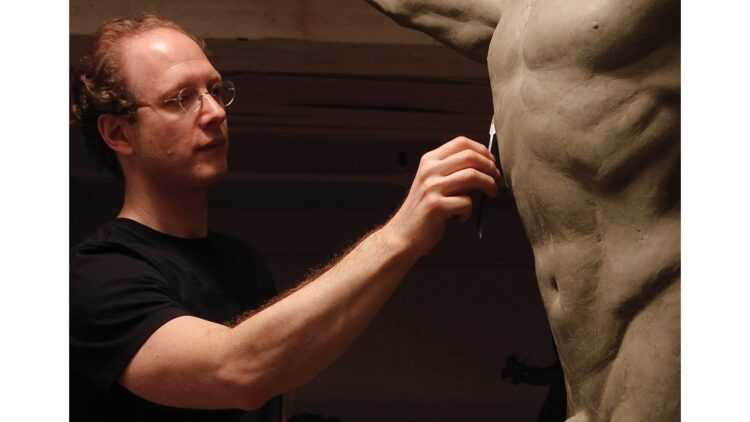
Sabin Howard
—who created A Soldier’s Journey at the National
World War I Memorial in Washington, D.C.
He steps off of the airplane of the gods,
in black tee shirt, sun glasses and black shorts,
and stops. Beneath the cirrus clouds, he nods.
It’s hard to say what he is going towards.
He trods along the furrowed sands of time,
his head, his arms, his hands, his legs, in bronze;
a Hermes soaring high through the sublime,
he meets the renaissance of a new dawn.
With grandeur, grace, perhaps nobility,
why not a sculptor this side of the sea?
With greatness, as was once in Italy,
why not create Bronx capolavori?
He looks across the Atlantic, open eyes,
and then extends his sternum to the skies.
capolavori: masterpieces
Lightning Striking
He looked up high, and saw it—lightning striking—in the sky.
Sunt lacrimae in things, he thought, and he began to cry…
for mortal things that touch the mind, and interrupt the soul,
exciting, lighting up the mind, enlightening the whole.
And then he heard it afterwards—the thunder rumbling,
the crashing, smashing, pounding raindrops, pouring, tumbling.
It shook the atmosphere. He heard it there where he was at.
It rattled to his very bones, a booming rat-a-tat.
He felt so lost. How could he ever understand life’s cause?
It passed so fast. Alas, he didn’t have the time to pause.
Reacting to events encountered, swirling all around,
he faced them all, he met the squall, his feet still on the ground.
Sunt Lacrimae: short form of “Sunt lacrimae rerum,” which translates to “there are tears for things”
Bruce Dale Wise is a poet and former English teacher currently residing in Texas.













Bruce, thank you for making me aware of the sculpture works of Sabin Howard. I had to look him up on “Wikipedia” and learned that “A Soldier’s Journey” is a 60-foot masterpiece. He is one those rare classical sculptors, especially in America, who, as you say, brings to us sculptures reminiscent of Italy. I learned some of his sculptures are large-scale pieces, such as Hermes, Aphrodite, and Apollo. “Lightning Striking” is one of the best and most sensitive poems I have read on the subject with instant introspection and emotional reaction.
So frequently is Mr. Peterson first to the punch,
one wonders if he even has a chance to eat his lunch,
and write as many poems as he does—obsessed with rhyme—
I must confess I am impressed he does this all the time.
“Sabin Howard” is a typical Wise biopic, which typically takes a life from any general area of history, in this case sculpture, and comments on the person or the work(s) through a poem, in this case, a sonnet written in the winter of 2013. It is a poem that has appeared no where on the Internet; but I thought maybe Mr. Mantyk might be interested in it because of his interest in many of the arts, including architecture and sculpture. For example, Mr. Mantyk has interviewed and published poems by Michael Curtis.
One of my early interests in late PostModernism was the architectonics of poetic utterance, as can be seen in my creations of various poetic structures, in particular, the bilding [sic], a syllabic structure of 12 lines of 12 syllables, rhyme scheme ababcbcdcdad, used predominantly for pictures, sculptures, buildings and cities. It is a form I shared with R. B. in the mid-1970s, when I was studying Modernist American Poetry with Elizabeth Bishop at the University of Washington.
Here is a mistitled poem written in May of 2023. And there it was—lightning striking the sky, and immediately Aeneas came to mind, as when Aeneas arrives at Carthage, and he sees pictures of the Trojans fighting, emotion overwhelming him. The dodeca’s title should be “Aeneas at the Temple”: sunt lacrimae rerum et mentum mortalia tangunt.
Thankful that Mr. Mantyk chose the poem, I okayed his editing of the poem, as for example, in the second stanza where the hyphens were dropped from “rum-bl-ing” and “tum-bl-ing” [indicating rain]. I have ever, since I read it, enjoyed Mark Twain’s onomatopoetic expression of lightning and thunder in “Huckleberry Finn”.
So many things go through one’s mind in such a situation. All the things that still remain unaccomplished splashing around one’s life. “He felt so lost.” Life’s cause remains ununderstandable. “It passed so fast.” One moves from one’s early daze into another realm, and it all passes so fast; and here he was facing them at this particular place. A flash from the heavens, and a following storm; and though his feet are still on the ground, and he is still surprisingly alive, after so much, knowing certain accomplishments remain unfinished, it can definitely be overwhelming.
“Sabin Howard” seems like a poetic video of the sculptor revealing himself as what his masterpieces are made of. Classically carved, Bruce, with appropriate touches of colloquiality.
“Lightning Striking” is full. You’ve taken the few seconds of the strike, and the wait before the thunder, then the sounds, and packed these all with electric reflections on the experience in relation to life as a whole. That can be exactly what the reality achieves by its nature–the poet by equally striking words.
There are so many poetic approaches to lightning strikes. Here is a baker’s dozen of more recent lightning stabs:
Sheltering Beneath a Tree
by Caleb Wuri Seed
At Daymin Gardner’s farm in Alabama, lightning struck.
It hit a tree, where thirty-one cows huddled from the storm.
But as luck would have it, or fate, all those beef cattle died.
Though they took shelter, they were killed, stilled. Hera was cow-eyed.
She did not cry, but, how she sighed. They needed burial.
It was a waste of life; the meat was not salvageable.
But this was not a crime of humans, no, Immortals, like
as in Thrinacia centuries ago; Zeus sent this strike.
When Fahrenheit degrees hit 50,000, tree sap cooks;
electrocution is conducted, zapped down through the roots,
some 50,000 miles per second, its velocity,
a harsh reminder of the natural world’s ferocity.
—-
The Schumann Resonances
by Ira “Dweeb” Scule
The Schumann resonances are a set of spectrum peaks
in Earth’s EMF in th’ extremely lower frequencies,
excited by discharges, lightning-generated jolts;
Earth’s atmosphere’s potential is 200,000 volts.
At any time there are about two-thousand lightning storms—
some fifty flashes ev’ry second—this then is the norm.
The fundamental, u-s-u-a-l-l-y, strongest frequency
is 7.83 hertz, the base resonance we sense.
Each cell that’s found within the nervous system, brain, and heart,
is highly tuned and sensitive to what these spikes impart.
—-
In th’ Inverted Bowl
by Wilude Scabere
When shall we meet again? In lightning, thunder, and in rain,
when wild winds are blowing hard, and rains swirl down Earth’s drain?
The Sun has set, the night dark black, the weather stark and grim;
the Moon is lost behind the shrouds, the tempest-tossed clouds swim.
Here is no heath beneath the bleak and wrecking swirling wreaked;
the hurly-burly keeps us up, the heaving heavens leaked.
The black cat’s frightened, hiding from resounding, pounding booms.
It is as if the very present, whirling world is doomed.
Why have we reached this kingdom’s realm that overwhelms one’s soul?
What is this place so fresh, yet fearsome, in th’ inverted bowl?
—-
On Lightning Striking
by Éclair Dub W. See
Like as when lightning strikes nearby and shakes the atmosphere,
one wonders, ‘Am I dead or not? Am I still living here?’
A golden shaft blasts fast and hard and outward radiates
a cylinder tornado, like a zapped tsunamic taze.
One looks around to check and see just what was it that hit,
and then the thunder rumbles loud in an unsettling fit.
It seems the very Earth has twitched, as in an earthquake’s shift,
and knocks one down with growling sound and an alarming lift.
That jolting spark that cracks the dark with its bright bolt and start,
electric’lly and momen-tair-ily splits us apart.
—-
The Lightning Map
by “Wild” E. S. Bucaree
“He gave them rain, that they may gather grain.”
—Deuteronomy paraphrase.
The lightning map of Oklahoma state reminded him
of days when he was at Fort Sill—although they still are dim.
It was the first time he had ever seen rain fall so hard,
bombarding them outside the barracks of the provost guard.
He didn’t understand th’ import of cleaning showers then
with a used toothbrush and a toothpick, like a hidden wren,
within the plumage of an eagle flying high above
the tiny kinglet or the gray, long-tailed mourning dove.
He’d scrub and scrub till the drill sergeant said they were relieved,
and they could go forth in to Lawton on that very eve.
Those days were long ago, before he’d ever heard the names
of Aristotle, Pliny, Leibnitz, Kant or William James.
—-
Sheltering Beneath a Tree
by Caleb Wuri Seed
At Daymin Gardner’s farm in Alabama, lightning struck.
It hit a tree, where thirty-one cows huddled from the storm.
But as luck would have it, or fate, all those beef cattle died.
Though they took shelter, they were killed, stilled. Hera was cow-eyed.
She did not cry, but, how she sighed. They needed burial.
It was a waste of life; the meat was not salvageable.
But this was not a crime of humans, no, Immortals, like
as in Thrinacia centuries ago; Zeus sent this strike.
When Fahrenheit degrees hit 50,000, tree sap cooks;
electrocution is conducted, zapped down through the roots,
some 50,000 miles per second, its velocity,
a harsh reminder of the natural world’s ferocity.
—-
The Lightning in the Skies
by Caderius E. Blew
He still remembers seeing it—the lightning in the skies—
a frightening, enlightening, electrical surprise.
What God could make it crackle so, so powerful its charge?
What mighty, forceful energy could be so great and large?
What kind of memory is this that shakes one to one’s core,
that leaves one wondering about what once was here before?
It does not go away as easily as it appears—
this crazy atmosphere that stays amazing, raising fears.
Cold air and warm, meet up, and arm; the thunderstorm clouds form,
ice crystals and the water drops colliding as they swarm,
their rubbing causing static, while the bolt goes through the air.
It zigzags with a striking jolt; then packs a roaring blare.
====
Tesla’s Mother
by Aleš Eduw Rebič
“Necessity is the mother of invention.”
—Aesop, “The Crow and the Pitcher”
“Amidin is starch modified by heat.”
—Beau Lecsi Werd
Born in the middle of a lightning storm, around midnight,
the midwife thought it an ill omen, but his mother not.
The difference between the two could not be much more stark.
Mom thought that he would be a child of light, and not the dark.
—-
The Life You Save May Be Your Own
by Cause Bewilder
The life you save may be your own, so drive defensively,
not really pensively, no, nor de trop offensively.
Avoid distractions, like The Hot Spot, or hitchhiking schmo,
and focus on the driving, not your phone or radio.
Until you reach your destination, Mobile or beyond,
be sharp and notice signs and lights, in order to respond.
Check mirrors frequently around your moving vehicle,
evading situations that give rise to piacle.
Scan far ahead to see what’s coming further down the road,
like hazards, fallen limbs or turns, some large descending cloud,
that crowds the golden Sun, and brings forth lightning, and a loud
guffawing crack of thunder, giant raindrops and a shroud.
—-
A Demiurging Gee
by Sri Wele Cebuda
He woke up at the crack of Dawn; ‘twas time to go to work.
The morning’s beauty spreading out before the eyes…Occur.
He kissed the sky; he was so high; a kite flew overhead.
The soft light glowing over flowers, like a lover’s bed.
He wore his baseball cap on backwards to deflect the Sun,
which was so hot and furious, a nuclear plo-zhún.
How could he keep its raging, flaming heat from burning him?
In meditation’s lotus pose, he hummed his urban OM.
He sought to reach the cosmic flux in lightning energy,
enlightening his being with a demiurging gee.
—-
That One Guy in a Million
by Rudi E. Welec, “Abs”
Long-dstance tra-il runner Thomas Stanley had bad luck.
He was a lean and hardy guy who loved to trek and truck.
But near the end of Flatrock 50K on Saturday,
September 28, the lightning struck, he passed away.
Near Independence, Kansas, near the race’s finish line,
the runner, in his tank-top, shorts and sport shoes, lost his life.
Near th’ race’s end, the gaunt, athletic thirty-three-year-old
had done the off-road sections and was running on paved road.
He’d left behind the rugged path along Elk River Trail,
that one guy in a million struck by lightning, and was killed.
—-
His First Stupendous Lightning Storm
by Eber L. Aucsidew
Though it was long ago, I still recall that stormy night.
The room was dark and narrow; there was very little light.
My eyes were closed, and I was half asleep in dreamy mode.
I’d no idea that the atmosphere would soon explode.
A flash of lightning lit my resting body’s lenthened form:
electrical and frightening, I suddenly felt warm.
The lightning’s jagged fingers jabbed the local, nearby hills:
exciting, yes, inviting, no, I wasn’t up for thrills.
I tried to shove it from my mind—greased lightning in the dark—
but I had no control, the thunder roared, the lightning sparked.
I rose up like one shocked. I tensed my arms, my legs, my abs,
for fear that it would overwhelm me with its striking jabs.
For some good while, I held quite still, for fear what would come next.
In truth, to say the least, I felt quite put upon and vexed.
But then the final flash appeared, and I collapsed in bed.
And that great storm—it was no more—o, no more overhead.
Now I have seen a lot of storms; but then I was quite young;
and that great, crazy violence, that over me once hung,
shook me back there, took me back then, its dreadful power’s vent,
that I can still recall it well, a message heaven-sent.
—-
An Apuleian Passage
by Air Weelbed Suc
When he has risen very high, up through the clouds, in fact,
and eagle-eyed, has passed above where rain and snow are flakked,
if not beyond the slashing lightning and the thunder’s roar,
he, at the ether’s edge and o’er the weather’s rooftop, soars.
He glides his jet from right to left and banks upon the shrouds;
the pilot gazes over everything he sees, and down,
the jet wings hovering, so far from any prey that roams,
there in the heavens, monitored by radar from below.
He scans, as well, the fields, mountains, cities, at a glance,
and then, caught in a slant, he dives nose-first, and gladly lands.
—-
Yes, I did come back to read them! Considering the many possibilities, I’ll simply say which I like best. They are “The Inverted Bowl” by Scabere, “On Lightning Striking” by See, and “His First Stupendous Lightning Storm” by Aucsidew. Did not at all care for “Sheltering,” which is presented twice here. Thanks for taking the positive charge to present such energy+++
Since I did at least get one negative response for one of the many lightning poems, I should like to discuss what was going through my mind in its creation.
Margaret Coats noted that she did “not at all care for ‘Sheltering’”.
Structurally, the poem “Sheltering Beneath a Tree” is a dodeca of three four-lined stanzas. The poem takes an incident that occurred now in the NewMillennium. The setting is Daymin Gardner’s farm in Alabama. I like the particularity and actuality of the situation. This was written up in various newspapers from which I gleaned the first couplet. I used a slant rhyme struck/storm, to show the disconcerting harshness of the event. I liked the reference to Daymin Gardner, because he is not famous, but just an ordinary individual, probably the single time at his fifteen minutes of fame. What a distorted press, which chases after sensation and fame, we have in America. This was quite an astounding event in my mind, because the cows were trying to protect themselves; but ironically because they were all under the tree, they died. I also like the delayed rhyme of luck. And then at the end of the four sentences, the first stanza transitions to Ancient Greece. The second stanza proceeds with a slightly differing sentence structuring. From Hera, the poem develops a brief Homeric episode from the “Odyssey”. The language here is stark, reminiscent of English PostModernist Ted Hughes. It lands on Zeus. Finally, from the mythological, the third stanza leaps to science, and an unEmersonian view of nature; it is an American view in the NewMillennium.
What an education ‘Sabin Howard’ was to me, Bruce. With the controversy of ‘The Blue Lady’ in Trafalgar Square raging, this poem takes on new significance. I liked the allusions to the master sculptors of Italy during the Renaissance.
Strangely enough, we had a massive, all-night thunderstorm here in Mauritania, and unable to sleep, I put pen to paper… It’s true that an event like a thunderstorm, or just a thunderclap and roll of thunder, can be described and portrayed is so many different ways and styles. With last night still in mind, I found your work captivating.
Thanks for the reads.
The brief epigraph placed after “Sabin Howard” was put there by Mr. Mantyk. I didn’t put it there. Mr. Mantyk feels free to help explain my poems by changing words, adding information, etc. As an artist, especially one so reliant recently upon the ballad, I understand a reader’s involvement in such a process. In this, and in the unwillingness of editors to print my poems, I feel much like Emily Dickinson must have felt; and yet I am quite thankful for any exposure in a World of billions.
As for the structure of “Lightning Striking”, I am reminded of the work of Coleridge whose own balladic “Rime” helped me lead to the dodeca, which steps outside of the sonnet in a way the tennos does not. Here is a poem of mine, from the early 1980s [late PostModernism], which has yet to see the light of day, but may be a clue, as to where I have been, and where I am going, in understanding my overall poetic vision.
Coda For Coleridge
by Basil Drew Eceu
He dove deep into the white light
of the full round pearl shining bright
in the eternal blue of night,
because he desired his vision
would be refined with precision,
crystal clear and sharply defined.
He was obsessed with the outline
of reality seen under
the clash of lightning and thunder;
for it was there, yes, it was there,
where he could see, feel, and find fair
fire, frost, between the frozen lake
and forest damasked in ice flake,
performing, unhelped by any
wind, its secret ministry.