


Island of Poets
Settlers came from Thessaly, eastward sailing
Far as Lesbos, loveliest isle regaling
Grateful hearts with poetry countervailing
___Laughable wailing.
Lesbos means “desirable.” It’s magnetic.
Tour the creativity sympathetic:
Local ouzo fortifies energetic
___Spirits poetic.
Here the lyrist Térpander, singing clearly,
Fathered Grecian musical modes by dearly
Loving wine and cíthara cavalierly,
___Verse more sincerely.
Lesches’ Little Iliad briefly stated
Final epic stories of Troy ill-fated,
Worded just as losers had stipulated:
___War should be hated.
Drama names Aríon an early writer,
One who gave the dithyramb chorus lighter
Realistic dialogue plotted tighter:
___Theater shines brighter.
Sappho sang that girlish love quickly passes.
Lasses marry; Sappho grows old, amasses
Farewell odes in memory’s fond morasses
___Damp with sweet grasses.
Stronger lines Alcǽus composed, of bolder
Themes and feelings. Eloquent hymns hail older
Times when love was warm, fateful journeys colder;
___Martial songs smolder.
“Holy Sappho, goddess-like luminary,
Be my partner, honey-sweet adversary.”
“My Alcǽus, passion is temporary.
___Ardent but airy.”
“Answer me triumphantly, melancholic
Music maker; liven our land bucolic.”
“Pin your ears back. Take a reply symbolic:
___Let’s have a frolic!”
Poet’s Note
The poem features sapphic stanzas of falling rhythm. Each longer line has two trochees, a dactyl, and two more trochees. The final shorter line (called an “Adonic”) is made up of a dactyl and a trochee. The English accentual meter adapts a quantitative Greek meter used by ancient poets Sappho and Alcaeus, who like Terpander, Lesches, and Arion came from Lesbos off the coast of Asia Minor.
The above rhymed sapphic stanzas acknowledge fine examples by Vivian Yeiser Laramore Rader, Poet Laureate of Florida from 1931 to 1975. For easier unrhymed sapphics and much more, see James A. Tweedie, “Beginner’s Guide to Sapphic Verse.”
Margaret Coats lives in California. She holds a Ph.D. in English and American Literature and Language from Harvard University. She has retired from a career of teaching literature, languages, and writing that included considerable work in homeschooling for her own family and others.










Margaret, this is an amazing poem with intelligent attention to detail, mind-boggling word choices and word play, along with brilliant rhymes. It takes a Grecian scholar to have pulled this one off with knowledge of characters and understanding of how the poem was constructed and then matching the ancient form.
Thank you, Roy. I know I can always count on you to appreciate a feat of rhyming, and this one took a lot of thought to get four meaningful rhyme words closely placed together in each stanza. My Greek study was more philosophical than poetic, but I knew of Sappho and Alcaeus, both practitioners of the ancient form I try to replicate in an English manner here. The other poets mentioned are more obscure, but it is remarkable that so many with some claim to fame came from this single island.
Your poem is subtle and yet expository, Margaret C. It is remarkable how you draw upon your classical education to enlighten these contemporary times. I believe it was Henry James who suggested that writing is just vanity if there is nothing to measure it by. Your literary skills establish high standards for the poetry world.
from Margaret B.
Thank you for reading and responding, Margaret B. This poem uses a classic stanza form that is rare in English–but shouldn’t discourage anyone who writes otherwise. My education happily covered a vast array of kinds of poetry, and gave me an appreciation for most. You and Henry James are, however, right to value ways of measuring literary art. As readers, we tend to apply standards of goodness and beauty, in addition to our personal preferences!
This is exquisite! And, certainly for me beautifully informative. I checked your link to Sapphic Verse. I don’t know if I dare to attempt it.
Thanks so much, Rohini! Sapphics take determination once you understand what’s required, but I found inspiration in the beautiful sapphic verses of the fellow poet I cite above, who led me toward Sappho herself with a book called “Had Sappho Written Sonnets.”
I guess we could call these English Sapphics. The few that I have written were done in this manner, and there was a long thread here at SCP, some years ago, involving Sapphics. But two things really stand out to me in this poem: 1.) how nicely the diction (poetic diction, if there ever was any) blends with and highlights the impeccable rhetoric, and 2.) the audacity to lean heavily on rhyme. This poem might be a masterpiece.
Thanks very much for your high opinion, C. B. The form and the rhymes, with clarity, pay tribute to my model, Vivian Yeiser Laramore’s “Sappho Is Singing,” published in 1939. I saw your contribution to the 2018 SCP long thread (linked above) on this kind of lyric, in which James Tweedie outlines better known English examples, while providing one of his own. Glad to join the classic conversation!
Well, Margaret, This poem is cut from the whole cloth and utterly seamless.
That’s quite a feat for shears without needle. Thank you kindly!
Let’s drink. Why are we waiting for the lighting of the lamps?
There’s only but a little bit of daylight on our maps.
Lift down the cups—the painted ones—o, friends and family,
for wine’s a blessing come to us from Zeus and Semele.
It helps us take the broken heart, the sadness in our minds.
Mix one part water to two parts of sparkling scarlet wine.
Do not be frugal with the bottle; pour it to the rim;
and see the lovely, twinkling bubbly winking at the brim.
And while we drink the lively stuff, let’s talk or sing a song,
and happily thus emptied push another cup along.
One of the loveliest anacreontics I’ve read, Bruce. Thank you for the aroma, the balance, and the finish of your comment on the Old World vintage of my poem–which is “Old World” wine itself in emphasizing the region rather than a variety of grape. You understand the conversation between poets.
Very enjoyable, Margaret. Thank you for a nice poetic romp!
And thank you, Marguerite, for expressing your enjoyment!
Margaret
Brava! I am impressed with your technical virtuosity in constructing Sapphics in English.
You have composed 9 stanzas of 4 lines. The first 3 lines of each 4-line stanza is constructed as follows: spondee/ spondee/ dactyl/ spondee/spondee. The last line uses the form of dactyl/spondee. Then, to dazzle the reader further, you have crafted exact end rhymes for the 4 lines of each stanza. Because the lines end with a spondee, the rhymes are feminine, and consist of multisyllabic words that are tricky to rhyme in English.
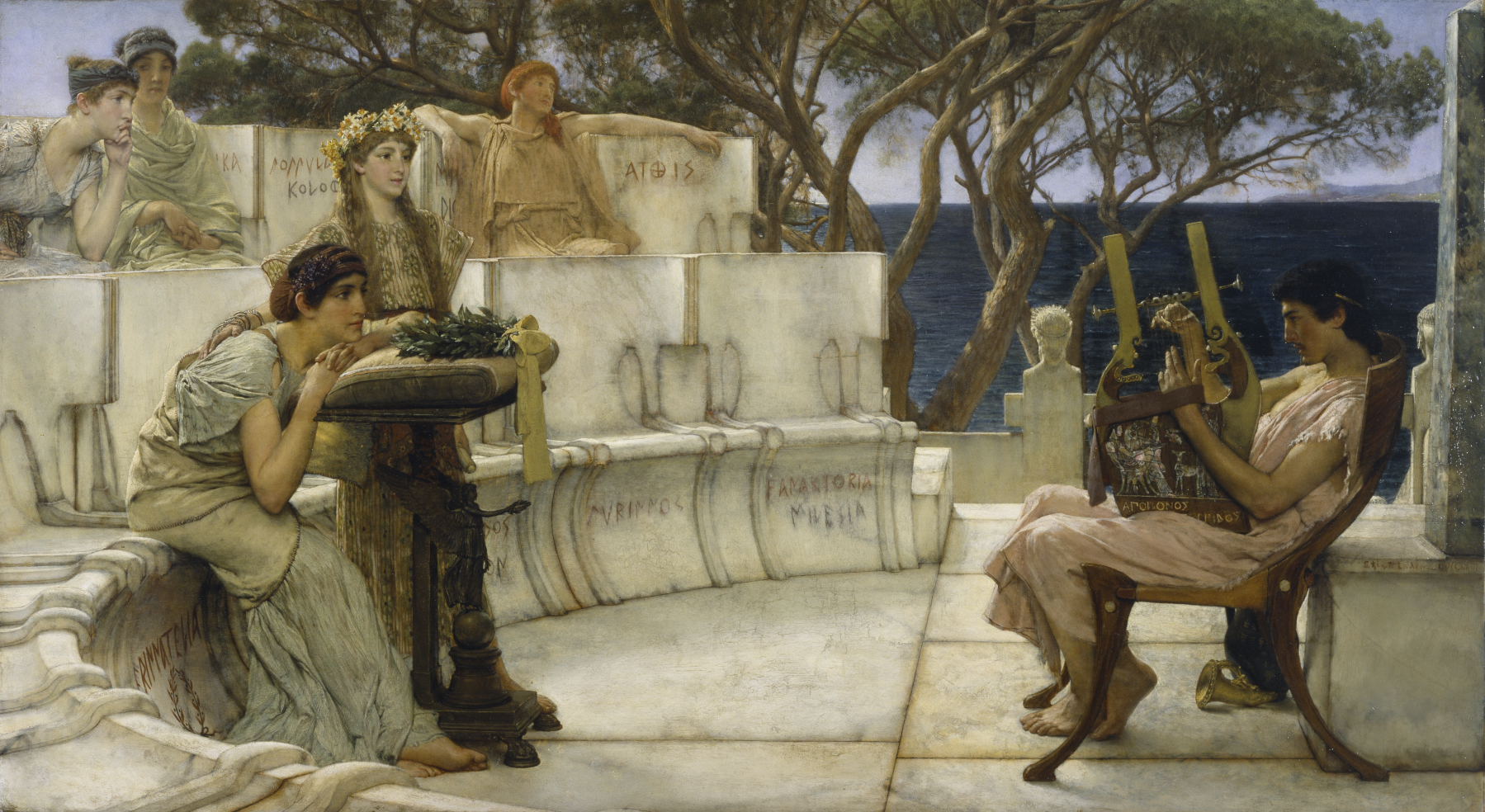
The content of the poem is fascinating. In the first seven stanzas, the reader gets a “literary history lesson” (a la Michael Schmidt’s The First Poets). In the final two stanzas the reader is treated to a legendary flirtation between Alcaeus and Sappho (as painted by Alma-Tadema). Alcaeus flatters Sappho: ‘Be my partner, honey-sweet adversary.’ To which the ironic Sappho ripostes: ‘Passion is temporary, ardent but airy.’ And finally, her clever ‘reply symbolic’: “Let’s have a frolic!’
Well, this reader is certainly having a frolicsome time reading (and reciting!) this artful poem!
Mary Jane
Thanks, Mary Jane! I’m glad it’s frolicsome after the literary lesson–but I did have to point out that little Lesbos is renowned for all kinds of poetry (lyric, narrative, and dramatic). Once we get to the flirtation, I only had to take flattering words from Alcaeus’ own works, supposed to be addressed to Sappho. The Alma-Tadema painting does tempt the viewer to imagine what he could be singing, and why Sappho is so intent on listening! Her words are entirely from my imagination; I think the island atmosphere might well breathe artful inconsistency.
The rhymes were fun to select for variety. Since each stanza was to have four of the same rhythm as well as the same sound, I had to listen in my mind for perfect music suited to the story, such as there is one. With this kind of unusual lyric, substitutions create disasters. Thus it was a matter of finding a group of four–or rather nine groups of four! Twice I discovered a group was not suitable after all, but changing for better effect was delightful in itself. Be sure to have fun if you try rhymed sapphics!
As someone who has only tried iambic due to being new to poetry, this is quite a feat to witness; it seems quite difficult to write. Thank you for the note that clarifies the form and subject matter for those of us who may not be as knowledgeable of these subjects. Thanks for sharing.
Happy to share, Paul, and thank you for the attention. I really appreciate the affirmation. Each attempt at something new can bring its own knowledge to those who work and those who watch. I wouldn’t have done this without a model!
Margaret, this is incredibly beautiful, and the structure and rhyme is refreshing and stimulating to the mind. Lovely to the ear as well!! I love how you are experimenting with various forms!!! Brava!!!
Thank you for your reading and response, Theresa. Varied forms challenge our receptivity to our heritage, as I’m sure you understand from taking up Anglo-Saxon style. First by reading and then sometimes by writing we make the less familiar our own, and become capable of passing on.
Holly Sapphic verse, Margaret!
Unqualified though I am to speak with authority on Sapphic verse, I enjoyed these and will try to educate myself on this type of poetry in the not too distant future. I am reminded of my introduction to Chaucer.
That said, I loved the ‘Lesbos- ouzo’ stanza. It had a feel of modernity to it and reminded me of my only ever foray into Greece.
Thanks for the read.
I’m so glad you like them, Paul! Studying sapphics can be rather confusing because you’ll find varied opinions on allowable substitutions. Especially confusing when the allowed substitution is a spondee–a verse foot in which both syllables are said to be accented. From my point of view, that is very, very rare. One syllable will practically always have a stronger accent than the other. Therefore, my advice is to think of sapphics as nothing but falling rhythms. Trochee and dactyl we understand: the accent for both is on the first syllable, and the additional syllable or syllables fall away from that level of stress. TROchee, TROchee, DACtyl foot, TROchee, TROchee. To coin a catch phrase, “FALLing FLOW the CAdences FORMing SApphic.” And for this poem, the title itself is an Adonic line of DACtyl plus TROchee: ISLand of POets. Please excuse my teaching tone, and accept a wish that you fall happily into sapphics!
Astronomers Date Sappho Poem
by Esiad L. Werecub
Astronomers and physicists have used advanced software
to date the lyric poet Sappho’s undisturbed despair,
back in 570 BC on Lesbos rocky isle,
her sad and haunting, lonely lines: I wonder, would she smile?
The moon had set back then, as had the starry Pleiades;
they left her in the darkness, on her couch and ill at ease.
At midnight, time was passing by, and she lay all alone;
nobody there to sense or hear her uncomplaining moan.
Did these researchers, furthermore, detect, the residue
of quiet resignation in the metered lines construed?