


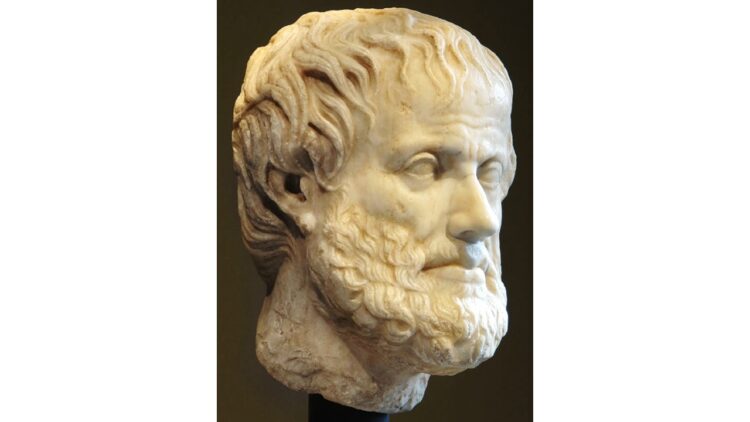
A Prayer of Aristotle
“Anyone who wonders whether we ought to
honour the gods needs a whipping.” ―Aristotle
Our twelve great gods I serve with veneration,
Pay tribute as accustomed rites suggest,
And sing glad paeans pleasing in effect.
But reverent reason finds unification
Of countless godly spirits coalesced
To be true piety for minds elect.
Philosophy performs investigation
In love of wisdom with religious zest
Of One unmixed, unmeasured, and unchecked.
My God, I honour you by imitation
As far as possible. Your acts are best.
Mimesis cultivates the intellect.
My mind, the best of me, shapes an oblation
Of thought, like temple gifts more manifest,
Displaying deep devotion and respect.
You are Thought Thinking Thought. My admiration
I give to what you actively attest;
The cosmos is the window I select.
O limitless beginning of creation
And endless Theoria self-possessed,
My self in praise of you I would perfect.
My talents I employ in contemplation
And writing on our ancient palimpsest
Of knowledge from one greatest Architect.
Let me advance with real appreciation
Of unity in nature holiest,
Where goodness, truth, and beauty intersect.
My unmoved mover, act as motivation
To draw me, metaphysically caressed,
Toward you, while all I’ve known I recollect.
Let wonder help me reach sanctification,
O thinking God whose worth is steadiest.
My ways direct; my honesty protect.
Hear this my just and dutiful oration;
Prosper my home and friends as I request;
Make me a better man, more circumspect.
Margaret Coats lives in California. She holds a Ph.D. in English and American Literature and Language from Harvard University. She has retired from a career of teaching literature, languages, and writing that included considerable work in homeschooling for her own family and others.


















Thanks, Margaret! This is wise, subversive, and almost seductive. And I say this as someone who is 55% Aristotelian…
Thanks for your response, Golan! Undoubtedly you, as a man of science, have been accustomed to others who view Aristotle as a philosopher of science, little concerned with matters beyond the material. I know that’s not you, because of your concern for what is immaterial and personal as highly important in medical practice. Some modern scientists even see Aristotle as a thinker much like themselves, tending toward atheism. I think you refer to them when you call my poem “subversive.” It is subversive of those who refuse to consider the great philosopher as a man of his own time and place–and who neglect what he actually wrote about religion. For my references to that, please see below the recommendation of Louis F. Groarke’s book.
You have put so much dignity into these verses, Margaret C.
from Margaret B.
Aristotle would have considered dignity absolutely required in addressing the God of his thoughts. Thank you, Margaret B., for pointing out that I’ve followed his requirement!
Margaret
Thank you for this intricately patterned and erudite poem that reflects and does honor both to Aristotle and to the one God. You are reaching for ultimate truth—as did Aristotle. You weave in his pagan philosophical insights about one God: Thought Thinking Thought; unmoved mover; One unmixed, unmeasured, and unchecked.
I am impressed by the regular pentameter and the exact rhyming pattern. There are 12 tercets in regular iambic pentameter. The rhyme pattern is a-b-c, where ‘a’ is a feminine rhyme based on the ending “ation”; ‘b’ is a masculine rhyme based on the ending “est” or “essed”; ‘c’ is a masculine rhyme based on the ending “ect” or “ecked.”
You have imagined what Aristotle’s interior “prayer” might be like. While he conforms outwardly to the temple practices of the polis, as a good citizen must, he prays silently (‘My mind, the best of me, shapes an oblation of thought’) to the God that is ‘countless godly spirits, coalesced’ that ‘minds elect’ discover.
My favorite lines are from stanza 8: ‘My talents I employ…writing on our ancient palimpsest of knowledge from one greatest Architect.’ You are using that lovely word ‘palimpsest’ to mean ‘something having usually diverse layers or aspects apparent beneath the surface’ (per Merriam Webster definition number 2 b) . This gestures toward Aristotle’s project of uncovering the truths that one God has implanted in human souls.
Brava, Margaret!
Most sincerely,
Mary Jane
Thanks so much, Mary Jane, for all you notice and understand here. I’m glad you pay attention to the form of the poem, since I created it based on a remark by Aristotle that “we use the number three in worship of the gods.” No how or why given, but that was enough for me to choose tercets with three rhyme sounds only for the entire prayer. Aristotle would not have rhymed a Greek prayer, but if he knew about English poetic traditions, and wanted to write in English, he would have conformed to our great body of religious poems which are mostly rhymed. And probably would have done so in a way that could be considered noble because it involved difficulty.
Aristotle is supposed to have written a treatise on prayer, but some experts claim that is a fable, and if he did write it, it is now lost. Therefore I have to use prayer traditions we know about, carefully fitting them to what Aristotle says about the God he might have addressed in private thoughts. Obviously, there would be a self-presentation establishing the relation between himself and the deity, and I think praise would be most important, followed by suitable petitions. Petitions that seem like bargaining, or that ask for something impossible like immortality, would not be suitable. We do have one statement where Aristotle says he prayed for a friend named Nicanor, so praying for friends is acceptable. And Aristotle did seem to believe that people should pray for peace and prosperity in the polis (which must have been done publicly in the temples, as well). His God is not the Judaeo-Christian Creator and provider and redeemer, so I’ve put very little thanksgiving, contrition, or reparation in here. Asking to advance in virtue and understanding, and to avoid known evils, seems appropriate for an intellectual like Aristotle to request from a God whose principal activity is thinking!
Margaret, the words that come to me after reading this excellently-wrought poem are elegant, tender, thoughtful, skillfully rhymed, structure fit for the task. I always know when I see you have had a poem published, that it will be a very special and satisfying experience to read it. You inspired me to download the complete worlds of Aristotle on my Kindle!!
That was quite an inspiration, Theresa! Hope you will find worlds of wisdom there. Aristotle seems to me an inspiring pattern of the most a man can do with his reason as his guide. If, though, you’re interested particularly in his religious attitudes, I would still say consult the book by Louis Groarke mentioned below. Groarke shows how we have to search through that vast corpus you’ve downloaded to put together what I tried to assemble in this poem. Thank you so very much for your praise of it.
I am overwhelmed with what you have done with the Aristotelian thought process with your superb intellect and penetrating powers combined with knowledge and voluminous vocabulary. Moving forward from the “gods” to “God” is a brilliant display of creative genius and innate devout religious consciousness. There is so much of divine worth to contemplate ensconced in fascinating words and rhymes.
Thank you, Roy. This work was particularly deserving of elegant rhyming. The creative genius with innate devout religious consciousness is not mine but that of the great philosopher Aristotle. His move from “gods” to “God” shows what a serious intellect can do in contemplating the ancient pagan religious tradition he inherited and respected. Christian seminarians today study philosophy before moving on to theology, and they get an introduction to Aristotle’s ideas about the nature of God, supernaturally supplemented by what is revealed in Christian Scripture and tradition. Aristotle’s idea that thinking is the paramount divine activity certainly offers inspiration to do more thinking, and to think very carefully!
In addition to what I’ve already said, and hoping it will come forth, I’ll add more on the “gods” to “God” topic. The archaeologist and anthropologist Ivar Lissner, who lived with and studied primitive peoples, was convinced that one God was the fundamental human understanding of divinity. More gods came later, as people noticed multifarious divine activity and tried to account for it in myths. Therefore, Aristotle would have been a thinker who used his mind to recover and develop early human insights.
This poem took a lot of profound thought! I admire your talent in carrying the rhyme scheme through for so many stanzas (especially the lines ending in -est.) I love the contrast in “O limitless beginning of creation / And endless Theoria self-possessed”. And my other favorite line is, “Where goodness, truth, and beauty intersect.”
Thanks so much, Cynthia. My own choice and use of words did take profound thought, but again I must admit I rely on Louis Groarke’s long career of profound study of Aristotle and of the extensive commentary about him. The contrast you like is my attempt to honor Aristotle’s apparent belief in the eternity of both God and cosmos. For him, there would have been no “in the beginning” to creation. That’s astounding to most of us, whether we are creationists who think the beginning was not so long ago, or evolutionists imagining how very long ago elementary particles became the first elements so that the first living cell could arise. For Aristotle, beginning and end are “limitless.” The capitalized “Theoria” roughly corresponds to God’s eternal self-contemplation. By the way, Groarke suggests some notion of intelligent design in Aristotle–not before “the beginning,” but in the manner of the Unmoved Mover activating potential in accord with his thought.
The triad “goodness, truth, and beauty” is not identified as such in Aristotle, though he frequently associates beauty and goodness. That’s why I thought of “intersect” as a possible way of relating truth to the other two. Truth is primary; Aristotle seems to have little hesitation declaring that flawed ideas or arguments are false. I much appreciate your attention!
Well crafted and well executed in thought and cadence. It is after all, the ABCs of philosophy!
You are an impressive poet, Pearl of great price!
Jonathan Kinsman
Thank you, Jonathan. In traditional study of philosophy, we do start with human reason and what it can achieve. We say reason alone can come to the knowledge of God’s existence, his oneness, and his goodness–as Aristotle did. But since many thinkers do not get this far, I imagine we continue to study Aristotle because he provides a clear ancient example proving our philosophic point about reason! Glad you find the poem well executed to do so.
Thanks to all who have commented! I’ll hope to answer each of you soon enough, but first I must thank LOUIS F. GROARKE. His book “ARISTOTLE, OEDIPUS, AND GREEK RELIGION,” published in December 2025 by The University of Ottawa Press, inspired my poem by collecting and discussing all the material throughout Aristotle’s works that bears upon his religious attitudes. Magnificent effort by our fellow poet and Society of Classical Poets member, whose profession is professor of philosophy.
An elaborate elastic labyrinth of lexical legerdemain. To pull this off with one rhyme would be noteworthy. But three-peats carry Aristotle to a higher level entirely. Contrived yet clever.
Thanks for your praise, James. I like the description of the rhyme scheme as “three-peats.” Aristotle achieved a significantly high level on his own, and might have contrived something more clever than mine if he had chosen to write a prayer poem. And as you may have seen above to Mary Jane, he did say “we use the number three in worship of the gods.” My contrivance was to bring in quotes of his, along with paraphrased statements that are well supported, and connect them as cleverly as I could.
Margaret, this is an eye-opening poem for me to consider that for so many centuries, such things are contemplated. In addition, I also learn so much from comments!
Thank you, Laura. Glad this effort of mine was worthwhile to you, and sorry I missed replying earlier. If you remember our friend Rita, she was trying to read Aristotle on her phone. He and his wide-ranging thought remain fascinating to many beyond the scholarly sort!
Very nice assonance on the ‘e’ throughout and introduced very pleasantly by combining it with the alliteration on the ‘v’ in the first line (of which there are faint echoes later).
Daniel, thank you for appreciating the rather restrained sound effects I considered to be like those that might be spoken by an ancient Greek philosopher. The “v” alliteration in the first line draws attention–but otherwise the speaker puts forward his meaning with only the decoration of rhyme required as a salute to the English language. With my choice of only three rhyme sounds, that does include the “e” assonance in the second and third lines of each stanza!
The “e” assonance in the second and third lines of each stanza is very impressive and creative.
In studying the Divine Comedy, scholars over the centuries have marveled at Dante’s ingenious terza rima. Translators have found that they can’t render it in English while preserving the poetry and the meaning. I think it’s because Italian has so many more words that end in vowels.
Margaret I believe that you have found the equivalent in English. Not the same as terza rima, of course, but an ingenious rhyme pattern that fits the English language well.
The last two lines are my favorites. We pray for our family and friends first of all, then for help with discernment when we face moral or ethical decisions.
There is a new translation by Michael Palma of the complete Divine Comedy, published last year. It renders into English all three books into perfect terza rima, with very close adherence to the meaning of the original text. See my review of it at Expansive Poetry Online.
Thanks, Gerard! This ingenious rhyme pattern fits the English language well, when choosing rhyme sounds used in a relatively large number of words. Glad you liked the last lines, since prayer for others is one thing Aristotle directly mentions, and because I think the final petition I put in his mouth is one that fits his concerns superbly. As you may know, he wrote a great deal on the subject of ethics, and a prayer to be more “circumspect” asks that he “look around” himself better, to discern everything that needs to be taken into account.
Thank you Mr. Salemi. It’s what I like most about this website. I’m always learning.
That’s what I like most about this site. Always learning new and edifying things.
About Aristotle and the Divine Comedy, here are some words of Dante that agree very well with what I’ve had Aristotle say about God. Aristotle himself does not appear, but Vergil tells Dante, “Filosofia nota . . . come natura lo suo corso prende da divino intelletto e da sua arte.” That is, “philosophy notes how nature takes its course from the divine intellect and its art.” And then Vergil refers to Aristotle’s Physics by title! From Dante’s Inferno, Canto XI, lines 97-101.
Hi Margaret,
What a wonderful poem! I think Aristotle would have appreciated it. Of course, he was a man who put formal cause front and center and you have such a balanced, judicious sense of structure. I won’t repeat some of the comments above but I agree whole-warmheartedly.
Of course, many aspects of Aristotle’s thought are a bit of an enigma and there are confounding tensions that one picks up in scholarly analysis. But everything indicates that he was a proud Greek–that means, not that he had a naive view of Greek mythology and the gods, but that he thought (as he says in the “Metaphysics,”) that there was was something deeply precious about the Greek temple tradition. I like very much how the poem–in line with neglected parts of the corpus–pays homage and explores this other side of Aristotle.
Aristotle’s thought-thinking-thought God is a highly intellectualized rendering of the Greek religious heritage he valued. But (despite modern academic resistance) there are many other aspects of religious feeling touched upon in his work and in the poem.
I won’t rattle on but very nice work; in dealing with a perennial theme, and with some nicely nuanced and judicious phrasing, you add substance to your poetic eloquence. We get a really good poem and a reworking of a Greek episode in philosophy and in the beginnings of the Western religious tradition.
Thank you for mentioning my humble treatment. You need to publish a book of your poems. It is interesting to me how poetic inspiration works and seizes on all sorts of subject matter for expression.
Congratulations! Well-done!
Thank you, Louis, for your confirmation that I’ve understood and made good use of your diligent and thorough work, revealing what we can know of Aristotle’s religious views from his existing works. While I’ve had the privilege of studying the ancient Greek language, and reading varied texts in it, I much appreciate your authoritative survey. We can know that the great philosopher valued temple practice, that in addition he developed an intellectualized view of divinity, and that his more esoteric teachings did not contradict, but rather supported his other ideas, and indeed tended to respect general opinion.
Trying to imagine a prayer Aristotle might have made takes him seriously. Though the wording and structure are mine, this poem reflects his perspectives, and rejects much that would be mine. But I do find a likeness that you mention in reference to “the beginnings of Western religious tradition.” Greek thought and prayer represent one source that profoundly helped shape those beginnings–just as we can say that Greek civilization in its maturity accepted and made unique contributions to Christianity.
The Prose Apartments
by Esiad L Werecub
Along the highway of communication, one can find
the prose apartment paragraphs conveniently designed.
They rise above the light-green lawns, below the azure sky,
wherein the Sun is flaring, glaring, in its changing hikes.
Here one can find Herodotus and novel histories,
before one comes upon the theories of Thucydides;
as well as the dramatic works of Plato’s broad discourse
and all those mighty writing drafts of Thé Philosopher’s.
Those solid prose apartments are so tidy, neat and clean,
and from them there is quite a lot of living one can glean.
They are a place where one can dwell beside time’s swimming pool,
where fun and one luxuriate, in space, room after room.
Thanks, Bruce, you offer luxurious appreciation of valuable prose which is mostly Greek to us, even when we’ve learned to read it with modest facility. It’s the ancient authors’ followers and their editors who do most to make it “tidy, neat and clean,” as I discovered from Louis Groarke’s careful distinctions. Still, you’re quite right to point out how much “living one can glean” in those solid prose apartments!
Eternal Laws
by Esiad L Werecub
“The Sun proceeds unmoved…”
—Emily Dickinson
This figure is not a creator, this self-thinking Mind,
in-spi-r-ing the motion of the cosmos and spacetime,
pure actuality, this unmoved Mover—who just…awes—
devoid of potency and change, and serves as final cause.
Is this the figure come to mind, when Alexander died,
that gave rise to impiety, by being deified?
When Aristotle left Athenians for Macedon,
was this the charge against his guide that caused him to be gone?
Yes, pure act, or in your own other words, Bruce, “devoid of potency.” Awe or wonder is the ultimate effect on the contemplator of this unmoved Mover, who is indeed the final cause of the cosmos and spacetime. However, the Philosopher also describes him as efficient cause, without applying that name.
You might enjoy Groarke’s book cited above. It is fairly easy to read, and does cover interpretive writers with a fair evaluation of how seriously each takes Aristotle’s metaphysical and religious statements. Does not, however, answer the questions asked in your last quatrain here.
Thanks again for taking my work seriously enough to produce two further poems about Aristotle!