


.
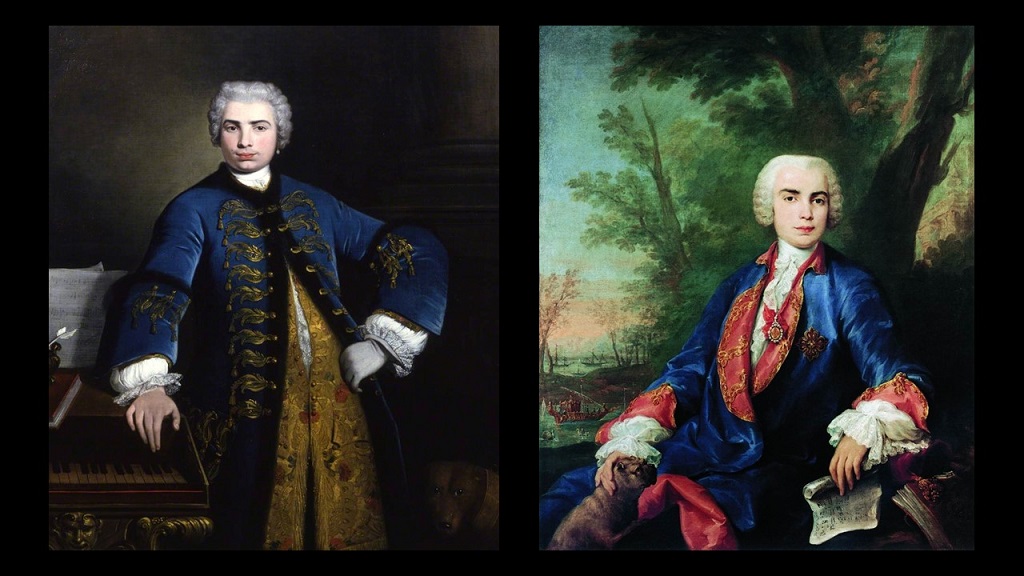
Farinelli
A thousand thanks, Martini, for your visit.
Bologna is a town of balladeers.
You’ll love it! Now I wonder, how long is it
Since we both quit Madrid? Ah! Twenty years
Since I last sang before the King of Spain!
And forty since vast crowds hailed me on stage:
“May Farinelli’s music always reign!”
It seems so long ago. A different age.
Such memories inflict more aching than
My unfused joints. My brother is to blame.
Riccardo was an honorable man
Yet traded my virility for fame
And sterile wealth. My canny, long-dead brother
Who chose for me this well-paid, grotesque life!
Am I too candid? How can I be other?
Resentment sometimes stabs me like a knife.
Come sit beside the fire—the heat, the flash;
The crackling sounds are music. Watch the flame
Transform once-living branches into ash!
Riccardo thought with flesh it was the same:
My body could be artfully adjusted
So my soprano voice would stay unchanged.
He met a doctor whom musicians trusted.
To thwart my puberty was then arranged.
The doctor said he needed one small lie
To justify this drastic operation:
Pretend a fall had knocked my groin awry
So he might plausibly suggest castration.
He found a clamp. He donned his spectacles.
He gave me opium. He placed a pan
Between my legs then crushed my testicles.
I screamed, deformed to something less than man.
But crowds adored my singing! “Heaven sent”
They cheered in Venice, Barcelona, Munich.
“The Great Castrato”—Europe’s main event;
The opera world’s most celebrated eunuch!
No wonder Music soon became my life,
For there was nothing else that I could do.
Quite celibate, I dared not take a wife—
The parts that make men virile never grew.
I will say this: I like my fame and wealth
Despite the flaws within my brother’s schemes.
Although I’ve neither progeny nor health,
My great success surpassed his wildest dreams.
In secret, though, I ponder: might my voice
Not still be splendid as a baritone?
I’ll never know. He took away my choice.
And like my life, my death shall be alone.
.
Poet’s notes: Farinelli (1705-1782) was an enormously popular Italian castrato singer of the 18th Century. He was born Carlo Broschi, younger brother of the mostly-forgotten composer, Riccardo Broschi. Carlo was about 12 years old when Riccardo made the decision to have him castrated. This was done to preserve Carlo’s unusually strong soprano voice and thereby enhance the Broschi family’s finances.
Martini is the famous Italian composer, Giovanni Battista Martini—one of Farinelli’s few friends in his latter years.
When Farinelli died in Bologna at the age of 78, it was 45 years since he had stopped performing in public. Exceedingly wealthy, his estate included gifts from royalty, a large collection of paintings, a collection of keyboard instruments and violins by Stradivarius and Amati.
He died alone.
.
.
Brian Yapko is a lawyer who also writes poetry. He lives in Santa Fe, New Mexico.



















Everyone is entitled to comment here concerning his or her opinion regarding a variety of issues that have been triggered by my concern for the rights of prepubescent children — those who are incapable of making informed decisions regarding drastic procedures and their consequences. Some of the comments here have gone way beyond either the poem itself or its underlying subject of concern. That being said, I would like to make it clear that the only opinions I have in this comment thread are those that I have explicitly stated under my own name. If I choose to adopt anyone else’s views, I will be explicit about it.
All I can say is that I am sick of Categorical Moral Imperatives; I am sick of such imperatives being used by religionists to paralyze our Western will to fight back against our enemies; I am sick of hearing about “what the Church stipulates;” I am sick of being browbeaten into apologizing for being part of the greatest and most dynamic civilization the world has ever produced; and finally, I am sick of the miasma of self-loathing cowardice that seems to hang over the West.
If those are my crimes, I admit to them. But I won’t repent of them.
What crimes?? I would like to email you directly, Joseph, if you’re willing to release your address. A clarification of my comment may be in order.
I’ve asked Mike Bryant to send you my e-mail.
My previous comment about crimes was not addressed to you, but was just a general expression of exasperation over the hobbling of rightist polemics in this country by sectarian religionists.
Brian, I’m very glad to see that this fine poem of yours has been the source of important discussions, including some that go beyond the topics you intended to deal with. I have spent some time considering the question you give Farinelli, of whether his life and career could have been successful had he been allowed to mature naturally. This is certainly at the heart of what you say about children currently being mutilated. Are there no treatments for their psychological distress that do no irreparable harm to their bodies? All the more so when it appears that so many have a pathological disorder (autism) demonstrably present before gender dysphoria manifests itself. Comparisons with castrati are useful. The castrati were subjected to irremediable mutilation for the purpose of insuring their career security. Those who did not become wealthy and famous could expect long-term employment in a choir with no competition from boys and women. It was surely not worth all the suffering to have some few choirs entirely made up of adult men! Boy choirs had to go on in order to identify prospects, and of course they go on to this day for the sake of musical education, as well as to provide soprano and alto singers in the few places that still have an all-male program.
Today, however, we are told that we mutilate to save lives. Children and adolescents may commit suicide if not treated as adults suggest. But are there no less harmful ways to prevent suicide among the young? And please note that the only benefit offered is life itself, not a secure career, and certainly not the “satisfaction” after mutilation reported by some. Is that our equivalent to employment as a castrato choir singer?
I see how this topic becomes interminable! But returning to the question of Farinelli’s potential satisfaction with life, I am sure that someone with his musical gifts could have had a great career as a baritone singer, voice coach, and conductor. And maybe his high voice could have lasted. We now tend to call male singers with skill in high ranges “countertenors.” Go back to YouTube and look for a video comparing “Pie Jesu” as sung by Moreschi and by our contemporary countertenor Philippe Jaroussky. The compositions are different, but they are of the very same time period. The main difference is the style of enunciation. Also look for a 50-second video in which Jaroussky shows that he can sing baritone, but prefers the beautiful high tones from his head voice. He does say “head voice”; it is not falsetto. Where a singer is comfortable (for whatever reason) contributes very much to his range. And if all that is not enough, try as well Jakub Jozef Orlinski, who is being called “the new star of castrati” because he plans to record many of the pieces especially written for them. He is not a castrato but a countertenor, as easily seen by his breakdancing performances. That’s how he gets away from the stress of his work, in a way that would be impossible for someone with “unfused joints.”
Margaret, this is part two of a comment that I started below (inadvertently missing the “reply” button!
You’ve raised a most interesting subject in a comparison and contrast of the voices of the actual castrato, Alessandro Moreschi and the contemporary counter-tenor, Philippe Jarousski. I’ve listened to the comparison video/recording of the two men singing “Pie Jesu” (a fascinating exercise, actually!) and to my ears, I actually prefer the sound of Jarousski’s head voice. In other words, what was superior about the male castrato voice to the male falsetto? (I’ve always heard “head voice” in the context of women and “falsetto” in the context of men.) The difference you observe in enunciation is, I would guess, a factor of singing styles rather than physiology. Singing styles can be quite dramatically different from age to age. I notice listening to Caruso that he can sound quite different from Pavarotti in a way that reflects stylistic differences between 1910 versus 1995. This is even more apparent with soprano voices from, say, the 1930s like Lily Pons or Jeanette McDonald who have excessive vibrato compared to more contemporary sopranos like Kathleen Battle or Jessye Norman.
What I am left with here is the fact that Farinelli would have had a splendid baritone voice and he would have had a falsetto/head voice as well which he might have developed and there was no justifiable reason for him to be mutilated, endure a life of eunuch-celibacy, suffer the pain of unfused joints, have oversized ribcage (the latter symptoms attributable to the hormone disruption) and a host of other miseries that he endured “for art.” Recall that this was a 12-year old boy who had no idea what he was facing yet was at the mercy of an adult’s decision carried out by a people-pleasing doctor. No one was there to advocate for him. Nowadays there are a lot of advocates pushing for children to transition lending them “support.” They will have much to answer for. Who will be an adult in the room now and advocate for prepubescent children to WAIT until they have at least hit puberty before making life-changing decisions which may well ruin their lives?
I’m posting the Youtube comparison of the castrati and the countertenor below for the benefit of anyone interested in a listen.
https://www.youtube.com/watch?v=nukZS61W8f4
Thank you again, Margaret.
Margaret, thank you for this fascinating and detailed comment which brings so many layers to it that I scarcely know where to begin in responding. Because I have much to say in response, I will probably break this response into two parts, starting with the issue which is the primary point of the poem — child mutilation and the corollary between castrati and modern children diagnosed (frequently misdiagnosed, I would suggest) with gender dysphoria. There is obviously a vast difference between sterilizing children for profit and art versus sterilizing children because people think this is something that saves lives. Western culture has largely decided that mutilation for the sake of profit is no longer within the pale of being of ethical — although one hears of women having their small toes removed so they can fit into designer shoes, and one sees plastic surgery horror stories of people made to look like plastic dolls or even satan. But as gross as these practices are, they are voluntary and decided by adults. These grotesqueries weigh little compared to the sterilization and mutilation of prepubescent children. It amazes me that this is done in the delusional name of preserving their lives. First of all, since when do children under the age of 13 know enough to be able to make informed decisions about life-altering medical decisions? Second, since when do we give in to people (especially tantrum-throwing children) who want something because they threaten to commit suicide if we don’t? Third, why is this suddenly a health crisis when somehow human prepubescents have stumbled along for millenia and survived without having to have breasts and penises amputated? Four. Explain to me how a gay child who is 11 years old can possibly know the difference between being a lesbian or a transgender girl. Gay boys and girls are being systematically erased by a criminally hasty system of diagnosis and treatment. It’s telling that transgender children NEVER transition into a GAY adult of their target gender.
You ask the very pertinent question of whether these children can be treated in a less drastic way. The answer in theory is: OF COURSE. Therapy, treatments for autism… all the tools that existed before the year 2010 still exist. It’s the political climate that has changed and caused everyone to get on the transgender bandwagon. And I want to be perfectly clear here: I believe that gender dysphoria does exist. But I believe it to be far rarer than modern society would have us believe as it engages in a frenzy of turning autistic and gay people trans. Liberals believe they are doing a good thing by liberating people they believe to be struggling with their identity and who deserve all sorts of legal and social protections. But I believe they are placing the entire machinery of the Democratic party (and foreign corollaries) into the service of promoting misdiagnosis, sterilization and the erasure of gay men and women by showing great deference to a population that is statistically psychiatrically challenged all to burnish their Compassion credentials. That is so wrong. Where are the adults here?
In closing, let me get this straight. Children under the age of 18 may not vote. They may not serve in the military. They may not even buy alcohol. But they can change their gender on a whim? And people think this is okay?
Well it’s not.
I’ll write a separate comment on your Moreschi and Jaroussky observations a bit later. Thanks again, Margaret.
On that note, there are adults who don’t even have gender dysphoria who transition for the social benefits, which they call “transmaxxing:” https://dailycaller.com/2023/01/08/transmaxxing-gender-transitions-sexually-frustrated-males-incel/
It reminds me of Blaise Pascal’s statement that if you want to believe in God, pretend to believe, and soon you will believe. Look at Dylan Mulvaney—his transition started out as a video he did for a joke about “day one of being a girl,” and then it went viral, leading to his decision to make it a permanent change.
I think part of what’s behind so many male-to-female transitions (I don’t know anything about the female-to-male transitions) is that at least in some ways (though not all), women really do have a higher status and more legal rights under feminism, and trans “women” have the highest status of any sex/gender presentation combination in modern culture. This isn’t some kind of male-chauvinistic whining session; there are women who have the same complaint about men being treated unfairly in many ways.
Thanks for this, Josh. “Transmaxxing” sounds like yet one more outrage against both sanity and integrity. One of the medical/technological horrors of the present age is that Medicine does not acknowledge the Frankenstein-like unnaturalness of claiming to change people’s gender. I remember a comment Dr. Salemi recently made on another thread to the effect that a man who puts on lipstick and mutilates his genitals doesn’t magically become a woman. Medicine refuses to accept that fact, even though everything from tooth size to musculature to questions of fertility, pelvis shape and size, and a myriad of other variables which can’t be altered militate against the subjective unreality of turning a male into a female. And yet we as a society go on pretending. And will until the destructive consequences of this madness come home to roost with a few billion-dollar class actions, some insurance carrier bankruptcies, some arrests and a remorseful transitioner making a whistle-blowing speech at the Oscars.
I can only adduce one example of sex-change transitioning in my personal experience. A male relative by marriage had a dispute with his wife (of many years) around 1995. She told him that she had decided she was a lesbian, and wanted a divorce. (How one decides that at the age of 56 escapes me.)
Her husband couldn’t deal with the prospect of losing her, and declared “If you want a female companion, I’LL BECOME ONE!” And he proceeded by becoming a transvestite, and aping stereotypical female postures and gestures. By the way, he was six-foot-two and built like a linebacker, so these antics were both laughable and disgusting. Women tittered at his absurd flouncing, and his ham-handed use of cosmetics. As a novelist once said, “He looked like a truckdriver in drag.”
Since these superficial things didn’t work (his wife left him anyway), he resolved go through a sex-change operation. He had to wait for the death of his conservative and very wealthy European father, who would have disinherited him in a flash if he had found out what was going on. When the old man passed away, his son now had unlimited funds, and went ahead with every type of hormone treatment and surgery (facial, pectoral, genital, and whatever else the sicko doctors have dreamt up). All to win back his disaffected wife! He was 66 years old at this time, and looked it.
He never got his wife back. But he became a vociferous champion of trannie-dom, spouting politicized bullshit at every meeting he attended, whether public or private. His personal deportment as a fake woman was so idiotic, so off-the-wall, and so utterly phony that he could have been in a comedy sketch. And he insisted on using women’s public bathrooms, upsetting and frightening all the real women there.
So consider the genesis of this opera bouffe. His older wife decides she is a lesbian, no doubt entranced by the chic trendiness of the idea. She wrecks her marriage (they had three grown children), and drives her husband insane. He then embarks on this bizarre odyssey of transitioning and mutilation, and gains nothing at all from it, other than becoming an ideologized fanatic who alienates all his relatives and friends. All because of SICK IDEAS.
He never became happy after all this. As a truly pathetic sign of his anguish, he would carry in his pocketbook (yeah, he had all the accessories) some piece of legal paper that said he was a woman, and would whip it out whenever anyone seemed skeptical about what he claimed. He seriously believed that legislative action could change his sex.
I prefer to remember him from 1957, when he was a normal, energetic young guy with athletic ability and a perfectly sound grasp of reality. And I recall the words of the mad Ophelia:
“Oh Lord, we know what we are,
But we know not what we may be.”
Thank you for sharing this story, Joe. Depressing, yes, but yet more compelling evidence that a psychiatric issue should be dealt with psychiatrically and not surgically. Marginal personalities can be easily persuaded to think and do the most outrageous things. These people need supervision and reality-checks. Simply humoring them and letting them have whatever they want –no matter how destructive — is taking the easy way out. It is dishonest, it co-signs people’s nonsense and, as such, is a severe dereliction of duty to them, to their friends and relatives, and to society as a whole. It’s sometimes uncomfortable, but adults need to be adults.
This man’s mother — a very old lady — went to her parish priest because she was deeply troubled by all of this unheard-of craziness. The priest told her to accept it all and not worry.
That’s your Bergoglian Catholic Church.
Yes, Pope St. Paul VI was right when he said that the smoke of Satan has entered the Temple of God. Gone are the days when you could go to a priest—or a doctor or psychologist or policeman, or anyone in authority, for that matter—and get sound advice.
Wow, how crazy—we’d love to see a poem about it!
Not by me, Joshua. It was enough to experience it in real time.
Brian, I have known about the famous castrati for many years. Since I first read of this, it has stuck in my heart like a sharp thorn. But in my case, I have related it to painting and how visual artists are cut up and squeezed into conformist boxes, then tossed aside.
In jest I call it “the curse of Sally Cook,” but it is the same thing.
Yours is a fine poem. Congratulations – well done and well deserved.
Thank you so much, Sally, I’m intrigued by your comment about visual artists! And so grateful that you liked this sad poem.
Brian, I have seen the castration of so many vigorous art groups like The Tenth Street cooperatives of the forties through the 60s, and tiny galleries statewide that were choked off; large galleries with a non art agenda – . I could go on for pages but won’t because you need your space; I will just say I was treated like a non-person over and over. Some day I may write about it. But thanks for asking. Ballet is even worse.
Brian, congratulations. Your poem reminded me that I have actually heard the last of the castrati sing, on a very early phonograph recording (played on the radio). I can’t recall his name. He didn’t sound too good, but he was an old man at the time of the recording, and also of course the sound quality of those early devices was not a patch on modern equipment.
Thank you, David! Might you have heard the recording of castrato Alessandro Moreschi? A Youtube video of him singing Ave Maria is actually linked to one of the comments above. I will link it again here. Moreschi was the last castrati and he died in 1922 so that would probably fit your timeline. If you haven’t heard this particular recording, it’s worth listening to… and more than a little eerie. https://www.youtube.com/watch?v=KLjvfqnD0ws