


.
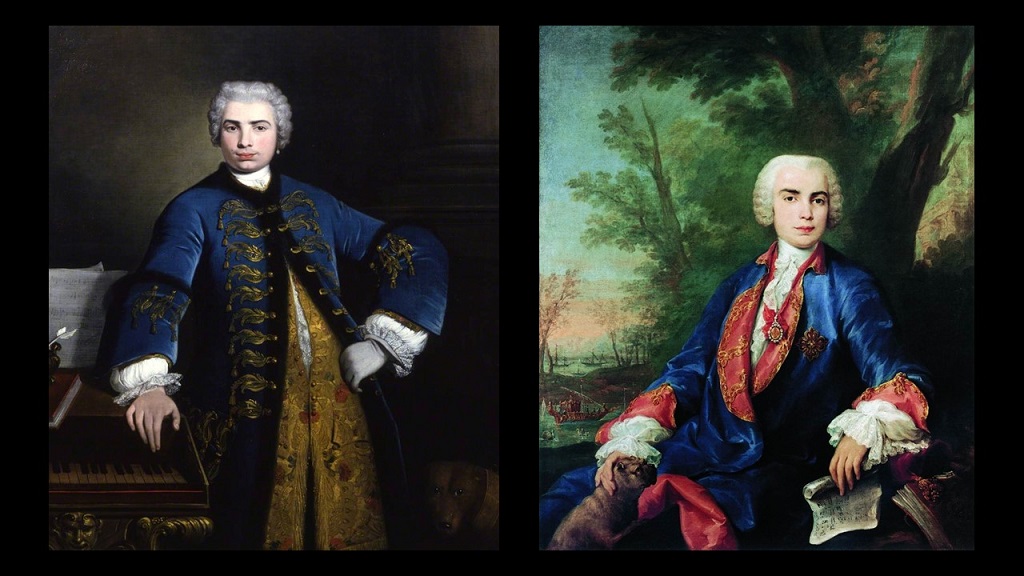
Farinelli
A thousand thanks, Martini, for your visit.
Bologna is a town of balladeers.
You’ll love it! Now I wonder, how long is it
Since we both quit Madrid? Ah! Twenty years
Since I last sang before the King of Spain!
And forty since vast crowds hailed me on stage:
“May Farinelli’s music always reign!”
It seems so long ago. A different age.
Such memories inflict more aching than
My unfused joints. My brother is to blame.
Riccardo was an honorable man
Yet traded my virility for fame
And sterile wealth. My canny, long-dead brother
Who chose for me this well-paid, grotesque life!
Am I too candid? How can I be other?
Resentment sometimes stabs me like a knife.
Come sit beside the fire—the heat, the flash;
The crackling sounds are music. Watch the flame
Transform once-living branches into ash!
Riccardo thought with flesh it was the same:
My body could be artfully adjusted
So my soprano voice would stay unchanged.
He met a doctor whom musicians trusted.
To thwart my puberty was then arranged.
The doctor said he needed one small lie
To justify this drastic operation:
Pretend a fall had knocked my groin awry
So he might plausibly suggest castration.
He found a clamp. He donned his spectacles.
He gave me opium. He placed a pan
Between my legs then crushed my testicles.
I screamed, deformed to something less than man.
But crowds adored my singing! “Heaven sent”
They cheered in Venice, Barcelona, Munich.
“The Great Castrato”—Europe’s main event;
The opera world’s most celebrated eunuch!
No wonder Music soon became my life,
For there was nothing else that I could do.
Quite celibate, I dared not take a wife—
The parts that make men virile never grew.
I will say this: I like my fame and wealth
Despite the flaws within my brother’s schemes.
Although I’ve neither progeny nor health,
My great success surpassed his wildest dreams.
In secret, though, I ponder: might my voice
Not still be splendid as a baritone?
I’ll never know. He took away my choice.
And like my life, my death shall be alone.
.
Poet’s notes: Farinelli (1705-1782) was an enormously popular Italian castrato singer of the 18th Century. He was born Carlo Broschi, younger brother of the mostly-forgotten composer, Riccardo Broschi. Carlo was about 12 years old when Riccardo made the decision to have him castrated. This was done to preserve Carlo’s unusually strong soprano voice and thereby enhance the Broschi family’s finances.
Martini is the famous Italian composer, Giovanni Battista Martini—one of Farinelli’s few friends in his latter years.
When Farinelli died in Bologna at the age of 78, it was 45 years since he had stopped performing in public. Exceedingly wealthy, his estate included gifts from royalty, a large collection of paintings, a collection of keyboard instruments and violins by Stradivarius and Amati.
He died alone.
.
.
Brian Yapko is a lawyer who also writes poetry. He lives in Santa Fe, New Mexico.



















Again, a poem that’s something of an education. Is ‘a stanza turner’ a term?
There’s an excellent book by Wilbur Smith called ‘River God’, narrated by a eunuch, which is also something of an education on the theme of castration and had me squirming in my seat in certain places, just as your poem did.
The price of fame and fortune, eh?
Thanks for the read, Brian.
Thank you, Paul! I appreciate your newly-coined term “stanza-turner.” I do try to not write dull work, so that’s a great compliment! As for squirming in one’s seat — well, I struggled over whether to go there and I just felt I had to. The consequences Farinelli experienced medically, socially and psychologically were significant and even though he ended up a rich celebrity, I don’t believe the reality and consequences of his castration should be sugar-coated.
I really like the contrasted metaphor of the burning logs in the third stanza.
Also, “The parts that make men virile never grew” seems so simple, concise, yet profound.
Taken as a whole, the poem reminds me of passages from Robert Browning’s poetry – the interaction between the two men echoing the sense of poems like “My Last Duchess” – in a way, I feel like both poems are about the dehumanizing of others through imposed values – if that makes any sense.
Thanks for the read!
I’m thrilled by your comment, Jeremiah, as Robert Browning is one of my very favorite poets and his dramatic monologues have been a major influence on my own poetry. I really struggled with “the parts that make men virile…” line because I wanted to convey one of many dire physiological consequences to castration but to do so in a way that was true to the character, not anachronistic and without losing the reader. So thank you for confirmation that I made the right poetic choice here.
As for your mention of “dehumanizing of others through imposed values” — oh boy does that make sense! In particular, I wanted to present the fact that Farinelli was a prepubescent minor who was medically subjected to the “adult” decisions of others who had venal motives and no concern whatsoever for whether this 12-year old boy might someday want to marry, have children, have a normal life with normal relationships. He was transformed not just into a eunuch but a commodity.
I hope you and others see the modern corollary here to the idea of sterilizing young children who have no ability to give rational, informed consent. I also hope that people will see how the fad of creating castrati which swept much of Europe in the 16th and 17th centuries was ultimately discredited as cruel and misguided.
Thanks for commenting, Jeremiah, and for letting me offer a bit of insight into the poem.
Thank you, Mr. Yapko, for “Farinelli,” a quietly moving (and disturbing) first-person account in the classical plain style. Ably, admirably done.
Thank you very much indeed, Tiree! Moving and disturbing are what I was aiming for so I’m glad you found it so!
I never heard of Farinelli until your poem, Brian, but was fascinated with the amazing story you told by your powerful rendition of his life and death. I am not certain how one finds such an obscure figure now from history. Although I pride myself on historical facts and figures, you have to read much more than I do to find such an astonishing tale. I was fascinated, also, by what happened to the young boy, since I won 1st place in state singing soprano solos in the 4th, 5th and 6th grades, but only 2nd as an alto in 7th grade, when my voice was changing. I am so glad nothing similar happened to me, because I developed a wide-ranging voice from tenor to baritone and bass that allowed me to win country music festivals and competitions and imitate all the country/rock and roll singers of the 50’s and 60’s. One thing is for certain, I am now glad I never had a brother! Writing from the first-person point of view in the present tense helped bring this poem alive along with things like “Bologna is a town of balladeers.” I enjoyed this very much.
Thank you very much, Roy. Farinelli was certainly an unknown figure to me as well until I studied Baroque music — especially Handel who wrote a number of operatic roles specifically for castrati. My knowledge of him was increased when I saw a foreign film called “Farinelli,” which I highly recommend.
I very much enjoyed reading your own story as a prize-winning soprano solo when you were a boy. I would certainly hope nothing similar would happen to you in this day and age! I look forward to hearing your music someday.
And, fortunately, few brothers are as manipulative as Riccardo Broschi was — at least that’s my earnest hope. By the way, speaking of Riccardo — I hope readers catch the irony in the line “Riccardo was an honorable man” the language of which I borrowed from Marc Antony’s speech in “Julius Caesar.” Antony, of course, was referring to Brutus.
This poem brings to mind all of the butchering that is happening to todays ‘lost’ children and youth. Thank you for this informative poem Brian.
Thank you very much indeed, Norma. In all candor, I began this poem by pondering what might be a historic corollary to the present craze of having prepubescent children brainwashed, mutilated and sterilized. The castrati of 17th and 18th Century Europe came to mind and became the springboard for this work. When I did background research on the castrati I was especially struck by the roles of physicians. It was considered unethical even then to perform a needless operation so it became common practice to have the doctor record a lie to justify the need for a castration. It was all very modern.
Brian, this is an absolutely perfect dramatic monologue with a silent interlocutor. And the rhymes! There isn’t a single forced or awkward one among them. It reminds me of Belloc’s skill in that same area.
It is a poem that is both beautiful and upsetting, perfectly crafted and yet frightening. And if it has a didactic or moral point, it is carefully embedded in the structure of the spoken words, and not blared at us by some overly-earnest speechmaker.
Top-notch work.
I’m deeply honored by this comment, Joseph. “Absolutely perfect” is a rare compliment indeed — especially when coupled with the comparison to Belloc! I will find much encouragement from this for quite some time. I’m particularly pleased that you like the rhymes, many of which are rather ordinary, but some of which (spectacles/testicles, Munich/eunuch) were particularly lucky finds.
I very much appreciate your observation concerning the didactic subtext of this poem. You know well that I do not shrink from writing poems critical of social and political issues. But my law experience has also suggested that sometimes it is more effective to whisper than to shout, to show rather than to tell. I’m glad that this poem is seen as making a point without having to use a baseball bat.
Thank you again, Joseph.
This is a very sensitive poem, Brian. You made a fine choice in imagining a conversation of an old man with an old friend at what may be their last visit. That’s the kind of place where all the important feelings of the heart can come out. The memory of the castration itself is well done to present the physical and psychological torture inflicted on the boy and recalled with pain by the man. The consequences of sterility, lifelong loneliness, and ill health come about as the crimes of the brother (I did notice the irony in “honorable man”).
Resentment at the constraints of his life is apparent throughout the poem, although you have Farinelli speak in such a refined and courtly manner that we can credit him with an emotional maturity gained in difficult spiritual combat. Having read about him, I understand still better from your poem why he chose to abandon a public career for personal satisfactions of music and friendship with the Spanish royal family–and why he retired to Bologna when these came to an end. You have done this great singer a great service.
Thank you very much indeed, Margaret, for this generous comment! Thank you especially for highlighting the choice of setting the poem within the visit of an old friend as “where feelings of the heart can come out.” I find that the most important decision in a dramatic monologue is to figure out why the speaker is sharing, and with whom. A dramatic context is important and the more organic the better. In this case having Farinelli look back upon his life with an old friend allowed for a logical interlocutor, distance from the events in question and a certain amount of possibly uncharacteristic introspection triggered by the visit.
I also greatly appreciate the second half of your comment which focuses on the historical Farinelli, his character, his spiritual challenges and, ultimately, his withdrawal from the limelight. Rather like Greta Garbo, it seems that being a star was not satisfying to him and that he simply “wanted to be alone.” And who can blame him? This was one of those poem-writing experiences where I set out to use history to make a contemporary point and, along the way, developed deep compassion for the historical Farinelli. To say that I “have done this great singer a great service” is not only very meaningful to me but very moving. Thank you, Margaret.
A very interesting poem, Brian. It reminded me of a book I read, written by a Saudi princess, who was once able to ask an elderly eunuch how he ended up as one. The man said that he was captured as part of a group in a raid by Arabs. They were castrated and buried in the sand. Those who survived became eunuchs and were charged with overseeing a man’s harem. But do you know how the practice of castration to retain a boy’s soprano originated? Was any particular person or group responsible?
Thank you for your comment, Cheryl. Yes, this is definitely not your typical poetic fare. I did do quite a bit of research on the castrati in the course of writing this poem and I can simply summarize what little I know as follows: castration has been used since time immemorial as a way of subjugating enemies and ensuring that they would not procreate. This became more entrenched in Byzantium. I know there was an empress in Constantinople in the 300s who had a eunuch choir director. Castration was certainly a common practice once the Ottomans took over Constantinople in 1453 — as you point out eunuchs were charged with overseeing the Sultan’s harem. I believe this was to ensure that the Sultan’s hundreds of wives remained faithful. Castrati as we know them in the musical sense were first seen in Italy during the 16th Century. They were part of the Sistine Chapel choir in the late 1500s, so I’m sure the Church was one of the beneficiaries of this strange practice, but I do not really know how it arose. I just know that by the time of Handel’s operas in the first half of the 18th Century it was firmly entrenched. I also know that the last castrato, Alessandro Moreschi, died in the 1920s. There’s actually a recording of him, I believe, on Youtube.
Also, didn’t the Chinese once have a class of eunuchs who enjoyed special status?
Yes indeed, Cheryl. The Chinese Imperial Court has had eunuchs as civil servants for 2000 years. Chinese eunuchs suffered much more drastic surgeries than eunuchs in the West. China has a long history of mutilating body parts, whether it is genital removal or the binding of women’s feet until a woman is left with nothing but stumps to hobble on. It is a horrid history which finds expression even today with the harvesting of organs from those the government persecutes such as the Falun Gong.
Thank you, Brian, for a well-told story, sad though it is. Your poetic skill shows through beautifully.
Thank you so much, Cynthia. A sad story to be sure.
Wow, Brian, another of your really good first-person poems! You always write them so well that I would think the speaker wrote them if I didn’t know better. I don’t know how you do it.
As others have pointed out, I can really see the parallels between castrati and transgender children, especially the last four lines:
In secret, though, I ponder: might my voice
Not still be splendid as a baritone?
I’ll never know. He took away my choice.
And like my life, my death shall be alone.
Incidentally, I read that in Ancient Greece, there were boys who followed a particular sect and chose to be castrated before puberty and live in the female role from then on.
Being male, I can imagine how horribly painful the method of Farinelli’s castration must have been—that bit was well done!
That was the cult of the goddess Cybele. Joining was voluntary, but I believe it was men well into puberty who chose to be in the cult, and not prepubescent boys.
Catullus wrote a powerful poem about a young man named Attis who was seized by a mad desire to join, and who castrated himself in the prescribed ritual of the cult. You had to slash off your testicles with a sharpened flint in a ecstatic ceremony, and the open wound was then cauterized with a flaming torch by the priests of the cult.
Catullus wrote the poem using male pronouns for Attis in the beginning, but switching to female pronouns for Attis immediately after the castration occurs.
Thank you for the cite to this fascinating poem, Joseph. I have just read it and find it mesmerizing and bizarre. Here is a link to a translation of Catullus, Poem 63:
https://aestheticrealism.net/poems/the-poem-of-catullus-about-attis/
Thank you very much, Josh! As for how I write dramatic monologues, it’s not so very difficult. At one point in my life I thought I might like to be a playwright. When writing drama (or performing it!) you really do have to be able to “get in character.” So I just try to put on my speaker’s shoes and see the world through his/her eyes.
You are very right about the parallels between the fad of castration for music and the current transgender craze. The practice of castrating boys for aesthetic reasons eventually was regarded as cruel and unethical. I can only hope that sanity returns to those who believe puberty blockers, genital mutilation and sterilization are truly the best way to treat confused patients who are steered into a diagnosis of gender dysphoria. Maybe they change their minds and want children and grandchildren? Maybe they are easily suggestible people who jump on a bandwagon that happens to be popular at the moment? Who can say. I just know that 10% of the world’s souls haven’t suddenly been plopped into the wrong bodies by a ridiculously careless Creator.
Thank you as well for your compliment on the writing of the castration scene. I wanted it to be accurate (especially the doctor soliciting the lie that would justify t he operation) but I didn’t want to get too clinically accurate, if you know what I mean. Nobody would have read past that stanza if I went into more detail! To make the reader squirm was, I think enough. But I wanted people to realize that this was something drastic and maiming. I hope people think twice before doing the same in 2023.
I have not heard of that sect in Ancient Greece before, so that’s very interesting. Castration does indeed go a very long way back and, apparently, for many different purposes. One would have hoped that here in the 21st Century we would be done with all that.
As always, Josh, I’m very grateful for your thoughtful comments!
To any reader who might be interested, I have located the Youtube recording of Alessandro Moreschi, the last-known castrato who died in 1922. He is the only castrato known to have made any solo recordings. This recording presents him singing “Ave Maria.”
https://www.youtube.com/watch?v=KLjvfqnD0ws
If you close your eyes and just listen, it really does sound like it’s a woman who’s singing!
Isn’t it uncanny, Cheryl? There’s definitely an ethereal quality to the voice, and knowing the circumstances of how the singer acquired this unusual voice makes it all the more poignant.
Good Day, Brian! I am at a loss for words, hearing Moreschi sing! It made me quite sad! I have read your poem with horror of this inhumane practice. What a powerful piece. It’s an outstanding poem. And educational with a cry to humanity to stop maiming the young. (From which they cannot return.) Our society seems to have gone mad! Glad my grandson never was in a public school. The Boards of Education are unethical.. I did read about the Greek practice last week. Greek box last week, past, and present. You are a master of history and poetry.
Ave Maria I heard so often growing up. Especially when performed at Loyola University’s Madonna de La Strada Chapel. I love Gregorian Chant and studied Latin for four years, Mass with guitars does not cut it!
I am with Joe Salemi’s comments. How you create poetry is tremendously inspirational. What a gift you are to all. Thank you for sharing this gifted masterpiece with us.
Patricia
Hello, Patricia! Thank you very much for your kind comment here. I love history and so poetry which addresses history is a favorite theme for me. I agree fully about how mad our society has become — especially on this issue of children being diagnosed with gender dysphoria. Just yesterday I read that a great many such children are actually autistic and are being misdiagnosed. The Moreschi Youtube video also makes me quite sad. It just wasn’t worth it. Thank you again for sharing your thoughts here.
A most interesting story, superbly rendered in your poetry, Brian. Moreschi’s Ave Maria is haunting.
Thank you very much, Paul. “Haunting” is exactly the right word. His rendition of Ave Maria is unlike any I’ve ever heard. I can see why composers wanted to write music for this type of voice.
This is so good and what an effective way to address a horribly disturbing feature of our times: indirectly, through historical analogy.
I think a lot about the Ethiopian eunuch as well and what Jesus said about those “made eunuchs by men.” He saw them and they were seen.
Thank you so much, Monika. And thank you especially for the reminder of Acts and Phillip the Evangelist’s encounter with the Ethiopian eunuch who became a follower of Jesus, and the words of Jesus Himself in Matthew.
Brian, I have read ‘Farinelli’ several times over simply because there is so much to take in. I’ve read this superb poem as a fellow poet and I’m in awe of the way the language flows seamlessly and beautifully within the constraints of form. It has a smooth conversational tone, yet employs all those literary techniques that elevate it to the realms of fine art. Your words have a musicality that is subtle and oh so admirable… perfect for the mood. I especially like the deft use of never-intrusive, carefully chosen end rhymes and the quiet echo of internal rhymes – ‘visit/love it’, ‘flash/ash… flesh’ (superb). Your close attention to the finer points has paid off big time… your wondrously woven words bring the character alive, elevating the message to greater heights. And, what a message. How it taps into today’s atrocities concerning our propagandized, pre-pubescent children.
I love the way you deal with the subject sensitively and compassionately, yet at the same time the sheer horror of Farinelli’s predicament screams out and grabs the reader with lines that make the misery of the situation plain and clear. Stanzas 3 and 4 are exceptionally powerful with potent and poignant language serving to highlight the pain the forgiving Farinelli endured, both mentally and physically.
The closing four lines tugged at my heart… the sheer enormity of the consequences surrounding the removal of personal choice really hits home. It’s exactly what’s being done in many areas of life today, and something we should all resist. Brian, I believe this is one of your finest works… I love everything about it. Thank you!
After reading your poem, I was unable to listen to Alessandro Moreschi from beginning to end… the power of your words made the experience far too sad – the mark of an excellent poem.
Susan, I am overjoyed to read this comment and to know that “Farinelli” worked for you both as poetry and as having a point to make. I do indeed “sweat the details” so when an accomplished poet such as yourself points these out it means a lot to me. You see and understand so much! The conversational tone is essential to the context of elderly Farinelli reflecting on his life with an old and trusted friend. Also, there is drama here that might have been over-the-top if it wasn’t spoken in matter-of-fact conversation between friends.
I’m especially glad and grateful that you understand the full import of this poem as a cautionary tale for all those in the present-day who would manipulate children into a faddish diagnosis of gender dysphoria and then push them into puberty blockers, hormone therapy, amputations, sterilization. On these subjects I think I’ve said much quite directly in other poems and comments. But a first-person account allows us to look at the situation from a new angle. Farinelli speaks for himself regarding the real-life consequences of sterilization: poor health — including those unfused joints at the beginning, the impossibility of sexual relations, lack of partnership, no ability to have children, grandchildren, etc. And when you research the medical effects of castration there are many more physiological consequences. Do people seriously think that transitioning children (let alone adults) do not face an extraordinary array of physiological horrors from having gone down this “transition” path? Why is “gender affirming treatment” so ubiquitously promoted? Does misery truly love that much company?
I understand about the Moreschi recording. It’s hard to fathom that this man’s ethereal voice is the result of his being castrated as a boy. But I’m glad the recording exists.
Thank you again, Susan, for your generous comment and your powerful insights.
Brian, riveted to your wonderfully flowing prose, I knew what was coming when I reached “Spectacles.”
What a disturbing tale of lost manhood for the sake of a melody. As ever, after reading your work, I will be heading off to Wikipedia and on to YouTube where I hope to find Moreschi. You have educated and informed us once again. Thank you
Thank you so much for this generous comment, Jeff! You have a very keen eye for an anticipated rhyme! Yes, it is indeed a disturbing tale — but one of many, since castrati were quite a craze from the 1500s to the tale end of the 1700s!
I posted the Youtube video of Moreschi in a comment a few comments prior to yours if that saves you time.
Thank you for commenting. Always glad to entertain and inspire research!
Skilfully crafted poem. Just makes me grateful that my brother was not a scheming kind of fellow!
Thank you, David. I second that! With brothers like Riccardo… Well, I like to think that Cain and Abel are the exception rather than the rule!
Thanks for the history lesson in top-notch poetic format!
I listened to the recording of A. Moreschi and it sounds creepy to me, although if I didn’t think it was a man I would have thought it’s an unusual sounding female voice. Goes to show that it’s not good to make assumptions about anything or anyone.
Thank you very much, Yael. I’ve listened to Moreschi a few times now and I just shake my head wondering: why did people think this was worth the terrible price?
Brian, I wrote a lovely comment earlier, and when I tried to enter it, it wouldn’t take it. I checked my name and the address and they still wouldn’t do it so I just wanted you to know before I try it again. Let me know what’s going on I never saw this before SCP.. I tried twice. Hope this works.
Patricia
Patricia
Thank you very much, Patricia. I saw your earlier comment and replied. Let me just also add my voice to yours concerning public school boards and their insistence on addressing issues concerning sexuality and gender dysphoria to young children, even going against parental wishes and using the wrong pronouns or opposite sex names for confused children. I very much respect what Ron DeSantis is doing in Florida by keeping this subject out of the classroom until 3rd Grade. And yet so many on the left see this as a terrible and bigoted thing. Really? I mean really?? This can’t wait until third grade? Suggestible children between kindergarten and third grade ought to be taught about gender dysphoria and gay issues? My friend in Oregon who had three little children is deeply resentful of such “education.” His view is that a normal, ethical, respectful, non-ideological teacher would/should say “Tommy, that’s something you should discuss with your parents.” Period.
An additional comment to interested readers: Please consider the following article which makes perfect sense to me. Children who are autistic are being systemically misdiagnosed as transgender. “Children with high-functioning autism previously showed up at eating disorder clinics with suicidal and anxious depression and body image distortions, but as pediatric gender clinics began cropping up, autistic adolescents began gravitating more toward those…”
https://dailycaller.com/2023/03/12/horrifying-huge-proportion-of-children-pursuing-gender-transitions-are-actually-autistic-experts-believe/
Wow, how awful. They think “changing sex” will solve their social problems, and they won’t know until it’s too late that their problems will still be there afterwards.
Just as you’ve rightly mentioned that the transgender movement is erasing women and gays, now it’s erasing people with disabilities. Not in keeping with what the left claims to believe in at all (is anyone surprised?).
In reality, the concept of “rights” is a zero-sum game, like poker. As Freeman Dyson said in his book The Sun, the Genome, and the Internet (wildly outdated; I read it when it was still current), a step forward in social justice for some is a step backward for others. We’ve seen plenty of examples of that in our own lifetimes, one of the latest being that every step forward for transgender people has been a big step backward for women, gays, people with disabilities, parents, Christians, and a whole host of other groups, all for half a percent of the population (in the United States, that’s a population slightly larger than San Antonio, Texas).
Those who want to give 100% of social justice to each person need to understand that there’s only 100% of anything to distribute to all the people. Then they’ll understand why different groups fight so much.
Thank you, Josh, for this very insightful analysis. I’ve just read it over three times and I find myself completely in agreement with you. Yes, now add people with disabilities who are getting thrown under the bus to support a specious movement for transgender rights. (Btw, I don’t recall transgenders being denied the right to vote or marry or receive education or purchase property or… ad infinitum. So what exactly is the battle here?)
Thank you especially for putting population numbers into perspective and pointing out the fact that when one group’s social justice comes at the expense of another group’s social justice then the net effect is to create substantial injustice.
A very ‘Ouch’ poem, Brian. Love the final rhyming of baritone and alone, and though one could almost find the predicament comic, the poem moves in a strange, but human way. Excellent work.
Thank you very much, James! “Ouch” indeed! But I think it was a necessary wake-up call. I agree with you — it’s quite a strange poem but one which I felt I simply had to write.
This poem, Brian, was executed perfectly, in every dimension, but especially in the way that the narrative seemed so natural, without any awkward space-filling lines. Every word in every line seemed natural and necessary.
The funny thing is, I published a poem some years ago with a similar theme but from a somewhat different perspective. This is it:
For the Unresurrected
The Easter Lilies, so immaculate,
Are stationed near the altar of a church
To mark the holiday that follows Lent,
Though jutting rusty anthers might besmirch
The noses poised to catch a lily’s scent
With what’s essentially ejaculate
Of floral grade. There was a time when males
Below a certain age were dispossessed
Of gonads to provide cathedral choirs
With ample boy-sopranos. You may rest
Assured that Hell reserves its fiercest fires
For mutilators, but this measure fails
To temper the immoderate behavior
Of florists who forthwith emasculate
Each perfect bloom to bar the orange stain.
While organs sound their pipes and clerics prate,
The lilies and castrati know the pain
That’s suffered for the glory of the Savior.
My poem is somewhat funny, but there is nothing funny at all about yours, which reminds me that I should try to be a bit more serious.
Thank you very much for this very generous comment, C.B.! Your poem “For the Unresurrected” is brilliant — entertaining, skillfully executed and gives the reader some interesting observations to ponder. I would never have thought of this floral connection to the castrati! You do indeed make a very serious point when you bring up Hell and the mutilators. You dress up hard truths with a wry sense of humor and thereby make difficult subject matter accessible. That’s quite a gift.
I came across this article this morning which offers a fair summary of the Left’s manipulation and misuse of “trans children” for political and ideological gain. Here is an excerpt.
“At the end of this road, what we’re seeing is that the political Left is willing to engage in child sacrifice—removing the breasts of healthy young women, and, as we know from the medical literature, castrating young boys, removing their penis, and then transforming it into what they call a “neo-vagina,” or an artificial vaginal cavity, which has just horrific medical consequences, in a way, almost reminiscent of the Aztec child sacrifice rituals. We’re castrating kids in service of a political ideology that uses them as totems to move humanity into the new left-wing metaphysics. It’s something that we’re going to see in the next few years yielding horrific consequences, dystopian consequences, because it’s fundamentally at war with the reality of the universe, the reality of human nature. It cannot stand.”
https://rufo.substack.com/p/the-trans-child-is-the-new-totem
What’s being done to our kids is absolutely shameful. There will be much to answer for.
The article is spot on. Biden calls any prohibitions on child mutilation “close to sin” because that’s an integral part of the religion of the left, which I think tells us all we need to know about them. Why do some conservatives want to protect the West from Muslims, when Muslims have far more respect for God, family, and marriage than any Western country?
Because we want to remain Western Europeans, with a European culture and civilization, and with European genes. Period.
The Spanish remained European under Muslim rule; otherwise they wouldn’t be European today.
It’s not specifically that I want to live like the Spanish did at that time; rather, leftism is the most evil religion ever to have existed, no exaggeration, and compared with it, literally anything else looks good. No other culture (unless it’s been influenced by leftists) does as much killing and mutilation of children or destruction of families, or has been so successful at spreading its evil around the world. The Abortion Holocaust greatly exceeds the evil of the Nazi Holocaust in every way; that alone (let alone everything else) is sufficient grounds for even greater contempt for the modern West than for the Nazis.
We really can’t argue, Joshua, because you are driven by Categorical Moral Imperatives that are universalist, while I am driven by a political agenda that is ethnic and particularist.
I had to look up half of that… as far as I can tell, you mean to say that our positions stem from the fact that for me, stopping the horrors of our culture is more important than preserving its European character, and for you, it’s the opposite. In which case, you’re right; unless one of us learns something that will convert him to the other’s position, we’re not going to agree, we’re just going to keep talking past each other.
Believe me, I want to stop those same horrors too. But I refuse to let my religion become a pious excuse for Western suicide, as it has in the mouths of all mainstream churches, including most of the Novus Ordo Catholic Church.
We can still fight in the same war as long as our rifles are pointing towards the enemy at all times.
I was thinking of it more in terms of putting down an animal with advanced cancer, respectfully disposing of a worn flag, or condemning a building decayed beyond repair.
I don’t think of it as an excuse for Western suicide, because that would start with a desire for Western suicide and look for a reason to back it up. For myself, I just came to realize that a desire to end the evils of the modern West and a desire to keep Western culture going are mutually contradictory, and so I had to choose which was more important to me. The article Brian linked to brought this to the forefront for me, and I’ve been thinking about this a lot since; that’s why I felt I should bring it up here. It doesn’t mean I love my country any less; it means I recognize that the end is near, that it’s useless to prolong the inevitable and allow further decay.
Of course, Western suicide is going to happen no matter what you and I do, since leftism is too powerful, and people aren’t having enough children anyway… but I’m seeing the silver lining in it. When we learn that the Aztecs did human sacrifice, it’s hard to see why anyone mourned the demise of their culture.
Eventually, unless Jesus comes before (which seems more and more likely), all that’s left of Western civilization will be some rural agrarian Christian communities here and there (such as the Amish, Hutterites, Clear Creek Monastery, etc.). How geopolitics will play out at that point is academic right now. In any case, it’s a natural process of Darwinian selection—any culture with small families as a norm will die out in the long run. Darwin would be the first to say this selects for religious belief. Read Progress Debunked by Samuel Thomsen (a traditional Catholic!) for more.
Take a look at James Burnham’s brilliant book “Suicide of the West.” Burnham was a secular agnostic, so he did not allude to any religious aspects of the problem. He simply explained that all the secular and political trends current at the time of his writing (1962) pointed to decline and decay.
Western culture and civilization are not identical with Christian belief. Christianity is one aspect of our culture — a very important and crucial one, but not the only one. We defend
Christianity with the same energy that we use to defend classical pagan literature, high art from all periods on all subjects, traditional architecture and design, and anything else that is a part of our heritage. We also have the right to speak up in favor of our genetic heritage, even if we are accused of “racism.”
Remember what Hilaire Belloc said — “The Faith is Europe, and Europe is the Faith.”
An undeniable fact of political life today is that almost all the major spokesmen and hierarchical structures of Christianity are now giving full-throated support to left-liberalism, wokesterism, globalism, gender perversions, and the slow extinction of European genetic identity. Trying to deny this is like denying that the earth is a globe.
I’ll have to read that book, thanks for sharing it.
Belloc’s statement may have been true at the time, but now Europe is anything but the faith, and Christians in Africa and Asia are the ones who actually believe it, for the most part. Europe is now the children of the kingdom who shall be cast into the outer darkness.
Just so we’re clear, I’m not in favor of the complete destruction of all Western culture. However, just as I would rather have a smaller, poorer and persecuted, but more devout, Catholic Church, I feel the same way about Western culture, its individual countries, etc. I think conquest and persecution would be good for us in the long run, even if we have to lose a few aspects of our culture along the way.
Of course, we can’t change the course of our culture or the Church, any more than we can change the course of the sun. All we can do is try to influence a few people into making changes in their own lives with benefits reaching to Heaven (see my poem “Poetic Influence”). If there’s one thing I’ve learned over the years, it’s the need to pick my battles. Race, culture, heritage, etc., are negotiable; matters of faith, morals, and family are not. I would sacrifice anything on the negotiable list for anything on the non-negotiable list; in fact, without going into details, I find that I have to on a regular basis.
You’re absolutely right that almost all spokesmen and structures of Christianity these days are as much a force of evil as schools and media. Even the so-called “traditionalists” I meet mostly push the woke agenda in Catholic clothing and call my thinking illogical and flawed because I don’t buy their idiocy.
For the record, when I heard of the beheaded babies in Israel, I thought back to this question I asked… now I have my answer.
I guess those countries can’t be that great if the best thing I can say about them is that even they won’t spay and neuter children like dogs the way the leftist West is doing. In retrospect, my question seems a bit like calling a serial killer good because he hasn’t killed his wife and children.
To Joseph and Josh, I’ve followed your conversation with interest. I personally believe that Western culture (which for me is essentially Western European culture as it has existed in Europe and has subsequently been disseminated throughout the Americas) is committing a slow and painful suicide. I think Joseph is largely right that this is not a church issue other than to the extent that the Western churches have become pawns to leftist ideology and are largely presided over by fictionalists who really don’t give a damn what the Bible says or Augustine or Aquinas or even the early leaders of the Reformation like Luther or Cranmer. But demonstrating that woke failing need not be endemic to Christianity is the fact that the Russian Orthodox Church is thriving — despite Soviet attempts to stamp it out. All of the orthodox churches are, along with the Coptic Church and related non-Western churches. Christianity is alive and well in many parts of the world. It is here in the West that Christianity along with Judaism has been hijacked by woke atheists. Voluntarily hijacked, I might add in what strikes me as something of a suicide pact.
The other piece of the puzzle here, which neither of you have mentioned, is the bitter accusation of Colonialism, which is one of the major factors in the astonishing anti-white hatred that exists in the U.S., Canada and throughout Western Europe — by self-abasing, self-loathing white people who are ashamed that they actually spread culture and civilization throughout the world. I recently saw a video about Mexico and the Aztecs and it grossly lamented the coming of the Spaniards and destruction of indigenous Aztec culture. Well, they didn’t do it alone. They were supported by countless tribes who despised the Aztecs. Human sacrifice has a way of eroding good will.
Wikipedia on the subject notes that at the re-consecration of Great Pyramid of Tenochtitlan in 1487, the Aztecs sacrificed about 80,400 prisoners over the course of four days. This number is considered by Ross Hassig, author of Aztec Warfare, to be an exaggeration. Hassig states “between 10,000 and 80,400 persons” were sacrificed in the ceremony.” There are other historians who have said the figure was “only” 4000 people. Only! Human sacrifice went on and on with lavish numbers like this year after year.
And we’re supposed to lament the fact that Spain put a halt to this? I refuse to be ashamed of a culture I celebrate, despite its flaws, and I feel sorry for chronocentric wokesters who don’t realize that they are just as fallibly human as humans have been in every century since the stone age. They have the same hatreds, the same failings and, no, they do not have the formula to perfecting humanity figured out. Far from it. All they’ve done is triage other hate-filled values — in this case, mostly self-loathing ones. Their arrogant assumption that they are the enlightened culmination of history is breathtaking.
Orthodox churches are gradually becoming more and more lax on issues such as birth control because people are pushing for it. When Protestant communities did that, they started to weaken in other ways, and more and more, they turned into what Susan describes in her poems. I give the Orthodox churches another generation… maybe.
I see modern Western culture in exactly the same way you’re describing Aztec culture, except modern Western culture is far worse. I would cheer another culture forcibly putting a halt to abortion, child mutilation, etc. Western Colonialism is alive and well, but somehow that’s all right because it’s spreading leftism instead of Christianity. To quote my own lines, “Colonialism is okay/As long as churches are suppressed.” (“The Great Satan.”)
My main point through all this is: leftism is so evil through and through that literally anything is better. To quote Peter Kreeft, when a mother can murder her own child, what is left of civilization to save?
To Joshua —
When you say “I think that conquest and persecution would be good for us in the long run, even if we have to lose a few aspects of our culture along the way,” you are candidly confessing an ingrained penchant for surrender. The left has already destroyed as many aspects of traditional Western culture as it can manage, and is stepping up the process every damned week! Your attitude is completely unsuited for battle, where you are not supposed to think about surrender but about killing or maiming the enemy. Consider what “Vae victis!” means, and read about the unspeakable horror of being conquered by cultural aliens.
You talk about what is “negotiable” and what is “non-negotiable.” Do you not understand that NOTHING is negotiable in the eyes of the left — they intend complete victory, and our slow extermination and replacement? Nothing else will satisfy them! Many Jews delayed their exit from Nazi Germany after 1933 because they simply couldn’t believe that Hitler was serious — they too thought their difficulties were “negotiable.” They even favored the deportation of their Ostjuden co-religionists, as a way to cozy up to Der Fuhrer.
In my view (and it’s only my opinion) your are fixated on abstract moral categories linked to a religious faith, and it is at the expense of political realism. Politics is about survival, advancement, deflection of enemies, and if necessary the shedding of blood without concern for ethical issues. Would Italy be overrun with African refuges if the Italian navy had torpedoed a few of those goddamned crammed boats before they washed ashore with their loads of human garbage? Or would your jackass Pope Bergoglio and his nancy-boy cardinals have been upset by that?
Races disappear. Where are the Vandals, the Visigoths, the Burgundians, the Alans? They were all once thriving and warlike identities, fierce in their pride and powerful in both offense and defense. But they were swallowed up and digested by larger and stronger entities, and there is no trace if them today. Are we going to let that happen now to Europeans as a whole? Do you want us to kneel down and pray and hope that the Novus Ordo fake church will bless our pious benevolence?
First comes life and survival. Then comes ethical theory.
I’m interested in hearing what you think should be done. It sounds as if you’re in favor of destroying the left and any would-be foreign invaders through some kind of guerrilla warfare. I wish you the best of success with that, but I’m not optimistic about it.
Your analogy with Nazi Germany suggests that you think we (cultures of European descent) are the good guys in the fight. We’re not. We’re worse than the Nazis, for reasons I’ve already stated. Do you think it was a moral good to fight for Hitler? If so, why, given that you’re against the Nazis too? If not, then why is it good to defend a bunch of child-mutilating baby-killers just because they’re the same race as we are? It’s better for a race to die out than to keep on committing these unspeakable crimes, and history shows that cultures that become decadent don’t repent without some kind of catastrophe. If God doesn’t send the West a massive chastisement, then He owes Sodom and Gomorrah some serious compensation; given what a ridiculous concept that is, He will punish the West. It doesn’t have to be conquest by another culture; anything catastrophic will do. You call African refugees “human garbage,” but I can guarantee you that they’re morally superior to the leftist devils who use them as pawns. Just as you’re glad that the Spanish stopped Aztec human sacrifice, I would be glad if someone stopped abortion and all those other evils in the same way. I don’t see what’s so problematic about that.
The problem with politics is that political opinions don’t have the slightest influence on what happens to us. I can say what I think until I’m blue in the face, but I have no power to do anything about it. Cultures and races do die, you’re right. People die too, but that doesn’t mean I can cure end-stage cancer.
Western culture is a sinking ship with a hole too big to plug. You seem to be insisting that we can plug it in time; I focus on rescuing as many as possible. I write my poetry to help influence individuals and de-colonize their minds, and I’ve had some success. That won’t change the culture; nothing can. But as C.S. Lewis said, the individual is more important than the state, because the state is temporary, but the individual will last forever. Survival of the culture is your priority, not mine. A lack of concern for ethical issues leads to mortal sin, which leads to Hell. In reality, it’s better to die than to be guilty of a mortal sin, because someone who dies in a state of grace is assured of Heaven, while God gives no promise of the grace of repentance to someone who commits a mortal sin. That kind of talk is surprising to hear from a Catholic.
So, you were right, we’re never going to agree on this.
Yes, of course it was a moral good to fight the Nazis. But no one seems to recall that there never would have been a Nazi movement or a second world war if we hadn’t let ethical morons like Woodrow Wilson (with their ideals about “democracy” and “freedom of the seas” and “wars to end wars”) interfere in World War I and prevent what might have been a negotiated settlement between the belligerents. It’s always the spiritual dreamers, with blather about their sacred Categorical Imperatives, who prevent sane realists from reaching sane solutions.
I don’t claim that we are always the good guys. In fact, in another thread here at the SCP, I pointedly said that we Americans are the BAD GUYS in the current Ukrainian fiasco. Skin color doesn’t prevent someone from being an idiot, but at the same time I prefer to keep company with my own genetic confreres. Is that a “mortal sin”?
You ask what I think should be done. Yes, I would like to see the left beaten and killed. I don’t want to convert them — I want to hear their death rattle.
In World War I, a German general, who was sick of the incompetence of the Austro-Hungarian army, said of them this: “We are shackled to a corpse!”
I sometimes feel that way about religionists on our political side, and how their pious moral obsessions seem to stymie any real progress we might make.
I don’t have a problem with a preference to keep company with one’s own race.
Myself, I would rather convert the left, but since this has proven impossible, it seems likely that the irreconcilable differences between us and the left could very well lead to a second civil war once enough people choose a side once and for all.
To Brian —
The West is committing suicide, but it is at the behest and urging and pressure of a small coterie of elitist criminals who have seized control of almost every visible outlet for dissemination of information and for the training of the young. And this elite’s alliance with Big Business (what we used to call “capitalism”) and with the new emerging technologies has made the situation virtually unfixable at first glance.
Yes, it can be fixed, but only through massive violence and a savage retribution against those who brought this nightmare about. No mercy, no forgiveness, no deals, no compromises, no Novus Ordo synodality and accompaniment. We’re going to need plenty of lampposts and firing squads. Left-liberalism is as much of a disease as the Black Plague was.
You ask about Colonialism. Colonialism is simply the way of the world, and always has been. Stronger races thrive and spread and conquer and build new cities, which means that one must be trained for war and prepared for war, to maintain one’s hegemony and supremacy. Colonialist practices can be mild, or they can be severe, but the practices will be there in any case.
About the Aztec mass sacrifices — yes, they were horrible, and I’m glad the Spanish conquistadors came in and put a stop to them. But let’s add some sobering context — from 1914 to 1918 we Europeans sacrificed countless millions of our best young men in a pointless and insane war, the only result of which was the birth of Communism and Fascism, and the signing of an idiotic and vindictive treaty that set the stage for an even bigger bloodbath from 1939 to 1945. Insanity seems to a threat in every culture.