


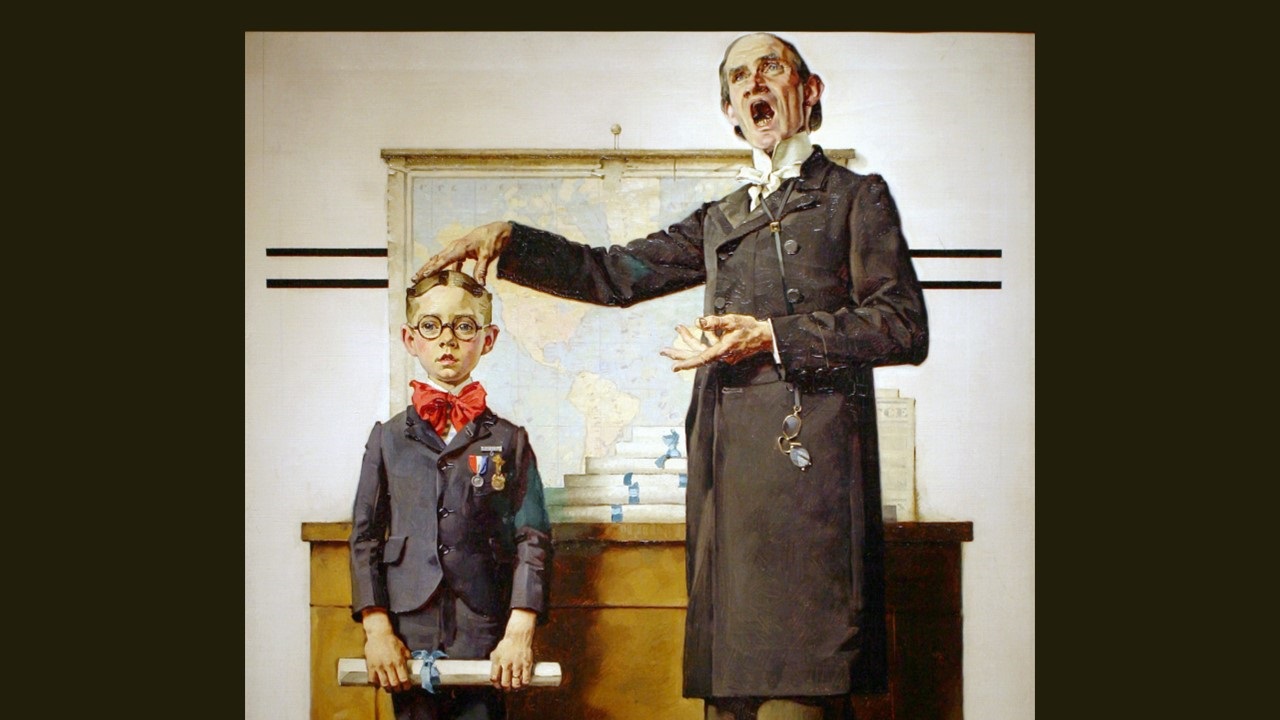
Good and Evil
The professor was so proud
Of his knowledge and his theories.
He loved to prod his students
With his question and his queries.
“If God is only good.
Then how can evil exist?
God must then be evil,
And that’s why evil persists.
“If God created evil
As He did like everything,
The idea that God is good
Is a myth to which we cling.”
The students all were silent
As they tried to understand.
At last, one student there
Did boldly raise his hand.
“Then tell me, good professor,
What is hot and what is cold?
I do not buy your theory
In the way that it was told.”
“For can we say that cold
Exists and is a thing?”
The professor quickly asked,
“Does not the coldness sting?”
The students giggled out;
They loved the professor’s joke.
But silence filled the classroom
As the student further spoke.
“Sir, you’ve taught us physics:
That cold does not exist.
We consider it the absence
Of heat, as you insist.
“We’re taught at absolute zero
There is all loss of heat.
All matter is inert.
The absence is complete.
“Evil is like cold
And it can’t stand alone.
It only is the absence
Of light from God’s great throne.
“God didn’t create evil,
It’s neither faith nor love.
It’s like the dark and cold
That I was speaking of.
“Evil comes when love
Leaves the human heart.
Like the cold and darkness.
It’s when from God we part.”
This student one day saw
Through time and space’s confines
And gave the greatest awe
To God. The student? Einstein.
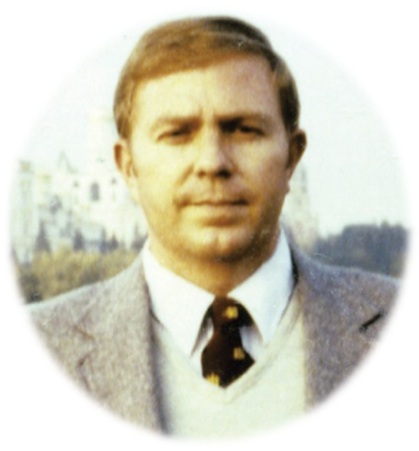 LTC Roy E. Peterson, US Army Military Intelligence and Russian Foreign Area Officer (Retired) has published more than 7,300 poems in 102 of his 125 books. He has been an Army Attaché in Moscow, Commander of INF Portal Monitoring in Votkinsk, first US Foreign Commercial Officer in Vladivostok, Russia and Regional Manager in the Russian Far East for IBM. He holds a BA, Hardin-Simmons University (Political Science); MA, University of Arizona (Political Science); MA, University of Southern California (Int. Relations) and MBA University of Phoenix. He taught at the University of Arizona, Western New Mexico University, University of Maryland, Travel University and the University of Phoenix.



















You’ve got some good word-play here, Roy, with sense behind it. I like the idea of evil and darkness (and presumably other things) being essentially absences but absences that do have significant effects. Einstein said this? Regardless, it’s a fresh (at least to me) idea on how we may approach some philosophical or moral questions. Whether it actually diminishes the problem of evil, I leave for others to dispute, but putting the idea in verse is just the sort of task at which you excel. Thanks for making me think.
Bless you, Bhikkhu Nyansobhano! The story I read from which I wrote the poem made me contemplate as well.
Good venture into philosophy, Roy–with a child very well known for later contemplations as your speaker. I hadn’t heard this story, but it does take a rather confident thinker of a child to take an argument with a teacher beyond a single step. You show how it works. The teacher can dominate with readily prepared (and often repeated) counter statements that lead the class in favor of him as authority figure, right or wrong. I think the argument presented here by the young Einstein goes back to ancient times, and I know it was put into good form by Aquinas in the Middle Ages. A domineering teacher doesn’t have to compete with classic authorities his students have yet to hear about!
Margaret, I love your perspective and contribution. When I was in the eighth grade, I thought I made 100 on a World History final exam. The teacher marked one wrong. I went home and told my mother. She talked to the teacher who said that was how the answer key had it in her teacher’s book. I told my mother the book answer key by Harper & (I think Row at the time) was incorrect and I should have 100. My mother and teacher got together again and decided if I would write a letter to the publisher and tell them their answer was incorrect and they came back telling me they were wrong, She would give me the 100. I wrote the letter. The publisher came back and said I was correct and they were changing the text and answer key. You need to understand that I had a set of encyclopedias and I would read excerpts while studying my World History to improve my understanding. I made 100 on the final exam.
The American poet and literary critic, John Crow Ransom, argued in his book “God Without Thunder” that God is the author of both good and evil, and that any other view of God turns Him into a benevolent, mild-mannered, polite bourgeois gentleman of the sort valued by modern Western humanists. Ransom was a southerner, a poet, a member of the important pro-Southern group of writers called the Agrarians, and a key figure in the development of New Criticism in the 1930s and 40s.
The notion that evil is merely the absence of good is one of those convenient cop-outs that sound nice in a theology textbook but that fail the test of real human experience. Those who have seen real evil in action, in all of its repellent horror and gut-wrenching manifestations, can never dismiss evil as a mere “absence.” It’s ironic that the same religionists who have tried to explain away evil as a non-existent illusion, a lack, and an absence, are the same ones who have created an amazingly spectacular panorama of the devil, hell, demons, and coming apocalyptic wars between a triumphant God and a nefarious Antichrist. That’s a lot of energetic and colorful imagery for something totally non-existent, isn’t it?
John Crow Ransom obviously failed to account for what is required to maintain a righteous kingdom. We can only approach theology with our poorly penetrating earthly minds if we are among those who wish to delve deeper into the mystical enterprise of heaven and paradise.
I am reminded of Friedrich Neitze who wrote, “Gott ist Tod,” and the God is Dead Movement of the 1960’s. “In Nietzsche’s thought, ‘God is dead’ does not mean “God is now physically dead.” Rather, it is his way of saying that the idea of God is no longer capable of acting as a source of any moral code or sense of directed historical purpose. Nietzsche recognized the crisis which the ‘death of God represents for existing moral considerations. ‘When one gives up the Christian faith,. he wrote, “one pulls the right to Christian morality out from under one’s feet.” (Quote from “The Death of God: A Theological Movement from Nietzsche through the 1960s,”
April 18, 2025.
The “God is Dead” movement in the 1960s included a cover story by “Time Magazine.” (April 8, 1966) The difficulty is comprehending what the protagonists were saying. Like Nietzsche most of them were saying “dead” in the sense of in the modern culture of the time. [By the 1960s, the “death of God” theological movement had taken on a specific form and developed a considerable influence. Also known as “radical theology,” it is sometimes technically referred to as “theothanatology,” derived from the Greek Theos (God) and Thanatos (death). The main protagonists of this theology included the Christian theologians Gabriel Vahanian, Paul van Buren, William Hamilton, and Thomas J. J. Altizer, and the Jewish writer Rabbi Richard Rubenstein. Vahanian’s book The Death of God was published in 1961. He argued that modern secular culture had lost all sense of the sacred, lacking any sacramental meaning, transcendental purpose, or sense of providence. He concluded that for the modern mind “God is dead.” However, he did not mean that God does not exist. ] (Source for the material enclosed in brackets: Ibid.)
I posit my own theological theory of Righteous Homeostasis. In a shortened form, in order to ensure righteousness and other god-like qualities, God has to act in destructive ways to preserve the kingdom. While some might view this as evil, it is a necessity for preservation.
The Bible tells us “God is a jealous God.” [Exodus 34:14: “For thou shalt worship no other god: for the LORD, whose name is Jealous, is a jealous God.”] To some that drifts into the realm of evil, since we are taught jealousy is a sin, but in my own theological theory, it is a necessity at the heavenly level to preserve the kingdom.
We are told in the Ten Commandments, “Thou shalt not kill,” which is both a mistranslation given the difference between “murder” and “killing,” and a misconception, since God uses us as His instruments to destroy evil on earth.
I go along with Einstein and his consideration that good is the absence of evil just as light is the absence of dark to put it in my own way. That matches my concept of Righteous Homeostasis.
You, yourself, commented recently that such things are up to God, not us.
Perhaps this is the best place for me to leave the discussion.
OK, LTC Peterson, I won’t continue the argument. But I must correct one thing contained in your quote from Nietzsche. This is a correction of him, not you.
When Nietzsche says that giving up Christian faith pulls the rug out from under one’s feet in regard to Christian morality, he completely neglects the actual history of what happened. Dropping Christianity had the effect of generating the succedaneous religion of left-liberalism in all its forms. The succedaneous religion (or para-religion) that we call left-liberalism is simply Christianity with its otherworldly supports gone, but which survives by allowing its sentimentality, its love of weakness, its pity for the “other,” its need to moralize, and its “toxic empathy” for strangers and enemies to grow to elephantine proportions.
You put your finger on the regrettable present-day condition of our culture.
Enjoyed it. I’ve heard some propose that Jehovah must not be entirely good and perfect since he created Satan as an evil being. Of course this is a fallacy. Satan was drawn out and enticed by his own desires and became what he is. All have free will and some misuse it.
Thank you, Michael. I appreciate your comments.
Roy
Thank you for this interesting poem. You have written 13 quatrains in iambic trimeter (with some substitutions); lines 2 and 4 rhyme.
The poem tackles the difficult “question of evil” in an engaging way. The narrator relates an anecdote of a bombastic professor intimidating his students with the argument that God created evil, and that therefore ‘The idea that God is good is a myth to which we cling.’ And then a bright God-fearing student speaks up and challenges the professor’s logic to his face, even as class is still in session. So the reader is cheering on the student for his courage and intelligence.
I think the poem would be stronger if you leave out the claim that this tale is a “true story.” (See my discussion below—this is most probably not a true story). Perhaps you could rewrite the last stanza to simply note how admirable this student’s behavior was. You could insert a brief “moral epigram”— that students are heroes when they push back against overbearing professors who peddle atheist worldviews.
It appears that this Einstein story circulates among Christian apologists who like to think that he might be one of their own. However, Einstein definitely was not a Christian, and he thought the idea of a personal God was naïve. The son of secular Jews, he professed “agnosticism” (rather than “atheism”) and wrote extensively about his religious beliefs. (I read many years ago his little 1935 book: The World As I See It). At the risk of gross oversimplification, he appears to have been a humanist who believed in “Spinoza’s God.” Einstein characterized his beliefs as a “cosmic religion.”
The student’s argument in this poem appears to use the logic put forward by the Roman Catholic Christian St. Augustine (354-430 AD) in his disagreement with the Manicheans, a religious sect to which he had belonged for nine years during his young manhood. The Manicheans can be characterized as Gnostics. They believed that good and evil are two separate equally powerful and radically opposed forces. Augustine countered with the idea that evil is an “absence of good.” This idea had been developed by Plotinus, a non-Christian Neoplatonist philosopher.
In any event, the ”problem of evil” is one of the thorniest religious issues. Many great minds have engaged with this problem (and I note the erudite discussions of our colleagues above for some of the twists and turns). Thank you for this very readable poem that helps a contemporary “common reader” to ponder this issue.
Most sincerely
Mary Jane
Dear Mary Jane, my source for this story was taken from a Facebook post and it seemed to be true. With your challenge, I conducted some research. Snopes, which I never trusted, claims he did not engage in such a discussion. Other sources claim it is apocryphal. Still others just provide the story. I appreciate your comments and will consider changes in the poem before publishing it in a book. You offered some great religious contributions in the process. Thank you.
To Roy —
A poem doesn’t have to tell the truth. Changing a good poem because of some fact-checker’s advice is not a good policy. Poetry is fictive mimesis, and therefore you can say whatever you have to say, whether symbolically or allegorically or figuratively or imaginatively. It doesn’t matter whether the Einstein story is true or apocryphal. In either case the poem works to make you point about arrogant professors.
Thank you, Joseph for the enlightenment and encouragement. You are right about making the point, which this seems to have done.
The “problem of evil” is what the philosopher Gottfried Leibniz termed the question of “theodicy.” It basically involved trying to understand how the concept of God (“theos”) can be reconciled with the absence of justice (“dike”) in the created world.
The thing which most people fail to take into account is that the “theodicy” question only exists within the context of Abrahamic monotheism, and the later development of Christian theology and ethical standards. In a world of many gods, the existence of evil isn’t a difficulty. The gods argue among themselves, cause trouble, and frequently interfere in human lives. No pagan Greek or Roman would have dreamt of the “theodicy” question, nor would it have appeared among the Hindus, who believed in a pantheon of divinities that included many unpleasant and destructive ones who were always stirring up trouble. The Teutonic gods were also brawling fighters and squall-makers.
Besides monotheism, the Christian development of a complex of ideas surrounding the nature of God also made the “theodicy” question a pressing one. If God is All-Good, All-Benevolent, All-Knowing, All-Powerful, All-Seeing, All-Loving, and All-Just (and there isn’t any other rival god) how do we explain the palpable presence of the vilest kind of evil and injustice here on earth, God’s special creation? Why would He allow it? Why would He not instantly stop it? If He has the seven Alls enumerated above, what excuse does He have for not acting decisively? He knows it and He sees it, and yet He lets it happen.
The writers of the Book of Job tried to deal with this conundrum, but all they could come up with was God blustering out of a whirlwind, browbeating poor Job with His claims to supreme knowledge and overwhelming power and utter sovereignty over the whole of existence. It wasn’t a good answer. As C.G. Jung said, the Book of Job is something of an embarrassment for God. He comes across as a petulant child. The issue, as you say in your comment above, still has to be pondered.
But my real objections to your argument is this: you suggest that Peterson should rewrite a stanza to say how “admirable” the student was, or write a “moral epigram” about how students are heroes when they “push back against atheist professors.” To me that shows a complete surrender to the notion that poetry is about issuing “meanings, messages, and morals” (the three miseries). You want the poem to be more in attune with your orthodoxies.
Moreover, why do you attack Einstein for his religious views? He may have been an atheist or an agnostic or a Deist, but what bearing does that have on the critique of Peterson’s poem? The fictive student Einstein in the poem is just that: fictional, and we are told nothing at all about his background, except that he is a believer in God. Trying to use real-world facts to criticize a fictive artifact called a poem is not part of the job of a critic.
Once again, I think it must be repeated — the SCP is not a place to exercise one’s apostolate.
Your postulates regarding theodicy are profound and your support for the message is deeply appreciated. I wish I could have been one of your students. In a sense, I am.
Teachers and professors often take up these positions, I believe, so that they can pontificate from a position of power. Your poem exposes this type of ‘educator’ well, Roy.
Thak you, Paul. Teachers are not infallible, especially in this day and age.