


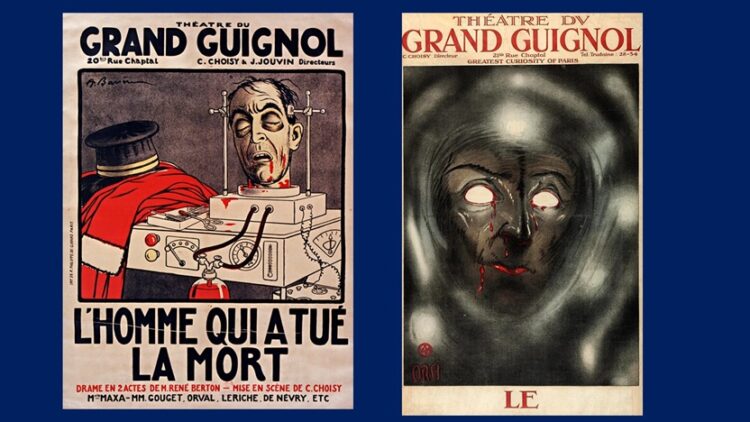
Grand-Guignol de Paris
Paris 1928. Backstage at the Théâtre du Grand-Guignol. A distraught
patron is attended to by Monsieur Choisy, the theater manager.
Cher mademoiselle, how truly I regret
That you have fainted—twice!—during our play!
Those severed limbs? Ah. Something few forget
For ours are perfect—truly distingué,
Though some prefer the gouging of the eyes
And streams of blood which spurt and freely gush.
Effects like these have earned many a prize
As audiences scream or gasp and blush.
What is your name, cheri? They call you “Fleur”?
Allow me, Fleur, to rid you of confusion
By taking you upon a backstage tour
Where you can pierce our secrets of illusion.
A sip of cognac, first. Now can you stand?
Parfait! Now let me bring you to the room
Which houses all our props. A bloody hand,
With veins and arteries spun from a loom.
The actor has it sewn onto his jacket.
Then in the torture scene when he is cursed
The villain very skillfully will hack it
Till it pops off and sacs of stage blood burst.
The first two rows receive a crimson rain
So we advise the audience to wear
A sheet so that the stage blood doesn’t stain
Their clothing or the fabric of the chair.
And here’s the room where actors wait backstage!
Allow me to present our jewel, Monique—
The actress Claude decapitates in rage.
Her head? She molds six new ones every week.
And here’s a sword made out of pliant wax—
With painted rust and glint it looks quite real.
It’s perfect for our murderous attacks
Since it stabs hearts as cleanly as if steel.
And here we have a pair of rubber eyes
As blue and white as sky and sauerkraut;
The actress simply has them set with ties
Until the scene where they are both gouged out.
No wait, cheri, don’t leave! There’s so much more!
Besides the blood there’s sex! Be not a prude!
Voyeurs should sample flesh as well as gore
So we show rapes and ruts—just shy of nude.
We’re legal since we’re not completely bare,
Though we come close; ripe women, panting men.
There’s very little, Fleur, that we won’t dare.
Fleur?! Quel dommage! She’s fainted yet again!
I do not understand! I’ve shown her all
Our tricks! The sex, the horror are in fun!
So why such shock?! As if she’s hit a wall!
Eh bien. Stage torture’s not for everyone.
Poet’s Note
The Théâtre du Grand-Guignol was a theater in the red-light district of Paris. From its opening in 1897 until its closing in 1962, it specialized in horror shows. Its name has become a recognized term for graphic, amoral horror entertainment, a genre popular from the time of Shakespeare (“Titus Andronicus”) and Webster’s “Duchess of Malfi” to today’s splatter films and the Stephen Sondheim musical “Sweeney Todd.”
People came to this theater for an experience, not only to see a show. The audience at Grand Guignol endured the terror of the shows because they wanted to be filled with strong “feelings” of something. Many attended the shows to get a feeling of sexual arousal. With some frequency, audience members found themselves overwhelmed by the brutality of the actions taking place on stage. Frequently, the “special effects” would be too realistic and often an audience member would faint or vomit during performances. At one point, the theater director used the goriness to his advantage by hiring doctors to be at performances as a marketing ploy.
The theatre owed its name to Guignol, a traditional puppet character from Lyon, joining political commentary with the style of Punch and Judy. The theater’s peak was between World War I and World War II when it was frequented by royalty and celebrities in evening dress.










Brian, what a welcome respite from all the poems about love and flowers and kindness and nicey-nice feelings! Sometimes I think we’re drowning in a flood of saccharine exhalations from Miss Goody-Two-Shoes. This strange piece really slams home an antidote to all that tripe: Grand Guignol! Leo Yankevich would have adored this poem.
You never hear much about Grand Guignol theater these days. It was a product of late nineteenth-century decadence that was given a major boost by post-World War I Dadaism, and was usually a must-see spot for visitors to Paris, very much like Madame Tussaud’s wax museum of horrors. It was meant to be transgressive, shocking, and over-the-top.
I love the octet stanzas with their perfectly rhymed quatrains (“jacket” and “hack it” are great!) And the careful mix of French phrasing here and there is precisely the right touch. The set-up of Monsieur Choisy guiding Fleur around for a behind-the-scene tour replicates what Browning sometimes did with his silent interlocutor — the words come out of the speaker’s mouth, and all we get from the listener is a reaction that is described to us by the speaker via his reactions and comments. In this case, it is Fleur’s horror at what she sees, and her need to escape the place.
The last time I even heard the phrase “Grand Guignol” was from a Greek colleague at work. He had to return to Athens three years after the death of his father, for the required “anakorisi” or exhumation of the body for examination. This is required by both Greek law and by a religious custom of the Orthodox Church, and the visiting relative is to be present to examine how far decomposition of the corpse has progressed. He described the entire procedure to me, shivering with disgust.
I said to him, “I’ve never heard of anything like this!” He just looked at me and said “Read up on Grand Guignol.”