• Submit Poetry
  • Support SCP
  • About Us
  • Members
  • Join
Saturday, August 8, 2026
Society of Classical Poets
  • Poems
    • Beauty
    • Culture
    • Satire
    • Humor
    • Children’s
    • Art
    • Ekphrastic
    • Epic
    • Epigrams and Proverbs
    • Human Rights in China
    • Music
    • Performing Arts
    • Riddles
    • Science
    • Song Lyrics
    • The Environment
    • The Raven
    • Found Poems
    • High School Poets
    • Terrorism
    • Covid-19
  • Poetry Forms
    • Sonnet
    • Haiku
    • Limerick
    • Villanelle
    • Rondeau
    • Pantoum
    • Sestina
    • Triolet
    • Acrostic
    • Alexandroid
    • Alliterative
    • Blank Verse
    • Chant Royal
    • Clerihew
    • Rhupunt
    • Rondeau Redoublé
    • Rondel
    • Rubaiyat
    • Sapphic Verse
    • Shape Poems
    • Terza Rima
  • Great Poets
    • Geoffrey Chaucer
    • Emily Dickinson
    • Homer
    • Henry Wadsworth Longfellow
    • Dante Alighieri
    • John Keats
    • John Milton
    • Edgar Allan Poe
    • William Shakespeare
    • William Wordsworth
    • William Blake
    • Robert Frost
  • Love Poems
  • Contests
  • SCP Academy
    • Educational
    • Teaching Classical Poetry—A Guide for Educators
    • Poetry Forms
    • The SCP Journal
    • Books
No Result
View All Result
Society of Classical Poets
  • Poems
    • Beauty
    • Culture
    • Satire
    • Humor
    • Children’s
    • Art
    • Ekphrastic
    • Epic
    • Epigrams and Proverbs
    • Human Rights in China
    • Music
    • Performing Arts
    • Riddles
    • Science
    • Song Lyrics
    • The Environment
    • The Raven
    • Found Poems
    • High School Poets
    • Terrorism
    • Covid-19
  • Poetry Forms
    • Sonnet
    • Haiku
    • Limerick
    • Villanelle
    • Rondeau
    • Pantoum
    • Sestina
    • Triolet
    • Acrostic
    • Alexandroid
    • Alliterative
    • Blank Verse
    • Chant Royal
    • Clerihew
    • Rhupunt
    • Rondeau Redoublé
    • Rondel
    • Rubaiyat
    • Sapphic Verse
    • Shape Poems
    • Terza Rima
  • Great Poets
    • Geoffrey Chaucer
    • Emily Dickinson
    • Homer
    • Henry Wadsworth Longfellow
    • Dante Alighieri
    • John Keats
    • John Milton
    • Edgar Allan Poe
    • William Shakespeare
    • William Wordsworth
    • William Blake
    • Robert Frost
  • Love Poems
  • Contests
  • SCP Academy
    • Educational
    • Teaching Classical Poetry—A Guide for Educators
    • Poetry Forms
    • The SCP Journal
    • Books
No Result
View All Result
Society of Classical Poets
No Result
View All Result
Home Art

On Paintings by Hunt and Millais: Two Ekphrastic Poems by James A. Tweedie

November 3, 2023
in Art, Ekphrastic, Poetry, William Shakespeare
A A
17
poems On Paintings by Hunt and Millais: Two Ekphrastic Poems by James A. Tweedie

.

Two Ekphrastic Poems

poems On Paintings by Hunt and Millais: Two Ekphrastic Poems by James A. Tweedie

.

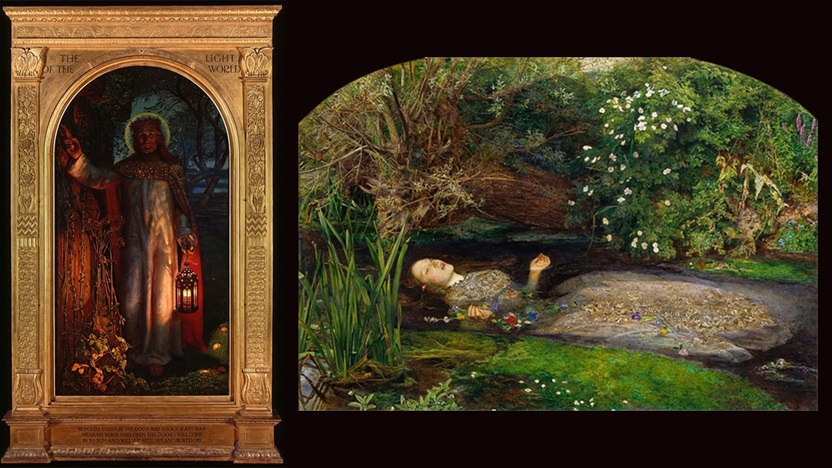
The Light of the World, Holman Hunt

As predawn darkness shrouds the land,
With warm-lit lantern in his hand
The risen Jesus stands before
A rusted, weed-choked, shuttered door
And knocks, and waits, in hope that he—
Before the night has passed—might be
Invited in to sup with you.
But as he waits, he turns his head
As if to ask what I would do
If that closed door were mine, instead.

.

Poet’s Note: Hunt painted three versions of this iconic work. The original (completed in 1854) hangs in the chapel at Keble College, Oxford; the largest and most famous (shown above) in St. Paul’s Cathedral, London; and a smaller version in the Manchester City Art Gallery. The painting illustrates Jesus’ words, “Behold, I stand at the door and knock. If anyone hears my voice and opens the door, I will enter his house and dine with him, and he with me.” (Revelation 3:20). The painting’s title is taken from John 8:12 where Jesus says, “I am the light of the world. Whoever follows me will not walk in darkness, but will have the light of life.” Hunt painted the door without an exterior latch, indicating that the door can only be opened from the inside. It is also interesting to note that Hunt, after using several male models for his head of Christ, completed the image with the poet Christina Rossetti—the sister of another of Hunt’s Pre-Raphaelite friends, Dante Gabriel Rossetti—as his final model for the painting.

.
poems On Paintings by Hunt and Millais: Two Ekphrastic Poems by James A. Tweedie

.

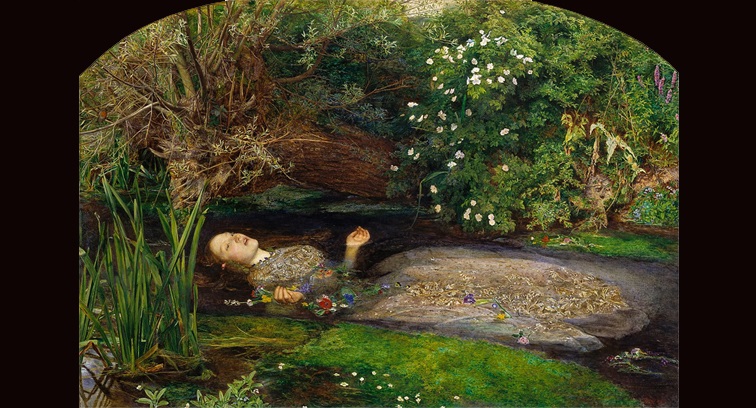
Ophelia, John Everett Millais

O fair Ophelia, as if in prayer,
With hands upraised and a melodious lay
Upon your soon-to-be departed lips,
You float, as if in sweet ambivalence,
To be, or not to be, to sleep, perchance
To dream of willowed garlands, fallen, strewn
About like fresh-plucked funereal flowers
Foredoomed to wither on a fresh-dug grave.
While mermaid-like—borne up by billowed gown
Adorned with twining floral gold brocade—
Your rose-tinged cheeks and sodden auburn hair
Await the grasp of dead men’s fingers, tasked
To pull your garments, heavy with their drink,
To muddy death beneath the weeping brook.

.

Poet’s Note: Both Millais’ painting and the accompanying poem (with numerous references) draw from Queen Gertrude’s account of Ophelia’s death in Hamlet, Act 4, Scene 7. It is unclear in the play whether Ophelia’s death was by accident or suicide. As the murdered Polonius’ daughter, sister to the plotting, vengeful Laertes, and Hamlet’s beloved future queen, caught up in the whirlwind of King Claudius’ murderous treachery, Hamlet’s real or feigned madness, and grieving her father’s mistaken homicide, either cause of death could be considered possible. Also of interest is that Millais and Hunt were close friends, leaders in the Pre-Raphaelite Movement, and wildly popular in the English-speaking world. The two paintings here described were painted within miles of each other and at the same time. It is said that Millais spent 11 hours a day for six months engaged in plein-air painting of the stream and its vegetation.

.

.

James A. Tweedie is a retired pastor living in Long Beach, Washington. He has written and published six novels, one collection of short stories, and three collections of poetry including Mostly Sonnets, all with Dunecrest Press. His poems have been published nationally and internationally in The Lyric, Poetry Salzburg (Austria) Review, California Quarterly, Asses of Parnassus, Lighten Up Online, Better than Starbucks, Dwell Time, Light, Deronda Review, The Road Not Taken, Fevers of the Mind, Sparks of Calliope, Dancing Poetry, WestWard Quarterly, Society of Classical Poets, and The Chained Muse. He was honored with being chosen as the winner of the 2021 SCP International Poetry Competition.


ShareTweetPin
The Society of Classical Poets does not endorse any views expressed in individual poems or commentary.
Read Our Comments Policy Here

RandomPoems

‘Sinister Symbols’ by James A. Tweedie
Deconstructing Communism

‘Sinister Symbols’ by James A. Tweedie

March 28, 2021

. O, how I wish I could write about pandas, Cute, bamboo-shoot-eating, black and white pandas. Furry and cuddly like...

‘La Llorona’: A Poem by Manuel Carpio, Translated by M.D. Skeen
Poetry

‘La Llorona’: A Poem by Manuel Carpio, Translated by M.D. Skeen

October 5, 2025

  La Llorona by Manuel Carpio (1791-1869), translated by M.D. Skeen I turned pale when I first heard the story...

Next Post
A Poem Inspired by Music from Aandhi, 1975: ‘Paths’ by Paddy Raghunathan

A Poem Inspired by Music from Aandhi, 1975: 'Paths' by Paddy Raghunathan

‘Beyond the Shadows’ and Other Poetry by C.B. Anderson

'Beyond the Shadows' and Other Poetry by C.B. Anderson

Traitors on Ice: Canto XXXII of Inferno, Translated by Stephen Binns

Traitors on Ice: Canto XXXII of Inferno, Translated by Stephen Binns

Comments 17

  1. Joseph S. Salemi says:
    3 years ago

    These are two very beautiful and resonant pieces — the first for the unanswered question that it poses, and the second for its elegant blank verse and its use of Shakespearean echoes for direct linkage to the original story (“to be, or not to be,” and “garments, heavy with their drink”).

    The Millais painting creates an amazing and dreamlike backdrop of nature’s greenery to contrast with the pale face and hands of Ophelia. This is a synthesis of beauty and death that is almost Poe-like in perfection. Millais’ six months of labor produced a haunting and unforgettable picture. And this ekphrastic poem is equally haunting.

    Reply
    • James A. Tweedie says:
      3 years ago

      Your comment is much appreciated and most satisfying. Thank you.

      Reply
  2. Margaret Coats says:
    3 years ago

    In “Ophelia,” I am impressed with the use of “dead men’s fingers, which are known from Gertrude’s speech to be the name of one variety of Ophelia’s fresh-plucked funereal flowers. In your poem, James, they come to life and pull the unfortunate young woman’s garments down into the water. This has enough implications for a short paper on Shakespeare’s poetry, because yours adds to it a stronger touch of the macabre.

    The form of “The Light of the World” is couplets until you stop at the seventh line. For the remaining lines, you alternate rhyme sounds as Jesus turns His head from door to viewer (and maybe back again), thus paying attention to both.

    About Christina Rossetti being the final model for the divine face, we can reflect that Jesus had only Mary’s genes to create His human looks. Features were masculinized, but because there was no contribution from a human father, a woman could have served as appropriate model.

    Reply
    • James A. Tweedie says:
      3 years ago

      Margaret, I didn’t plan to switch the rhyme pattern mid-poem, but my muse more or less imposed it on me as I was composing it. I liked the way it read and did not make any attempt to reconfigure it back into couplets.

      You always have a good eye for such things, which makes your comments all the more valuable, both for me and for others who may benefit from your comments.

      As for “Dead Men’s Fingers” the use of the floral sobriquet was quite intentional and, as you point out, produced a very satisfying layer of meaning, as does the suggestion that her flowers double as the floral tribute for her own grave.

      Reply
  3. C.B. Anderson says:
    3 years ago

    I’ve never written an ekphrastic poem, James, and I don’t really want to, but I do like reading very good ones where the art is redoubled. I think I’ve said this before: you are a national treasure. Keep pressing on.

    Reply
    • James A. Tweedie says:
      3 years ago

      Thank you, C.B. If you’ve ever written a poem inspired by a particular flower in your garden, I would suggest that it could be considered a type of ekphrastic poetry.

      And by the way, while I have your ear (or eye, perhaps), let me compliment you on your marvelous interview with ABB on his latest Classical Poets LIVE podcast. He is a wonderful interviewer and works magic as he edits the final product. He made me sound a lot better because of his edits. You, of course, would have been just as good even without it!

      Reply
  4. Gary Borck says:
    3 years ago

    These are two beautifully written poems, James. They are both moving (particularly the first) and poetic. I particularly like the vivid, poetic imagery in the second poem, especially the second half.

    Reply
    • James A. Tweedie says:
      3 years ago

      Thank you, Gary, for reading and commenting on my two poems. I am glad the comment was a positive one!

      Reply
  5. Paul A. Freeman says:
    3 years ago

    I liked how The Light of the World has an all-encompassing feel to it rather than being a specifically Christian message.

    As for Ophelia, I get the feeling I’m seeing half rhymes and internal rhymes at the end of lines rather than a purely blank verse sonnet – though I may just be projecting too much.

    I’ve always felt Ophelia’s part and character was underused in ‘Hamlet’ (maybe because we like to see tragic characters make good before they depart, one way or the other), so I’m glad to read such a moving piece, complete with a nod to Hamlet’s famous ‘to be’ speech.

    Thanks for the reads.

    Reply
    • James A. Tweedie says:
      3 years ago

      There are indeed a number of incidental near rhymes in Ophelia.

      Departed lips/ambivalence
      Strewn/foredoomed
      Sweet/sleep
      Bourn/adorned
      Grasped/tasked

      And a phantom rhyme begging for and hinting at a pairing that is anticipated but never arrives:

      Brown/(drown)

      Such pairings were serendipitous and, to my ear, do, in fact, make the poem more lyrical and melodious than it would have been without them.

      Thanks, Paul, for the nice catch.

      Reply
      • Julian D. Woodruff says:
        3 years ago

        The neighbors ambivalence/perchance, too; and perhaps the distant prayer/hair.
        For another rhyme denier, how about drink/(sink)?

        Reply
  6. Julian D. Woodruff says:
    3 years ago

    James, These are both excellent Did you go straight to blank verse for Ophelia, or was conventional rhyme in your sights at first?
    I have to wonder: ever thought of taking on Elaine (Waterhouse, Rosehthal [R’s is less well known than W’s efforts, but has a romantic history in social commentary, music, and even crime]) in verse?

    Reply
    • James A. Tweedie says:
      3 years ago

      Julian,

      Ophelia was blank verse from the get-go.

      With SCP I have posted poems on Bruegel, Rembrandt, Michelangelo and now Millais and Hunt. I will look over your suggestions and see what my Muse has to say about it.

      Reply
  7. James Sale says:
    3 years ago

    Two beautiful works of art and two matching and beautiful poems, James – I especially like the Holman Hunt piece: ‘But as he waits, he turns his head …’ So simple, but sublime. Great work – well done.

    Reply
    • James A. Tweedie says:
      3 years ago

      Ty, James. “Simple” is always best when it can be pulled off.

      Reply
  8. Jeff Eardley says:
    3 years ago

    James, these are simply wonderful. I was so entranced by “Ophelia” that I never noticed that it was in blank verse. I first encountered the Pre-Raphaelites at Wightwick Manor in middle England, and later, the superb collection in the Lady Lever gallery near to Liverpool. Eleven hours a day for six months is dedication indeed. I am in awe of these guys. Thank you for a most enlightening read.

    Reply
    • James A. Tweedie says:
      3 years ago

      You’re very welcome, Jeff. I’ll have to research that Liverpool venue in case I’m ever in the neighborhood!

      Reply

Leave a Reply Cancel reply

Your email address will not be published. Required fields are marked *


  1. Paul Freeman on ‘Warfare by Remote Control’: A Poem by Paul A. FreemanAugust 8, 2026

    There's a not very good film (though it's one I'll put on to veg out and be entertained) called Angel…

  2. Paul Freeman on ‘Warfare by Remote Control’: A Poem by Paul A. FreemanAugust 8, 2026

    I lived in Zimbabwe under the Mugabe regime until being forced out. The diaspora are just as you imagine, nostalgic…

  3. Paul Freeman on ‘Warfare by Remote Control’: A Poem by Paul A. FreemanAugust 8, 2026

    So wrapped up as we are in our own everyday concerns, it's sometimes difficult, if not impossible, to put ourselves…

  4. Paul Freeman on ‘Warfare by Remote Control’: A Poem by Paul A. FreemanAugust 8, 2026

    Poison gas, military aircraft used as missiles, civilian aircraft used as missiles, vehicles used to mow people down, now drones.…

  5. Joseph S. Salemi on ‘Good and Evil’: A Poem by Roy E. PetersonAugust 7, 2026

    The "problem of evil" is what the philosopher Gottfried Leibniz termed the question of "theodicy." It basically involved trying to…

Subscribe to Daily Poems

Enter your email address to subscribe to this blog and receive notifications of new posts by email.

Join 1,608 other subscribers

Recent Poems

  • ‘Deliverance’ and Other Poetry by Peter Venable
  • ‘Rain’ and Other Poems by Russel Winick
  • ‘The Story of a Plague’ and Other Poetry by Michael Robinson
  • ‘Javert Derailed’: A Poem by Zanna Barton
  • ‘People Forget’: A Poem by James Sale
  • ‘Good and Evil’: A Poem by Roy E. Peterson
  • ‘The Royal Arse Hortillery’: A Poem on the Spoonerism, by Jeff Eardley
  • ‘Who Hears a Robot’s Prayer?’ and Other Poetry by Brian Yapko
  • The Society of Classical Poets 2026 Haiku Competition
  • Four Love Sonnets by Adam Sedia
  • ‘Rasputina Confers with Her Cohorts’: A Poem by Joseph S. Salemi
  • ‘Warfare by Remote Control’: A Poem by Paul A. Freeman
  • ‘The Passing’: A Poem by Margaret Brinton
  • ‘Of Webs and Whispers’: A Poem by Susan Jarvis Bryant
  • Poetry Book Review: Petrarch’s Canzoniere, Translated by A.M. Juster
  • ‘What Folly Dares’ and Other Love Poems by James A. Tweedie
  • ‘Allegrezza’ and Other Poetry by Rob Griffith
  • ‘The Lessons of Lot’: A Poem by Adam Wasem
  • ‘Prophecy and Divine Intervention in Virgil’s Aeneid’: An Essay by Kaitlyn Brown
  • ‘The Last Voyage of Barnaby Bear’: A Poem by Tashvi Reddy
  • ‘Impressions’ and Other Poems by Russel Winick
  • ‘The Reveal of the Rocks’: A Poem by Kyle Fiske
  • ‘Art Work’: A Poem by T.M. Moore
  • ‘A Strange Sun’: A Poem by Patricia Rogers Crozier
  • ‘Shave Off Those Whiskers’: A Poem by Roy E. Peterson
  • ‘The Man from China’: A Poem by Evan Mantyk
  • ‘The Ballad of the Ghost Mountain Boys’: A Poem by Rachel Lott
  • ‘The Threat of Virtue’: A Poem by Zumwalt
  • ‘A Poet at the Tower’ and Other Poetry by Michael C. Paul
  • ‘Florence Foster Jenkins’ and Other Poetry by Brian Yapko

Categories

  • Acrostic
  • Alexandroid
  • Alliterative
  • Art
  • Best Poems
  • Blank Verse
  • Chant Royal
  • Classical Poets Live
  • Clerihew
  • Covid-19
  • Deconstructing Communism
  • Educational
  • Epic
  • Epigrams and Proverbs
  • Essays
    • Interviews with Poets
    • Poetry Reviews
  • Featured
  • From the Society
  • Great Poets
    • Dante Alighieri
    • Edgar Allan Poe
    • Emily Dickinson
    • Geoffrey Chaucer
    • Henry Wadsworth Longfellow
    • Homer
    • John Keats
    • John Milton
    • Robert Frost
    • William Blake
    • William Shakespeare
    • William Wordsworth
  • Human Rights in China
  • Limerick
  • Love Poems
  • Music
  • Pantoum
  • Performing Arts
  • Poetry
    • Beauty
    • Children's Poems
    • Culture
    • Ekphrastic
    • Found Poems
    • High School Poets
    • Humor
    • Riddles
  • Poetry Challenge
  • Poetry Contests
  • Poetry Forms
    • Curtal Sonnet
    • Haiku
  • Poetry Readings
  • Rhupunt
  • Rondeau
  • Rondeau Redoublé
  • Rondel
  • Rubaiyat
  • Sapphic Verse
  • Satire
  • Science
  • Sestina
  • Shape Poems
  • Short Stories
  • Song Lyrics
  • Sonnet
  • Symposium
  • Terrorism
  • Terza Rima
  • The Environment
  • Translation
  • Triolet
  • Video
  • Villanelle

Quick Links

  • About Us
  • Submit Poetry
  • Become a Member
  • Members List
  • Support the Society
  • Advertisement Placement
  • Comments Policy
  • Terms of Use

Welcome Back!

Login to your account below

Forgotten Password?

Retrieve your password

Please enter your username or email address to reset your password.

Log In
No Result
View All Result
  • Poems
    • Beauty
    • Culture
    • Satire
    • Humor
    • Children’s
    • Art
    • Ekphrastic
    • Epic
    • Epigrams and Proverbs
    • Human Rights in China
    • Music
    • Performing Arts
    • Riddles
    • Science
    • Song Lyrics
    • The Environment
    • The Raven
    • Found Poems
    • High School Poets
    • Terrorism
    • Covid-19
  • Poetry Forms
    • Sonnet
    • Haiku
    • Limerick
    • Villanelle
    • Rondeau
    • Pantoum
    • Sestina
    • Triolet
    • Acrostic
    • Alexandroid
    • Alliterative
    • Blank Verse
    • Chant Royal
    • Clerihew
    • Rhupunt
    • Rondeau Redoublé
    • Rondel
    • Rubaiyat
    • Sapphic Verse
    • Shape Poems
    • Terza Rima
  • Great Poets
    • Geoffrey Chaucer
    • Emily Dickinson
    • Homer
    • Henry Wadsworth Longfellow
    • Dante Alighieri
    • John Keats
    • John Milton
    • Edgar Allan Poe
    • William Shakespeare
    • William Wordsworth
    • William Blake
    • Robert Frost
  • Love Poems
  • Contests
  • SCP Academy
    • Educational
    • Teaching Classical Poetry—A Guide for Educators
    • Poetry Forms
    • The SCP Journal
    • Books

© 2025 SCP. WebDesign by CODEC Prime.