


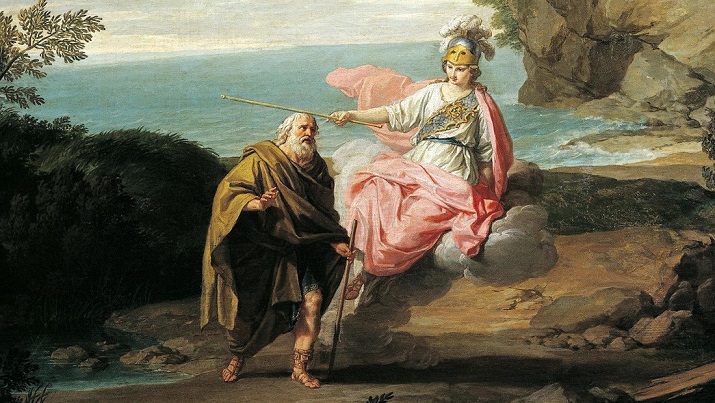
Ulysses
He stands upon the sandy strand alone.
He has been dropped off, stranded, left. A crow
caws out above a fleshy bone. Unknown,
this no one in particular, so low
in spirit, walks along Poseidon’s ledge.
He looks on naught. There is no Trojan Horse.
Long suffering, he lingers on the edge.
He has been plagued by many friendless shores.
Though rosy-fingered Dawn has come to him,
right here there is no hospitality
nor generosity. It is too dim,
this morning light, next to the wine-dark sea.
No Danai, Achaian, or Argive
will meet him at this reach of beach and rock;
yet he is free and very much alive.
He may be hungry, but he still can walk.
It’s true, Athena is invisible
to him and has not come to guide him on;
however, he is not miserable;
he still can cheerfully sing out his song.
Though there aren’t any contests, life’s a trial
itself. Though no Demodokos to retell
his tale, he still speaks forth words all the while.
It’s nice no Circe dwells upon this isle,
though he’s met souls who act like animals,
like pigs who’d eat the cattle of the Sun,
nor Cyclopes–those one-eyed cannibals,
who, if they could, would eat up anyone.
There are no Lotus-eaters here, though he
has passed some in his voyages, who do
not give a thought for going home; solely
the plant in front of them is in their view.
There is no Scylla or Charybdis here,
nor siren song, though he feels he’s between
a rock and a hard place. How can he veer
when only sky and land and sea are seen?
There are no dead souls talking, but his head
is filled with memories of ten-thousands;
they plague his waking hours and his bed,
like these innumerable island sands.
Would that Telemachus, Penelope,
and faithful dog Argos were here to greet
him, or perhaps just some Peloponnese;
but no one is here, just some old, weak feet.
Bruce Dale Wise is a poet and former English teacher currently residing in Texas.












This is an very good depiction of Ulysses on the beach at Ithaka, at the end of his long voyaging. It is a homecoming, but it is devoid of any welcome, any recognition, any relatives or friends.
What I like about the poem is its deliberate recollection of many of the adventures and scrapes that Ulysses has been in during his long absence. These references to specific stories are much different from the tendency of modernist poetry to make clipped allusions to mythology, on the assumption that the reader will either simply know what is being alluded to, or will have to look it up for himself. This poem sets the scene of Ulysses on the beach of Ithaka within the larger context of the Trojan war and his multiple adventures after it.
The reference to “no one” in line 4 is a clear memory of the nightmare in the cave of Polyphemus. The quote from Homer concerning “rosy-fingered Dawn” in line 9 is apropos. Circe, the Lotus-eaters, Scylla and Charybdis, dead souls talking — it’s as if we were allowed into the mind of Ulysses as his thoughts passed over all of these episodes, to see how his brain is roiling with tension and uncertainty.
Bruce, you really captured the mood in this brief but comprehensive ‘odyssey.’ Much enjoyed it!