


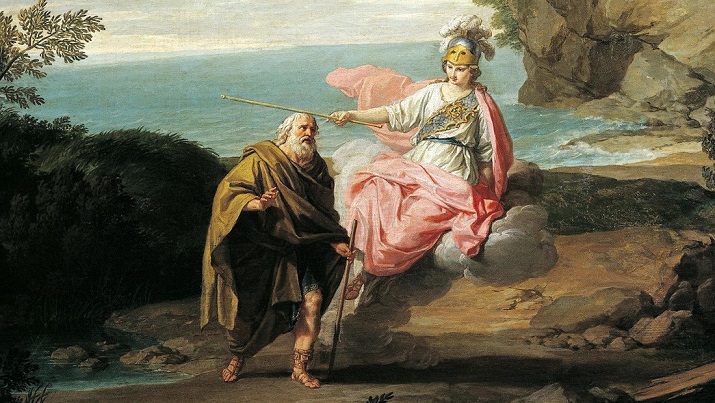
Ulysses
He stands upon the sandy strand alone.
He has been dropped off, stranded, left. A crow
caws out above a fleshy bone. Unknown,
this no one in particular, so low
in spirit, walks along Poseidon’s ledge.
He looks on naught. There is no Trojan Horse.
Long suffering, he lingers on the edge.
He has been plagued by many friendless shores.
Though rosy-fingered Dawn has come to him,
right here there is no hospitality
nor generosity. It is too dim,
this morning light, next to the wine-dark sea.
No Danai, Achaian, or Argive
will meet him at this reach of beach and rock;
yet he is free and very much alive.
He may be hungry, but he still can walk.
It’s true, Athena is invisible
to him and has not come to guide him on;
however, he is not miserable;
he still can cheerfully sing out his song.
Though there aren’t any contests, life’s a trial
itself. Though no Demodokos retell
his tale, he still speaks forth words all the while.
It’s nice no Circe dwells upon this isle,
though he’s met souls who act like animals,
like pigs who’d eat the cattle of the Sun,
nor Cyclopes–those one-eyed cannibals,
who, if they could, would eat up anyone.
There are no Lotus-eaters here, though he
has passed some in his voyages, who do
not give a thought for going home; solely
the plant in front of them is in their view.
There is no Scylla or Charybdis here,
nor siren song, though he feels he’s between
a rock and a hard place. How can he veer
when only sky and land and sea are seen?
There are no dead souls talking, but his head
is filled with memories of ten-thousands;
they plague his waking hours and his bed,
like these innumerable island sands.
Would that Telemachus, Penelope,
and faithful dog Argos were here to greet
him, or perhaps just some Peloponnese;
but no one is here, just some old, weak feet.
Bruce Dale Wise is a poet and former English teacher currently residing in Texas.

















This is a very good depiction of Ulysses on the beach at Ithaka, at the end of his long voyaging. It is a homecoming, but it is devoid of any welcome, any recognition, any relatives or friends.
What I like about the poem is its deliberate recollection of many of the adventures and scrapes that Ulysses has been in during his long absence. These references to specific stories are much different from the tendency of modernist poetry to make clipped allusions to mythology, on the assumption that the reader will either simply know what is being alluded to, or will have to look it up for himself. This poem sets the scene of Ulysses on the beach of Ithaka within the larger context of the Trojan war and his multiple adventures after it.
The reference to “no one” in line 4 is a clear memory of the nightmare in the cave of Polyphemus. The quote from Homer concerning “rosy-fingered Dawn” in line 9 is apropos. Circe, the Lotus-eaters, Scylla and Charybdis, dead souls talking — it’s as if we were allowed into the mind of Ulysses as his thoughts passed over all of these episodes, to see how his brain is roiling with tension and uncertainty.
I have struggled for a title for this poem. The first title was “Another Odysseus”, which shows it is just one more brief interpretation (eleven quatrains of abab) of Odysseus over the centuries–this a NewMillennial one.
The second title was to be a contrast with Tennyson’s striking, picture of a bold, old hero in seventy lines of blank verse; that is, his still vigourous “Ulysses”.
Tennyson’s dramatic monologue suggested the vantage of this poem, but Salemi’s opening sentence has suggested what I think is a better title; that is, “Odysseus on the Beach”, which I am now satisfied with.
Bruce, you really captured the mood in this brief but comprehensive ‘odyssey.’ Much enjoyed it!
It may seem odd, if not entirely preposterous, the structure of this poem, was a form I used back then, when I penned the now named “Odysseus at the Beach”: 2009. It hardly comes as much of a surprise that not only would I make up new forms—that really has been my M. O. since my earliest years. This form, drew from the American Modernist Hart Crane (1899-1932), i. e., his “To Brooklyn Bridge”.
How many dawns, chill from his rippling rest
The seagull’s wings shall dip and pivot him,
Shedding white rings of tumult, building high
Over the chained bay waters Liberty—
Then, with inviolate curve, forsake our eyes
As apparitional as sails that cross
Some page of figures to be filed away;
—Till elevators drop us from our day . . .
I think of cinemas, panoramic sleights
With multitudes bent toward some flashing scene
Never disclosed, but hastened to again,
Foretold to other eyes on the same screen;
And Thee, across the harbor, silver-paced
As though the sun took step of thee, yet left
Some motion ever unspent in thy stride,—
Implicitly thy freedom staying thee!
Out of some subway scuttle, cell or loft
A bedlamite speeds to thy parapets,
Tilting there momently, shrill shirt ballooning,
A jest falls from the speechless caravan.
Down Wall, from girder into street noon leaks,
A rip-tooth of the sky’s acetylene;
All afternoon the cloud-flown derricks turn . . .
Thy cables breathe the North Atlantic still.
And obscure as that heaven of the Jews,
Thy guerdon . . . Accolade thou dost bestow
Of anonymity time cannot raise:
Vibrant reprieve and pardon thou dost show.
O harp and altar, of the fury fused,
(How could mere toil align thy choiring strings!)
Terrific threshold of the prophet’s pledge,
Prayer of pariah, and the lover’s cry,—
Again the traffic lights that skim thy swift
Unfractioned idiom, immaculate sigh of stars,
Beading thy path—condense eternity:
And we have seen night lifted in thine arms.
Under thy shadow by the piers I waited;
Only in darkness is thy shadow clear.
The City’s fiery parcels all undone,
Already snow submerges an iron year . . .
O Sleepless as the river under thee,
Vaulting the sea, the prairies’ dreaming sod,
Unto us lowliest sometime sweep, descend
And of the curveship lend a myth to God.
A couple of earlier examples suffice to show that this is true.
The Bridge #1
How many dusks shall fall upon its shores,
with ferries passing under its strung lights
and buildings climbing high above its moors,
some disappearing in day’s darkest nights?
Its low, hard curve that spans the East River
follows the Earth, does not forsake our eyes.
Stone towers and steel cables deliver
a million vehicles across its rise.
We think, therefore, we are amidst greatness.
The multitudes move over its quaint dream
of surety, unsure what its fate is,
a thousand thousand watching its feint stream.
And here it harbors still, for ill or good,
the machinations of a nation’s will,
emotions ever spent on that which could
be in the future, free and rational.
Below, the subway trains take travelers
to points around the city’s era’s span.
Above, the elevated’s drone unravels,
the traffic moves, a honking caravan.
Down Wall Street past the gilded, girdered heights
that scrape the sky’s sleek blue-black back, unsettling
as glittering imprints on starry sites,
we fly upon time’s wind with metal wing.
Cloaked in inchoate chaos, there it stands
before God’s throne, minute and miniscule.
About Orion, beaded ceinture bands
and bright electric strands adorn the cool.
Here once the belted Mayakovsky stood,
composing syllable by syllable;
the bolted buildings of the neighborhood
surround a threshold taut and terrible.
The traffic lights continue time to skim
the surface of its firm unfractured path,
where Crane condensed the cosmic all: for him
and Moore, an actuality, a math.
Such figures still ascend in lucid glow
the windowed structures of that shadowed skull,
while all around the living come and go,
indubitable, inevitable.
Asleep, that mighty heart is beating still
that faces the Atlantic Ocean’s waves,
submerged in the infinite and the eternal,
alone on all that lives, what Jesus saves.
The Bridge #2
Leashed from the continent, they fly—
the seagulls’ wings spread out along the bridge—
and catch the currents of the airy sky
that swirl about above the river’s edge.
Sweet liberty, Columbia flows on,
while all about in cars, on bikes, afoot,
we follow gray asphalted curves at dawn
between the buildings climbing high and mute.
We multitudes move toward some flashing scene,
past cinemas and panoramic sights,
and speed to reach the ever-turning green,
amidst the traffic, wires, lines and lights.
And there, beyond Astoria, we rise
upon the spiral of infinity,
and drive up to the bright, white, cloudy skies,
as if we were enroute to being free,
away from elevators, subways, els,
and we had come to Eldorado’s door,
there momentarily atilt—hell’s bells!
phantasmagorically at heaven’s floor.
We shoot past girders, steel, green, aloft,
a settling acetylene, as hard
as rock, against wet morning’s misty soft,
here on this earthly stage on this mere shard.
Beyond, the vast Pacific Ocean writhes,
absorbing waters from the East and West.
The nations of the World pay their tithes
in lives, in transports, contrails from their jets.
Percussive melodies from radios
burst from the open windows of the cars,
occasionally fiery talk shows;
the voices of the forceful slice the farce.
We leave the shores of lovely Oregon,
while following the compass to true North,
and purposefully go to Washington;
Columbia continues to pour forth.
We sweep past crashing wavelets flickering.
The city in the distance vanishes
amidst a brief, but sweet, tranquility
that time erases, living banishes.
It is a dream, American and real,
that we, who now are wide awake, can see;
though we’ll fall too asleep soon at the wheel
as it spins onward through eternity.
It is a strange phenomenon, Bruce, arriving home from some years’ long ‘adventure’ and no one cares a toss. You’ve conveyed this feeling well with one of the most prominent historical examples of this.
One of the most poignant moments of “The Odyssey” is Odysseus’ encounter with Argos his old hunting dog, who had been “tossed” upon a garbage heap to die, and does; but not before he “sees” his master one last time.
Bruce, the poem offers a splendid Odyssey of allusion in thought, with a slight similarity to confessional poetry, though written in the third person. It calls to mind other stranded figures, first of all Robinson Crusoe. Crusoe, of course, was not returning home, but having to make do in a faraway place after disaster. One such doom-facing figure in reality was Takashi Nagai, the Japanese doctor who bemoaned silence after the nuclear explosion in “Bells of Nagasaki.” He’s a far cry from your Ulysses, or Odysseus on the Beach, but your character does miss a great deal that he might have expected in coming home. Unlike Crusoe or Nagai or the Odysseus of Homer, or the Odysseus of Kazantzakis, he seems unequipped to construct a new future with “some old weak feet.”
Haiku
by “Wired Clues” Abe
Amid Earth’s loud wars,
the leaves change colours and fall—
Nihon Kidankyo.
“Wired Clues” Abe is a poet of NewMillennial haiku. Nihon Kidankyo, survivors of Hiroshima and Nagasaki, advocating for a nuclear free world, received the 2024 Nobel peace Prize.
A Cursory Comment
by Lew Icarus Bede
One of the things I have been striving for in my poetry is a line, a line I could believe in, a line aligned with the Ancients, particularly the Greeks and Romans, but others as well, from the Italians, like Dante, to Baroque figures, like Shakespeare and Milton. I didn’t gain all that much from Hebrew, Indian, or Chinese prosody, but I looked here, there, and everywhere, for a line I could inhabit. Of course, Homer was the guiding light, with Vergil following after; but the dactylic hexameter just doesn’t work well in English, despite attempts of Spenser, Southey, et al.
In my twenties, I even strove for a “haiku” line of seventeen syllables in the manner of William Carlos Williams. [O, there were so many attempts! including unrhymed, eight-lined, sixteen syllables and alternatingly rhymed iambic hexameter lines based on the Fibonacci sequence.] Of course, no one ever thought my experiments were a good idea, except, perhaps Leo Yankevich, as the thirteen-syllable Polish line had infected his poetry to some degree. That is, of course, the reference to “some old, weak feet”—i. e., the iambic pentameter. By 2009, I had not yet decided to move to iambic heptameter; although, looking back at my writing in those and earlier years, one could see I was moving in that direction. But that, though still “unsatisfactory” now, gave me renewed purpose, by leaning into the ballad, a natural English language form, as in adumbrations of Blake, Coleridge, Dickinson, and many others; and, at least minimally, gave me a step up to “construct a new future” with an acceptably traditional base.
The Battle
Ms. Coats is on target when she says there is here in “Odysseus on the Beach”, “a slight similarity to confessional poetry”; for that is what it is—this dramatic monologue in the tradition of Tennyson, Browning, Pound, and T. S. Eliot. For me it is the artistry of the Victorians against the experimentation of the Modernists in the actual literary battle.
Mr. Salemi has hit upon the strongest evidence that shows this true, when he says L9, “Though rosy-fingered Dawn has come to him” is “apropos”. She is the wife of this Odysseus, and even now reads through the “Iliad” in Greek, the “Aeneid” in Latin, and the “Gospels” in Koine, as her New Year’s Resolution. She is his Penelope, and his Muse.
Poetically, what strikes me of “Odysseus on the Beach” is the purity of its diction, as if the realism of the portrait had brought the language of the artist to such an extreme simplicity, coincidentally coiling around the breathtaking Ancient Greek World, which he loves so much, even as his whole life has been a battle with it.
Bruce, I thought the “weak old feet” might refer to your long odyssey through varied kinds of poetic line. Didn’t realize you had tried a “haiku line.” I imagine that might tend to fall apart and re-shape itself as renga. Keep walking on the beach, where nice firm sand can comfort the tired old feet before tides come to wash their works away. May you have good fortune transcribing your Greek endeavors before that happens! This new year’s plum blossoms are ready to bloom, I’m sure.
As per B. S. Eliud Acrewe
From your sentences, I am reminded of T. S. Eliot:
“What we call the beginning is often the end
And to make and end is to make a beginning.
The end is where we start from. And every phrase
And sentence that is right (where every word is at home,
Taking its place to support the others,
The word neither diffident nor ostentatious,
An easy commerce of the old and the new,
The common word exact without vulgarity,
The formal word precise but not pedantic,
The complete consort dancing together)
Every phrase and every sentence is an end and a beginning,
Every poem an epitaph. And any action
Is a step to the block, to the fire, down the sea’s throat
Or to an illegible stone: and that is where we start.
We die with the dying:
See, they depart, and we go with them.
We are born with the dead:
See, they return, and bring us with them.
The moment of the rose and the moment of the yew-tree
Are of equal duration. A people without history
Is not redeemed from time, for history is a pattern
Of timeless moments. So, while the light fails
On a winter’s afternoon, in a secluded chapel
History is now and England.”
and Nijō Yoshimoto (1320-1388), the noted Japanese renga poet of the early Muromachi period:
“How hard it will be
to see spring once again,
and cherry blossoms,
even if I perchance go
back along this very road.”
In our back yard now, the oriental pear-trees are budding, even as they carry the weight of icicles and bird feeders.