• Submit Poetry
  • Support SCP
  • About Us
  • Members
  • Join
Monday, August 24, 2026
Society of Classical Poets
  • Poems
    • Beauty
    • Culture
    • Satire
    • Humor
    • Children’s
    • Art
    • Ekphrastic
    • Epic
    • Epigrams and Proverbs
    • Human Rights in China
    • Music
    • Performing Arts
    • Riddles
    • Science
    • Song Lyrics
    • The Environment
    • The Raven
    • Found Poems
    • High School Poets
    • Terrorism
    • Covid-19
  • Poetry Forms
    • Sonnet
    • Haiku
    • Limerick
    • Villanelle
    • Rondeau
    • Pantoum
    • Sestina
    • Triolet
    • Acrostic
    • Alexandroid
    • Alliterative
    • Blank Verse
    • Chant Royal
    • Clerihew
    • Rhupunt
    • Rondeau Redoublé
    • Rondel
    • Rubaiyat
    • Sapphic Verse
    • Shape Poems
    • Terza Rima
  • Great Poets
    • Geoffrey Chaucer
    • Emily Dickinson
    • Homer
    • Henry Wadsworth Longfellow
    • Dante Alighieri
    • John Keats
    • John Milton
    • Edgar Allan Poe
    • William Shakespeare
    • William Wordsworth
    • William Blake
    • Robert Frost
  • Love Poems
  • Contests
  • SCP Academy
    • Educational
    • Teaching Classical Poetry—A Guide for Educators
    • Poetry Forms
    • The SCP Journal
    • Books
No Result
View All Result
Society of Classical Poets
  • Poems
    • Beauty
    • Culture
    • Satire
    • Humor
    • Children’s
    • Art
    • Ekphrastic
    • Epic
    • Epigrams and Proverbs
    • Human Rights in China
    • Music
    • Performing Arts
    • Riddles
    • Science
    • Song Lyrics
    • The Environment
    • The Raven
    • Found Poems
    • High School Poets
    • Terrorism
    • Covid-19
  • Poetry Forms
    • Sonnet
    • Haiku
    • Limerick
    • Villanelle
    • Rondeau
    • Pantoum
    • Sestina
    • Triolet
    • Acrostic
    • Alexandroid
    • Alliterative
    • Blank Verse
    • Chant Royal
    • Clerihew
    • Rhupunt
    • Rondeau Redoublé
    • Rondel
    • Rubaiyat
    • Sapphic Verse
    • Shape Poems
    • Terza Rima
  • Great Poets
    • Geoffrey Chaucer
    • Emily Dickinson
    • Homer
    • Henry Wadsworth Longfellow
    • Dante Alighieri
    • John Keats
    • John Milton
    • Edgar Allan Poe
    • William Shakespeare
    • William Wordsworth
    • William Blake
    • Robert Frost
  • Love Poems
  • Contests
  • SCP Academy
    • Educational
    • Teaching Classical Poetry—A Guide for Educators
    • Poetry Forms
    • The SCP Journal
    • Books
No Result
View All Result
Society of Classical Poets
No Result
View All Result
Home Poetry Beauty

‘Longinus, Spearman’ by Joseph S. Salemi

March 30, 2018
in Beauty, Blank Verse, Culture, Poetry, Short Stories
A A
18
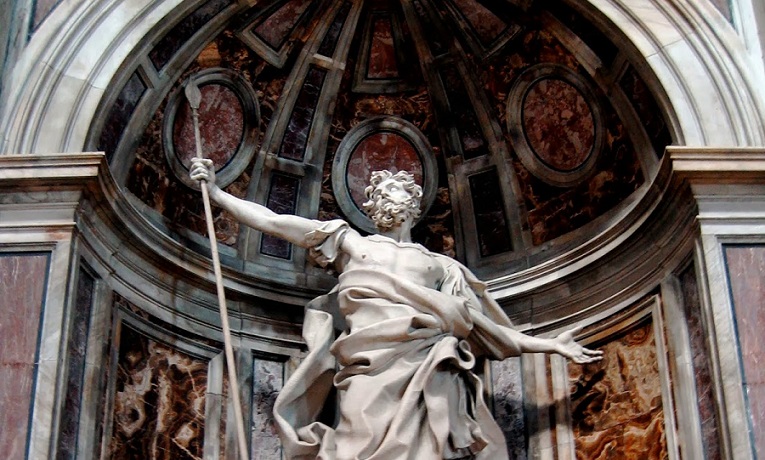
poems 'Longinus, Spearman' by Joseph S. Salemi

Miles hastatus (spearman) of the Legio Decima Fretensis, stationed in Roman Judaea, A.D. 33

Vere, filius Dei erat iste. —Roman centurion at the crucifixion, noted in Matthew 27:54.

They say he was the King of Jews. In fact
We nailed a wooden title to his cross
In Latin, Greek, and Hebrew. All I saw
Was REX and NAZARENUS, so I guess
He was some sort of troublemaking yid
Who fomented rebellion in a province.
That’s what you get for stepping out of line—
The higher-ups decide you’ve got to go.

Well, who knows… I’m just a legion boot.
Politics is no concern of mine.
I take my orders and I march in step
With everybody else, and thrust my spear
Wherever and whenever Rome commands.

You know the drill—we start with the flagellum.
Thirty whacks with that, the luckless wretch
Loses enough blood to die then and there,
Or else goes into shock and doesn’t feel
The nailing that comes afterwards. It’s meant
As an act of mercy to the man—
Agony’s not the point, but spectacle.
All he has to be is an example
Of what Rome dishes out to fractious types.

He didn’t die. A tough break, to be sure—
We marched him to the execution ground
And nailed him up. It took a full three hours.
I was ordered “Lance him in the flank”
Just to make sure the job was really done.
I felt bad, but we couldn’t wait all day.

A cloud passed overhead that very minute
And darkened things. I don’t know what it was,
But we all felt a momentary chill.
The centurion—a level-headed sort—
Said “Man, he really was a demigod.”
That broke the tension, and we laughed aloud.

He had a few possessions that we took
And shared among ourselves. His seamless robe
Was just too nice for cutting up. We said
“Let’s cast the dice and see who gets the thing.”
I made the lucky throw. So here it is—
Bloody and dirty, but without a rip.
A good wash by a fuller and it’s fine.

Yes, not a rip. And yet some rumor spread
That there was a minor earthquake back in town.
I didn’t notice. But some people swore
They felt a tremor by the Hebrew temple.
Anyhow, the sacred veil was torn—
The one that hides the innermost recess
Where the Jews keep their god in some old box.
What can I tell you? All religion’s cracked.
Mithra, the Delphic Oracle, Osiris…
I’ve seen them every country we’ve been stationed.
Spirits, holy men, and divination
Done up in different wrappings, nothing more.

I’ve served at a dozen crucifixions. Still,
Something about this one sticks in the mind.
It’s not just that it lasted so damned long,
Or noontime darkness, or a minor quake.
He cried out only once, right at the end,
In his own dialect. Don’t know what it meant.
But you could tell despair, incomprehension,
Heartbroken grief as deep as the Dead Sea.
Sure, it’s natural when you face the end
But somehow this was different. Almost like
The whole damned world had sunk in widowhood
And pangs of desolation pierced its heart.

Enough. The sentry’s due for his relief.
I’ve got to watch the main gate till dawn breaks.
More of that hot wine if you please—one cup
To keep the night cold off me for a bit.


Joseph S. Salemi has published five books of poetry, and his poems, translations and scholarly articles have appeared in over one hundred publications world-wide.  He is the editor of the literary magazine Trinacria. He teaches in the Department of Humanities at New York University and in the Department of Classical Languages at Hunter College.


 

ShareTweetPin
The Society of Classical Poets does not endorse any views expressed in individual poems or commentary.
Read Our Comments Policy Here

RandomPoems

Sonnets on the Music of Bach, Handel, and Mendelssohn, by Peter Hartley
Beauty

Sonnets on the Music of Bach, Handel, and Mendelssohn, by Peter Hartley

June 16, 2020

  “Laudamus te” from J.S. Bach’s B-minor Mass This aria so beautifully sung, Its obbligato part ethereal; Such coloratura from...

‘A Sonnet for My Son on Father’s Day’ by Susan Jarvis Bryant
Beauty

‘A Sonnet for My Son on Father’s Day’ by Susan Jarvis Bryant

June 16, 2024

. A Sonnet for My Son on Father’s Day You coo her name in buoyant notes of joy Then watch...

Next Post
‘The Sun’ and Other Poetry by Alec Ream

'The Sun' and Other Poetry by Alec Ream

‘On Secretaries of State: Falling from Grace’ and Other Poetry by Bruce Dale Wise

'On Secretaries of State: Falling from Grace' and Other Poetry by Bruce Dale Wise

‘April Fools Easter: April 1, 2018’ and Other Poetry by James A. Tweedie

'April Fools Easter: April 1, 2018' and Other Poetry by James A. Tweedie

Comments 18

  1. Joe Tessitore says:
    8 years ago

    What could be more powerful and sobering and appropriate than this for Good Friday morning?
    Thank you Joe for writing it.
    Thank you Evan for presenting it.

    Reply
    • Joe Tessitore says:
      8 years ago

      PS I just put down a prayer book before I read this. It was a seamless transition.

      Reply
  2. Jenni Wyn Hyatt says:
    8 years ago

    So natural, so moving, absolutely superb, Joseph. Thank you.

    Reply
  3. Shiny Titus says:
    8 years ago

    A very heart touching narrative. Loved every line of it. Just the thing to read on a blessed day like today. Thank you Sir

    Reply
  4. David Hollywood says:
    8 years ago

    There is tremendous functional normality in the reflections of the spearman, which as a reader grounds and challenges our response to the description as being within the realms of a mental and emotional sphere of combined purgatorial guilt for having to acknowledge, through the presentation, that this was not an unusually special event. For the soldier it was just one of lots of routine crucifixions, and which for him in this case included a heightened sensitivity (if that is the word) which was aided by some unexpected environmental occurrences. Stunningly effective poem on this day (Good Friday) of Christian mourning and contemplation. I do not feel better for reading it, but I am glad that I have. Extremely moving. R.I.P.

    Reply
  5. Amy Foreman says:
    8 years ago

    Thank you, Joseph, for this riveting and moving account of the cross from the centurion’s perspective. It is beautiful merely as a reading . . . but even more so to those of us who believe.

    Reply
  6. Leo Yankevich says:
    8 years ago

    I’ve read this over a hundred times; it only gets better with each reading. Masterful writing.

    Reply
  7. C.B. Anderson says:
    8 years ago

    Joe,

    It reminds me of something you published many years ago at The Pennsylvania Review (which I cannot seem to find in their archives), but since we are discussing here “The Greatest Story Ever Told,” it bears repeating in unending iterations. How odd it is that I will celebrate Easter with a 17-pound smoked ham I picked up today at Blood Farm in Groton, Massachusetts. This has become a family tradition, and I swear it’s the best damn ham in the universe.

    Reply
  8. David Watt says:
    8 years ago

    Your narrative is truly moving because it is written from the perspective of a flawed member of humanity. We can therefore feel the undoubted mixture of emotions felt by the the centurion.

    Reply
  9. Joseph S. Salemi says:
    8 years ago

    Thank you all for your kind comments, and a blessed Easter to everyone.

    Reply
    • C.B. Anderson says:
      8 years ago

      Joe,

      Of course, “yid” in stanza 1, line 5 is an anachronism, “yid” being a slang word of modern Germanic origin, derived, I would guess, from the language of German Jews, i.e. Yiddish. This can be forgiven, because it is perfectly understandable in the context of the poem, but I wonder what slang contemporary Romans might have used to identify their Jewish subjects. I’m nit-picking here, but I’m unashamed to give due attention to detail.

      Reply
      • Joseph S. Salemi says:
        8 years ago

        In Latin, a Jew would have been “Judaeus,” but if there were some different slang pejorative it hasn’t survived. In any case, a Roman legionnaire would have spoken not pure classical Latin but ordinary vulgar Latin, of which we have only a limited record. He also likely spoke a basic koine Greek, for use as a lingua franca in the mixed populations of the cities of Roman Judaea. In Greek, the word for Jew would have been “Ioudaios,” pronounced ee-yoo-DIE-os. In both Latin and Greek the words approximate the sound /yud/ or /yid/, so the Germanic “yid” seemed a most appropriate and serendipitous equivalent.

        Reply
    • C.B. Anderson says:
      8 years ago

      Joe,

      I get your point, and “Yid” is indeed phonetically close to “judaeus.” But how might “Hebe” have worked here? Another pejorative term, of course.

      Reply
      • Joseph S. Salemi says:
        8 years ago

        “Hebe” is too slangy Noo Yawkish, and is also rather dated. There is nothing wrong with slang or dated terms, but never use a slang or dated term in a poem if the term calls attention itself as such. You would never use the word “groovy” in a poem, or “Daddy-O,” or “super-duper.” It would be a silly affectation, and a parochialism. The first tells the reader that you’re stuck in the 1960s, the second that you’re stuck in the 1950s, and the third that you’re stuck in the 1930s.

        Reply
  10. Shiny Titus says:
    8 years ago

    Happy Easter to everyone

    Reply
  11. J. Simon Harris says:
    8 years ago

    This is such a great poem. The story from Longinus’ perspective is loaded with dramatic irony, given the biblical perspective. I love how he too witnesses the miraculous events, like the eclipse and the earthquake, and all but dismisses them (although there is some sense that a part of him wants to see the miracle). The centurions laughing at the suggestion of Christ being a true “demigod” is the perfect exemplar of this. You can almost see the mixture of fear and wonder on their faces at the thought, before the first among them ventured to laugh it off.

    Your writing is also superb. The conversational tone fits like a glove for a soldier like Longinus, and it allows the more dramatic lines to really stand out (such as the last two lines in the second to last stanza). Really great work, and so fitting for Easter weekend. Thanks for posting this. Happy Easter everyone!

    Reply
  12. Dave Whippman says:
    8 years ago

    Powerful piece of blank verse about an event that is tremendously significant for many people. You gave it a new take.

    Reply
  13. James Sale says:
    8 years ago

    Great writing and seemingly effortless too, which of course is never the case. The perspective is unusual, and so are the insights which accrue from it; this is real writing and part of that is not just down to the skill, but the fact that this is about ‘something’, although to paraphrase what it ‘says’ is something else entirely.

    Reply

Leave a Reply Cancel reply

Your email address will not be published. Required fields are marked *


  1. Penny Lamkins on The Society of Classical Poets 2026 Haiku CompetitionAugust 23, 2026

    When I look at you What I see in you is me Run baby girl wild and free

  2. Thomas Smith on The Society of Classical Poets 2026 Haiku CompetitionAugust 23, 2026

    leaves nod to the rain and splash of bare feet running an unfurled umbrella a wave breaks offshore white surf…

  3. Ulyana Machneva on The Society of Classical Poets 2026 Haiku CompetitionAugust 23, 2026

    Summer cicadas Don't think of the short lifespan, Enjoying their life. Summer is changing Her linen dress and flip-flops, -…

  4. Tom on The Society of Classical Poets 2026 Haiku CompetitionAugust 23, 2026

    Hannah, this is a beautiful image. You have a perfect fragment in your first line and phrase in the next…

  5. Jan Mennite on ‘Act III’ and Other Poetry by C.B. AndersonAugust 23, 2026

    When mortality ends, redeemed life begins, as you eloquently put it, "My future debts are paid in full, they say,…

Subscribe to Daily Poems

Enter your email address to subscribe to this blog and receive notifications of new posts by email.

Join 1,622 other subscribers

Recent Poems

  • ‘Humdrum and Harum-Scarum’: A Lecture on Free Verse, by Robert Bridges (1922)
  • ‘Unrest On the Floodplain’: A Poem by Bhikkhu Nyanasobhano
  • ‘Latitude and Loss’: A Poem by Martin Briggs
  • ‘Act III’ and Other Poetry by C.B. Anderson
  • ‘God’s Funeral’: A Poem by James Sale
  • ‘Star Festival’: A Poem by Margaret Coats
  • ‘Song of the Frog Princess’: A Poem by Scharlie Meeuws
  • ‘The Odyssey: Nolan and Solot Compared’: An Essay by Michael Curtis
  • ‘Solitude’ and Other Poems by Mary Jane Myers
  • ‘The River Not Taken’ and Other Poetry by Brian Yapko
  • ‘Totentanz’: A Poem by James A. Tweedie
  • ‘In God Is Our Trust’: A Poem by Roy E. Peterson
  • ‘Confession’: A Poem by Jeffrey Essmann
  • ‘Religious Poetry, and Religionist Poetry’: An Essay by Joseph S. Salemi
  • The Zingers of Adam Sedia: A Review by Theresa Werba
  • ‘A Paradox’: A Poem by Shamik Banerjee
  • ‘A Prayer of Aristotle’: A Poem by Margaret Coats
  • ‘The Sparrow’: A Poem by Michael Pietrack
  • ‘Chemo Refusal’ and Other Poetry by Golan Shahar
  • ‘Deliverance’ and Other Poetry by Peter Venable
  • ‘Rain’ and Other Poems by Russel Winick
  • ‘The Story of a Plague’ and Other Poetry by Michael Robinson
  • ‘Javert Derailed’: A Poem by Zanna Barton
  • ‘People Forget’: A Poem by James Sale
  • ‘Good and Evil’: A Poem by Roy E. Peterson
  • ‘The Royal Arse Hortillery’: A Poem on the Spoonerism, by Jeff Eardley
  • ‘Who Hears a Robot’s Prayer?’ and Other Poetry by Brian Yapko
  • The Society of Classical Poets 2026 Haiku Competition
  • Four Love Sonnets by Adam Sedia
  • ‘Rasputina Confers with Her Cohorts’: A Poem by Joseph S. Salemi

Categories

  • Acrostic
  • Alexandroid
  • Alliterative
  • Art
  • Best Poems
  • Blank Verse
  • Chant Royal
  • Classical Poets Live
  • Clerihew
  • Covid-19
  • Deconstructing Communism
  • Educational
  • Epic
  • Epigrams and Proverbs
  • Essays
    • Interviews with Poets
    • Poetry Reviews
  • Featured
  • From the Society
  • Great Poets
    • Dante Alighieri
    • Edgar Allan Poe
    • Emily Dickinson
    • Geoffrey Chaucer
    • Henry Wadsworth Longfellow
    • Homer
    • John Keats
    • John Milton
    • Robert Frost
    • William Blake
    • William Shakespeare
    • William Wordsworth
  • Human Rights in China
  • Limerick
  • Love Poems
  • Music
  • Pantoum
  • Performing Arts
  • Poetry
    • Beauty
    • Children's Poems
    • Culture
    • Ekphrastic
    • Found Poems
    • High School Poets
    • Humor
    • Riddles
  • Poetry Challenge
  • Poetry Contests
  • Poetry Forms
    • Curtal Sonnet
    • Haiku
  • Poetry Readings
  • Rhupunt
  • Rondeau
  • Rondeau Redoublé
  • Rondel
  • Rubaiyat
  • Sapphic Verse
  • Satire
  • Science
  • Sestina
  • Shape Poems
  • Short Stories
  • Song Lyrics
  • Sonnet
  • Symposium
  • Terrorism
  • Terza Rima
  • The Environment
  • Translation
  • Triolet
  • Video
  • Villanelle

Quick Links

  • About Us
  • Submit Poetry
  • Become a Member
  • Members List
  • Support the Society
  • Advertisement Placement
  • Comments Policy
  • Terms of Use

Welcome Back!

Login to your account below

Forgotten Password?

Retrieve your password

Please enter your username or email address to reset your password.

Log In
No Result
View All Result
  • Poems
    • Beauty
    • Culture
    • Satire
    • Humor
    • Children’s
    • Art
    • Ekphrastic
    • Epic
    • Epigrams and Proverbs
    • Human Rights in China
    • Music
    • Performing Arts
    • Riddles
    • Science
    • Song Lyrics
    • The Environment
    • The Raven
    • Found Poems
    • High School Poets
    • Terrorism
    • Covid-19
  • Poetry Forms
    • Sonnet
    • Haiku
    • Limerick
    • Villanelle
    • Rondeau
    • Pantoum
    • Sestina
    • Triolet
    • Acrostic
    • Alexandroid
    • Alliterative
    • Blank Verse
    • Chant Royal
    • Clerihew
    • Rhupunt
    • Rondeau Redoublé
    • Rondel
    • Rubaiyat
    • Sapphic Verse
    • Shape Poems
    • Terza Rima
  • Great Poets
    • Geoffrey Chaucer
    • Emily Dickinson
    • Homer
    • Henry Wadsworth Longfellow
    • Dante Alighieri
    • John Keats
    • John Milton
    • Edgar Allan Poe
    • William Shakespeare
    • William Wordsworth
    • William Blake
    • Robert Frost
  • Love Poems
  • Contests
  • SCP Academy
    • Educational
    • Teaching Classical Poetry—A Guide for Educators
    • Poetry Forms
    • The SCP Journal
    • Books

© 2025 SCP. WebDesign by CODEC Prime.