


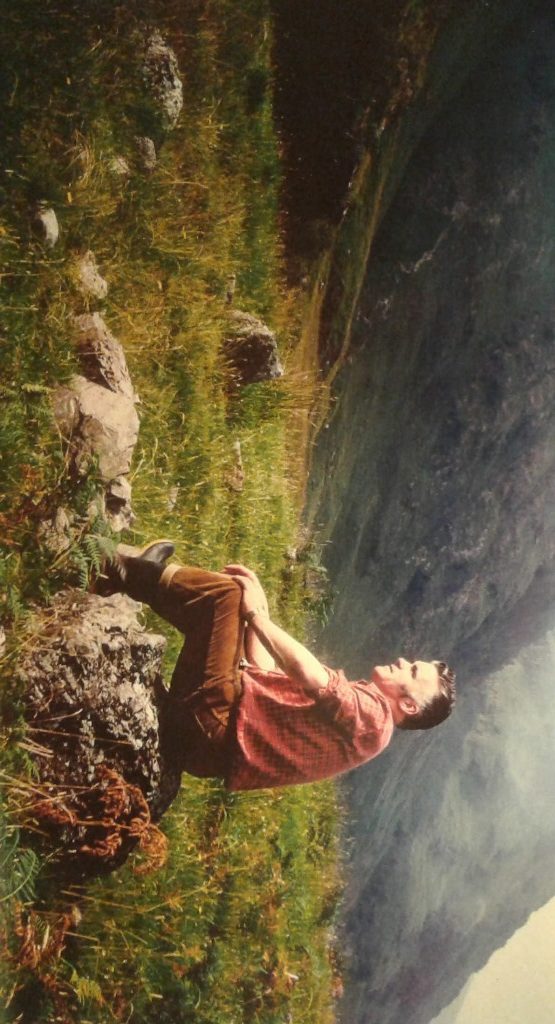
Waters of Irvine and Annock, flow with my tears,
West to the Firth of Clyde and Arran:
Soon, soon, Ayr will be mute and barren.
Flow, waters, flow, like the passing of long, lost years.
Gilliland! Singer of moors and the pensive glen,
The muses fade on your final breath,
Love resigns your harp to tender Death,
And my heart weighs heavy, beyond all earthly ken.
Your soul in silence moves on the high bonny braes,
As cloud-shadows cross the Lowland plains;
Sweet falls your music, like summer rains,
As if to quell my grief no happiness allays.
Great Bard, who tuned my green lyre, my mentor, my guide,
Soft be your sleep on Galloway’s breast,
In your fathers’ plaid, take now your rest,
Your Lallan lays, in Time’s embrace, shall yet abide.
Waters of Irvine and Annock, flow with my tears,
West to the Firth of Clyde and Arran:
Soon, soon, Ayr will be mute and barren.
Flow, waters, flow, like the passing of long, lost years.
Joseph Charles MacKenzie is a traditional lyric poet, the only American to have won Scottish International Poetry Competition. His poetry has appeared in The New York Times, The Scotsman (Edinburgh), The Independent (London), US News and World Report, Google News, and many other outlets. He writes primarily for the Society of Classical Poets (New York) and Trinacria (New York). MacKenzie has been nominated for the Pushcart Prize.












For Dr Salemi:
We must always bear in mind the crouching ignorance of those in the Lallans movement. Very few have really read Gavin Douglas’s Eneados or, if they have, it would be without a sufficient knowledge of Virgil’s original Aeneid to appreciate not only Douglas’s accuracy as a translator—a clear sign of his humanistic intentions—but also his ability to make of his translation a kind of political treatise on princely virtue, specifically referencing James IV.
By contrast, as we have seen in this thread, today’s Scotsmen, contemptuous of their own history through decades of Marxist indoctrination, are the very first to lay the ills of Scotland on the backs of the Stuarts. For these there is no hope.
When a man’s contempt and scorn for his own nation devolves into support for the EU’s annexation of Scotland, complete with the loss of national identity this implies, then why should we be remotely surprised if those in the Lallans movement behave as if their cause were already lost? Easy to organize an annual conference, put up a website, and struggle to keep a journal going, but when it comes to the defense the language in a public forum, their own disbelief in the future of their own language rises to the surface. Men are judged deeds, not words.
Why, in short, would a pro-“European” put any hope in his own language, if he puts none in his own country?
Granted, there was William Neill, and the translation of Homer, with the ghost of Douglas somewhere in the background of that brave project. Douglas’s Eneados, however, was no mere academic exercise. The makar’s defense of Scottis is symptomatic of his genuinely nationalistic agenda. Douglas did not see himself as not writing for other academics or fellow travelers in a small and shrinking club. He fully expected his vernacularized Virgil to be as widely received in England as in Scotland, “to be song fra town to town.” Douglas does not place himself in a vulnerable position of defense. Rather he sees “our awyn language” as equal if not superior to Inglis. to speak of a poet who goes out of his way to correct Chaucer!
But there is even more. Mr. Sale, above, declares that he “must draw the line” at the idea that Catholicism is the condition of poetry. This, however, is not my actual contention. I assert simply that authentic Christianity is the condition of poetry simpliciter, but the greatest poetry, and I do so simply because it is an undeniable truth of the history of civilization that no one has ever dared to refute.
With Gavin Douglas it was otherwise. His reading of Aeneis as a model of the Renaissance prince is everywhere evident, but just as evident—and a good deal of ink has been spilt on this very subject—is Douglas’s Christian typlogical interpretation of Aeneis developed in Prologue X as an ideal proposed not only to the Stuarts, but universally to all rulers. Nothing could be more outstandingly Catholic! What, after all, would we expect from a priest and theologian who wore the mantle of poet under, not over, his cape.
Alas, one would think that a desert rat from New Mexico would not have to be the one hold up the Eneados to British readers as a perfect illustration of how Christian culture created for Scottish poetry a truly sane and healthy humanism, or to be the sole voice of indignation at the abuse of a title, that of “makar,” best exemplified by Scotland’s true national poet. For, Gavin Douglas was just that, the poet of a nation, not, unlike Burns, of a simpering class with a perpetual chip on its shoulder.
If I stand alone, so be it.
Dear Joseph MacKenzie:
Yes, those short prologues that Gavin Douglas puts before the individual books of the Aeneid are in the “accessus ad auctores” tradition of medieval writing, but in this particular case Douglas attempts to read at least some of the original Vergilian text in terms of Christian typology. This was an ingrained habit of medieval critics and commentators, both lay and cleric.
I don’t share your Thomist approach to poetic interpretation, since I am still a dedicated l’art pour l’art partisan. But we have argued this question before, and there is no need to rehash it here.
I do think, however, that you are quite right about many persons in the Lallans preservation movement, at least from the evidence of this discussion thread. The movement seems nothing but a cosmetic attempt to preserve the exterior appearance of a cultural and linguistic identity, while allowing all else in life to be swallowed up in the globalist orthodoxy of rigid, bureaucratic, E.U. groupthink. What good is it to speak pure Lallans if your thoughts and beliefs are identical with the politically correct mindset of every left-liberal German, Swede, and Spaniard? As soon as this conversation became too politically hot for them, the Lallans preservation people ran for cover.
In fact, the E.U. is particularly hypocritical on this question. It makes a big public stink about “preserving” little linguistic subcultures in Europe: Welsh, Cornish, Catalan, Frisian, Romani, Basque, Breton, and a host of others. But the actual, living, breathing small cultures that these languages come from? The E.U. has nothing but contempt for them, and wants them ground down to nothing by the boots of capitalist consumerism, and the mass influx of Moslem dregs.
Yon cheil George Watt criticised Americae so he maun hate Americae fur Americae is unimpeachable. I dinnae hate Americae. I luve Americae.
Watters o Irvine an Annock
Ma suat tears mell wi the sautie ocean
Wast o Arran Isle an the Clyde
I hae freins an relatives in Americae fa I luve dearlie, fit wey wuid I hate Americae? Div the parents faw correct thair bairns hate thair bairns? The teenage faw quastions the parent hate the parent? Occours naw. I hae relatives in California. Thay bide in ae sma toun an fan the fires wis searin I worried fur thaim fur thay wirnae that fuar awa frae the flem. Thay are richt wing republicans, ae dochter an guidson in the marines. Nae front line like, she’s in the band an he’s ae gym teacher. Thair life revolves roun the church, ae son a ‘missionary’ in Africae fur ae while. Thay’re true blue white middle cless American, weel eiducated, talented, musical, he’s ae lecturer, she runs her ain dental practice. Ilka Yuiltide I wuid get ae cairdie wi ae newssheet o the year. Aa aipple peh gushin wi guidness. Fan thay wir ower visitin I speired o the mither anent it. I luve tae read o yer news I said til her, but, div ye nae hae ony fears or worries? ‘Of course I do’ wis her repone, but, I pyntit oot, we want tae hear o that anaa, oor luve an concerns oweratate aathin. ‘Father won’t hear of it, he wants it to be all good news’. He’s ma relative, nae the guiwife. I luve Americae, it wis sic ae pairt o ma youth. The music o the post weir, 1949-59 fan the Blues, Jazz, Appalachian, Fowk, Gospel aa melled an streivit tae fun ae new wey forrard that wis fur aabiddie. Fit excitement it gennered. Louis Jordan, Caldonia, note the title, Hank Williams, Fats Domino – The Fat Man – Buddy Holly, michty hoo we luved yon times. An fan tin pan clossie gaed tae sweetin it wi Pat Boone an Tony Bennett yous wuid hae nane o it. Elvis, faa sayed in 1955 ‘I’m gonna sing a song by friend of mine, I aint never met him but he’s a friend’ that wis anely on ae bootleg album. Faw wis it? Little Richard. Ae white cheil frae the sooth, the hert o apartheid spikin o freinshup wi ae blek lad faw wis gay! May no rax like muckle noo but bek then it wis pooerfu. An aa this led up tae the Ceivil Richts movements equalitie. Great muckle mairches. Fit haepent? I mind yet the awfy pit in ma wame fan I came hame ae nicht an ma mither telt me Kennedy haed bin shot. We aa thocht Americae haed muived forrard. It seems noo fan thay shotten the Kennedys an Martin Luther King thay shotten aa o yous. Fan I say ‘thay’ I dinnnae mean faaiver pued the trigger, but thaim faa’s ill wittins, thair speil an rodden thochts faa gaed the notie that it wuid be ae richtfu thing tae dae. Fit haepent tae the vyce o the people? I sayed aboot the skule murthers. I dinnae belie yous are nae laithlike an dowie wi it, but fit is duin anent it aa? Naithin. Ower an ower we raed o it. Div yous no care? Occours yous div, but ye cower awa frae sayin or daein ocht fur the eistablishment maun nae be criticised. Ye gotten rid o the divine richt o kings an reponed wi a divine richt o preses. Gin onywan says ocht agin the murthers thay cam oot wi the ‘constitooshun’. Yon Constitution wisnae cast in stane. It didnae cam doun Ben Sinai wi yon cheil Moses. It wis screivit by man an cuid, an can, be chynged by man. Noo yer haein elections fur the neist Preses contenders. Is yon twa really the best yous hae? Yon sautie ocean that divides us also jyns us. The deepest sheuch is but ae step, we luve an care fur brithers an swesters in americae, we are feart fur fit becomes yous aa. I’ll no be screivin ony mair. I’m forfochten. An aul bek injury wearies agin me. I haenae haed a richt nicht’s sleep the dear kens hoo lang. I hae better things tae dae than screive awa here. As I sayed afore, I dinnae care fit yous think o me, it disnae matter. An as fur the Scots Leid, it’s cantie an vogie nocht yous say or div will mak ony difference, it haes survived waur.
Watters o Irvine an Annock
Ma suat tears mell wi the sautie ocean
Wast o Arran Isle an the Clyde
Fur lang syne thay watters hae jynt us.
OK, you love Americans. But you only love us when we think the thoughts that you want us to think, and do the things that you want us to do. What kind of love is that?
I do appreciate, Mr. Watt, your notion of our man-made system—surviving in our day by only a slender thread and quite capable of disappearing in an instant. Thomas Jefferson, a pseudo-intellectual demon vomited from the depths of hell, would agree with you about the impermanence of the very system he and his fellow Puritan-liberal dimwits managed to hobble together piecemeal.
Like you, we as a people are not reducible to our form of government. Increasingly, the old Masonic governments of the 18th century are increasingly disconnected from the people. Only in a true monarchy do people find a living representation of themselves as a nation. I am certainly not about to discard the immemorial teachings of Aristotle and St. Thomas just because the errors of the 18th century continue to wreck our world—including the materialist idea that the executive functions of government are so easily handed over to a junta of medical technocrats. Good as our amazing President is, he is nevertheless a liberal, like yourself, who knows nothing of the three theological or four moral virtues, the queen of these latter being Prudence. While this is another matter, it nevertheless affirms to a certain extent your critique of our pathetic, Rousseauist system from which yours also emerges.
Was it not for what the men of the phony “Enlightenment” borrowed from Catholic teaching, we as a nation would have vanished more than a century ago.
Take, for example, the Declaration of Arbroath which I personally celebrate through the sportin o the tartan on April 6. It is the entire basis of our American Independence, giving the American Founders a historical footing for our Declaration of Independence.
But what our Declaration borrows from the Arbroath document came through William de Lamberton, Bishop of St. Andrews, its author. Lamberton had taken the prudent step of consulting Scotland’s most famous theologian, Duns Scotus, then teaching at the University of Paris, on the question of monarchical legitimacy, asking, quite simply, what is that gives a monarch authority. Scotus simply drew from the Church’s moral teachings on government when he answered [drum roll, please]: The Consent of the Governed. In other words, God can certainly give you the right to rule—complete with a hereditary throne and the sacrament of coronation, and so forth, but if you rule so badly or imprudently that everyone ends up hating you, your legitimacy quickly erodes and in some cases evaporates altogether.
Was it not for a Franciscan monk giving Bishop Lamberton the doctrinal basis for the three letters he sent to Pope John XXII—the Declaration of Arbroath being contained in the third and final letter—and was it not for the prudence of a Catholic bishop who managed the difficult trick of reconciling the Scottish crown and other important leaders to the Holy See, overcoming all kinds of obstacles including a brief excommunication due to a series of misunderstandings, our Founders might never have had the idea of formally asserting independence as a nation through a declaratory document.
The Declaration of Arbroath is indeed a crucial document for understanding our American Revolution. By the way, it’s written in beautiful Latin, though with a medieval flavor.
“Consent of the governed” is precisely what no one in Europe will enjoy when the damned bureaucrats in the E.U. get finished dictating all their pet policy decisions.
There’s an austere dignity in being ruled by a traditional monarch. But being ruled by an officious Belgian charge-d’affaires with a snotty attitude? No thanks.
We are quite a long way from the wonderful poetry in these political deliberations, but I have to say as a Brit that I agree that the Scottish National Party is a viper and Marxist organisation which is misleading and corrupting Scotland, which is dreadful as the Scottish are warm, generous and highly creative. Perhaps the most important to focus on is the sheer humbuggery of their position: to claim they want independence from the UK AND to be part of the federalist EU superstate is a contradiction that even a 5-year can understand. But they can’t. Why? For two reasons, primarily: one, because they are crypto-marxists they want to create an ‘equal’ state dependent on hand-outs – where better than sticking with the EU that will readily help you create a supine population. Second, and most sadly, the SNP and its membership actually hate the English – the bigger, the more successful neighbour. As the ‘younger’ brother they cannot stand England’s success and feel diminished in its presence. This must be the case because why else protest, given the levels of independence and funding Scotland already enjoys? They have their own legal, educational systems and more beside, and their funding formula exceeds that of England itself. In Dantean terms, it’s envy. The ex-First Minister – a humbug of the first order – is currently meeting his nemesis in the courts; I am sure, although the charges will be different, the current First Minister is going to meet her nemesis too. For, as Dante knows, you can’t peddle hate and disaffection for too long before it catches up with you. I am hoping all right thinking and wonderful Scots people are going to reject all this nonsense soon (including as Mr Mackenzie has virulently pointed out, their non-poet ‘Makar’) and regain their greatness which is truly part of their character.
Yes, we must distinguish between the Scottish people, and the vicious radicals in the SNP. The latter group has a secret agenda that, as with all Marxist organizations, aims at a totalitarian society. The SNP loves the E.U., which is a totalitarian society in the making.
Yes, I suppose we in the States have our flirtation with totalitarianism, given that one of our communist politicians—we have many now—has recently come very close to appropriating the Democrat party for his comrades in Russia and China.
The discussion of Scotland’s relation to th EU was never meant in any way to diminish the very important and most significant work of the Scots Leids Associe. Many are the treasures they have made available on their website, including a beautifully edited edition of the Eneados with updated typography, making it less of a slow slog for those like me who are just returnin to their reading in the Scots.
And their catalog of recordings is really quite the thing! https://www.lallans.co.uk/index.php/19-scots-language/63-sscd042
I firmly believe that the Society of Classical Poets would do well to open a Scots section in the the Journal and a special tab for the online venue.
Returning to the poem, and poetry, Mr. Sale, as you so patiently suggest with aught of courteousness and good humor, may I please indicate Mr. Watt’s translation of the repeated stanza of “The Last Bard of Scotland” given in the poet’s comment, as I believe it justifies every argument I have essayed to present as to the vast superiority of the Lallans to our soulless, ossified English.
Watters o Irvine an Annock
Ma saut tears mell wi the sautie ocean
Wast o Arran Isle an the Clyde
Fur lang syne thay watters hae jynt us.
Notice how Scots refused to swallow that “ó” sound in our word “salt” (pardon my phonetic symbols) as we do because of the closure of the back of the tongue against the soft palette when we pronounce it. True, an actor on a stage might for purposes of projection opt for touching the blade upon the hard palette to emphasize the “l,” but this is not usual in our language. You get a much lovelier sound out of the Scots with that dipthong-like “au” they have when the “l” is dropped before the “t” in words of this type.
I could go on and on all day. Whereas I have to fall back on the device of repetition to draw a sound out of our language, just look at how easily Mr. Watt captures the flowing of water with his perfectly limpid “Ma saut tears mell wi the sautie ocean”—let alone the metaphor of the bitterness of loss he conveys. Yes, there is repetition here, but it is subtle and the poet has balanced this second verse to perfection.
And look at how the Scots treats time so lyrically, in the “Fur lang syne” of the last verse. What have we got that matches that?
I am really beginning to think that our English was never designed for poetry. Maybe it’s passable for words artificially metered and rhymed on a page, but, let’s face it, it has nothing like the great sonorous spirit of song that is natural to both spoken and literary Scots.
At least Scotsman have a living language, compared to our dead one!
I think Mr Mackenzie makes a very good case, although I could never accept it, or even accept that English is ossified at present, since English always has been ‘ossified’ – various critics were complaining about the state of English in Shakespeare’s time, and in Dr Johnson’s they were still banging on about Latin and the regrettable deviations of English from its grammatical structures! I think that every age feels its language is debased, and we are not as great as our forefathers. Indeed, how must the Edwardians have felt following Tennyson and Browning? But then, something or someone happens and language’s expressive capabilities are renewed: Yeats and Wilfred Owen to take two examples achieved greatness once more for the English language. And so now, we are looking for the greats again to renew the language: perhaps Mr Mackenzie’s own sonnet sequences may be just such a tonic to help renew language? Others, too, on these pages are attempting wonderful things and we must believe that they also may succeed.
Regarding the Lallans language, what can one say? I made the point recently in my review of Alessio Zanelli’s collection that the mother tongue is where the feeling state really resides, and so I am surprised that Mr Mackenzie seems so ready to abandon the language in which he has been nurtured and in which his own potential resides. But that is his choice. For me English remains a consummate instrument of language, able to express every subtlety under heaven and the language of angels. There is no limit to what it might possibly achieve. And on that thought, I shall return to Canto 12 of The English Cantos and attempt to finish volume 1 of my own epic project in the English language!
It too think that Mr. MacKenzie goes a bit too far in downgrading the potential of English. But one must recall that MacKenzie’s real language of choice is French, in which he is both fluent and very learned. And although English is his native tongue, he is also fluent in the Spanish of Cervantes, which is still spoken in parts of New Mexico.
My personal opinion is that good English does not need to be renewed — all we have to do is practice it and write our work in it, as poets in the past did. The English language of Samuel Johnson in England, and that of H.L. Mencken in America, are quite good enough for me.
In regard to Dr. Johnson, I invite readers at the SCP to see my latest essay at Expansive Poetry On-Line, which deals with his poetry, and with his contributions to English prose style. A new essay on Alexander Pope will also appear there shortly.
Dr. Salemi, I must tell you that I had always considered an essay on Pope long overdue, and could only hope that you would be the one to write it. Pope is the final, greatest master of the English closed couplet. Never was this form more perfectly developed than under his immortal pen.
Oh yes, how I mourn the almost complete loss of our native New Mexican dialect, my “mither toungue,” in spite of the efforts of so many among us here. It may amuse you to know that my father’s academic specialty, Scottish as he was, was Ortega y Gasset’s relationship to Cervantes, as the entire oeuvre of this important philosopher is nothing other than a contemplation of Don Quixote. But why write a single verse in Spanish, which already boasts the immortal masterpieces of San Juan de la Cruz, Lope de Vega, Luis de Gongora, and countless others? All we can do is admire in awe and silence. Fray Angelico Chavez took the same approach. He felt that “English is the language that most needs my help.”
A friend, who is also one of our foremost scholars of New Mexico history, told me I should not bewail my failure to compose in Spanish as “the Sonnets for Christ the King are English in language only.”
By the way, I just acquired a superb facsimile copy of Samuel Johnson’s Dictionary. What a coincidence! Is there a link to the essay on Johnson?
Joe, I have now read your Dr Johnson article: it is excellent, and loaded with insight and information. Especially revealing is your account of Johnson’s translations from the Latin – you really make a great case for how good they are. Well done. We need more people to read Dr Johnson, and BTW the Rambler essays are my favourite – no. 1 in my top ten! – writings of his. I do have a Third Edition of his original dictionary on my shelves. Not quite a First, but we have to make do as we can!
Alas, Mr. Sale, I am not quite ready to abandon English, as there remain three more projects which I have already conceived in it and which demand completion.
What I say of the Scots, of course, I might also say of what is truly my “natural language”—the language of my grandmother—which is French, my true specialty. The decision to compose in English the Sonnets for Christ the King and its sequel, the Sonnets for Heaven’s Queen, was not mine. This was decided by clergy.
But the sonnet I composed during the burning of Notre-Dame Cathedral, because my emotions at that time were consuming me even as the flames were surrounding Viollet-Le-Duc’s magnificent spire, could not have been in any language other than French. To my consternation, the poem poured out of me all too easily, possibly because the laws of the French hemistiche are so impossibly strict (hence easier to deal with), or because the whole affair had struck me in the heart like an arrow. The sonnet was actually recorded by a professional “diseur” and was praised by one of his listeners as “digne de Péguy.”
In fact, I am not nearly as knowledgeable in English as you and Dr. Salemi. The attitude I had in my twenties I still have regarding the English poets. In my estimation, as I survey the literary record, they are to be pitied, as I am to be pitied for embracing this language. Being forced to read the entire Canzoniere, and then some, for my graduate studies did not push me any closer to such a thin poetical tradition as our English one.
For now, I shall use my time as I hope all Anglophone poets of the lyric genre will use theirs, in the study of Scots. There is really nothing difficult in such an exercise. The glorious syntactical usages of spoken and literary Lallans (these often intersect), are so egregious (and recurrent) in any poetical text one comes upon, as to be obvious, hence easily learned. he process is no different than that which we already use in acquiring whatever tradition we write in anyway. The rest is vocabulary and forms, but if one has an etymological sense of English, Scots is quite accessible. The patterns begin to emerge quite clearly.
A poet such as yourself, working in the field of the terza rima in the format of a grand spiritual epic, that is one thing. But for the humble craftsman labouring in the smaller forms of lyric verse, there is no excuse for failing to acquire a solid reading knowledge of Scots. This is both an obligation and a privilege. An obligation because of what English lacks in the lyric, and a privilege because it is not given to everyone to acheive.
I think it may have been given to me, so I must continue in my struggle, even as I complete my English language projects.
There is also the “gestuelle de la langue.” In Scots, the language “comports” itself in so many wonderful ways. It doesn’t just sit there like a lump on a log. To the same extent that it can wail and mourn, it can also smile and laugh—Scotsmen are as “souriant” as the Italians, if not more so. Both are truly peoples of song. Also, Scots is the great manly language of Britain.
You say English is the language of angels. I say Scots is the language of men.
If you wish to read my essay on Pope (along with several others on English poets) just do a search for Expansive Poetry On-Line. You will get a link to the site, which is very easily navigated.
There are also a number of my latest poems up there. You, Joseph MacKenzie, would most likely be interested in the one titled “1541”.
And please, good friend — don’t attack English! Next to my wife, she’s the love of my life.
“September 11, 1541” is a remarkable poem, Dr. Salemi, uniting perfectly crafted couplets with a historical narrative of the most astonishing nature. A masterpiece.
Obviously there is the date of September 11 uniting the victory of the Chileans over the heathen savages with the failures of liberalism’s grovelling worship of the “noble savage” that led to the pampering of the Muslim barbarians which, in turn, prepared our own “9/11.”
Your explosive final couplet gives the moral that we would have done well to apply had we not been shackled by the left’s Islamo-globalist policies.
Such is the way when savages rebel—
Give them a taste of unforgiving Hell.
And, indeed, had our own Juan de Oñate been allowed to make good on his threat to put the trecherous brutes of Acoma Pueblo in their place, their descendants might be walking upright today, instead of playing “artiste” for the tourists on top of their rock they no longer live on.
Dear Mr Mackenzie – I certainly don’t want you to abandon English; you have so much to contribute! Two small points, though: again, I could not really accept that the literary record of English speaking poets is to be pitied! Indeed, whereas as I give first place in music to Germans and Italians, and in artists to Italians and the French, I resolutely hold that the English language has produced the greatest body of poetry in the world – even Dante may – may, I say – have to take second place to Shakespeare. It’s a fine point, and I think TS Eliot thought otherwise, but if we roll out the criteria, I think Shakespeare ahead by a nose! But my second point is that I am not saying English is the language of angels, for that would be to say too much; no, I am saying that English is able to express everything ‘under’ heaven and the language of angels. In other words, is inferior only to those elevated modes, and whilst my argument cannot be completely compelling in that to be so, one would need to know every other language, I base it on three pillars: first, its ubiquity round the world, second its flexibility/adaptability, and thirdly the body of literature itself and its influence. Put these three points besides Lallans, for example, and what can one say? Without disrespect, Lallans seems a language on a life-support system. So, being proud of the English language is to me, as an Englishman, essential, and in saying so I am promoting Brexit and all those values which seemingly have been repressed by minority voices over the last 50 years. I am speaking up for what we have – and not being ashamed of it because it has been contaminated by labels such as ‘imperialist’, ‘colonial’ and such like. Yes, English is the language of men, or rather of peoples – men and women speaking it all over the world, including in the great USA, a gift from the old world!
I shall comment on Dr Johnson and read your article soon; he is a favourite author of mine and I am a member of the Dr Johnson Society in the UK! Indeed, as a member I quite recently went on a trip to the famous Garrick Club in London, which was fascinating. Meanwhile, Joe, I think we can infer correctly that the wife is number 1, and English is number 2. Seems right to me! Without any disrespect to Mr Mackenzie’s undoubted and deep erudition, and as an Englishman (not a Brit here) who has never suffered from Franco-philia, I have to put Italian third. But equally, I fully accept we all have our own peculiarities in this respect!! Regards!
I think we should all put aside this unprofitable game of trying to “rank” languages. My own experience is that any language, in the hands of a skilled craftsman, can produce something sublime.
I’m very sorry to hear that Lallans is on life-support, and that the very special Spanish spoken in Mr. MacKenzie’s New Mexico is also disappearing. The world will be poorer for their loss. We can chalk it up to the seemingly unstoppable fiat of standardization.
As for a poetry that is connected with men, I just completed an essay titled “Kipling and the Language of Manhood.” It will be published at Expansive Poetry On-Line. Any language can be virile if the poet is willing to kick arse.
Oh, I think it always profitable, Dr. Salemi, to argue for that most useful perspective which only true philology provides to those striving for excellence in their work.
If my sonnets had arisen from the English tradition alone, they would have other than they were. It is the sonnet itself, in its various Italian, Spanish, and French incarnations, and considered over time, from which I drew in writing the Sonnets for Christ the King.
One of the most destructive elements of poetry today is the linguistic parochialism of those pretending to write it. Which is why I find so very much welcome an essay on Kipling, a true cosmopolitan who was more sensitive than any other poet of his day to the dialects of Britain!
Could one imagine what the English sonnet might have been if the “well languaged” Sir Thomas Wyatt had never been an ambassador to the Papal court, had never been able to speak or read Italian as fluently as he did, or had never translated Petrarch? He would have had nothing to hand down to Shakespeare’s generation.
As for ranking languages, I believe this is an important exercise. In classical philology, the nobility and excellence of a language is strictly and correctly determined by its proximity to Latin. Therefore, the order is Italian, Spanish, and French, and then one can dilly-dally in the boggy morass of the Germanic languages.
Is English even really a language, or is it perhaps more of a “dialect cluster”? Again, not to denigrate, but simply to show that philology can give perspective.
The very worst thing about today’s “classical” poetry movement is that it is not classical at all if one considers the all too evident educational background (if any) of most of its poets. Understanding the history of the English language—which is utterly fascinating—and possessing some kind of formal grasp of morphology from the Latin all the way to Old English, is critical, absolutely essential to the development and preservation of our exalted art.
I do not mean to denigrate English altogether, and certainly appreciate that England’s best poet loves English, but simply to indicate its limitations for lyric poetry and to show how a language like Scots can be by its very nature more lyrical.
I do insist that the study of Scots can be enriching for Anglophone poets, as there is no better way to understand our own language than through the knowledge of others.
We rank things all the time, Joe, we can’t help it; even dissimilar things, such as wives being more important than language – a point I picked up from your post. In reality, everything has value and is valuable and can be learnt from. But as with ‘pop’ music, we all assemble our own top tens. I thought it was important to insist on the importance of English – on an English language site to be sure – when there seemed to be some ‘picking’ at its power and expressivity. For that, I need make, and would not make, any apology. I look forward to reading your Dr Johnson and Kipling pieces, both very fine writers.
OK Mr Mackenzie, I think you have made a very cogent argument, although one I do not fully accept. A more important thing is to read and appreciate your first rate poetry. So I shall leave further thoughts on this for now, since it seems to me to require essay length analyses to really explore all of these fascinating aspects of language – and if that happens, I shall never get to reading Dr Salemi’s article on Dr Johnson, which I really must do. Thanks for stimulating a great debate.
Mr. Sale, it does occur to me that you are quite fortunate also, as you yourself live in a very rich linguistic environment, when one thinks on it—and I am not thinking only of accents. The varieties of English I heard in London alone surprised me to no end!
I’ll agree with Joseph MacKenzie on this point — understanding and appreciating other languages definitely improves one’s command of English. It also sharpens your technique in writing English.
I can give an immediate example: Kipling was born in India, in a bilingual setting. From early childhood he spoke English with his parents, and spoke a native Indian tongue with his nurses and nannies. He himself said that his English was halting, but that he was perfectly fluent in the native speech of those Indian caretakers. Can anyone doubt that this bilingualism was part of the reason why Kipling developed such an amazingly strong yet supple English?
My word, Dr. Salemi, you could not have selected a more dialectical author to expound upon in your essay (which we all await most ardently), and yes, a poet growing up bilingual in the already abundantly multilingual environment of India during the Raj.
I am really quite disappointed in those who dismiss Kipling’s significant use of dialects (including our own Americanisms which he seemed to take considerable delight it) in prose and verse. The reality is that he is always and everywhere drawing out the character of people and places, and the best way of doing that is through those particularities of language for which he had an unusually sensitive, and I dare say, loving, ear.
“Tommy,” for example would be unimaginable if Kipling did not give its speaker that unforgettable East London ring which carries all the poem’s genius:
I went into a theatre as sober as could be,
They gave a drunk civilian room, but ‘adn’t none for me…
The bigotry against Kipling is ferocious. I touch on the source of it in my essay. As usual, it is the usual suspects.
The best sample of Kipling’s skill with lower-class or London East End accents is his brilliant poem “The Widow at Windsor.”
I just wanted to add, perhaps, a final comment on this fine poem. I have known Mr. MacKenzie since our college days, when he was already a fine poet, but he seems, almost miraculously, to grow better with the years. But then again, Verdi wrote his wonderful opera “Falstaff” when he was in his late 70’s! Ad multos annos, Joseph!
And our college was not so far from the Sante Opera where one could see Verdi’s masterpieces performed rather well, often with a glorious New Mexico sunset behind the stage (as the house’s architecture was open on four sides) and a fantastic moonrise in the east.
The mention of Verdi reminds me of my days in a priory outside of Rome. We had a girls school in the summer run primarily by the nuns. During the Mass, the girls would sing old 19th-century devotional hymns, always in harmony, something Italians naturally do whenever they sing anything together. It reminded me of Verdi’s choruses, to the point that my musical memory (my mother let me collect hundreds of Italian opera recordings when I was young) led me to wonder if Verdi had not sung the same hymns as a boy and if they had perhaps inspired some of his music. I am inclined to think so.
Thank you, everyone, for this vibrant and most edifying conversation. I am particularly indebted to Mr. Watt for helping us make a much needed “bridge” across so many many figurative waters of contention and agreement. May we ever keep in mind Scotland’s glorious tradition of song, the envy of lyric poets throughout the world.
Thank you, Nicholas. Aye & aye, Sam.