


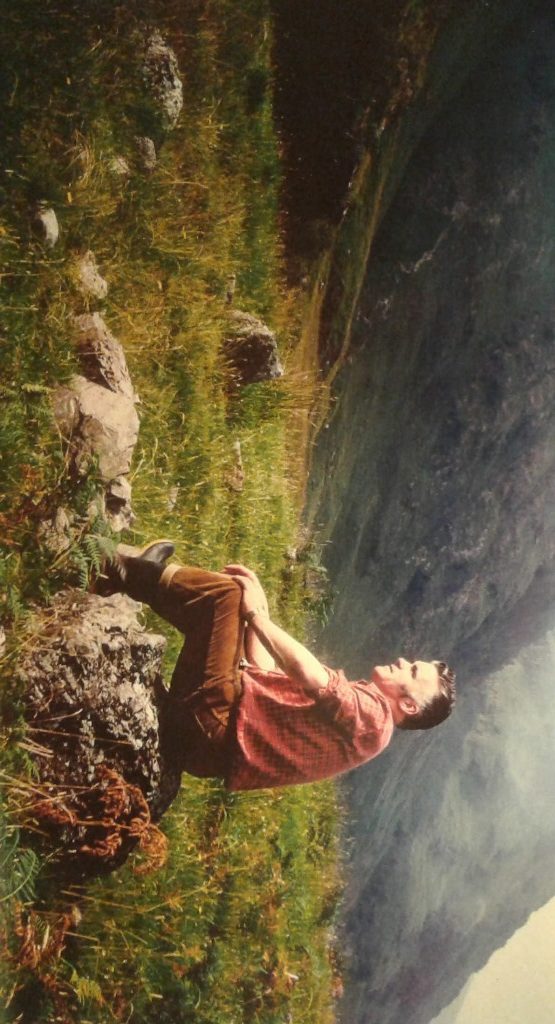
Waters of Irvine and Annock, flow with my tears,
West to the Firth of Clyde and Arran:
Soon, soon, Ayr will be mute and barren.
Flow, waters, flow, like the passing of long, lost years.
Gilliland! Singer of moors and the pensive glen,
The muses fade on your final breath,
Love resigns your harp to tender Death,
And my heart weighs heavy, beyond all earthly ken.
Your soul in silence moves on the high bonny braes,
As cloud-shadows cross the Lowland plains;
Sweet falls your music, like summer rains,
As if to quell my grief no happiness allays.
Great Bard, who tuned my green lyre, my mentor, my guide,
Soft be your sleep on Galloway’s breast,
In your fathers’ plaid, take now your rest,
Your Lallan lays, in Time’s embrace, shall yet abide.
Waters of Irvine and Annock, flow with my tears,
West to the Firth of Clyde and Arran:
Soon, soon, Ayr will be mute and barren.
Flow, waters, flow, like the passing of long, lost years.
Joseph Charles MacKenzie is a traditional lyric poet, the only American to have won Scottish International Poetry Competition. His poetry has appeared in The New York Times, The Scotsman (Edinburgh), The Independent (London), US News and World Report, Google News, and many other outlets. He writes primarily for the Society of Classical Poets (New York) and Trinacria (New York). MacKenzie has been nominated for the Pushcart Prize.
















This is truly a beautiful 5 x 12.8.8.12 Poem.
Thank you, Narendra. I hope this poem will be translated into Scots very soon by a competent poet and colleague of Mr. Gilliland.
A beautiful and heartfelt poem, which I greatly appreciate. But am I to assume from it that Sam G has actually died? If so, I am sorry to learn of it. A few years back I had some communications with him and he was obviously a great spirit.
I am greatly honoured by your most gracious assessment of this poem, Mr. Sale.
The feelings this poetry calls up within me are serious, amazing!
These feelings I know well, as they are the same that my mentor’s magnificent verses have elicited in me. The man himself is an embodiment of Scotland, and of poetry.
UPDATE ON GILLILAND
In obtaining for my poem this very morning the the imprimatur and nihil obstat from the poem’s illustrious subject, I have learned that our great bard is now resting comfortably at home (read: simply hiding out as he was always want to do) having placed himself in the care of a certain Nurse Glenffidich, a most experienced professional who has been practicing since 1887 and whose patient ministrations are sure to bring about a happy prognosis.
Very droll – ha ha ha – she is an excellent nurse indeed, and puts a certain fire in the blood! Great to hear he is alive and well and under such loving supervision.
Yes, by all accounts doing well, indeed.
I know Nurse Glenfiddich very well, and I should say that Sam is in very good hands. I trust that the good nurse has been ably assisted by Nurse Balvenie & Nurse Kininvie.
The great single malts of Scotland are the drink of the gods! Mr. Gilliland has always been partial to the Glenffidich as I know personally from my conversation with Norman MacCaig in Edinburgh who shared the same preference as I believe almost all the poets of the 20th-century Scottish Renaissance did. So, let us all endeavor to celebrate Scotland’s great bard the Lallans by raising a wee glass of the elixir to the his health.
Quoting from memory, it was Dr Johnson who said, ‘Wine is for boys, port is for men, but he who aspires to be a hero drinks brandy’. Whisky/Brandy are I feel synonymous here, although devout devotees will no doubt complain. But we get the drift – Scottish Malt whiskies truly are inspired potations!
When Joseph MacKenzie sent me this poem a couple of days ago, I too assumed that Sam Gilliland had died. I am glad to hear that he is still with us!
I have had to deal with all kinds of communications about this matter of my mentor’s “disappearance” over the past several days and am emotionally exhausted. There was even a rumor that Gilliland was unreachable somewhere in Portugal, a country which has found pride of place in many of his poems.
As my poem was composed in causa mortis of its subject, it is by that very fact an homage to a living person for whom I am now free to celebrate in yet other verses pertaining to his genius.
I confess I do not know your mentor ( though I am somewhat enamoured of his nurse!) however, as a lover of Scotland and all things Scottish I found this beautiful poem very endearing. It just soars! I cannot help but imagine it set to music and possibly being performed by the likes of Isla Grant or John McDermott. Congratulations on a great work.
May I please offer you, Mr. Walford, my author’s note which I had not thought of publishing until reading your most gracious comment.
The Water of Annick (anciently and therefore more poetically Annoch, or Annock) is a major tributary of the River Irvine. Their confluence takes place in Ayr, before the Irvine becomes the Firth of Clyde, the great body of water surrounding the mystical island of Arran. These are the waters that surround the Bard’s birthplace and childhood. Their invocation in the repeated stanza is therefore intended to honour the poem’s subject.
As the Irvine flows west all the way from the County of Lanark where it originates, this cardinal direction is given in the poem as a symbol of the ending of days, the setting of the sun.
The “high bonny braes” transpose “les collines” of the French romantic poets who frequently image the poet as moving upon the crests of the mountains, that is, above and thus removed from the world in the solitude of poetic contemplation.
The song of the Great Bard falling “like summer rains” is an intertextual borrowing from one of Gilliland’s own poems of homage to another poet, entitled, “To Have Heard MacCaig,” in which he describes the poetry of our mutual friend, Norman MacCaig. This is my way of saying: “But your works are the equal of MacCaig’s (falling on my ears in the same way).” MacCaig is also the primary and most precious “link” between Gilliland and the 20th-century Scottish Renaissance in many ways not merely chronological. I have always considered that Gilliland was MacCaig’s young successor.
“My green lyre” alludes to the fact that I was young and inexperienced in the arcanes of Scottish verse when I first met Gilliland, and his “tuning of the lyre” references how very much I learned from the great master’s verses even then, and how they have influenced and continue to influence all my work.
The region of Galloway is where the poet currently resides and where many a member of the Gilliland clan may still be found. But the region is pregnant with literary meaning, as Robert Burns, the national poet of Scotlan, is buried in Dumfries, the administrative capitol, in St. Michael’s Kirk, which I have myself visited. While I esteem Gilliland as even more important than Burns, the invocation of Galloway unites the two bards in death, as it were.
“Your fathers’ plaid [pronounced like ‘played’]” is the mantle of the Bard, but also the tartan of the poet’s ancestors, a symbol of his outstanding fidelity to the Lallans leid, the language of his ancestors.
As I do not consider myself at this time able to compose in Scots, I compensate for the relative tonal poverty of our English through the repetition of sounds that are most expressive of my grief, hence “soon, soon,” “ flow, flow,” “long, lost,” all variations of the same vowel to emphasize the aspect of sorrow.
Finally, the nine-syllable verses of the enclosed rhymes occur marvelously in Gilliland, especially early Gilliland, and therefore a further homage to the great genius.
Thank you Mr MacKenzie for your thoughtfulness in posting your note which has certainly expanded my insight into your work. I could almost hear the pibroch resounding in my head as I read through it. Much appreciated.
A most perfect pibroch. I truly heard the piper on a distant hill.
It’s interesting how I do seem to be getting that same response from others and will have to think about that quite seriously, Mr. Darling, although it would take a very competent, experienced, and sympathetic piper to make the poem into a veritable pibroch for the Phìob Mhòr.
On a strictly technical and historical level, there has been a certain and very important commerce, if you will, between poetry and piping which has enriched the traditional piobaireachd well into the Victorian period—such that we use the very term “pibroch” to signify both a poem and a tune almost interchangeably.
Sam Gilliland could not ask for a finer tribute. There is within the poem a flow attributable to much more than the inclusion of the Irvine and Annock.
I believe that your reply on the point of sound repetition provides a valuable explanation.
Tradition is a river that begins and ends in God who animates all human expressions of the heart to glorify Himself.
Joseph that is an exceedingly good lyrical poem that is a fitting tribute to Sam Gilliland. Sam’s poesie has aa the souch o the soothwast o Scotland aye preisent waein it, an yer ain screivins manages tae captur that speirit waein its chairm. Sam is kenspecklet waein the Scots Leid Associe fur his fell fine poesie. I wull gae serious thocht tae owersettins yer tribute tae Sam in Scots, but, it is sic a cantie an braw wark o airt, I wull nae dae it lessen I feel I can dae it justice. Masel, I’ll hae a Bruichladdich, while I mull it ower.
George T Watt
memmership secretar
Scots Language Society / Scots Leid Associe
Dear Mr. Watt,
For the benefit of our many American readers, you are yourself an award winning Scots language poet (Top Twenty Poems 2014, Scottish Poetry Library, “Whaleback City” anthology published by Dundee University, recipient of a McCash Competition prize, etc.). You have also played a vital role as the Membership Secretary of the all-important Scots Leid Associe which for many years has been the great flagship of the Scots language movement with its formidable “Lallans Journal o Scots Airts an Letters” (publishing exclusively and uncompromisingly in Scots) and, of course, the great Sangchaw whose top prize, the MacDiarmid Tassie, is by far the finest literary award any poet could ever dream of winning.
Having myself experienced—on my way to visiting Mr. Gilliland in Springside, when the poet-rich region of Ayr could yet boast the honour of his residing there—the unforgettable “souch o the soothwast,” I must say that I agree with you most heartily that this is a veritable hallmark of Gillilandian verse.
And I am most grateful to you, Sir, for having jogged within my memory one of the great bard’s Lallans sonnets in which he gives us a sunset vision of Arran, viewed from Ayr, which has not only served as one of the inspirations of the poem which you are only to generous to have honoured by your sole suggestion of applying your talent to “owersettin” it, but which has haunted my imagination ever since first reading it many years ago. (I am certain that our young editor, Evan Mantyk, who first took the very bold step to establish a bridge between the Society of Classical Poets and the Scottish movement by publishing not only some of my master’s poems but also my interview with the illustrious poet, would well consider presenting your translation in these pages.)
With your permission, I should like to quote its unforgettable opening quatrain of Sam Gilliland’s “Auld Mans Fantice” which could not more powerfully confirm your sense of his work:
Sheddaed in the lispin sea, Arran’s bens,
Auncient tours, bleck, buirdly, whaur sterk stanes speak.
Haudin furth the Almichty’s saft silhouette,
Bluid rid gin a ruby sun whiles forfens
The ee frae wha’s wha, peak frae peak…
Thank you, again, Mr. Watt, for your most kind and gracious attentions. I speak for all us American poets in saying that we are greatly honoured by your reaching out to us given your extremely busy schedule.
Aye & aye,
Joseph Charles MacKenzie
Dear Mr MacKenzie.
This is a magnificent and very moving poem of tribute to an evidently very fine Scottish poet; although, to be honest I don’t understand much of his poetry – maybe because I am not Scottish. I like his take on the English classic sonnet form which I find successful even though I don’t quite understand it quite what his poetry is about.
I guess he is Catholic. Am I right? I am pleased that he is still with us, I was a bit worried.
Personally I prefer a wee dram of Laphroaig but Glenfiddich is nice too.
With all good wishes,
Nicholas Wilton
Personally I prefer Laphroaig. to Glenfiddich as it is very smoky and peaty and goes well with a bowl of Irish twist
Thank you, Mr. Wilton, for your very kind and most gracious comment.
No, Mr. Gilliland is not a Catholic, although he shares my appreciation of both his Excellency Bishop Gavin Douglas (translator of the Aneid into the Middle Scots of the Eneados) as well as Rev. Fr. William Dunbar, the sacred poet who was also the most important figure of the Makar movement.
A propos of Scotland and Dundee, I would like to please use this occasion to inform our readers of a very important, yet highly affordable, new recording, namely your recent CD of sacred choral music by composed by yourself and Peter Kwasniewski and performed by Cantiones Sacrae at St. Mary, Our Lady of Victories Church, in Dundee, Scotland.
Cantiones Sacrae is a four-voice ensemble specializing in polyphonic choral music of the Renaissance period as well as music by contemporary composers. Nicholas Wilton is well known for his sensitive and atmospheric liturgical settings which have been performed in both the UK and the USA. He has also written collections of piano music which have recently been performed and recorded by Alexei Knupffer.
I urge everyone to acquire this rich, full-length recording here: https://www.tutti.co.uk/cds/divine-inspiration-wilton-kwasniewski-choral-NSWIN-20191-R4
Thank you, Mr. Wilton, once again.
All good wishes!
Joseph Charles MacKenzie
Dear Mr MacKenzie.
This is a magnificent and very moving poem of tribute to an evidently very fine Scottish poet; although, to be honest I don’t understand much of his poetry – maybe because I am not Scottish. I like his take on the English classic sonnet form.
I am pleased that he is still with us, I was a bit worried.
Personally I prefer a wee dram of Laphroaig but Glenfiddich is nice too.
With all good wishes,
Nicholas
Please see my “Note on Bruichladdich” below.
NOTE ON BRUICHLADDICH
I remember Remy Cointreau’s purchase of this exquisite and ancient house of Bruichladdich making news all around the world some years ago. Bruichladdich [Gaelic: “brae of the shore”] is one of only nine of the great distilleries remaining on the Hebridean island of Islay, the famous “paradise of whiskeys.” Bruichladdich is one of the finest in the world, rivaled only by its fellow Islay houses, Laphroaig and Lagavulin.
Gin I micht tak advantage
Islay Malts
Brawlie, brawlie, brawlie
Laphroig aamichty
Ardbeg Lagavullin
Fit ae trinitie.
Swallie Buinahabhain
Bowmore or Ceol Ile
New loun Ardnahoe
Maks a cheerie glow.
Kilchoman I’m comin
Tae faa unner yer flavour
Bruichladdich, Bruichlddich,
Ae gless abune thaim aa.
This is a magnificent and warming “Ode Tae the Whiskeys o Islay,” complete with an opening, triple repetition of the adjectival form of “braw” which is a word so inherently Scottish, and so very complex like the whiskeys the poet is celebrating in using it, as to give a very classic tone to the whole.
Note that all of the nine of the famous distilleries are invoked in so short a space.
My final opinion is this: You can never translate “down” from Scots to English, you can only translate “up” the inverse.
How tonally impovershed is our English, with its sissy consonants and anemic vowels.
Just think of how wonderfully and playfully Watt has given us—in only two words!—the the fact that Ardnahoe, the £14 million dream realized by Hunter Laing which only begin producing late in 2018, is the newest of all the Islay distilleries. How would we translate Watt’s ingenious “New loun Ardneho” which means something like “that new young rascal on the block” without losing those wonderful vowels and the whole galaxy of connotations that surround “loun.”
And note how the poet exploits those sonorous names of the great distilleries, maximally musical in themselves.
This elegant song was written for the memory, to be voiced aloud by all men everywhere who know and love the whiskeys of Islay!
COREECTION
I meant to say that “brawlie” is the adverbial form of “braw” and meanwhile neglected to indicate how it is echoed in the “swallie” which opens the second quatrain, yet another ingenious, but perfectly organic device quite natural to the Scots.
Dear Joseph, yer kennin o Islay whisky (note nae ‘e’!) amazes me. I’m honoured tae that ye hae read sae muckle intil sic ae wee bit poem. Scots is indeed a superb leid, that haes fur ower three hunner year syne been pit doun, dehumanized, suffered aa kin o abuses an still survives. Scots is recognised by the EU as ane o Europe’s lesser leids, an shuid be respectit, but michty, the Scots Parliament daes naithin tae enhaunce it o ony import. We in the Scots Language Society / Scots Leid Associe, receive nocht in the wey o government aid. Wir anely income is frae oor annual stent frae oor memmers and sales throu oor CD catalogue. Ma apologies fur gaein vent tae ma thochts an frustrations.
Oh no, Mr. Watt, you mustn’t be surprised as there are many throughout the world who possess far more knowledge of whisky than I. The appreciation of this quasi-divine libation, if even intellective, has always been, and always will be, the appenage of all cultivated gentlemen, in the same way that we strive to maintain some knowledge of the wines of France—which, by the way—and this is important—the Scots excel in, as I noticed when visiting Stanley Roger Green in Edinburgh. Some of the best sommeliers in the world are Scots. What your country lacks in the ability to grow grapes it seems to make up for in the knowledge and appreciation of fine wines.
As for the ignorant opinions issued by the kleptocrats of the so-called “European” so-called “Union” regarding the status of Scots, these hold the same meaning for us in America as a bag of dirt. We only call Scots a leid, as opposed to a language, because Scotland, at the present moment, lacks a monarch. If the EU had its way, Arabic would be the language of its member “nations.”
Scots is moreover a godly language, as it has never been used as the language of a heathen court. Gavin Douglas was able to sing the praises of Scotland’s true queen, the Holy Virgin, and lament the Passion and Death of her divine Son, in this most worthy of all tongues.
Indeed, Dr. Joseph Salemi, our best American poet who is also both a classicist of distinction as well as a practicing philologist, has communicated to me about the Eneados which he highly recommends. He doubtless takes the usual interest, proper to men of his intellectual station, in the Scottish literary movement. I believe he would have a wee bit to say on the dolorous topic of the Scottish Parliament and the EU.
But now that you have intrigued thousands of readers, may I please ask, Mr. Watt, about this very special CD catalogue you have mentioned? And would you be able to enlighten us about the importance of spoken poetry as opposed to “writing for the page” which, in my mind, is the sad practice of those who possess only non-euphonic languages?
To add my “wee bit” to the conversation, let me say this: The E.U. is simply the Smiley-Face version of the German Third Reich. It is an overweening administrative and legal tyranny that has a bureaucratic contempt for all of the manifold cultural and linguistic traditions of Europe And Joseph MacKenzie is quite correct — the E.U. leftist ruling cliques doesn’t really like Europeans at all, but would much prefer to replace them with Arabs, Africans, and Turks.
As for Lallans Scots, when I was in graduate school, one of my professors who was a well-known English-language dialectician told us that he was especially fond of the Scottish tongue. He said it represented the single historical chance that there might have been another standard variety of English other than the standard London English that triumphed below the border. Unfortunately the amalgamation of “Great Britain” after the death of Queen Elizabeth I short-circuited this possibility. If Scotland had remained an independent kingdom, it would have been a different story.
And I can assure Mr. Watt and the Lallans Associe that those of us who, like Dr. Salemi, were blessed with a traditional formation in the currently suppressed science of philology—in my case with the extremely exigent professor whose mandatory courses in the history of the English language were a turning point in my life—were quite naturally exposed to the language of the Scottish peoples, taking up further studies as our curiosity or personal temperament moved us. This was nothing other than the normal case prior to the communist takeover of our academic system.
As Dr. Salemi has stated the role of Scotland’s ancient independence in securing the prestige of her most excellent language, I would be most interested to know if those in the Lallans movement understand by the word “independence” what many of your countrymen seem to understand, namely a kind of pre-Brexit Scotland whose status would be merely that of a fiefdom of Brussells under the grip of an Islamo-globalist hag like Nicola Sturgeon.
I will try and avoid getting involved in a political discussion, however, some comments are right out of the worse examples of the English, right wing, press. Ae meintion wis made o Standard English, ae mute pynt. Gin we tak the Staundard Anglo lexographie tae its logical conclusion, Shakespeare wuid be banned! I micht pynt oot here that the Dundee Rep, ane o the UKs best theatre associes, fan thay div ae Shakespeare play, thay use Scots fur some characters an michty me, it fair brings it tae life. Fowk, faa dinnae consider thairsels cultured enjoy it that wey. Aye, bein standard, tuik awa English’s ability tae be innovate. Gin ye want ma thochts on the poleitical situation I wuid suggest ye email me private like.
Professor Salemi is correct in asserting that the demise of Elizabeth 1 did not help the Scottish language; it was at this point that James Vi of Scotland became king of England in 1603. However, that was not the real end because despite having one monarch the two countries were still quite separate. It was the Act of Union in 1707, over a hundred years later, that joined the two countries and spelt the end of the power of the clans. But even then the Scots language may have survived more substantially if it had not been for the Young Pretender and his march on London. He quit at Derby, was defeated at Culloden in 1745 and so began the Highland Clearances – the real devastation of Scotland. Incidentally, one of the most famous organisations in the UK, Ordnance Survey (for whom I have been a freelance management consultant some years ago) was founded in 1746. What does Ordnance Survey do? Make maps – yes, you’ve guessed it: the English got the OS to map Scotland first so they could make sure they knew exactly where all those pesky Scots were in case another Pretender arose. And again, for Americans not familiar with this Brit history, the Young Pretender was the last male descendant (apart from a celibate Cardinal) of James 1 of England, the original Stuart king. Thus did the Stuart cause finally collapse and it could be argued did more harm to Scotland than it did good.
Yes, Mr. Sale, your depiction of “les grands traits” of the history is indeed quite interesting.
One of my ancestors died not at Culloden, but in delaying a contingent of English during the flight of the Bonnie Prince to Skye, something to do with the fact that this gallant personage known as the “Braw MacKenzie” bore a close physical resemblance to the noble Stuart and in a way exchanged his own life for his Prince. There is a story about this which has been handed down on my father’s side and which perhaps explains the persistence of the name Charles among us men. In other words, we never referred to His Royal Highness as a “pretender,” as you do, but as the “Bonnie Prince.” My father’s favorite whisky was the Drambuie, curiously because of its association with Skye.
When I was a seminarian I made a point of visiting the Monument to the Royal Stuarts whenever I had occasion to enter the Vatican, which was often. It is magnificent, a masterpiece by Antonio Canova in the purest Carrara marble. The tomb of Charles Edward Stuart lies next to it along with that of the Bonnie Prince’s brother Henry Benedict who was the Cardinal Duke of York, one of the most cultivated intellectuals of his day. When I first saw this monument for the very first time, I wept in thinking on Culloden.
I believe, like you, that, had Scots received the patronage these wonderfully well-educated Stuarts had traditionally given it, it would have remained the unrivaled national language. Alas, this was not to be.
Indeed, for us, Bloody Lizzy was a true pretender to the desecrated throne of England. Henry VIII’s marriage to Catherine of Aragon was never annulled. Therefore, he was never married to Anne Bolyne, which makes the death-dealing Lizzy a mere bastard with no legitimate claim to anything at all. Her own father, after executing her mother, declared her illegitimate. Lizzy the Apostate, moreover, was never anointed, an absolute requirement for the rite of coronation.
I am a Sicilian-American, and a born-and-bred Noo Yawker, without a drop of Scottish blood. But there is one song, sung to the whine and skirl of pipes, that can set my skin a-tingle and bring tears to my eyes:
Bonnie Charlie’s far awaa,
Safely o’er the friendly main —
Many a hert will braak in twa,
If he naa cum baack again!
God bless and keep the House of Stuart!
Ha ha ha!!! Thank you so much Joseph for some fascinating reflections on the house of Stuart, and you make loads of illuminating points. Regarding Henry, that is Cardinal Henry Bendict Stewart, all you say is correct and additionally he was known as “Henry IX in the eyes of God but not of men”. But as an Englishman one is duty bound to make a couple of points. We would not, for example, dispute the legitimacy of George Washington as first President of the USA. Why? Because the people self-determined it, and so America freed itself from its colonial status. In the same way with English/British Monarchs, Elizabeth 1 was legitimate because the English determined it, not in some sleepy, it just happened kind of way, but because they spent a 100 years embroiled in the issue. Indeed, the evil of Henry VIII paved the way for the final demise of Charles I near a hundred years later.
And this leads on to the more important issue: it would take some genius of casuistry to persuade me that those Americans who support the Constitution, the Bill of Rights, the War of Independence, and the end of the tyranny of George IV, simultaneously can applaud the house of Stewart (or Stuart) and their insistence on The Divine Right of Kings. Indeed, imagine: the Young Pretender, Bonnie Prince Charlie, went on to die in exile in 1788. If he had succeeded at Cullodon, re-established the Stewart dynasty, he would have been the king the Americans fought in the Independence War!!! Furthermore, George IV – not a believer in the Divine Right of Kings (actually, mad of course) – would, it seems to me, to have been a pussycat in comparison to Charles III. And keep in mind, how tenacious the Stewarts were: after the overthrow of James II in 1688, they carried on the war for the throne for another 60 or so years! Once we lost America, we gave up – you had won, your people wanted freedom, so Britain got on with other things – namely, the Napoleonic Wars! But would Charles III have given up? The Stewarts over a 600 year period of influence were marked by their stubborn and obstinate behaviours. I am not saying the result would have been any different for the USA, but the Divine Right of Kings is wholly incompatible with a Bill of Rights. So basically, whilst I totally get Joseph Mackenzie’s love and loyalty and early experiences shaping his views of Scotland, and also get that that wonderful old satirical curmudgeon, Professor Salemi, has a soft and romantic underbelly, I am going to conclude that the idea that we want the House of Stewart back is a bit of a stretch! We are a long way from Joseph’s wonderful poem, however, but the key point is: yes, the Scottish language has been impoverished, and that is a tragedy, since every language has some important contribution to make to human existence.
Aa very true an I wuid add tae that, gin Chairlie haed won, an tuik ower in Lunnon, he wuid nae doot hae fell fur Lunnon society as muckle mair tae his likin than the cosy beil o ae turf housie in the heilans, or e’en a caul drafty castle in the heilans. We wuid hae feinished in exactly the same wey, ie ruled by a Lunnon centric Westminister priveledged few. The clearances wuid still hae happent, Gaelic an Scots wuid still hae been victimised. I micht add tae anither comment, Scotland gotten mair oot o Europe in 50 year than it gotten frae Westminster in 300 year syne. But, tae quote Sam Gilliland, ‘ilk rothly cheil maun tak tent o his ain’, whiles it’s best tae kep some thochts tae yersel! Scots is ae braw Leid, threi hunner year o anglo rule an dare I say, ae hunner year o American movies, haesnae duin fur it yet.
America did not create the freedom of speech. The freedom of speech created America.
For, you see, Mr. Watt, we were never subjected, so our speech is neither guarded nor self-censored here. Alexis De Tocqueville observed as much. So, I do hope you will please forgive us our manner of taking great liberties in the expression of our thoughts. This is something which characterizes us as a people.
What may be seen as a virtue in one society, is not necessarily perceived as such in another.
For us, it is not a question of “what we can get out of” whomever we bow down to, but what we do for ourselves.
The true Jacobite Mass is offered in my private chapel four times a year. I know what the men of Culloden died for, because it is in my house.
For all the ahistorical, neo-Marxist revisionism by which Prince Charles Edward Stuart is habitually caricatured as just another “problem”—and the ill-informed speculation that he would have been worse for Scotland than Westminster—one truth remains: He would have restored Christianity to a land whose real poverty today is spiritual poverty, that of the secular atheist begging for crumbs from a godless Europe at the expense his own freedom and dignity.
Much depends on the idea of liberty. True liberty is not only perfectly compatible with monarchy, but each is the first condition of the other.
There are errors in Mr. Sales, major premises here, which were better remedied by a good reading of Benjamin Constant’s criticism of Rousseau’s “social contract.”
Do you know, for example, that the Freedom of Religion in our Constitution’s First Amendment was included to show gratitude to its primary advocate, Charles Carroll of Carrollton, the only Catholic signer of the Declaration of Independence who thought of this freedom in Catholic terms—the freedom to practice the True Religion from which all true liberty flows.
Of all the signers of the Declaration, Carrollton was by far the wealthiest and most educated (he had a 17-year formation in France with the Jesuits). He spoke five languages fluently and lived longer than all the other signers. He used a good deal of his own money to fund our War of Independence.
By the way, Carrollton’s understanding was that apostates do not rule by divine right, only by providential circumstance, in conformity with the Church’s moral doctrine.
I admire your devotion, Joseph, but whether the Bonnie Prince would or could have restored Catholicism to Britain is an unknowable. One thing we do almost certainly know about the Stewarts is that along with their stubborn, obdurate nature went a deep ability to equivocate: James I was definitely of the Reformed church; but his son, Charles 1, and his Catholic wife, was far more ambivalent about his actual religious position. And his son, Charles II, was reported to have converted to Catholicism on his deathbed; whereas his brother, James II, actually was a Catholic but temporised in order to accede to the throne and effectively gave succour to low – that is, real Protestants – church men. The position of the Stewarts is difficult to pin down – in a sense because they were politicians as much as theologians. Like George Thomas I tend to think the Bonnie Prince, whilst a wonderful figure of romance, would have compromised severely if he had had power in London. We need to keep in mind that unlike his saintly brother, Henry, who led a devout, learned and charitable life, Charles succumbed to depression and debauchery, both sexual and alcoholic. Even Henry was embarrassed by what he termed his brother’s ‘nasty bottle’. We will never know, but long may Scotland and its language live – and once again, congratulations on a remarkably fine poem.
I pray for the conversion of Scotland.
Interestin tae note mony o thaim faa deid at Culloden wir Scottish Episcopalian. Thay wirnae fechtin tae restore Catholicism, but tae protec ae wey o life that wis unner threit. Thare is still ae large community o that kirk in the nor-wast o Scotland. Ballachulish haes ae muckle great Episcopalian kirk. I micht add that Gleann Bhaile Chaoil is ane o the finest o Gaelic sangs.
To James Sale —
We did not wage our Revolutionary War against George III personally, nor even against the concept of “the divine right of kings.” We were pushed into that Revolution by the stupid policies of government hacks in Westminster, who attempted to tax us brutally, prevent us from crossing into badly needed land in the west, and to micromanage our domestic affairs.
As for our Bill of Rights, we adopted it so as to protect the time-honored rights of Englishmen, which the British government in 1776 was ignoring or flouting. Our American Revolution was profoundly conservative at the deepest level, despite the Enlightenment rhetoric of Jefferson and Paine (our two “Toms”).
No one can say how a Stuart king would have managed things if the Young Pretender had triumphed at Culloden. He might very well have cut Parliament down to size, and re-established a more traditional English monarchy, and perhaps thereby preventing some of the heavy-handed moves by politicians that prompted our rebellion.
Our love for the Stuarts is not based on actual support for monarchical rule in itself. Rightists like myself support any form of government (republic, democracy, oligarchy, aristocracy, or military junta) as long as it establishes, enforces, and defends solid conservative cultural traditions. Add to this the requirement that our government fight off foreign enemies, and purge us (vigorously and savagely) of domestic traitors and subversives. By the way, there was a movement after our victory in the Revolutionary War to make George Washington our king, so the notion that Americans were instinctively anti-monarchical is wrong.
Obviously the Stuarts are not coming back. Neither are the Hapsburgs nor the Romanoffs nor the Bourbons. But a lost cause it not necessarily a bad cause, and the fact that loyalties can live on for centuries (as Lallans Scots has lived on, despite neglect and persecution) is a touchstone of genuine value.
Hi Joe – I don’t think we are really disagreeing since we are both traditionalists and value tradition; the overt cause of the independence was, as you say, taxation. The fact that America considered and rejected monarchy was surely because at that early stage it is not at all clear – to those forging their independence – what the future might be. Oliver Cromwell resisted being a king, but ultimately the country fell back into old familiar ways; just as ultimately, America found something new. But in finding that ‘new’ thing, consciously or otherwise, they rejected the divine right of kings, just as centuries before the English through Magna Carta had put a brake on monarchal authority. Your Bill of Rights whilst directed against the English is equally directed against your own over-mighty state: it’s what stops a divine right of kings emerging. As you say, lost causes are not necessarily bad ones, and might-have-beens always fascinate: what intrigues me is what might have happened to C20th poetry if Wilfred Owen had not been shot in 1918? Or John Keats had not died so prematurely? But if we go to the Stewarts, the really fascinating issue is: what – oh what – might have happened if Prince Henry – that glorious champion of the arts, immortalised by Ben Jonson and all the poets of the time, excepting Shakespeare – first son of King James I had not died of typhoid so young; thereby permitting his neurotic younger brother, Charles I, to assume the throne in his place. The history of the Stewarts then, and Britain subsequently, might have been much much different.
Conversations stray when a topic becomes an idée fixe.
The greatest ill that ever befell Scotland was the Protestant Reformation. We have just shown how the virus infected and damaged the monarchy, but we have not addressed the disease.
I recommend the Orkney poet, Edwin Muir, who wrote the only accurate, comprehensive biography of John Knox. (“John Knox: Portrait of a Calvinist,” London, Jonathan Cape, 1929).
In one of his most famous poems, “Scotland 1941,” Muir identifies by name three of the pustular sources of septicity that rotted the very soul of Scotland and laid the foundations of the culturally Marxist “nation” it finally became:
A simple sky roofed in that rustic day,
The busy corn-fields and the haunted holms,
The green road winding up the ferny brae,
But Knox and Melville clapped their preaching palms
And bundled all the harvesters away.
Hoodicrow Peden in the blighted corn
Hacked with his rusty beak the starving haulms.
Out of that desolation we were born.
Liberals have always try to lay the real problem of modern Scottish history on the Stuarts. I have always found the strategy disingenuous.
‘Marxist “nation” it finally became.’ We are ae Nation, fit wey the invertit commas? As fur Marxist I dinnae ken aboot that! Nem a Marxist state that didnae pit the buit intil the warkin class? Lenin wis ae richt wing dictator o the worse kin. Mibbie by Marxist ye mean accause the warkin class hae focht, been murdered, kilt, selt intil slavery suffered aa kin o humiliations tae forge ae better life fur thairsels. Fowk like the Radicals, puir weavers faw streived fur ae bit o decency an wir cruelly murdered. Or the Tollpuddle Martyrs doun in England. Aye a sad day richt eneuch fan we got rid o the slum housies. Ae meintion wis made o Pinochet, he haed the richt idea, cram thaim intil helicopters an toss thaim oot at 1500 fit ower the ocean, that’s the wey tae deal wi the miserables faw want an honest day’s pey fur an honest day’s chyave. Ma Graunfaither wis ae shop steward in John Brown’s shipyaird. Knox wis ae bitter, seik man. He lead ae group o vandals faw destroyed muckle an gained nocht. The Holy Kirk wis an aberration at the time, rich, fu o patronage, fu o yunger sons o the rich faw did very weel fur thersels, an thair hoors. Knox wis incensed, but the fail cheil thocht that throu Calvinism, thay wuid claim the laun frae the kirk an hae it tae divvie up atween thairsels. Occourse, the laundid gentry sayed, oor forfaithers gaid the laund tae the kirk, we wull tak it bek, an the puir gotten nocht. Not that that wuid bother Knox muckle, ilk ane tae thair station was aye the notion o the new kirk. God pit the rich an pooerfu in thair place an wee shuid tak fit we get. Thay deys are lang gone. Edwin Muir neglected by the mainstream. Nem a Makar faw wisnae? Hooiniver, he wis heichlie regarded in Scotland by mony fowk. Tae be really thocht on, ye maun be deid fur ae hunner year or so. I live in howp.
George, while we are on the topic of all things Scottish, I have to admit that my favourite non-classical female singer of the last 50 years is the awesome Eddi Reader – I have all her CDs, and her The Songs of Robert Burns is a masterpiece: two great artists working in tandem, as it were – his lyrics, her voice – divine music!!!
Mr. Sale, I remember when I was very young what a splash Jean Redpath made all around the world when she attempted to record all of Burns and then some.
Her a capella is intoxicating:
https://www.youtube.com/watch?v=z97eYzFuvDI
Thank you for introducing me to this exceptional singer whom I had not heard of before: truly, a superb voice and rendition of Burns.
Great reference Joseph – actually Edwin Muir is my favourite Scottish poet. Some of his poetry is of the very first order – The Combat, for example – and it is a crying shame he has been so neglected by the main stream. Good that you should mention him here.
But you see, Mr. Sale, that today’s Scotland is incapable of producing the likes of Muir, or of GeorgeMacKay Brown, or Sam Gilliland at his best.
We can be grateful for the wonderful Lallans movement and the amazing work of men like Geroge Watt and his many associates.
But can movements be empty if deprived of that substance which only true faith—divina et catholica—can bring to art, music, and ideas? I am thinking of some verses of the Scottish poet George MacKay Brown, who died in 1996:
Of Scotland I sing
the Knox-ruined nation,
that poet and saint
must rebuild with their passion
Hi Joseph – I think we have been here before, some while ago! I love your poetry and I agree with your broad contention that the culture, which of course religion has a massive impact on, can be a determining factor on the quality of the poetry it produces. That is to say, a culture with anti-heroic, materialistic, inchoate and superficial values will scarcely be able to produce a poet worthy of the name (though we must always remember the folly of Elijah when he told the Lord that only he remained, but the Lord knew otherwise). But I do draw the line at accepting that only the Catholic faith provides the necessary backdrop to enable poetry to exist. Clearly, as in the case of Dante (and in your own case) this is true, and since Dante is one of the greatest poets the world has ever seen, then clearly Catholicism is no impediment to poetry; indeed, can be a massive spur. But the example I remember using all those years ago in a similar debate was Homer: his poetry is truly great, but he is not a Catholic. And it is important to say this on these pages because we have many fine poets who are not Catholics (and some fine who are) and it would be wrong – a sin, even – to sound discouraging to their efforts on the basis of doctrinal faith or creeds. I have written extensively on these page about the Muse, in whom I literally believe, and like the Holy Spirit of God, one can never predict who has been chosen to write those words that come from beyond the human personality. Equally, one must never assert that one has been chosen as if one could do it oneself; it is like grace, a true gift unmerited by our actions. Humility is everything.
Simple logic:
A “nation” cannot consent to be part of the Islamo-globalist European Union without a prior, sufficient indoctrination in cultural Marxism, or, at very least, the errors of Puritan liberalism, which is the same thing on the level of morals. Period. Full stop.
Note that Mr. Watt’s very criticism of the Kirk is cast in classic Marxist terms of class struggle, complete with the usual Puritan claim that the Church was in abberation. I wager the next step will be an inventory of every sin ever committed by a member of the Church as if our Holy Mother could do no right and those who hate her no ill, which is nothing other than crouching, anti-intellectual bigotry, in my humble opinion.
Because the very hallmark of a Marxist mentality is the incessant emphasis on material gain and class struggle.
And you wonder why, like Edwin Muir, I consider the proto-Marxist, Masonic Burns a “sham poet of a sham nation.”
I think Burns predeceased Marx by mair nor a few years. ‘Islamo-globalist European Union’! That’s the kin o gameramous gike the neo-fascist press o the richt wung o politics cams oot wi. Ma laet guidbrither wis ae kirk minister. Twa o ma sisters streive haird waein the kirk in ae fell commendable fashion. I admire aa that thay hae duin fur thair ain communities an furth awa in weys I’m nae gaein intil here. I wunner ane o thaim haesna fun hersel in ae furren jyle afore noo. I divnae think masel ae Marxist in fac, I speired gin ye can nem ae Marxist state that gaes a damn fur warkin fowk. Ye micht think, ‘a man’s a man far aa that’ an aberration, but screivit in a time slavery…. Gin it wirnae fir ordnar fowk faa fecht agin the rang daeins o the upper, rulin class, Mr MacKenzie wuidnae hae a vote, his forfaithers wuid maist likely be keppit in servitude, an wuid he hae enjoyed the priveledge o ae decent eiducation? Scotland is a nation and wull be independent again – God wullin!
Let me ask you this, Mr. Watt.
Is Scotland, in its present post-Marxist state, capable of producing a poet like Douglas or Dunbar? Or are we stuck with rambling endlessly on about a Scotland that is no longer?
This is what I am trying to get at.
And we cannot deny that Burns was a member of a Lodge, Masonry being responsible for, among other woes, the French Revolution and the diabolical sect of Vatican II.
And the slavery you speak of, that has everything to do with the very ills of which I speak. But far worse than material slavery is spiritual slavery. Burn’s mind was shackled by the false doctrines a false system which is generally considered one of the historical foundations of Marxism.
“A man’s a man far aa that” is nothing other than a statment of the obvious for those of us who never judged men by their class in the first place. Our Church is not a church of “the equal” but of rich and poor, sinner and saint, and everone in between.
In other words, life is not about our station in society. It is about how we work out our salvation within whatever circumstances we find ourselved in at the given moment.
Burns, let’s face it, lacks spirituality. Let me put it that way, to satisfy what I think is Mr. Sale’s preference for orienting the discussion.
The dynamic of the universe is not a perpetural feud of rich and poor, and I believe Burns did a great injstice to Scottish verse by making it so. This is what I am trying to get at.
Gin ye colour yer appreciation o Makars great an nae sae great on fit religion thay haud dear, then ye dinnae approach thair talents apen minded. I dinnae ken, fur I dinnae ken ilka poet o ilka tung, but I wuid jalouse thare are mony faa are exceptional faa follae aa kin o beliefs Christian an itherwise, an mony o the Catholic faith faa are wersh an crude. I wull nae apologise fur thinkin aabiddie deserves ae level o respec naematter whaur thay can frae, fit thay labour at or fir God thay prey tae or hoo thay prey til him. I hae guiid freins faa are Catholic, Protestant, Jewish, Islamic and nae pronounced faith ava. I hae freins frae Chinee, Africae, Americae, Brazil, maist European kintras, including England, aa o whom are a pleisur tae talk tae an hae intellects an talents aplenty. Thay dinnae aa believe in ma kin o socialism, (smaa s intendid) but aa recognise the need o bein humanitarian. Few are poets.
CONCLUSION:
If Rabbie Burns were alive today, he would be a freelancer writing television spots for the Bernie Sanders campaign—from a laptop in Alexandria Occasio-Cortez’s bedroom.
Very funny, very good!!!
Some say the problem with Burns was his “falling into English” in order to appease an audience that took little interest in Scots—and I grant that this was a mistake in his case. To me, however, this is the least of his problems.
It looks like the idiotic Leninism of Hugh MacDiarmid is still alive and well in Scotland. What a bloody shame.
They don’t call it Leninism anymore. They call it “humanitarianism.”
Their Scots vocabulary has changed in keeping with the times.
For example, the new Scots word for a morbidly obese, Nigerian lesbian who doesn’t know how to write is “Makar.”
A’m here tae speik aboot whither or no A think Scots is a langage or a Inglis byleid. An’ aye, A’m American.
A dinnae ken tha poleetics being talkt aboot here, an’ A wiss nae tae talk aboot tha lairger poleetical things commund else whaur. Aw fowks hiv tha richt tae thair awn poleetical beliefs, an’ we can faw oot aboot the differs. A’m here juist tae speik aboot the Scots leid, naething mair
A’m nae a mither speiker o Scots, but A study linguistics, an’ A think that Scots is a language, acause the mither speikers o Scots mak an express thair identity throu the language. This is sel and same seetiation whit wa find in the Scandinavian kintras, whaur the leids hae been clessifee’d as unalike throu poleetics an’ tha belieefs o the fowks, but reality suggests something else. Speikers o Swades, Dens, an’ Norse can onerstaun ilk ither, but thay need practeese/exposure wi tha ither langage (ither listenin or watchin TV programs, etc)… A think tha seetiation wi Scots an Inglis is verra seemilar.
Thare are wee differs atween Inglis and Scots in the syntax, soond systeem, an’ wird chyces (that gae Scots a kenmark frae Inglis). Scots differs nae anely frae Scottis Inglis but ither byleids o Inglis… For ensaumple, Scots can be difficult for American Inglis speikers tae onerstaun
A think the best explanation is that Inglis an’ Scots (like Swades, Dens, an’ Norse) are on a historical continuum (baith are frae different byleids o’ Auld Inglis.. Ye aw ken) that is slaw growin apairt ower time wi the differs atween thaim are noo mair appearant
I think we American readers should all be grateful to you, Aaron, as you have shown us that Scots is perfectly accessible to an American who does not possess Scots as his native language—granted that you are a linguist with an outstanding degree of knowledge in other tongues. Mr. Watt, above, has already engaged us in a conversation about the literary prestige of this enduring language and I have gone on at length as to its euphony. With Aaron’s comment, we see how very useful and communicative the language can be for all of us.
I do believe the office of the veritable lyric poet is to acquire what may seem a daunting language for us Americans to learn and am moreover inspired by the remarks of a fellow American who has shares the enthusiasm of so many of us living outside of Scotland.
Thank you also for simply stating the three areas that are most important in learning Scots: “syntax, soond systeem, an’ wird chyces.” We might say, less specifically, grammar, phonology, and vocabulary, but, even more important, Aaron assures us that these are “wee differs atween Inglis and Scots.” So, with this encouragement, I think it safe to say that Scots is certainly within the realm of the possible for many of us.
Thank you, once again, Aaron.
My linguistics professor in graduate school once quoted a sentence from some earlier philologist on the subject of languages and “dialects.” The sentence was this: “A language is a dialect that has an army and a navy.”
What we think of as a language is something that has acquired a level of standardization in grammar, syntax, phonetics, and diction. It has become a tool of teaching, a vehicle for a significant literature, a medium of linguistic exchange among the national population, and the official speech in the workings of government.
Any so-called “dialect” could perform all of these tasks, if it had the power, the political unity, and the popular commitment behind it. Castilian is standard Spanish, but northwest Gallego could do just as well — in fact, Gallego is the source of Portuguese.
My familial language of Sicilian is essentially a spectrum of various dialects, but the dialect of Palermo became a “standard” language in the eighteenth century because of the location of the Royal Court in that city, and the writings of the poet Giovanni Meli. After the unification of Italy, schoolbook Tuscan was pushed as the required universal standard tongue, and all varieties of Sicilian were dismissed as “dialects.” The same thing happened in France with Parisian French, and in Germany with Hochdeutsch.
The big obstacle that all dialects face is snobbery. Once a “standard” language is established and used in prestige functions such as literature, education, and government, upper and middle-class persons become ashamed to use anything else. You can’t get a bourgeois Italian or Frenchman to speak his local dialect to you — he’ll only do it in private, with family and close friends.
This, as I see it, is the dilemma of speakers of Lallans Scots. Are they ashamed to speak their tongue? Do they feel the pull of standard English’s prestige? If Scotland becomes independent, will they establish Lallans as the official speech of the nation?
I’m only an American. I’d like to hear what the Scots have to say on this subject. And it would be nice if we didn’t get answers laced with the usual liberal-leftist cliches about “diversity” or “multiculturalism,”
Please see my reply below.
Since Scotland has become a mindless, leftist sinkpit of cliché thinking, then we should not be surprised that Scots have decided to blackball the entire conversation here.
Keep in mind the leftist mantra of “politics must never be discussed in public,” unless, of course, you are a jefe in the failed SNP tearing apart a Brexiteer, bashing a Christian pro-lifer, or slamming President Trump. The straitjacket of mental uniformity the left imposes on its Scottish partisans was never so tight and frequently requires silence.
I notice that the Sots Leid Associe never issued a protest when the Scottish government named a manifest pervert and alt-left identity warrior, Jackie Kay, “The Scots Makar,” given that she never wrote a poem in Scots—or in any other language, for that matter. She doesn’t even live in Scotland, but in England. The abuse of the term, “Makar” could not be more obvious or repugnant, and yet they never made a peep about it.
If the Scots are unwilling to defend their language or the tradition from which it arose and drew all of its glory, then perhaps they do not deserve to keep it.
and what makes you lot think you are worth defending Scots from?
The trouble with you Americans is that those of you who are educated, and that’s precious few, are very well educated, very well educated indeed – to pass exams. You get your learning de facto swallow it up and regurgitate it verbatim pass your exams with flying colours and that’s that. You don’t wonder if perhaps what they told you wasn’t quite right, that perhaps there is another way of looking at a subject, you got the info you got the high marks, so all’s well. How you could you possibly be wrong? For example. A couple of lads with long coats walk into a school armed to the teeth and shoot dead many of their class mates. The rest of the civilised world looks on in horror but you lot don’t mind. Immediately the riflemen’s association or whatever you call these shit-heads, who would be banned in any other civilised country, start harping on about the right to carry arms and ‘sons of the pioneers’. 90% of then are descended from the riff-raff o Europe that landed in America in the early part of the 20th Century. It’s all bollocks. Then you have some preacher man squawking away about how it was a ‘good man with a gun that shot the bad man with a good gun’. What sort of glaikit reasoning is that? And so you have the authorities nervously suggesting they might ban the – coats. I was walking up the Lochee Road in Dundee and there was a couple of US ‘missionaries’ standing at a bus stop. You can spot them a mile away. No one else wears a suit and tie on a Thursday morning in Dundee. One stands in front of me and says ‘excuse me sir, do you know Jesus Christ will be born again and live amongst us?’ ‘Oh yes’ I replied, ‘and this will be somewhere in America’. ‘How did you know’ he said. Where in the bible does it say that? But America is God’s chosen country. God bless America. If Jesus was born again it is more likely to be in Iraq or Iran or Afghanistan, maybe even Bethlehem, but no, it must be America the beautiful. Yer heids are up yer arses. Some rich disgusting bastard awash with Russian money that he’s laundering (his slimy greaseball of a son was bragging about it) sticks on a baseball hat and shout’s I’m gonna make America great again (I thought it was) God bless America and you all shit yourself with joy. He says the magic words. Blacks and Hispanics to blame and that’s all you need to hear. God must be on his side coz he’s rich and white – what a load of shite. You call me and my country Marxist, commie and dear knows what all. Then you holler about Jesus. ‘Love thy neighbour as thyself’. As long as he’s rich and white – right. The good Samaritan heard of him? But of course he was sued by his patient for leaving him in a roadside inn smelling of donkey piss, right? I was speaking to an American lass recently at a poetry fair. She was telling me that she and her friend found a man collapsed on the pavement and phoned for an ambulance. Would you have done that in America I asked. She thought for a minute and said; no. In America if he recovered and refused the aid, they would have had to pay for the Ambulance. ‘Lerrim die’ as someone on one of your TV shows shouted out. If a kid runs out on the road in front of a truck and someone risks their life catches the wee bugger and saves him, he’s liable to be sued for fleggin the wee bastard. If that same person stood on the pavement, and watched as the kid was turned into a pile of mince he would get all sorts of help to get over the trauma. If he shouted ‘Oh my God’ a couple of times I expect he’d get a congressional medal. Guess what? I don’t give a shit what you think of me, my country or my friends. Cause quite frankly, you lot do not say anything worth listening to an we certainly do not need you approval. Good day.
It looks like Georgie was hitting a bottle of single-malt before writing that long, disheveled, hate-filled screed.
Notice that he never had a single thing to say in answer to the points raised by myself and Joseph MacKenzie. Just vituperation and billingsgate.
This woman was named “The Scots Makar,” and she doesn’t even write in Lallans Scots?
What the hell is going on in that country?
To judge from Mr. Watt’s reply—for which I am grateful—it appears that English is still the language one uses to make an impassioned statement.
So I think it safe to say that your question, Dr. Salemi, has been answered at least in part:
Scots no longer has any real defenders in Scotland. Their noblest and most venerable literary title, that of Makar, has been hijacked by the liberal establishment with the tacit consent of those who most pretend to defend the native language.
Scotland is struck from Honour’s roll.
It’s a pity this thread has devolved in this fashion as it commenced with such a beautiful poem. It’s enough to make the first Scottish Native American (Hawkeye the Noo ) turn in his grave!
No worries. I don’t expect real men to behave like old-lady Anglicans at a bridge party.
Not all of us have allowed ourselves to be emasculated by the politically correct left.
Yes, it looks like the Scots have chickened out. William Wallace must be turning in his grave.
Caledonia doesn’t remember Wallace’s words:
Dico tibi verum: libertas optima rerum! Nunquam servili sub nexu vivito!
(I tell you truly: freedom is the best of things! Never live under a servile yoke!)
But now Caledonia prefers to live under the servile yoke of E.U. bureaucrats. What a bunch of wimps.