• Submit Poetry
  • Support SCP
  • About Us
  • Members
  • Join
Thursday, October 15, 2026
Society of Classical Poets
  • Poems
    • Beauty
    • Culture
    • Satire
    • Humor
    • Children’s
    • Art
    • Ekphrastic
    • Epic
    • Epigrams and Proverbs
    • Human Rights in China
    • Music
    • Performing Arts
    • Riddles
    • Science
    • Song Lyrics
    • The Environment
    • The Raven
    • Found Poems
    • High School Poets
    • Terrorism
    • Covid-19
  • Poetry Forms
    • Sonnet
    • Haiku
    • Limerick
    • Villanelle
    • Rondeau
    • Pantoum
    • Sestina
    • Triolet
    • Acrostic
    • Alexandroid
    • Alliterative
    • Blank Verse
    • Chant Royal
    • Clerihew
    • Rhupunt
    • Rondeau Redoublé
    • Rondel
    • Rubaiyat
    • Sapphic Verse
    • Shape Poems
    • Terza Rima
  • Great Poets
    • Geoffrey Chaucer
    • Emily Dickinson
    • Homer
    • Henry Wadsworth Longfellow
    • Dante Alighieri
    • John Keats
    • John Milton
    • Edgar Allan Poe
    • William Shakespeare
    • William Wordsworth
    • William Blake
    • Robert Frost
  • Love Poems
  • Contests
  • SCP Academy
    • Educational
    • Teaching Classical Poetry—A Guide for Educators
    • Poetry Forms
    • The SCP Journal
    • Books
No Result
View All Result
Society of Classical Poets
  • Poems
    • Beauty
    • Culture
    • Satire
    • Humor
    • Children’s
    • Art
    • Ekphrastic
    • Epic
    • Epigrams and Proverbs
    • Human Rights in China
    • Music
    • Performing Arts
    • Riddles
    • Science
    • Song Lyrics
    • The Environment
    • The Raven
    • Found Poems
    • High School Poets
    • Terrorism
    • Covid-19
  • Poetry Forms
    • Sonnet
    • Haiku
    • Limerick
    • Villanelle
    • Rondeau
    • Pantoum
    • Sestina
    • Triolet
    • Acrostic
    • Alexandroid
    • Alliterative
    • Blank Verse
    • Chant Royal
    • Clerihew
    • Rhupunt
    • Rondeau Redoublé
    • Rondel
    • Rubaiyat
    • Sapphic Verse
    • Shape Poems
    • Terza Rima
  • Great Poets
    • Geoffrey Chaucer
    • Emily Dickinson
    • Homer
    • Henry Wadsworth Longfellow
    • Dante Alighieri
    • John Keats
    • John Milton
    • Edgar Allan Poe
    • William Shakespeare
    • William Wordsworth
    • William Blake
    • Robert Frost
  • Love Poems
  • Contests
  • SCP Academy
    • Educational
    • Teaching Classical Poetry—A Guide for Educators
    • Poetry Forms
    • The SCP Journal
    • Books
No Result
View All Result
Society of Classical Poets
No Result
View All Result
Home Essays

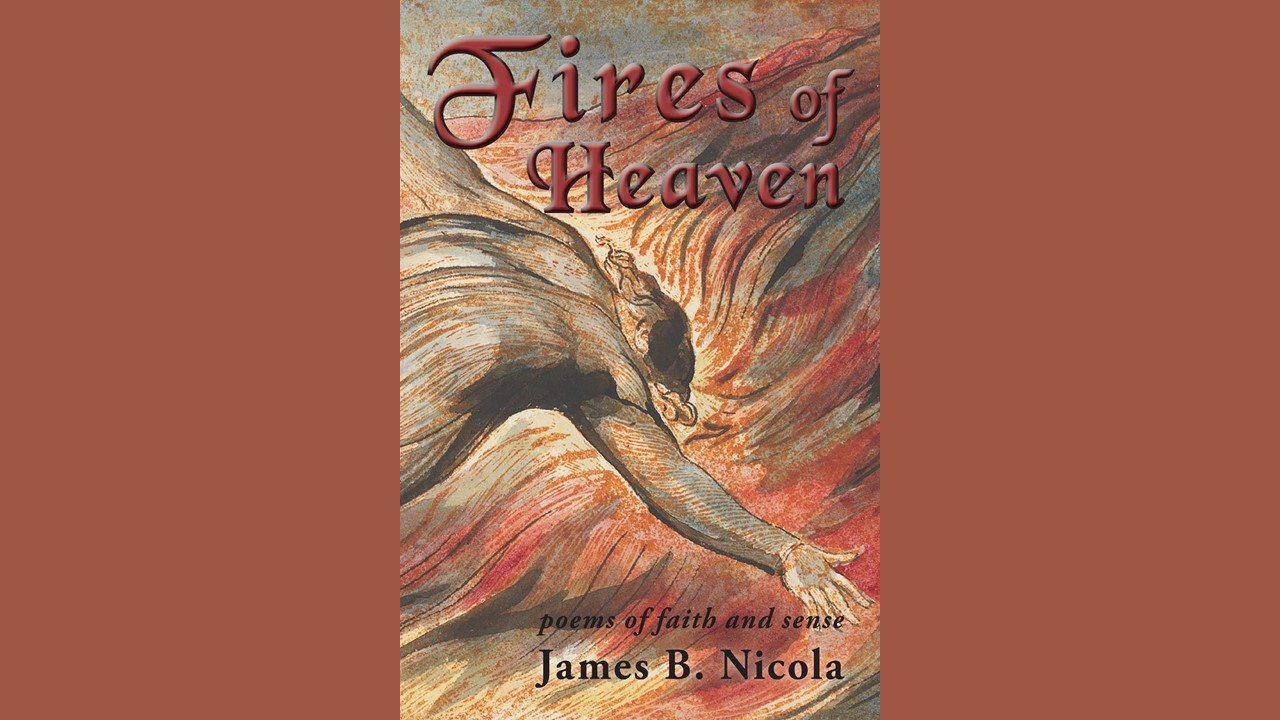
A Review of James B. Nicola’s ‘Fires of Heaven’

July 2, 2021
in Essays, Poetry, Poetry Reviews
A A
7
poems A Review of James B. Nicola's 'Fires of Heaven'

Fires of Heaven, published by Shanti Arts, 2020, can be purchased here.

by James Sale

James B. Nicola is one of America’s brightest poetry stars. His poetry is restless, searching, and soaring. There is, perhaps, no overarching “poetics,” except to the pragmatic, which works; in other words, Nicola is not a partisan free-verser or formalist poet exactly; he is able to switch from one form to formlessness with ease, and with varying degrees of success too. As I commented in my review of his last two books, “my own suspicion is that Nicola is someone who is not the best judge of his own best work”; instead, he gets it out. We have 105 poems in this collection but I could wish it were pruned a little more, since some of the poems seem really slight, and that detracts from the fact that many are magnificent.

As the title indicates, his primary concern is one of spirituality, his own, and he explores this within the context of the modern world. One of the epigraphs to the book is a quotation from Robert Francis: “…Some measure of faith is needed by us all. Pure doubt is death.” This seems to me to encapsulate the underlying dynamic of the whole collection; and furthermore, notice the phrase, “some measure.” There is a guardedness about Nicola’s attitude to faith—he wants it, but he simply can’t commit. He goes, therefore, as far as it is humanly possible to believing, yet without belief; and the yardstick which time and again comes back to haunt him is the exploration of his childhood when he did believe, but lost it.

The ambiguities of his attitude towards God are clearly seen even in the title of his poem, “Mixed Praise.” God is full of contradictions, as his first two lines indicate:

.

If God makes deluges and droughts,
I don’t think I can fathom God.

.

But the poem turns out to be not just about the twists and turns of God, but about love and the beloved:

.

But then you return, and I’m insane
with joy. And no hunger, drought,
or deluge can make me not praise God.

.

That’s a very powerful statement, indeed an extremely perceptive one too: what children have, what atheists tend to want to deny—namely, some aspect of the sheer riff of life that almost forces praise from us despite ourselves. The philosophers may deny it, but the true poet—James B. Nicola—has to acknowledge it, because … poets feel it.

One almost sublime poem, “One Time,” in the middle, picks up and explores this idea even further. Before commenting on content, it is worth mentioning it’s unique and unusual tripartite structure—not formal poetry exactly, but not free verse either. Mimetically, as ambivalent in form as his own attitude to the Creator. But having come across a “quaint cathedral,” and then a “city of the dead,” he finally encounters a “triple rainbow” which grabs his, and the “multitude’s” attention—the “work of someone other than man”—and from this awareness:

.

… my soul dropped down, unintentionally,
to my knees, then on all fours, and finally
prostate on the ground
as if in supplication
but with nothing more I could think of
to ask for.

.

This is deeply beautiful—a religion without a creed, an overwhelming sense of the mystery that Wordsworth, perhaps, alluded to. The language is simple, but entirely convincing, and the experience seems faithfully rendered. Nicola here is at his best.

As he is in poems like “Chimes,” which is worth quoting in full. His mastery is shown in the tight formal structure: the ballad form, the 4-3 iambic beat (though note the abrupt, because short, first foot in the final line) with perfect rhymes. Yet all so simple, natural and unforced:

.

No chimes, no choir, no mourning rites;
No marble twelve feet tall;
For me they’ll merely dim the lights
And silence may be all:

Or strike a rusted, tongueless bell
And crack it when I’m dead.
The pearly gates part just as well—
Better, some have said.

.

But he can be mischievous too, since he is prolific and so technically adroit; and so we range from the one word joke, or is that pun, in the title of “Heaven, Whateveritis,” to the four page deliberation in rhyming, iambic seven stress (heptameter) lines of “Exegesis on a Church Sign.” In the former case we realize that he is saying either:

.

Heaven, whatever it is, so we are not sure

.

Or

.

Heaven, whatever-itis, so it’s a human form of disease!

.

.In the latter case, we end with:

.

…. Though, since I hope it pleases,
The prosecutor’s guilty of an irony sublime:
To lure and then distract you, I’ve set the thing in rhyme.

.

Wonderful! This is of course a classic Sir Philip Sydney type of apology for poetry: ultimately, the entertainment precedes the learning and the poet unashamedly uses rhyme to achieve this effect. How glorious that somebody as contemporary and modern as Nicola rejoices in using rhyme— and uses it so effectively—and is not dismissive like some snooty post-modernist.

Nicola is a highly imaginative poet and there is so much technical ability displayed in this collection that nearly any other poet could learn much by scanning his verses. Given my early caveat that Nicola needs to prune more —sometimes his poems are too cerebral and excessive—nevertheless, this is a brilliant collection from a poet continually stretching himself, exploring new areas and dimensions of life, and with something important to say as he wrestles with the mystery. I strongly recommend this collection.

.

.
 

ShareTweetPin
The Society of Classical Poets does not endorse any views expressed in individual poems or commentary.
Read Our Comments Policy Here

RandomPoems

‘Don’t Get Caught’ and Other Poetry by C.B. Anderson
Beauty

‘Don’t Get Caught’ and Other Poetry by C.B. Anderson

April 1, 2020

  Don’t Get Caught The catfish and the trout hum different tunes, But both agree they love hot afternoons When...

‘Hide and Seek at the Bataclan’ by Elizabeth Boquet
Poetry

‘Hide and Seek at the Bataclan’ by Elizabeth Boquet

November 19, 2016

  Paris, 13 November 2015 The hiders: cheaters with suicide-belted access to ethereal hiding places — traceless but for grieving...

Next Post
Four Poems Possibly Written by Someone Else, by James A. Tweedie

Four Poems Possibly Written by Someone Else, by James A. Tweedie

‘Give It a Try’ by Amanda Hall

'Give It a Try' by Amanda Hall

A Poem for Independence Day, July 4th, 2021, by Roy E. Peterson

A Poem for Independence Day, July 4th, 2021, by Roy E. Peterson

Comments 7

  1. Julian D. Woodruff says:
    5 years ago

    Your review makes this sound like a very intriguing collection, James. Nicola would seem to sit on the cusp of belief (maybe a few doors down from the subjectivism of the famous hymn line “You ask me how I know He lives. He lives within my heart”); but I don’t get, in your review, the difference between his response to phenomena that seem to compel belief (e.g., the triple rainbow, which might be abstracted as beauty; a very different example might be seen in the adage “There are no atheists in the trenches”) and the will to believe. Is there any sense of the latter, or does the will hover in insignificance in the shadow of that triple rainbow?
    Thanks, in any case, for bringing Nicola and his work to our attention.

    Reply
    • James Sale says:
      5 years ago

      This is a great question, Julian, and one that I think only the poet can answer, for whilst the poetry reveals some things – as a fingerprint does – it may not include all that we wish to know (the size of his toe for example!). Furthermore, every human being has blind spots about themselves: as St Francis of Assisi said, ‘What you are looking for is what is looking’. The soul cannot see itself directly. Hence why we can so easily criticise others but fail to see our own failings. I have sent the review link to JBN and he may reply. Meanwhile, we can but speculate. Aldous Huxley once said an interesting thing about atheism, keeping in mind he was an adamant one himself: ‘Those who detect no meaning in the world generally do so because, for one reason or another, it suits their books that the world should be meaningless’. Clearly, the poetry of JBN does see meaning, does see beauty, as you observe, but the will fully sees that the ‘crucifixion’ of its old self requires such an inordinate sacrifice – and so it hesitates on the fringe, on the very brink. Remember what CS Lewis said after his conversion to Christianity? He was the most reluctant convert in Christendom! However, this may not be JBN’s reason or reasons: you will find some very negative religious, childhood experiences depicted in some of the poems.

      Reply
      • Julian D. Woodruff says:
        5 years ago

        Thanks, James. A lucid and learned reply.
        And NYC? Is there a future reading date there for you scheduled?

        Reply
    • James Sale says:
      5 years ago

      Thanks for this Julian. And since it is that day – happy Independence Day to all Americans, especially those reading the SCP pages! Regarding NYC, good question: Evan and I have agreed on the ‘theme’ for the show, but I need to confirm the date with him. I will try and do that this week so that we can give people as much notice as possible, as well as confirm a line-up of poets to read! All in hand, I would say. Hope to find you there!

      Reply
  2. Andrew Benson Brown says:
    5 years ago

    This seems like an interesting mix. Just ordered a copy! Will be excited to read it and, as you say James, educate myself by scanning the verses.

    Reply
  3. James Sale says:
    5 years ago

    I am sure that James B will be delighted Andrew! He is a very fine poet indeed, and as you like technical stuff, I am sure you will find plenty of meat here to consume! Next time I am in NY to do a live poetry reading, I hope James B will appear with me, as he did in Bryant Park in 2019; and who knows, perhaps Missouri’s most distinguished-to-be poet, Andrew Benson Brown, will join us? A consummation devoutly to be wished!

    Reply
    • Andrew Benson Brown says:
      5 years ago

      Ha ha, yes I will definitely be there! Hopefully sooner rather than later!

      Reply

Leave a Reply Cancel reply

Your email address will not be published. Required fields are marked *


  1. Jeffrey Essmann on ‘The Walking Wounded’: A Poem by Jeffrey EssmannOctober 15, 2026

    Thanks so much, everyone. I'm so glad the poem landed with you. As your comments confirm, this social disconnect--to put…

  2. Paul Freeman on ‘After-Action Report’: A Poem by Joseph S. SalemiOctober 15, 2026

    A vivid and well told military engagement from historical times we're beinning to forget. Thanks for preserving this event, Joseph,…

  3. Anna J. Arredondo on Poetry Challenge: Dictionary DelightsOctober 15, 2026

    Urszula and Roy, thanks for sharing your creations! Isn’t playing with words fun? As to the “rules”, Roy, in this…

  4. Joseph S. Salemi on ‘After-Action Report’: A Poem by Joseph S. SalemiOctober 14, 2026

    The event described in this poem occurred in 1967, when my friend "Melissa" was part of a clandestine CIA support…

  5. Margaret Coats on ‘The Mahjong Flowers’: A Set of Sonnets by Margaret CoatsOctober 14, 2026

    Thanks for your careful attention to several aspects of the whole bouquet, Bhikku Nyanasobhano. The rhyme schemes are four classic…

Subscribe to Daily Poems

Enter your email address to subscribe to this blog and receive notifications of new posts by email.

Join 1,661 other subscribers
No Result
View All Result

Resources

       1. A Guide to Writing Poetry

      2. The Best Poems of 2020      

      3. Poetry and Writing Contests

      4. Journals Accepting Formal Verse

Recent Poems

  • Poems by Derzhavin, Akhmatova, and Tyutchev, Translated by Kevin Rainbow
  • ‘After-Action Report’: A Poem by Joseph S. Salemi
  • ‘The Walking Wounded’: A Poem by Jeffrey Essmann
  • ‘Their Words, My Fault’ and Other Poems by Russel Winick
  • ‘Lazarus I’: A Poem by Jason Hunt
  • Poetry Challenge: Dictionary Delights
  • ‘In Defense of Rhyme’: An Essay by Euphrates Moss
  • ‘Gun Control’: A Poem by Kevin Ahern
  • ‘Power of a Pen’: A Poem by Janice Stanley
  • The Best Haiku of 2026
  • ‘One Night in Bangkok’ and Other Poetry by Brian Yapko
  • ‘Invocation’: A Poem by D.R. Rainbolt
  • ‘Enjoy the Peace, Prepare for War’: A Poem by Roy E. Peterson
  • Faust Part Two, Act One: ‘A Pleasant Landscape’ by Goethe, Translated by Josh Olson
  • A Song Inspired by Robert Frost’s ‘The Road Not Taken’, by Gunny Markefka
  • ‘Reappraisals of Mortality’: A Poem by C.B. Anderson
  • ‘What Is the Measure of My Days?’: A Poem by Peter Venable
  • ‘Polar Coordinates’: A Poem by Adam Sedia
  • ‘It Never Lies!’: A Poem by Paul A. Freeman
  • ‘The Mahjong Flowers’: A Set of Sonnets by Margaret Coats
  • ‘The Martyrdom of Saint Cassian’: A Poem by Joseph S. Salemi
  • ‘Mind Versus Beauty’: A Poem by Johann Wolfgang von Goethe, Translated by Eric v.d. Luft
  • ‘Summer Sails’: A Poem by Paulette Calasibetta
  • ‘Aquarius’: A Poem by Patricia Rogers Crozier
  • ‘No Body Here on Earth’: A Poem by Gerard Maritato
  • A Visualized Reading of The Odyssey: Book 1, Produced by Andrew Benson Brown
  • ‘Now?’ and Other Poetry by Stephen DiLauro
  • ‘From California to Louisiana’: A Sonnet by Mark F. DeWitt
  • ‘A Pot of Tea’ and Other Poetry by Samuel Gregg
  • Eight Riddles for the 2026 Mid-Autumn Festival, by Evan Mantyk

Categories

  • Acrostic
  • Alexandroid
  • Alliterative
  • Art
  • Best Poems
  • Blank Verse
  • Chant Royal
  • Classical Poets Live
  • Clerihew
  • Covid-19
  • Deconstructing Communism
  • Educational
  • Epic
  • Epigrams and Proverbs
  • Essays
    • Interviews with Poets
    • Poetry Reviews
  • Featured
  • From the Society
  • Great Poets
    • Dante Alighieri
    • Edgar Allan Poe
    • Emily Dickinson
    • Geoffrey Chaucer
    • Henry Wadsworth Longfellow
    • Homer
    • John Keats
    • John Milton
    • Robert Frost
    • William Blake
    • William Shakespeare
    • William Wordsworth
  • Human Rights in China
  • Limerick
  • Love Poems
  • Music
  • Pantoum
  • Performing Arts
  • Poetry
    • Beauty
    • Children's Poems
    • Culture
    • Ekphrastic
    • Found Poems
    • High School Poets
    • Humor
    • Riddles
  • Poetry Challenge
  • Poetry Contests
  • Poetry Forms
    • Curtal Sonnet
    • Haiku
  • Poetry Readings
  • Rhupunt
  • Rondeau
  • Rondeau Redoublé
  • Rondel
  • Rubaiyat
  • Sapphic Verse
  • Satire
  • Science
  • Sestina
  • Shape Poems
  • Short Stories
  • Song Lyrics
  • Sonnet
  • Symposium
  • Terrorism
  • Terza Rima
  • The Environment
  • Translation
  • Triolet
  • Video
  • Villanelle

Quick Links

  • About Us
  • Submit Poetry
  • Become a Member
  • Members List
  • Support the Society
  • Advertisement Placement
  • Comments Policy
  • Terms of Use

Welcome Back!

Login to your account below

Forgotten Password?

Retrieve your password

Please enter your username or email address to reset your password.

Log In
No Result
View All Result
  • Poems
    • Beauty
    • Culture
    • Satire
    • Humor
    • Children’s
    • Art
    • Ekphrastic
    • Epic
    • Epigrams and Proverbs
    • Human Rights in China
    • Music
    • Performing Arts
    • Riddles
    • Science
    • Song Lyrics
    • The Environment
    • The Raven
    • Found Poems
    • High School Poets
    • Terrorism
    • Covid-19
  • Poetry Forms
    • Sonnet
    • Haiku
    • Limerick
    • Villanelle
    • Rondeau
    • Pantoum
    • Sestina
    • Triolet
    • Acrostic
    • Alexandroid
    • Alliterative
    • Blank Verse
    • Chant Royal
    • Clerihew
    • Rhupunt
    • Rondeau Redoublé
    • Rondel
    • Rubaiyat
    • Sapphic Verse
    • Shape Poems
    • Terza Rima
  • Great Poets
    • Geoffrey Chaucer
    • Emily Dickinson
    • Homer
    • Henry Wadsworth Longfellow
    • Dante Alighieri
    • John Keats
    • John Milton
    • Edgar Allan Poe
    • William Shakespeare
    • William Wordsworth
    • William Blake
    • Robert Frost
  • Love Poems
  • Contests
  • SCP Academy
    • Educational
    • Teaching Classical Poetry—A Guide for Educators
    • Poetry Forms
    • The SCP Journal
    • Books

© 2025 SCP. WebDesign by CODEC Prime.