• Submit Poetry
  • Support SCP
  • About Us
  • Members
  • Join
Thursday, October 22, 2026
Society of Classical Poets
  • Poems
    • Beauty
    • Culture
    • Satire
    • Humor
    • Children’s
    • Art
    • Ekphrastic
    • Epic
    • Epigrams and Proverbs
    • Human Rights in China
    • Music
    • Performing Arts
    • Riddles
    • Science
    • Song Lyrics
    • The Environment
    • The Raven
    • Found Poems
    • High School Poets
    • Terrorism
    • Covid-19
  • Poetry Forms
    • Sonnet
    • Haiku
    • Limerick
    • Villanelle
    • Rondeau
    • Pantoum
    • Sestina
    • Triolet
    • Acrostic
    • Alexandroid
    • Alliterative
    • Blank Verse
    • Chant Royal
    • Clerihew
    • Rhupunt
    • Rondeau Redoublé
    • Rondel
    • Rubaiyat
    • Sapphic Verse
    • Shape Poems
    • Terza Rima
  • Great Poets
    • Geoffrey Chaucer
    • Emily Dickinson
    • Homer
    • Henry Wadsworth Longfellow
    • Dante Alighieri
    • John Keats
    • John Milton
    • Edgar Allan Poe
    • William Shakespeare
    • William Wordsworth
    • William Blake
    • Robert Frost
  • Love Poems
  • Contests
  • SCP Academy
    • Educational
    • Teaching Classical Poetry—A Guide for Educators
    • Poetry Forms
    • The SCP Journal
    • Books
No Result
View All Result
Society of Classical Poets
No Result
View All Result
Home Poetry Beauty

‘Snowshoeing on a Winter Morning’: A Poem by Paul Buchheit

January 28, 2026
in Beauty, Poetry, Sonnet
A A
16
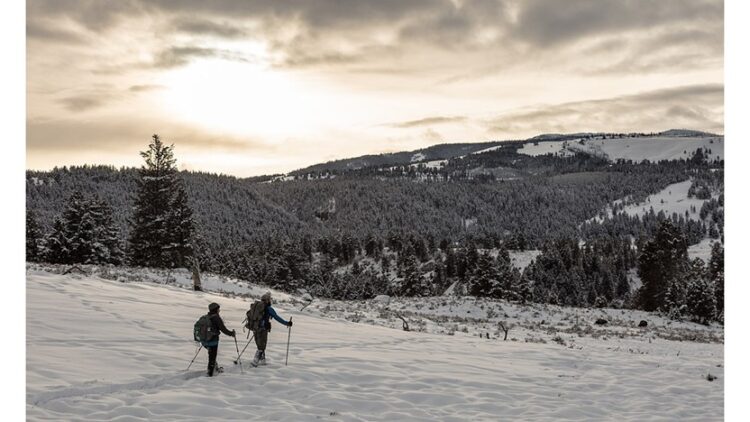
photo of people snowshoeing at Yellowstone (NPS/ Jacob W. Frank)

photo of people snowshoeing at Yellowstone (NPS/ Jacob W. Frank)


Snowshoeing on a Winter Morning

A silver flicker in the tangy pine
has stirred us: she, engulfed in puffery
of white, and I behind. The nightlong whine
of wolfish winds has carved a pageantry
of stony icescapes just beyond our womb
of crackling hearth. The pinkish blush of dawn
is on her skin; the smoky sweet perfume
of maple wafts and withers, here and gone.

She shoes ahead through rows of slumping pine,
their cotton boughs against the blue, like stairs
erected by a heavenly design.
She turns and smiles, and all the world declares
an instant of perfection in her eyes,
as pearly snowbanks sparkle in reprise.


Paul Buchheit is an author of books, poems, progressive essays, and scientific journal articles. He recently completed his first historical novel, 1871: Rivers on Fire.  His poetry has appeared in The Lyric, Illinois State Poetry Society, Poets & Patrons of Chicagoland, Maria W. Faust Sonnet Contest, Society of Classical Poets, and other publications.

ShareTweetPin
The Society of Classical Poets does not endorse any views expressed in individual poems or commentary.
Read Our Comments Policy Here

RandomPoems

Two Views of Sleep: Poetry by Martin Briggs
Culture

Two Views of Sleep: Poetry by Martin Briggs

September 1, 2025

. Hypnos Wraiths of twilight-conjured mist: At last, a prospect of release. Come child, keep our nightly tryst. To you,...

‘From the Tower’ by Francisco de Quevedo, Translated by Elwin Wirkala
Beauty

‘From the Tower’ by Francisco de Quevedo, Translated by Elwin Wirkala

February 25, 2022

. From the Tower by Francisco de Quevedo (1580-1645) | translated from Spanish by Elwin Wirkala Retired to these deserts...

Next Post
‘A Bit Player’: A Poem by Mary Jane Myers

'A Bit Player': A Poem by Mary Jane Myers

Epic of Gilgamesh I and II, Translated by Michael Curtis: Videos by Andrew Benson Brown

Epic of Gilgamesh I and II, Translated by Michael Curtis: Videos by Andrew Benson Brown

‘A Surviving Maduro Guard Speaks’: A Poem by Bruce Dale Wise

'A Surviving Maduro Guard Speaks': A Poem by Bruce Dale Wise

Comments 16

  1. Jeremiah Johnson says:
    9 months ago

    Paul, This has a wonderfully contemporary feel to it – nothing archaic in its style (and archaism, from personal experience, can be hard to resist when writing a formal sonnet). There are several lines in here to please the ear and the imagination. I’m definitely going to share this one with my students at the University of North Georgia.

    That, and you reminded me of a poem I wrote years ago about snowshoeing with my wife (it’s not nearly as well-crafted as yours, so humor me :-):

    Snowshoe Romance
    (Vancouver, B.C.)

    We both wander
    Through this cold mist,
    This winter solitude.

    And the evergreens
    Soar over our narrow path,
    Their boughs snow-laden.

    We are like children,
    Like Lucy and the faun
    With tongues out, tasting flakes.

    Awkward in our snowshoes;
    You bundled sweetly
    In red knee-length coat

    And your bright beanie,
    Posing funnily, arms spread
    And one leg stuck out.

    You stand on a bank
    And meet me face to face
    With warm, wet lips.

    In each others’ arms,
    We are not so childlike,
    Rubbing red noses together.

    Now we pry ourselves apart.
    You ‘twine your fingers
    With mine, we continue.

    6/13/2008

    Reply
    • Paul Buchheit says:
      9 months ago

      Jeremiah, thanks for your kind words! And I like your poem — it captures the scene nicely, with wonderful imagery.

      Reply
  2. Joseph S. Salemi says:
    9 months ago

    This is a beautiful sonnet, with diction and imagery perfectly fitted for a winter scene. All of it is neatly connected with the description of the woman who accompanies the speaker, and the adroit use of color (silver, white, pinkish blush, blue, pearly) seems to illuminate not just the landscape, but the woman herself. The octet is so intense that I’m glad the writer left a line space between it and the poem’s closure, where the volta carries the reader into a description of movement, and a focus on the woman’s beauty.

    I love the verb “shoes” — a perfect choice for the start of line 9. But all of the diction in this poem is as cool and fresh as the winter scene itself (“puffery of white,” “stony icescapes,” “cotton boughs,” “wafts and withers”).

    I have one question. The final couplet pairs “eyes” and “reprise” as a rhyme. I take the correct pronunciation of “reprise” to be reh-PREEZE. Now I am perfectly aware that poets have the license to use sight rhymes or near rhymes, rather than the usual phonic ones, and perhaps there are some places where “reprise” is pronounced reh-PRIZE. But the point I’m making is this — sight rhymes or near rhymes may occasionally be acceptable, but NOT in the final lines of a poem, especially in one like this where everything else runs as smoothly as a Swiss watch. The end of a poem is where the metrical and rhyming contract with the reader must be maintained without violation.

    I recall the opinion of the late poet Henry George Fischer, a very careful craftsman with language. He said “Using a sight rhyme at the closure of a poem is the literary equivalent of coitus interruptus — it’s deeply disappointing to everybody.”

    Reply
    • Paul Buchheit says:
      9 months ago

      Joe, thanks so much for your compliments and analysis. Much appreciated. As for ‘reprise,’ you’re right, and I appreciate your pointing it out. Since I like to consider myself a perfectionist, I will have to rethink that last line. Nobody likes ‘coitus interruptus.’

      Reply
  3. Paul A. Freeman says:
    9 months ago

    A sensory extravaganza with wonderful imagery!

    Thanks for the read, Paul.

    Reply
    • Paul Buchheit says:
      9 months ago

      Thanks for your kind words, Paul!

      Reply
  4. Roy Eugene Peterson says:
    9 months ago

    Beautiful love sonnet that inspires and uplifts the heart.

    Reply
    • Paul Buchheit says:
      9 months ago

      Thank you, Roy!

      Reply
  5. jd says:
    9 months ago

    A beautiful poem, Paul.
    “She” must love it.

    Reply
    • Paul Buchheit says:
      9 months ago

      Haha, thanks!

      Reply
  6. Margaret Coats says:
    9 months ago

    Paul, “Snowshoeing” sparkles splendidly, with all the beauties Joseph Salemi has analyzed. Unlike Joe, though, I failed to notice the rhyme discrepancy at the end. Agreed that the current authoritatively correct pronunciation is as in French, but I use the spoken word frequently, almost always referring to music, as I believe you intend here. It’s a magnificently meaningful ending. I and nearly all of my American interlocutors say re-PRIZE, while in British university circles I am more likely to hear re-PREEZE, or even RE-preeze. They know their French–whereas my musician friends of many nations in California are more attuned to English words like “disguise.” If we went way back to its French origins, we’d have to say “GHEEZE” but nobody does anymore. Probably, the spoken sound of “reprise” will naturally tend toward perfect rhyme with “eyes” and “disguise.”

    Joe is right about a perfect rhyme sound at the end of the poem, but despite the authorities we are already in the situation where “reprise” in global English has two possible pronunciations–and the “incorrect” one is understood and usually accepted without complaint. Thus SOME readers are sure to find your rhyme imperfect! Maybe you could revise and perfect the rhyme, but then would the meaning suit as well?

    Reply
    • Paul Buchheit says:
      9 months ago

      Thanks for that analysis, Margaret. Very informative and sensible. And I’m mainly thrilled that you enjoyed my poem!

      Reply
  7. Susan Jarvis Bryant says:
    9 months ago

    Ahh, the beauty… the musicality… the sensory appeal… the snow… the sparkle… Exquisite! What more could this sonnet lover ask for?! Paul, I thank you wholeheartedly.

    Reply
    • Paul Buchheit says:
      9 months ago

      Thanks so much, Susan. Your sweet words always make me feel like writing more sonnets!

      Reply
  8. Shamik Banerjee says:
    9 months ago

    In addition to the scenic magic of this sonnet, what intensifies it is the concluding couplet’s subtle demonstration of the lady’s unshaken confidence in her skill. I enjoyed this very much, Paul. Thanks for sharing.

    Reply
    • Paul Buchheit says:
      9 months ago

      Thanks, Shamik.

      Reply

Leave a Reply Cancel reply

Your email address will not be published. Required fields are marked *


  1. Roy Eugene Peterson on ‘Life Is Conflictual’: A Poem by Roy E. PetersonOctober 22, 2026

    How beautifully expressed are your comments, James! Thank you for sharing your salient perspectives and parallel conclusion.

  2. James Sale on ‘Life Is Conflictual’: A Poem by Roy E. PetersonOctober 22, 2026

    A thoughtful reflection on one of life's great paradoxes: that we often come to understand and value things through their…

  3. Alec Ream on ‘Every New Pantheon’: A Poem by C.B. AndersonOctober 22, 2026

    The beauty of this verse does not obscure the message. Thanks CB.

  4. Roy Eugene Peterson on ‘Life Is Conflictual’: A Poem by Roy E. PetersonOctober 21, 2026

    Yael, such amazing comments. Thank you.

  5. Roy Eugene Peterson on ‘Life Is Conflictual’: A Poem by Roy E. PetersonOctober 21, 2026

    Thank you, Paul, for your kind words.

Subscribe to Daily Poems

Enter your email address to subscribe to this blog and receive notifications of new posts by email.

Join 1,661 other subscribers
No Result
View All Result

Resources

       1. A Guide to Writing Poetry

      2. The Best Poems of 2020      

      3. Poetry and Writing Contests

      4. Journals Accepting Formal Verse

Recent Poems

  • ‘Foam’: A Poem by Josh Mitteldorf
  • ‘Again Autumnal’: A Poem by K.J. Salzmann
  • ‘Life Is Conflictual’: A Poem by Roy E. Peterson
  • ‘The Siege on Castle Hill’: A Poem by Apollo Clark Co
  • ‘Every New Pantheon’: A Poem by C.B. Anderson
  • ‘Biblical? Emblematic?’: A Poem by Stephen DiLauro
  • ‘The Valley’: A Poem by Briana Reavis
  • The Blobfish—‘Mr Blobby’: A Poem by Paul A. Freeman
  • ‘Nature’s Family’: A Poem by Margaret Coats
  • ‘The River & The Sea’: A Poem by Rohini Sunderam
  • Poems by Derzhavin, Akhmatova, and Tyutchev, Translated by Kevin Rainbow
  • ‘After-Action Report’: A Poem by Joseph S. Salemi
  • ‘The Walking Wounded’: A Poem by Jeffrey Essmann
  • ‘Their Words, My Fault’ and Other Poems by Russel Winick
  • ‘Lazarus I’: A Poem by Jason Hunt
  • Poetry Challenge: Dictionary Delights
  • ‘In Defense of Rhyme’: An Essay by Euphrates Moss
  • ‘Gun Control’: A Poem by Kevin Ahern
  • ‘Power of a Pen’: A Poem by Janice Stanley
  • The Best Haiku of 2026
  • ‘One Night in Bangkok’ and Other Poetry by Brian Yapko
  • ‘Invocation’: A Poem by D.R. Rainbolt
  • ‘Enjoy the Peace, Prepare for War’: A Poem by Roy E. Peterson
  • Faust Part Two, Act One: ‘A Pleasant Landscape’ by Goethe, Translated by Josh Olson
  • A Song Inspired by Robert Frost’s ‘The Road Not Taken’, by Gunny Markefka
  • ‘Reappraisals of Mortality’: A Poem by C.B. Anderson
  • ‘What Is the Measure of My Days?’: A Poem by Peter Venable
  • ‘Polar Coordinates’: A Poem by Adam Sedia
  • ‘It Never Lies!’: A Poem by Paul A. Freeman
  • ‘The Mahjong Flowers’: A Set of Sonnets by Margaret Coats

Categories

  • Acrostic
  • Alexandroid
  • Alliterative
  • Art
  • Best Poems
  • Blank Verse
  • Chant Royal
  • Classical Poets Live
  • Clerihew
  • Covid-19
  • Deconstructing Communism
  • Educational
  • Epic
  • Epigrams and Proverbs
  • Essays
    • Interviews with Poets
    • Poetry Reviews
  • Featured
  • From the Society
  • Great Poets
    • Dante Alighieri
    • Edgar Allan Poe
    • Emily Dickinson
    • Geoffrey Chaucer
    • Henry Wadsworth Longfellow
    • Homer
    • John Keats
    • John Milton
    • Robert Frost
    • William Blake
    • William Shakespeare
    • William Wordsworth
  • Human Rights in China
  • Limerick
  • Love Poems
  • Music
  • Pantoum
  • Performing Arts
  • Poetry
    • Beauty
    • Children's Poems
    • Culture
    • Ekphrastic
    • Found Poems
    • High School Poets
    • Humor
    • Riddles
  • Poetry Challenge
  • Poetry Contests
  • Poetry Forms
    • Curtal Sonnet
    • Haiku
  • Poetry Readings
  • Rhupunt
  • Rondeau
  • Rondeau Redoublé
  • Rondel
  • Rubaiyat
  • Sapphic Verse
  • Satire
  • Science
  • Sestina
  • Shape Poems
  • Short Stories
  • Song Lyrics
  • Sonnet
  • Symposium
  • Terrorism
  • Terza Rima
  • The Environment
  • Translation
  • Triolet
  • Video
  • Villanelle

Quick Links

  • About Us
  • Submit Poetry
  • Become a Member
  • Members List
  • Support the Society
  • Advertisement Placement
  • Comments Policy
  • Terms of Use

Welcome Back!

Login to your account below

Forgotten Password?

Retrieve your password

Please enter your username or email address to reset your password.

Log In
No Result
View All Result
  • Poems
    • Beauty
    • Culture
    • Satire
    • Humor
    • Children’s
    • Art
    • Ekphrastic
    • Epic
    • Epigrams and Proverbs
    • Human Rights in China
    • Music
    • Performing Arts
    • Riddles
    • Science
    • Song Lyrics
    • The Environment
    • The Raven
    • Found Poems
    • High School Poets
    • Terrorism
    • Covid-19
  • Poetry Forms
    • Sonnet
    • Haiku
    • Limerick
    • Villanelle
    • Rondeau
    • Pantoum
    • Sestina
    • Triolet
    • Acrostic
    • Alexandroid
    • Alliterative
    • Blank Verse
    • Chant Royal
    • Clerihew
    • Rhupunt
    • Rondeau Redoublé
    • Rondel
    • Rubaiyat
    • Sapphic Verse
    • Shape Poems
    • Terza Rima
  • Great Poets
    • Geoffrey Chaucer
    • Emily Dickinson
    • Homer
    • Henry Wadsworth Longfellow
    • Dante Alighieri
    • John Keats
    • John Milton
    • Edgar Allan Poe
    • William Shakespeare
    • William Wordsworth
    • William Blake
    • Robert Frost
  • Love Poems
  • Contests
  • SCP Academy
    • Educational
    • Teaching Classical Poetry—A Guide for Educators
    • Poetry Forms
    • The SCP Journal
    • Books

© 2025 SCP. WebDesign by CODEC Prime.