


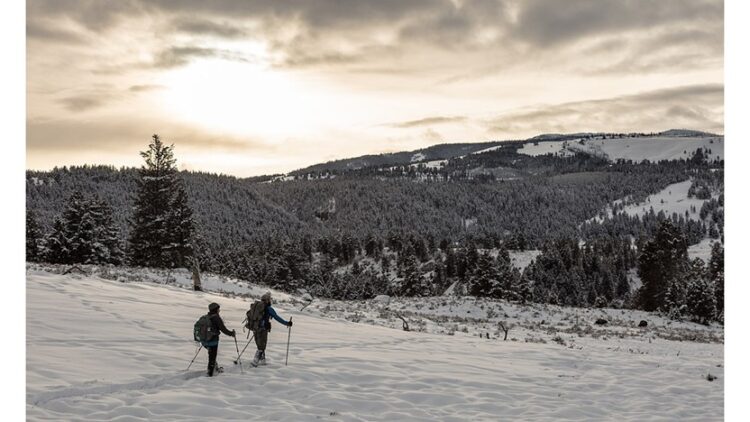
Snowshoeing on a Winter Morning
A silver flicker in the tangy pine
has stirred us: she, engulfed in puffery
of white, and I behind. The nightlong whine
of wolfish winds has carved a pageantry
of stony icescapes just beyond our womb
of crackling hearth. The pinkish blush of dawn
is on her skin; the smoky sweet perfume
of maple wafts and withers, here and gone.
She shoes ahead through rows of slumping pine,
their cotton boughs against the blue, like stairs
erected by a heavenly design.
She turns and smiles, and all the world declares
an instant of perfection in her eyes,
as pearly snowbanks sparkle in reprise.
Paul Buchheit is an author of books, poems, progressive essays, and scientific journal articles. He recently completed his first historical novel, 1871: Rivers on Fire. His poetry has appeared in The Lyric, Illinois State Poetry Society, Poets & Patrons of Chicagoland, Maria W. Faust Sonnet Contest, Society of Classical Poets, and other publications.

















Paul, This has a wonderfully contemporary feel to it – nothing archaic in its style (and archaism, from personal experience, can be hard to resist when writing a formal sonnet). There are several lines in here to please the ear and the imagination. I’m definitely going to share this one with my students at the University of North Georgia.
That, and you reminded me of a poem I wrote years ago about snowshoeing with my wife (it’s not nearly as well-crafted as yours, so humor me :-):
Snowshoe Romance
(Vancouver, B.C.)
We both wander
Through this cold mist,
This winter solitude.
And the evergreens
Soar over our narrow path,
Their boughs snow-laden.
We are like children,
Like Lucy and the faun
With tongues out, tasting flakes.
Awkward in our snowshoes;
You bundled sweetly
In red knee-length coat
And your bright beanie,
Posing funnily, arms spread
And one leg stuck out.
You stand on a bank
And meet me face to face
With warm, wet lips.
In each others’ arms,
We are not so childlike,
Rubbing red noses together.
Now we pry ourselves apart.
You ‘twine your fingers
With mine, we continue.
6/13/2008
Jeremiah, thanks for your kind words! And I like your poem — it captures the scene nicely, with wonderful imagery.
This is a beautiful sonnet, with diction and imagery perfectly fitted for a winter scene. All of it is neatly connected with the description of the woman who accompanies the speaker, and the adroit use of color (silver, white, pinkish blush, blue, pearly) seems to illuminate not just the landscape, but the woman herself. The octet is so intense that I’m glad the writer left a line space between it and the poem’s closure, where the volta carries the reader into a description of movement, and a focus on the woman’s beauty.
I love the verb “shoes” — a perfect choice for the start of line 9. But all of the diction in this poem is as cool and fresh as the winter scene itself (“puffery of white,” “stony icescapes,” “cotton boughs,” “wafts and withers”).
I have one question. The final couplet pairs “eyes” and “reprise” as a rhyme. I take the correct pronunciation of “reprise” to be reh-PREEZE. Now I am perfectly aware that poets have the license to use sight rhymes or near rhymes, rather than the usual phonic ones, and perhaps there are some places where “reprise” is pronounced reh-PRIZE. But the point I’m making is this — sight rhymes or near rhymes may occasionally be acceptable, but NOT in the final lines of a poem, especially in one like this where everything else runs as smoothly as a Swiss watch. The end of a poem is where the metrical and rhyming contract with the reader must be maintained without violation.
I recall the opinion of the late poet Henry George Fischer, a very careful craftsman with language. He said “Using a sight rhyme at the closure of a poem is the literary equivalent of coitus interruptus — it’s deeply disappointing to everybody.”
Joe, thanks so much for your compliments and analysis. Much appreciated. As for ‘reprise,’ you’re right, and I appreciate your pointing it out. Since I like to consider myself a perfectionist, I will have to rethink that last line. Nobody likes ‘coitus interruptus.’
A sensory extravaganza with wonderful imagery!
Thanks for the read, Paul.
Thanks for your kind words, Paul!
Beautiful love sonnet that inspires and uplifts the heart.
Thank you, Roy!
A beautiful poem, Paul.
“She” must love it.
Haha, thanks!
Paul, “Snowshoeing” sparkles splendidly, with all the beauties Joseph Salemi has analyzed. Unlike Joe, though, I failed to notice the rhyme discrepancy at the end. Agreed that the current authoritatively correct pronunciation is as in French, but I use the spoken word frequently, almost always referring to music, as I believe you intend here. It’s a magnificently meaningful ending. I and nearly all of my American interlocutors say re-PRIZE, while in British university circles I am more likely to hear re-PREEZE, or even RE-preeze. They know their French–whereas my musician friends of many nations in California are more attuned to English words like “disguise.” If we went way back to its French origins, we’d have to say “GHEEZE” but nobody does anymore. Probably, the spoken sound of “reprise” will naturally tend toward perfect rhyme with “eyes” and “disguise.”
Joe is right about a perfect rhyme sound at the end of the poem, but despite the authorities we are already in the situation where “reprise” in global English has two possible pronunciations–and the “incorrect” one is understood and usually accepted without complaint. Thus SOME readers are sure to find your rhyme imperfect! Maybe you could revise and perfect the rhyme, but then would the meaning suit as well?
Thanks for that analysis, Margaret. Very informative and sensible. And I’m mainly thrilled that you enjoyed my poem!
Ahh, the beauty… the musicality… the sensory appeal… the snow… the sparkle… Exquisite! What more could this sonnet lover ask for?! Paul, I thank you wholeheartedly.
Thanks so much, Susan. Your sweet words always make me feel like writing more sonnets!
In addition to the scenic magic of this sonnet, what intensifies it is the concluding couplet’s subtle demonstration of the lady’s unshaken confidence in her skill. I enjoyed this very much, Paul. Thanks for sharing.
Thanks, Shamik.