


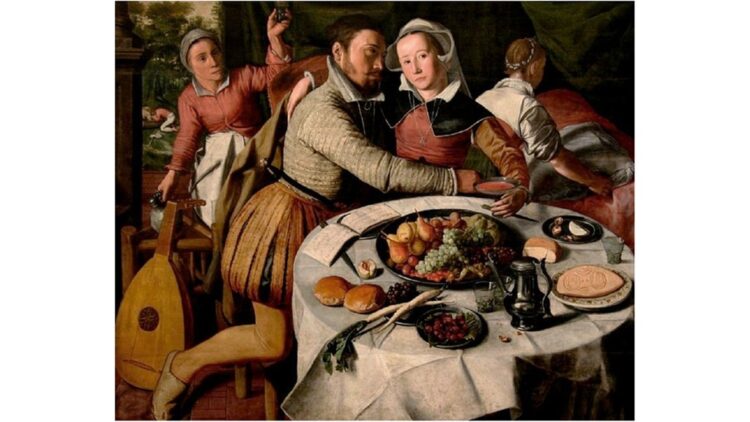
À la Carte
A crouton on a flaccid salad,
Your dinner date adds texture to
An otherwise anemic toss,
And with a tint not half so pallid
Promotes your lettucey appeal
To something more than total loss.
So drink the wine and thank the Father
For garnishing your evening hours
With parsley sprigs and other stuff
Without which few would ever bother
Imagining you’d fill their plate—
For, by yourself, you’re not enough.
Half a Loaf
A dog laps up exactly what it needs.
Most humans don’t know how to curb their drinking.
An animal’s selective when it feeds,
But people gravitate toward primal greeds
When actions supersede judicious thinking.
I showed my daughter how to shoot a gun,
Preparing her to join the autumn slaughter,
But she remembered nothing I had taught her
When trophy bucks stood steaming in the sun.
I eat to live, though once I lived to eat—
Ate far too much. I’d rather diet on
Green leaves and fruit and autolyze the brawn
I gained from lifting weights, than have to meet
With lawyers for the recently deceased.
What would I say? My health requires fresh lamb?
The burning bush instates all that I am
And bakes my bread, so nothing but the yeast
Is slain. By bread alone I feed the beast.
That’s hardly Christian. Still, if God is just,
There’s less at risk if I subsist on crust.
C.B. Anderson was the longtime gardener for the PBS television series, The Victory Garden. Hundreds of his poems have appeared in scores of print and electronic journals out of North America, Great Britain, Ireland, Austria, Australia and India. His collection, Mortal Soup and the Blue Yonder was published in 2013 by White Violet Press.
















Both witty bits of wisdom. I especially like the final lines of “Half a Loaf”.
Bon appétit, jd.
These are two highly complex and professionally crafted poems, the work of a long-lived and experienced poet who has a vise-like grip on the possibilities of language. In addition to these gifts, he has the capacity to turn a surface cynicism (typical of Kip Anderson) into real philosophical perception.
Each poem is ostensibly about food in some way. The first deals with salad and wine on a dinner date — presumably one where the subject is somehow dissatisfied with what is before him, even though it might be an expensive meal (ordered a la carte). The words “flaccid, anemic, pallid, and loss” all suggest that something is very wrong. The second stanza brings up a “Father” — possibly God, or maybe an actual male parent, either of whom could be thought of as providing the wherewithal for this fancy meal. And the last line is also ambiguous: “For, by yourself, you’re not enough.” That could be taken as a simple acknowledgment that the subject could not have afforded this meal without some kind of help, or as a suggestion that he is not alone at the table, and has a date with him. In either case, the dinner is definitely an emotional failure.
The second poem continues the theme in a different way. Here we get direct commentary and narrative — the speaker comments on the eating habits of animals and people, tells how he taught his daughter to shoot, discusses his diet, and alludes to “lawyers for the recently deceased,” which I take to mean medical doctors. When he say “My health requires fresh lamb,” it can be taken as a statement to doctors that he needs a meat diet regardless of their vegetarian advice, but it also suggests the religious idea that the speaker lives because of his beliefs, and that “the burning bush” (God) has made him, and provides the heat to bake his bread, killing only the yeast and therefore being acceptable to vegetarians. And yet Kip ends that stanza by saying “By bread alone I feed the beast,” which is an oblique allusion to Christ’s words to Satan on the mountaintop (“Man does not live by bread alone”).
The closing couplet is profoundly complex. The speaker describes his behavior as “hardly Christian.” But he guesses that a just God will not blame him for his choices, whether dietary, or on any other subject. We sense the solid independence of the speaker, and his complete confidence in his own choices, whether medical or philosophical or religious.
I am knocked over by these two pieces. They are the kind of complex, intricate, deeply troubling, and inquisitive poems that make the SCP a serious place.
K.A.N.D!
I am not unhappy that these poems can support various interpretations, Joseph, but let me disclose my own opinion on this matter. The first poem is about a person who is so bland and unprepossessing that he scarcely registers as a person to most onlookers, and needs to be accompanied by someone more charming and interesting to be noticed or recognized as a distinct entity. So have a drink and thank God He grants you even this.
The second poem does reflect a moral ambiguity (not necessarily one of my own) where we see the father’s wish to raise a stalwart daughter in conflict with her innate gentleness. Gentle people eat meat others have killed, some crazy people kill meat they refuse to eat, and then there are those nuts who won’t even touch leather. I (grow and) eat my vegetables, but that does not make me a vegetarian. And, dammit, when you eat meat you’d best appreciate where it comes from: there is no more sanctified food than a nice cut of well-raised meat. If animals actually had rights, there would be hordes of lawyers offering their services to the relatives of a slaughtered animal. You and I would be in deep trouble as willing accessories. Bread alone is certainly not enough, and that is why God gave us olive oil.
These are indeed both amazing poems, KIP. They call for multiple readings to really plumb the language, the imagery and the allusions. In other words, they are not just entertaining but provide real rewards. “A la Carte” made me smile. Ever since my undergrad days when I heard (with great puzzlement) Cleopatra talk about her “salad” days in Antony and Cleopatra I’ve been waiting for someone to make that peculiar phrasing modern-world literal.
“Half a Loaf” is fascinating for its complexity and density. And its theology. The casually-placed “I am” and the allusion to Deuteronomy’s “man does not live by bread alone” particularly intrigued me.
Hell, Brian, you and I both know that poetry needs to go for the throat, for otherwise it’s no more than a ruffle of feathers. I didn’t know Cleopatra, but I know her type. Though I like a good salad, a good salad is best served beside a nicely-seared Porterhouse steak. My supermarket of choice usually offers Porterhouse pork chops, if you’re into the “other” white meat. Theology is a necessary ingredient in any balanced regimen. What if someone were to say, “Man does not live by bread and jelly alone?”
C.B., both poems had me smiling broadly. I feel certain I should have been shedding a tear throughout half of “Half a Loaf” – and if so, I apologize. Your melodious flow has impressed me to the point that “autumn slaughter” sounds like civil seasonal entertainment, and “flaccid salad” sounds like the dish of the day. And as for “autolyze the brawn” – what a mellifluous attention grabber. In “À la Carte” I love the idea of the unadorned riding the rhinestone coattails of another in a no hat, borrowed cattle blaze. But my favorite is “Half a Loaf” – when it comes to appetites, moral clarity becomes a little hazy. I have a feeling hunger will always win in the end. C.B., thank you!
If you don’t have a sense of humor, you shouldn’t read any of my poems. You do, and you have done so, and that makes us even. Hunger only wins when there is no food to counter it. May you and I continue to be food for each other’s thought. No one has ever died from smiling too much, except at the hands of a very serious martinet. Let the feast continue!
The first line of À la Carte really lets us know what we’re in for – a less than sparkling, humorously handled dinner date.
Failed diets, overeating, an inability to moderate. In ‘Half a Loaf, the line ‘Most humans don’t know how to curb their drinking’ reminded me of a study that concluded overeating is a hereditary trait from Stone Age (not Stone ‘Ages’) man, who when he made a kill, would eat as much as possible since the food would otherwise rot and he wouldn’t know when he’d get his next meal.
In fact, lions do this. They eat until they’re bursting and can’t eat another thing. You can even go up toa lion in this stage of engorgement and smack it round the ear. It’ll do nothing – though I wouldn’t want to try this out myself.
Thanks for the engaging reads and a Sunday morning smile.
Your second paragraph, Paul, made me think of another reason to gorge on a fresh kill: there would be less weight to carry back to your cave. One time a doe, possibly fleeing coyotes, stumbled into our yard in the mountains of Arizona. It was so freaked out by our two dogs that it knocked down a gate post trying to escape. There was nothing for me to do bur shoot the damn thing. I cut large chunks of meat from the carcass and tossed them to the dogs, which they wolfed down insatiably. Once the dogs’ bellies were fully distended I gave it up, but they would probably have kept on eating until it killed them.
“A la Carte” is interesting, it turns the metaphor on both the speaker and the listener to offer advice on humility. The croutons and salad metaphor is interesting, a bit of a feint as to where the poem truly goes.
“Half a Loaf” is rich, in the sense of a gourmet dinner (to pick up your food analogies). It is so laden with allusion and pun that I still have to go through it to appreciate it fully. It is also the first poem I think I’ve read that uses “autolyze.” The stanza about teaching your daughter to shoot a gun is masterful, and drew a smile from me. “You can lead a horse to water …”
Your coment, Adam, is also very interesting, in so many ways I can’t spare the week it would take to address them all. I didn’t understand “[I]t turns the metaphor on both….” in your first paragraph, but let that go.
In a sense, writing a poem is a kind of autolysis a writer undertakes at the expense of his/her memories, feelings and ideals. Have you ever seen a healthy six-point buck steaming in the morning sun? It’s a real thing, and it’s something you wouldn’t want to kill unless you really needed to. Horses aren’t that smart, but they’re not that stupid either. They know when they need to drink. Inside the crown of my Stetson is an image of a cowboy watering his horse with that precious liquid contained in his hat. Horses love a nice apple.
A dog laps up exactly what it needs.
Most humans don’t know how to curb their drinking. – very, very apothegmatic, and grounded, which is the very impressive strength of this work.
Well, James, a poet takes in whatever the poet needs and tries mightily to see that what comes out does not look like projectile vomiting. Some days I see poetry as the endless reiteration of stock ideas an phrases. Escaping the past is nearly impossible, and it’s not clear that we were ever meant to do so. Making it true is better than making it new.
Well, the first one is just how I feel… without Susan!
Now the second… I’m still trying to figure it out. That’s a good thing.
You, Mike, are the first to understand what the first poem is really about. I’m fairly sure that Susan does not underestimate you any more than most of us here on this site do. As for the second poem, I’m still trying to figure it out myself. Ethics is a bitch.