


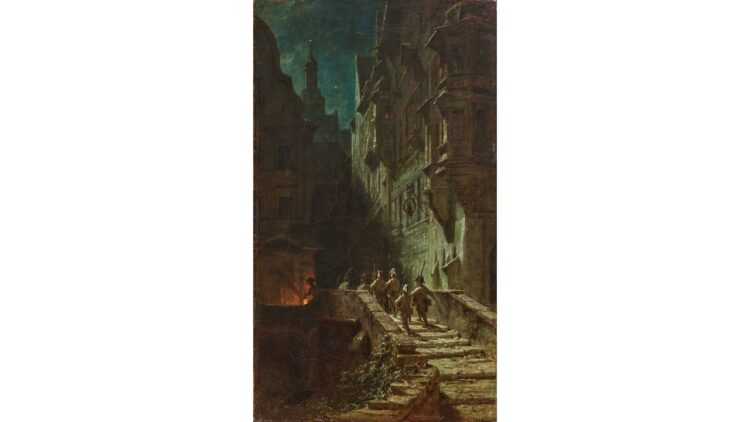
Faust Foresees His End
Now, as holy darkness falls
And curfew reigns within the walls,
To each gatehouse troops a guard.
Behind their doorways locked and barred,
Where warm domestic shadows creep
Men take themselves to honest sleep.
The wakeman sets off on his rounds;
Down cobbled ways his footfall sounds,
And as his lantern’s womb of light
Belies the menace of the night,
From high within Sankt Jakob’s tower
The tenor tolls the eleventh hour.
Deserted by the populace,
The town lies still and fathomless.
A fountain whispers in the street.
The wakeman’s lonely steps retreat.
At last the silence is complete.
I frown, and shiver, as a breeze
Agitates the tapestries.
The shutters rattle gently, once.
Surrendering to somnolence
I rest my eyes, desert the fray
Where pedagogic folly strays
Down dark dead-ends of speculation,
Theory and obfuscation.
Weariness brings no release:
Hostage to a strange unease,
Some unknown horror stirs in me,
Whispering insidiously.
The candle’s halo falters, flutters
In the draught. Old, cast-off, cluttered,
Once-respected disciplines—
Rhetoric, quack medicine,
Astrology, theosophy—
Dense pages of dishonesty
Transcribed in monkish ignorance,
Triumphs of inconsequence,
Riffle in strange gusts of air.
On priceless volumes, frail and rare,
I lay my head, too tired to care.
Embers settle on the fire,
Casting vaulted shadows higher.
Why tax oneself with dead men’s thoughts
And what misguided scholars taught
In vanished tongues? Let other brains
Go delving into printed plains
Of wasted words professing proof
And tiresome travesties of truth;
Let them argue life away,
Let them syllogise, display
The wisdom of a flock of sheep.
I sink into a final sleep.
The failing candle gutters low.
Cold stars advance, immensely slow
Across the sky. I dream below.
Resurgent flames start up and flare,
Redden with infernal glare
And heat enough to suffocate;
But not a sound. I do not wake.
Sankt Jakob starts to tell the hour.
The blaze attains ferocious power,
And from beneath the hearthstone slides
Arachne’s lord, a handspan wide.
A blot of blackness, round the wall
Unhurried but intent he crawls,
Pausing to investigate
Novelties that fascinate:
A thighbone of the Minotaur,
Crucibles of silver ore,
A mounted screech-owl with two heads,
Fairies in amber, harpies’ eggs;
A map of Thule; fossils, gems,
Symbols, formulae and charms;
Poisonous herbs; the unicorn
Of far Cathay, precisely drawn.
A globe of crystal magnifies
His six unblinking wine-red eyes
As, blind to anything amiss,
Unconscious of my nemesis,
I tread the brink of death’s abyss.
Midnight strikes. With one swift leap
He lights before me where I sleep,
Prompt to collect the debt I owe.
Sprawled prone across a folio,
Within my dream I wait for him
As, scaffolded on frightful limbs,
In nightmarish companionship
He inches to my fingertip
Then bites, but scarcely wounds the skin.
Oblivious of the tender sting,
I do not feel the venom flow,
Nor waken as my heartbeat slows.
For four and twenty years our pact
Has led me to this final act:
Executed more than killed,
Insight blinded, reason stilled,
High ambitions unfulfilled.
*
A warm bouquet of amber beams
Sheds grateful gladness on a stream
Of townsfolk bound for early Mass
Chattering, laughing, as they pass.
Above, behind a sunless gable
Sprawls a corpse across a table,
Victim of its own booklore.
The codices strewn on the floor,
The stillness of the shuttered gloom,
The lingering evil in the room,
The ashes cold and candle spent,
Seemed never so malevolent.
Pinned to the door, a testament:
“Pray for one whose night is due.
To falsehood only was he true.
Exiled from the state of grace,
Ashamed to meet his Saviour’s face,
He dreads the fires of righteousness.
Hear me, heed me: I confess.
The soul is God’s gift. I sold mine
To sound the depths of His design.
Perpetual Godlessness the price:
How paltry seemed that sacrifice
For a quarter-century’s
Lease of Mephistopheles!
Now, fruits of knowledge still untasted,
I languish here where, damned and wasted,
Ologies and isms spell
Not promised heaven but present hell.
For all eternity I’m cursed
To haunt a bookish universe
No wily sophistry unlocks;
Condemned to act the paradox
Of learning more yet knowing less,
Of living more yet being less.
The irony is limitless.”
Martin Briggs lives in Suffolk, England. He only began writing in earnest after retiring from a career in public administration, since when he has been published in various publications on both sides of the Atlantic.













Martin, you far surpass John Milton and other great poets of the past in this marvelous rendition that is simultaneously provocative, evocative, and captivating. Your magnificent vocabulary includes amazing words with deep meanings, rarified usage and creative instincts. I could taste the sensory images and flavors of phases beguiling and virtually overwhelming. This tour de force should be accorded gem-like status and become one of those seminal poems to be given superior status by future historians.
Roy, I can’t decide whether your comments are generous or extravagant – but thank you!
This is quite a tale, and the tetrameter rhyming couplets make it very readable despite its length. I take this to be more likely the Faustus of Marlowe rather the Faust of Goethe, since there is no mention of Gretchen.
The first stanza is an amazing evocation of night and darkness and silence. We don’t get a clear indication that this is a dramatic monologue until the second section, when the first-person pronoun is used. In this stanza (and the third) the emphasis is on bookish learning, rather than any of the other things Faustus got by selling his soul: money, status, women, reputation. He finds the learning “folly, speculation, theory, obfuscation.”
The fourth stanza is amazing — all of a sudden we get “resurgent flames,” the coming of a frightening black spider (“Arachne’s Lord”) as a messenger of Hell, or perhaps Satan himself, and nine lines of a traditional “catalogue section” wherein a list of strange objects is presented. I love such lists, and I wish more poets would write them.
The fifth stanza finds Faustus bitten fatally by the spider, and this is followed by morning, and the finding of a testament of penitence (too late, of course) given as a warning to the living. It asks for prayers, but it is clear that no prayer will be of any use at this point. The soul of Faustus is condemned to a “bookish universe,” a useless simulacrum of the life he had chosen.
The Faust legend is a fertile source for literary creation. There is something in the tale that appeals irresistibly to the Western mind.
Yes, Joseph, it is rather long. But thanks for sticking with it, and for your appreciation.
Arachne, Thule, Minotaur, Cathay… I imagined the diegesis of a character from Sinbad’s voyages—the claymation creatures of my childhood, in their otherworldly shapes, moving in stuttering motions toward my fear-wracked body. Thankfully, it was Faust, not I.
Well, I’m glad it had some sort of impact!
This was so enjoyable to read Martin. As someone who knew nothing about the story of Faust, I found it so interesting and entertaining, that I didn’t even notice how long it was.
Thank you Norma. There’s no authoritative version of the Faust legend, so this is just yet another re-imagining of it. But I’m pleased if it interested you.
This poem truly mesmerized me. I love the way you’ve bookended the first-person narrative, with the first stanza laying out the scenery and quiet action of nighttime around where Faust is, and the penultimate stanza portraying the daytime scenery and people. You’ve told this story beautifully, with some very original rhymes, amazing phrases such as “Ologies and isms”, and lovely alliterations such as “wasted words professing proof “and “tiresome travesties of truth”. Thank you for the pleasurable read!
You’ve picked up on the internal contrasts I hoped might be effective, Cynthia; so thank you for reading and for taking the time to comment.
Martin, this admirably crafted poem gallops along so smoothly that it carried me through magnificent poetic territory, sweeping me up in its vivid imagery and thoroughly engaging me. I was particularly taken with “The candle’s halo falters, flutters / In the draught,” which seems to mirror Faust’s own doubts and the fragility of his intellectual “light”—a subtle and effective touch that deepens the poem’s atmosphere. Thank you!
Thank you, Susan, for your sensitive response to my piece. I value and appreciate your thoughts.
Martin, I think I must’ve missed the day they covered Faust, but this made up for it. For some reason this perfectly executed poem feels like a hybrid of Poe and Ecclesiastes! Great stuff.
The Poe analogy had not occurred to me, and is interesting. Thanks Mike.
Martin, as you say to Norma Pain above, there is no authoritative version of the Faust legend; you may and do re-imagine as you like. Although you very effectively imagine a time and place like those associated with classic Faust tales of the past, it is distinctly possible to read your work as a twenty-first century Faust. For this reason, I agree with Roy Peterson on its status as seminal. And indeed, contemporary reading supplies meaningful touches of what we might call “gallows humour.”
The deceased is a willing suicide, in both physical and spiritual senses. He is postmodern man making no struggle with any lingering effects of Christian civilization. The time of death is planned; the pact of selling the soul is consciously confirmed as the moment approaches; the mode of death looks suspiciously “medically assisted.” It’s a lethal injection.
What is more contemporary than the idea of death with no physical agony as “sinking into a final sleep,” except possibly the overweening pride of “No Regrets”?
The 21st century Faust does not believe in God or Satan; neither plays a role. The man is his own god, as indeed so many insist on moral autonomy and personal interpretation of all standards. There is no demon present, only a material spider.
Your Faust is a materialist with an extensive collection of material objects suited to his tastes (in wealthy contemporary societies, even the poor have such inventories).
He sold his soul to intellectual ambition, if anything. It’s unfulfilled in the sense of being abandoned, partly due to his developing disdain for all learning. And let’s acknowledge that when a man does desire learning, no one and no books can give it to him, even at the price of his soul. He has to use his mind. Therefore your Faust, Martin, differs from the classic Faust who wanted esoteric learning in order to possess power. Your list of books includes reputed esoterica, but the library catalogue vaguely sounds like the good and the bad of Western civilization preserved by scribes of “monkish ignorance.” And isn’t this exactly the knowledge contemporary man finds beneath him?
Instead of an emotional outburst at the end of life, you give us a suicide note, reminiscent of a manifesto left by an assassin who expects not to survive the criminal attempt.
Both suicide manifesto and dramatic monologue are difficult to read as realistic and sincere. Your Faust’s final words are, “Irony is limitless.”
Margaret, I am astonished and (stupidly) flattered by the amount of thought my little nightmare seems to have provoked in you. Much of what you say never entered my head when writing it; and, though you have taken any meaning several steps further than I intended, I certainly wouldn’t argue with any of your observations. A classic example of the reader getting more out of something than the writer put into it. Thank you for a truly interesting response, and for your time in expounding it.
All the praise this poem has received so far is well founded.
Striking and challenging – to never give up with God, and to keep dusting oneself off, donning a grim smile, making application of truth and love, and reapplying oneself to the cause of the glory, pleasure (I will not say whim, but I owe Him for redeeming mine – I am spoiled) of Jesus the Son of God.