


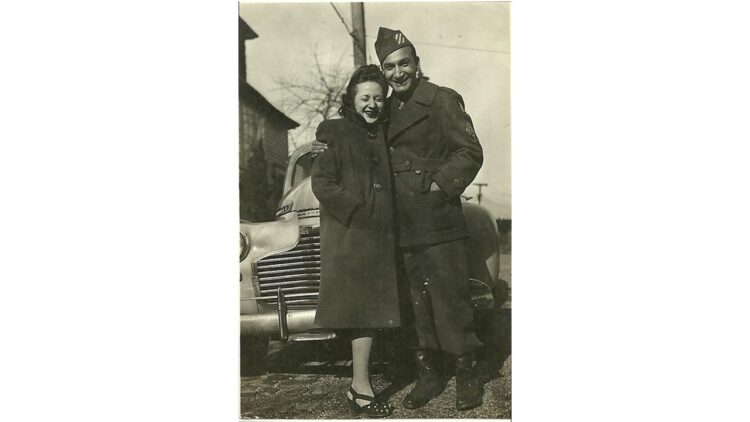
On An Old Photograph
It was late fall of 1944.
Dad was back from Italy, on leave,
When no one dreamt the Bulge would soon explode,
Or that an A-bomb waited in the works,
Or that a world was crumbling while they smiled,
Sure that the war would wind down before Yule.
They both seemed cold, wrapped up in heavy coats,
Their hands inside the pockets, and with smiles
A bit on edge from autumn’s pressing breeze
Here on a street in Woodside, by the house
Of Nonno—just a small, secluded turn
Curving off the main road to create
An island of sequestered calm and quiet.
My father wore his combat boots. For years
We kept them in the closet, by the hall,
Ready for winter weather, when it snowed.
By ’65 they fell apart, unseamed
With heavy use, and days of sleet and rain.
At twenty-nine and thirty-one, betrothed,
They had to wait till 1947—
So long did war and trouble postpone life:
My dad in that unlucky jeep that hit
A German mine, and he alone survived
To come back home again, and then to marry—
Was it not fated that the church should be
Our Blessèd Lady of the Seven Sorrows?
Poet’s Note
The photograph that illustrates this poem is of my mother (Liberty Previti) and my father (Salvatore Salemi) in the fall of 1944, when my father had been granted a short furlough to return to the States. At that time he was an interrogator of POWs in the Third Infantry Division’s G-2 section. The striped patch on his forage cap is the divisional emblem of that unit.
The photo was taken in Woodside (Queens County), on the street in front of the home of my father’s parents. The spot is called “58th Place,” and is a quiet and secluded angle close to Calvary Cemetery.
Nonno: “Grandfather” in Italian. This is the name by which I addressed my paternal grandfather.
German mine: My father was badly wounded in 1945 when the jeep in which he and some other soldiers were riding hit a land mine. He was the only survivor.
Our Blessèd Lady of the Seven Sorrows: This is the name of the church in which my parents were married on May 4, 1947.
Joseph S. Salemi has published five books of poetry, and his poems, translations and scholarly articles have appeared in over one hundred publications world-wide. He is the editor of the literary magazine TRINACRIA and writes for Expansive Poetry On-line. He teaches in the Department of Humanities at New York University and in the Department of Classical Languages at Hunter College.









Thank you, Joseph, for this poignant and sensitive family recollection. I was somehow especially touched by your third verse. I remember that when I was a boy in the 1960s many items (both unused and used) of wartime kit, including greatcoats, rucksacks, metal water bottles and even gas masks, were still freely available to buy from the Army & Navy Stores in the UK. When he visited us, my uncle still carried the sandy-coloured rucksack he must have had when he served in North Africa. How precious your family memories must be to you! Best wishes, Bruce
Many thanks, Bruce. I also recall the Army-Navy stores that were everywhere in the 1950s and 60s. You could get plenty of surplus equipment, including weapons like bayonets and rifles! So much equipment had been produced during World War II that a lot of it was still in military quartermaster’s storage during the Vietnam War, and was being issued to soldiers in that conflict.
A beautifully compressed expression of the dramatic happenings these years, from ‘44 to ‘47, and of this time in your family’s history, as well as of how much is in a photograph. And of course you’ve done it without sounding maudlin, though you’ve expressed your deep love for your family.
Thank you, Cynthia. My brother Rosario re-discovered the photo recently, along with many others pertaining to the war years.
Joseph, personal poems with historical insights are something of which we need to see more on SCP. Not only do we need to keep such experiences in our own memories, we need to share them with others to keep them alive in public consciousness. FYI: I commanded the 5th MI Company/18th MI Battalion/66th MI Group in Munich which was the remaining European interrogation unit with the term adjusted to “debriefing” for civilian purposes. We were responsible for “debriefing” defectors and legal migrants from the Soviet Union and all Eastern European countries and reporting them to the Army, CIA, and any other interested parties who had provided us with Intelligence Collection Requirements (ICRs). I feel so much closer to you because of your sharing this personal information.
Roy, thank you for these very kind words. I deeply appreciate them.
I think you are perfectly situated to write a great number of personal poems about your military and intelligence-gathering experiences. Many of these experiences must have been exciting, or even harrowing! If you don’t mind the suggestion, I’d advise you to try using iambic pentameter blank verse. When you are unconstrained by rhyme, you can say whatever you want to say without complications or difficulty, and this is a tremendous advantage when you need to express deep personal feelings, or if you need to stick to the strict facts of an event. I know that you don’t favor unrhymed poems, but I think if you tried doing this you might discover that the door will open up for composing many excellent poems about your unique experiences in the military.
Thank you for the advice, Joseph. I have a lot of personal military poems of historical value in my books but all in rhyming verse. I also have written some books about my military intelligence experiences. I did have one short one about Vietnam, the one about one of my military attaché experiences in the Soviet Union about “American Espionage and the Soviet Target,” the one about the Panama Plan, and the one about the Leicester Square Concert published by SCP. Most of my military poems are written in heptameter, since longer verses seem to work better for me using military materials. I did promise to provide another one on Vietnam (“My South Vietnam Vacation”) in a comment and am thinking about sending it shortly. Thank you for the kind comments, the valued advice, and for writing such an inspiring poem.
I’ve come to think that old photographs and letters are treasures–means by which the past permeates and enriches the present. It seems this photo did prompt reflections for you, followed by the inclination to write this poem. I’m glad you did, as you capably relate the fortunes and misfortunes of life. That world was real and full of feelings and incidents which were to influence you up to the present day. Connections matter. I see you had no need for extravagant language, the narrative in calm blank verse being enough to engage the reader. It’s the elemental power of story, perhaps. And yes, it does seem that war and trouble and other sorrows are fated–or at least likely in this world–but so is a memorable life if lived with conviction. Thanks for the illuminating glimpse of history.
Many thanks, Bhikkhu. I did choose simple blank verse for this, so as to let no rhetoric intervene between my feelings and the subject. As you say, the poem prompted reflections in me that were intense, and heightened language would not suit them.
I think that the invention of photography marked a major change in human perception of the past. Without it we only had untrustworthy memory, prejudiced texts, idealized portraiture, and dreamy nostalgia. But a photograph gives you unvarnished truth, as visible now as it was when the events transpired. I am frequently struck — nay, shocked! — when an old photograph shows me how wrong I was about a time or a place or a person’s appearance.
Joe, what a lovely, beaming picture and what a privilege it is to read about your remarkable parents in this poem. The first thing that strikes me about this poem is its plain language. It has a memorial quality that speaks with clarity and reverence. It captures a slice of history where ordinary people survived extraordinary danger and made a life together. The closing couplet says it all, succinctly and perfectly. This poem tugged at my heart and reminded me of my own grandparent’s journey during and just after WWII. For me, the wonder of this poem is that there is no overspill of emotion, and yet tears have welled in my eyes. A quiet and raw honesty pulses between the lines and tells me that sometimes less is more. Joe, thank you!
Susan, I am deeply grateful for your comments. This is a very recent poem — I only composed it about three weeks ago. Evan was kind enough to publish it on my parents’ anniversary.
It practically wrote itself, and I did almost nothing to change it, just leaving the blank verse to speak unhindered by any artifice. When you say “ordinary people surviving extraordinary danger” it hits me very hard, because you touch on a truth that I knew from early childhood: the adults around me had lived through a cataclysm, and all of them had been scarred by it in some way.
This poem is like a time capsule, a remembrance and a love letter to your folks.
I enjoyed the understated tenderness of it… didn’t miss the rhyme.
Mike, when this piece came to me I wouldn’t have dreamed of using rhyme. As Susan says, less is sometimes more.
I am so moved by this piece, Mr. Salemi. Old stories of love and WW2 have always been a wonderful combination and this poem exemplifies it. Love the story-telling and simple language. Thanks for sharing this gold with us.
Thank you for your comments, Shamik. I am very glad that the poem is pleasing to you. I was very happy to see this old photograph, and to honor the memory of my parents.
Joseph, annotating the photograph with a poem makes a fine signature tribute to your parents. There is much that a family member may know of place and circumstances, which will be lost after a generation or two. You pack a lot into 26 lines. I feel I hardly need the notes, though they do give the full names, and further information to create a middle distance and long view that’s missing in the photo itself. Enjoyed the smiles!
Thank you for your kind words, Margaret. I normally hesitate about adding notes to a completed poem (I agree with Adam Sedia that in a good poem they should be unnecessary). We often add notes here at the SCP because we are a teaching site, and notes can be very useful to those who are newcomers to the world of poetry. But in this case I was faced with a dilemma — the poem is purely the product of my reaction to a photograph, and I wanted my reaction to be simple and unrhetorical. This made some notation essential.
This is just such a beautiful tribute to accompany a beautiful photograph. They may be standing in the freezing cold but their warmth shines through.
Thank you very much, Maria. And yes — the poem is a mere accompaniment to the photo itself. When you say that warmth shines through the freezing cold, you’ve discovered a hidden metaphor in the piece: human warmth pulsating in the midst of the inhuman cold of a world war is what this photo celebrates.
Yes I understand and now I see how important the metaphor is. To survive physically is one thing , to survive spiritually is another. They are very special . I am so glad your father survived.
What a wonderful, loving poem this is, Joe! Using blank verse for this piece was exactly the right choice because it offers an intimacy and freedom of expression that would actually be diminished by rhyme. This is one of the key aspects of the use of blank verse and it is useful for readers to understand what is both lost and gained by the choice. There are stories or arguments or observations in which the element of rhyme actually becomes a distraction. Rhyme can bespeak intellectual force. But it can also bespeak artificiality or the sing-song patter of the nursery. It can impart musicality and it can serve well as a mnemonic to make a piece more memorable. And rhyme can offer a dimension of intellectual force to a piece which may serve a character — especially one who is clever or devious. But rhyme can also be a distancing factor which diminishes clarity or directness. It can sound forced. It is the difference between rhyming “I look at you and feel great love/Much greater than the sky above” versus simply saying “I love you and I always will.” Both versions of “I love you” are valid and have their own power. But if you want to really speak from the heart, the simple “I love you and I always will” – at least in my mind – carries more power. Yes, it is more taciturn. But sometimes that is what exactly called for – especially when feelings run too deep for rhyme. That is the time when rhyme becomes inorganic and artificial. It runs the risk of becoming performative rather than authentic.
It is that power of directness and intimacy which you bring to this piece. I simply love this poem which honors your dear parents and which further captures – with utmost skill and sensitivity – a moment both in your family history as a microcosm of monumental events taking place in the world. It is interesting to note that your use of language is generally spartan rather than lavish – almost journalistic. But when we read the lines, the love is clearly there. Details of observation rather than sentimental, effusive emotional. And it is the small details that really make this poem work — the boots, the cold, the story of the jeep – give the poem a strong sense of place. The deep spiritual import you give to the commitment and wedding of your parents is well-captured in your reference to the Church of the Blessed Lady of Seven Sorrows. Your respect and love is clear from this deeply telling detail with which you chose to end the piece.
I note that yesterday was your mother and father’s 79th anniversary. They can rest peacefully and proudly knowing that they have a son who remembers and honors them. Well done indeed, Joe.
Brian, I can’t thank you enough for these words of appreciation. I wanted the poem to be intimate and personal — not my usual style, to be sure — and the poem’s words came to me as if in a dream, by dictation. That’s normally the sign that a force beyond the individual is at work.
Your comments on the pros and cons of rhyme touch on a subject that troubled English poets during the Renaissance. Because so many poets had been trained in Latin and the Roman poets, some of them believed that rhyme was a barbarous medieval invention unsuited to the tasks of “serious” poetry. Gabriel Harvey and others tried to invent a new system of quantitative syllabification in English to allow poets to write English verse modeled on Greek and Latin poetry, omitting rhyme totally. It was a complete flop — first because the poetry produced in that manner was utterly awful, and second because rhyme had become so deeply rooted in the English literary tradition that no one wanted to read pseudo-poetry based on Latin measures.
The natural compromise is blank verse — careful and systematic meter with allowance for varied substitutions, and easily recognizable to the reader’s ear, and end-rhyme omitted except in a few spots for emphasis or closure, perhaps.
You are right on target with your remark about “details of observation rather than sentimental emotional effusion,” and how much more effective that can be. In fact, I think we all should admit that this was one of the few genuine contributions of modernism to the poetic toolbox — the idea that poems generally work better when they are descriptive and suggestive rather than discursive or hortatory.
Thank you again for your words. I deeply value your opinions, and most especially your approval.
I enjoyed how the everyday events of life are placed against the monumental changes happening around the parents and the narrator, from the A bomb not yet detonated, to the combat boots (a memory of an historic struggle) that eventually become unseamed, as perhaps the post-war world did.
Thanks for the read.
Thank you very much, Paul. I suppose the most frightening thing about monumental historical changes is that, when we are living through them, we often don’t even notice that they are going on at all. The A-bomb was a tightly guarded secret right up until the first bomb was dropped, and the Germans took us by complete surprise in the Battle of the Bulge.
I loved those combat boots and I always insisted on wearing them if it snowed, even though they were way too big for me. By 1965 I was in college, and that was the last winter before they fell apart.
I’m a latecomer to the comments, but I’m glad I went back and read this. My own grandparents had a similar story — two children of Italian immigrants in love, but marriage postponed by WWII. I’ve even seen pictures strikingly similar to the one that inspired your poem. This immediately struck a chord with me, moments of a bygone age captured to show how love and fate work (more often than not) together.
Thank you, Adam. I’m glad the poem (and the photograph!) conjured up memories for you.