• Submit Poetry
  • Support SCP
  • About Us
  • Members
  • Join
Monday, September 14, 2026
Society of Classical Poets
  • Poems
    • Beauty
    • Culture
    • Satire
    • Humor
    • Children’s
    • Art
    • Ekphrastic
    • Epic
    • Epigrams and Proverbs
    • Human Rights in China
    • Music
    • Performing Arts
    • Riddles
    • Science
    • Song Lyrics
    • The Environment
    • The Raven
    • Found Poems
    • High School Poets
    • Terrorism
    • Covid-19
  • Poetry Forms
    • Sonnet
    • Haiku
    • Limerick
    • Villanelle
    • Rondeau
    • Pantoum
    • Sestina
    • Triolet
    • Acrostic
    • Alexandroid
    • Alliterative
    • Blank Verse
    • Chant Royal
    • Clerihew
    • Rhupunt
    • Rondeau Redoublé
    • Rondel
    • Rubaiyat
    • Sapphic Verse
    • Shape Poems
    • Terza Rima
  • Great Poets
    • Geoffrey Chaucer
    • Emily Dickinson
    • Homer
    • Henry Wadsworth Longfellow
    • Dante Alighieri
    • John Keats
    • John Milton
    • Edgar Allan Poe
    • William Shakespeare
    • William Wordsworth
    • William Blake
    • Robert Frost
  • Love Poems
  • Contests
  • SCP Academy
    • Educational
    • Teaching Classical Poetry—A Guide for Educators
    • Poetry Forms
    • The SCP Journal
    • Books
No Result
View All Result
Society of Classical Poets
  • Poems
    • Beauty
    • Culture
    • Satire
    • Humor
    • Children’s
    • Art
    • Ekphrastic
    • Epic
    • Epigrams and Proverbs
    • Human Rights in China
    • Music
    • Performing Arts
    • Riddles
    • Science
    • Song Lyrics
    • The Environment
    • The Raven
    • Found Poems
    • High School Poets
    • Terrorism
    • Covid-19
  • Poetry Forms
    • Sonnet
    • Haiku
    • Limerick
    • Villanelle
    • Rondeau
    • Pantoum
    • Sestina
    • Triolet
    • Acrostic
    • Alexandroid
    • Alliterative
    • Blank Verse
    • Chant Royal
    • Clerihew
    • Rhupunt
    • Rondeau Redoublé
    • Rondel
    • Rubaiyat
    • Sapphic Verse
    • Shape Poems
    • Terza Rima
  • Great Poets
    • Geoffrey Chaucer
    • Emily Dickinson
    • Homer
    • Henry Wadsworth Longfellow
    • Dante Alighieri
    • John Keats
    • John Milton
    • Edgar Allan Poe
    • William Shakespeare
    • William Wordsworth
    • William Blake
    • Robert Frost
  • Love Poems
  • Contests
  • SCP Academy
    • Educational
    • Teaching Classical Poetry—A Guide for Educators
    • Poetry Forms
    • The SCP Journal
    • Books
No Result
View All Result
Society of Classical Poets
No Result
View All Result
Home Poetry

‘Rasputina Confers with Her Cohorts’: A Poem by Joseph S. Salemi

July 30, 2026
in Poetry, Culture
A A
9
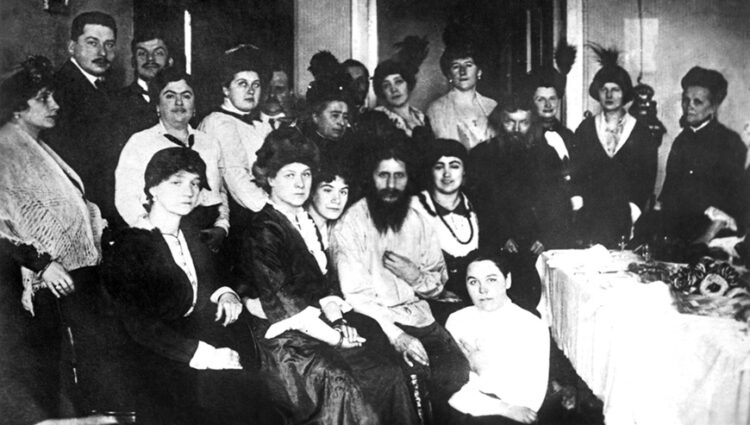
a photo of Easter night at Rasputin's, by Karl Karlovitsh Bulla

a photo of Easter night at Rasputin's, by Karl Karlovitsh Bulla


Rasputina Confers with Her Cohorts

“Rasputina” is the feminine form of the Russian name Rasputin.
He of course was the religious impostor who gained a malign
influence over the Romanov family, and used it to manage
important political decisions and state policy in Russia. He also
enriched himself, and indulged in gross bouts of drinking and
sexual abandon.

We never meddle in affairs of state.
We mystics stand above terrestrial matters.
The world is rank with lies and greed and hate—
Its anger seethes, the courtier smiles and flatters.

That doesn’t mean that God can be forgotten.
After all, the Kingship of the Lord
Must be established, and this sin-soaked, rotten
Vale of tears be cleansed by Word and Sword.

We cannot do it openly. There are
Just too many persons who oppose us.
They have no fear; their arguments by far
Are strong enough to flatten and bulldoze us.

And therefore we must plot by indirection:
Make friends with those in higher ranks above.
Rasputin got the Romanov connection
By influence, finagling, and fake love.

Sing songs of saints—they’ll always serve your need.
Once the Czarina’s wrapped around your finger
The others in the court will sweat and bleed
To join in with the music, and each singer

Will strive to be more orthodox than others.
Converts always cling to sacred texts
And hope that they’ll be better than their brothers.
If they don’t win, they’re very cross and vexed.

That’s the way—insinuate “the Word”
In everything you say and write and promise.
Cultivate the mindset of the herd
In all of them, from leader down to novice.

Once the Good Book has them hooked and wriggling
We then can use the Sword of Wrath Immense
And start imposing “guidelines”—that means niggling
Little rules devoid of any sense.

It’s easy—simply get them to agree
To minor things, and all the rest will follow.
All said and done, the fait is accompli.
Refusal would seem mulish, crude, and hollow.

And soon you’ll have a little cult around you
To do your bidding, and fulfill your whims.
When troubled, they will come to you and sound you
Out on how to follow pious hymns

And make their actions “godly” and attuned
To what we mystics teach is God’s desire:
A cult of rabid acolytes who’ve swooned
To be warmed by the flames of holy fire.

And doing this, we will serve the Almighty—
Our little lies and plots He deems as naught.
The only thing that matters is the sight He
Has of our triumph: paid for, sold, and bought.


Joseph S. Salemi has published five books of poetry, and his poems, translations and scholarly articles have appeared in over one hundred publications world-wide.  He is the editor of the literary magazine TRINACRIA and writes for Expansive Poetry On-line. He teaches in the Department of Humanities at New York University and in the Department of Classical Languages at Hunter College.


Tags: Historical FictionJoseph S. Salemi
ShareTweetPin
The Society of Classical Poets does not endorse any views expressed in individual poems or commentary.
Read Our Comments Policy Here

RandomPoems

‘For Sophie Pakaluk Barrows’ and Other Poetry by Joshua C. Frank
Beauty

‘For Sophie Pakaluk Barrows’ and Other Poetry by Joshua C. Frank

January 13, 2023

. For Sophie Pakaluk Barrows based on The Appalling Strangeness of the Mercy of God by Michael Pakaluk in pie...

‘The Night He Came’ by Martin Rizley
Beauty

‘The Eternal Design May Appear’ and Other Christmas Poetry by Cynthia Erlandson

December 24, 2023

. . “Even now, in sordid particulars, the eternal design may appear.” ---T.S. Eliot, Murder in the Cathedral . Among...

Next Post
Four Love Sonnets by Adam Sedia

Four Love Sonnets by Adam Sedia

The Society of Classical Poets 2026 Haiku Competition

The Society of Classical Poets 2026 Haiku Competition

‘Who Hears a Robot’s Prayer?’ and Other Poetry by Brian Yapko

'Who Hears a Robot's Prayer?' and Other Poetry by Brian Yapko

Comments 9

  1. Roy Eugene Peterson says:
    2 months ago

    Have mercy on us, Joseph! Dissecting this masterpiece requires both perversity and penance. Perversity is in the coldly calculated moves of “Rasputina” on the czarina and cohorts in which she cajoles, coaxes, reinterprets, dominates, lies, cheats, and steals in order to attain a godly, or dare I say goddess status controlling everyone and everything under her despicable domain. Penance for all the tricks performed by unorthodox and ungodly means should be in our recognition of anything we have done to pervert Christianity possibly depriving the “acolytes” of salvation. I am amazed at how you conceived such a radical view and at how silvery the words flowed with inspiration.

    Reply
    • Roy Eugene Peterson says:
      2 months ago

      Of course, I note you raised a profound theological question? Are the followers saved regardless of the propensities of the czarina?

      Reply
  2. Joseph S. Salemi says:
    2 months ago

    Well. LTC Peterson, you raise a slew of issues. You saw right to the heart of this poem. I made the speaker a female Rasputina because the male original had far too much attested history to deal with plausibly. Better to create a fictional female version who could be an easier persona to explore.

    I can’t answer for individuals’ salvation. That’s up to God. His criteria are not ours, and He is privy to information that we can never know. Rasputina, as I have created and imagined her, is an evil manipulator of deluded and naive persons (like the Romanov family, and scores of other superstitious idiots.)

    Rasputin (and “Rasputina” here) are simply confidence-game tricksters who do what they can to exploit and steal from naive believers. Those believers may be sincere Christians, or they may simply be conformists who “go along to get along.” But the key aim of Rasputina is to keep her little coterie of acolytes convinced that what they are doing is “The Will of God,” and therefore not subject to debate.

    Reading the history of Rasputin’s rise and fall is a frightening revelation of how one semi-educated provincial fanatic could gain control of an entire dynasty, an entire government, and even and entire army, and bring about the destruction of all of them.

    Prince Yussupov and his fellow assassins courageously took upon themselves the task of killing Rasputin in 1916, but it was too late. He had done his irreparable damage. The Russian army, and then the provisional Russian government, totally collapsed in 1917.

    Reply
  3. Cynthia L Erlandson says:
    1 month ago

    I really enjoyed this imagined historical speech by an imposter who successfully deceived and ruined people in power. The last verse is a strong portrayal of the arrogant thoughts of this vicious narrator.

    Reply
    • Joseph S. Salemi says:
      1 month ago

      Thank you, Cynthia. But keep in mind that the speaker in this dramatic monologue is not Rasputin himself, but a fictive female character of my own making named “Rasputina.”

      The satiric thrust of this poem is against religious zealots, fanatics, and mystics who cause endless trouble because of larcenous motives, or crackpot ideas, or a simple lust for power. In fact, my original intention was write this poem in the voice of Patriarch Nikon of Moscow, the seventeenth-century Russian Orthodox bishop who needlessly caused the “Old Believer” split in his church for stupid, petty, textual reasons that only a theologian could think up. That split practically destroyed Russian Orthodoxy, brought about thousands of deaths and exiles, tore families apart, and ravaged Russian society for centuries. All because some arrogant high-ranking ecclesiastic thought that “things had to change,” and got a naive young Czar to back him up. But since very few people outside of eastern Europe know anything about the Patriarch Nikon, I decided to use the wider familiarity of Rasputin as the basis for the poem.

      My larger aim was to paint a picture of the clerics who brought about the complete disaster of Vatican 2, and who wrecked the Catholic Church out of their selfish desire for power, and their insane need to “shake things up.” The disciples of those scum are still largely in power today, in dioceses all over the world.

      Reply
  4. C.B. Anderson says:
    1 month ago

    Well hell, Joseph, those who fell for this claptrap were lucky to get the USSR. If you hadn’t invented Rasputina, she probably would have miraculously arisen right out of the sea foam in arctic waters. The best we can produce here in the USA is St. Fauci.

    Reply
  5. Joseph S. Salemi says:
    1 month ago

    Yes, Fauci is personally responsible for horrendous crimes. He is — I regret to say — a Sicilian. Another evil Sicilian was the Mafia top capo Salvatore Riina, whom the Italian police estimated to be the authority or personal hit-man for close to two hundred murders. But Dr. Anthony Fauci is responsible for 1.2 million deaths in the United States alone, not counting the rest of the world. His Wuhan lab, his “gained-function” virus, and his Covid lockdown brought those deaths about.

    Riina was a small-time operator compared to Fauci, who is still honored by the left-liberals as a great hero and saint. We should all spit when we hear Fauci’s name mentioned. He has blood on his hands.

    Reply
  6. Adam Sedia says:
    1 month ago

    The title immediately intrigued me, “Rasputina” being the feminine form of Rasputin. But it can also be the genitive form in Russian, as well, and after reading the poem I think either interpretation works. You outlined the modus operandi “of Rasputin” and others like him. But your tone seems critical of the “church lady” types (hence the feminine) whose misplaced religious sentiment becomes gullibility, allowing the unscrupulous to take advantage of them. A lesson well-taught, and yet to be learned (as you well know, based on your Fauci comments).

    Reply
  7. Joseph S. Salemi says:
    1 month ago

    The character “Rasputina” in my poem is meant to be a representative of fake religion or a “cult,” of the sort designed solely to exploit persons, deprive them of their money and freedom, and gain wider power and influence. Yes, I made her female for a reason: those of us who are Roman Catholics have had the unendurable experience of dealing with “church ladies” on parish councils or diocesan committees. These women are the secular backbone of the Vat 2 establishment, and they serve as a Gestapo to sniff out thought-crime and to enforce whatever a pastor or a bishop wants to impose on his flock. I come from a Sicilian anticlerical tradition, where all clergy are distrusted until they prove themselves to be honest and pious. But dealing with these sniffy, patronizing, holier-than-thou, hyper-bureaucratic females would have tried the patience of Job. God help us if the current Antipope decides that we need “deaconesses.”

    I made Rasputina the head of a cult, because today we have a wealth of evidence and analysis about how cults start and how they operate. They depend on simple faith, and the desperate need of many persons to find a leader and a cause to follow. Elmer Gantry, L. Ron Hubbard, Jim Jones, and Aimee Semple McPherson were the models. Cults frequently attempt to gain celebrities and wealthy persons as members. Rasputin’s hooking of the Czar and the Czarina was a colossal tragedy of worldwide dimensions.

    Reply

Leave a Reply Cancel reply

Your email address will not be published. Required fields are marked *


  1. Adam Wasem on ‘Who Are the Villains?’ and Other Poetry by Adam WasemSeptember 14, 2026

    Yeah, nowadays right wingers (and even right-leaning types) in Hollywood either don't get work, like James Woods, or they have…

  2. Joseph S. Salemi on ‘Who Are the Villains?’ and Other Poetry by Adam WasemSeptember 14, 2026

    There have been some strongly anti-communist films, but certainly nowhere near the number of films which use Hitler and the…

  3. Adam Wasem on ‘Who Are the Villains?’ and Other Poetry by Adam WasemSeptember 14, 2026

    Isn't it wild how it's always "Hitler Hitler Hitler," but never, "Hey, maybe the gulags weren't such a great idea."…

  4. Margaret Coats on ‘Who Are the Villains?’ and Other Poetry by Adam WasemSeptember 14, 2026

    Good final lines for both, Adam. Looking up "movies against Mao" results in mostly the opposite. And your "Burns ever…

  5. Jeff Kemper on ‘How the Mighty Fell!’: A Poem by Jeff KemperSeptember 14, 2026

    Thanks, Yael. I'm glad you liked it.

Subscribe to Daily Poems

Enter your email address to subscribe to this blog and receive notifications of new posts by email.

Join 1,741 other subscribers
No Result
View All Result

Resources

       1. A Guide to Writing Poetry

      2. The Best Poems of 2020      

      3. Poetry and Writing Contests

      4. Journals Accepting Formal Verse

Recent Poems

  • ‘Who Are the Villains?’ and Other Poetry by Adam Wasem
  • ‘Isle of Romance’: A Poem by Margaret Brinton
  • ‘Professional Mourner’: A Poem by Brian Yapko
  • A Distillation of Shakespeare’s ‘A Midsummer Night’s Dream’ by Martin Briggs
  • ‘How the Mighty Fell!’: A Poem by Jeff Kemper
  • ‘The One Lone Juror’: A Poem by Joseph S. Salemi
  • ‘Soul of a Prophet’: A Trialog Poem by T.M. Moore
  • ‘Nelson and George’: A Poem by David Filpula
  • ‘When She Arrives’: A Poem by Bhairab Barman
  • ‘On to Better Days’: A Poem by Bruce Dale Wise
  • ‘Serenade’ and Other Poetry by Adam Sedia
  • ‘Self-Exploration’ and Other Poems by Paul Millan
  • ‘Victory’: A Poem by Jonathan Graver
  • ‘The Cristero Centennial’: A Poem by Margaret Coats
  • ‘A Potpourri of Aphoristic Verses’ by C.B. Anderson
  • ‘The Estuary’: A Poem by Jeff Eardley
  • ‘A World Without the Wednesday Child’: A Poem by Kimberly Fore
  • The 2026 Society of Classical Poets International Poetry Competition
  • The 2026 SCP International High School Poetry Competition
  • ‘Realistic Reflections’ and Other Poetry by Anna J. Arredondo
  • ‘China Made’: A Poem by Theresa Werba
  • ‘The Savage Moon’ and Other Poetry by Brian Yapko
  • Poetry Book Review: Love Found, Yearned For, and Lost by James A. Tweedie
  • ‘When Opportunity Knocks’: A Poem by Roy E. Peterson
  • ‘Legend of the Griffin’: A Poem by Iryna Hall
  • ‘Government Issue’ and Other Poems by Joseph S. Salemi
  • ‘Chaucer Announces His Desire to Retire’: A Poem by Paul A. Freeman
  • ‘Advantages of Restaurants’ and Other Poems by Russel Winick
  • ‘Bone China’: A Poem by Mary Gardner
  • ‘On the Death of One Too Young to Die’: A Poem by Jeffrey Essmann

Categories

  • Acrostic
  • Alexandroid
  • Alliterative
  • Art
  • Best Poems
  • Blank Verse
  • Chant Royal
  • Classical Poets Live
  • Clerihew
  • Covid-19
  • Deconstructing Communism
  • Educational
  • Epic
  • Epigrams and Proverbs
  • Essays
    • Interviews with Poets
    • Poetry Reviews
  • Featured
  • From the Society
  • Great Poets
    • Dante Alighieri
    • Edgar Allan Poe
    • Emily Dickinson
    • Geoffrey Chaucer
    • Henry Wadsworth Longfellow
    • Homer
    • John Keats
    • John Milton
    • Robert Frost
    • William Blake
    • William Shakespeare
    • William Wordsworth
  • Human Rights in China
  • Limerick
  • Love Poems
  • Music
  • Pantoum
  • Performing Arts
  • Poetry
    • Beauty
    • Children's Poems
    • Culture
    • Ekphrastic
    • Found Poems
    • High School Poets
    • Humor
    • Riddles
  • Poetry Challenge
  • Poetry Contests
  • Poetry Forms
    • Curtal Sonnet
    • Haiku
  • Poetry Readings
  • Rhupunt
  • Rondeau
  • Rondeau Redoublé
  • Rondel
  • Rubaiyat
  • Sapphic Verse
  • Satire
  • Science
  • Sestina
  • Shape Poems
  • Short Stories
  • Song Lyrics
  • Sonnet
  • Symposium
  • Terrorism
  • Terza Rima
  • The Environment
  • Translation
  • Triolet
  • Video
  • Villanelle

Quick Links

  • About Us
  • Submit Poetry
  • Become a Member
  • Members List
  • Support the Society
  • Advertisement Placement
  • Comments Policy
  • Terms of Use

Welcome Back!

Login to your account below

Forgotten Password?

Retrieve your password

Please enter your username or email address to reset your password.

Log In
No Result
View All Result
  • Poems
    • Beauty
    • Culture
    • Satire
    • Humor
    • Children’s
    • Art
    • Ekphrastic
    • Epic
    • Epigrams and Proverbs
    • Human Rights in China
    • Music
    • Performing Arts
    • Riddles
    • Science
    • Song Lyrics
    • The Environment
    • The Raven
    • Found Poems
    • High School Poets
    • Terrorism
    • Covid-19
  • Poetry Forms
    • Sonnet
    • Haiku
    • Limerick
    • Villanelle
    • Rondeau
    • Pantoum
    • Sestina
    • Triolet
    • Acrostic
    • Alexandroid
    • Alliterative
    • Blank Verse
    • Chant Royal
    • Clerihew
    • Rhupunt
    • Rondeau Redoublé
    • Rondel
    • Rubaiyat
    • Sapphic Verse
    • Shape Poems
    • Terza Rima
  • Great Poets
    • Geoffrey Chaucer
    • Emily Dickinson
    • Homer
    • Henry Wadsworth Longfellow
    • Dante Alighieri
    • John Keats
    • John Milton
    • Edgar Allan Poe
    • William Shakespeare
    • William Wordsworth
    • William Blake
    • Robert Frost
  • Love Poems
  • Contests
  • SCP Academy
    • Educational
    • Teaching Classical Poetry—A Guide for Educators
    • Poetry Forms
    • The SCP Journal
    • Books

© 2025 SCP. WebDesign by CODEC Prime.