


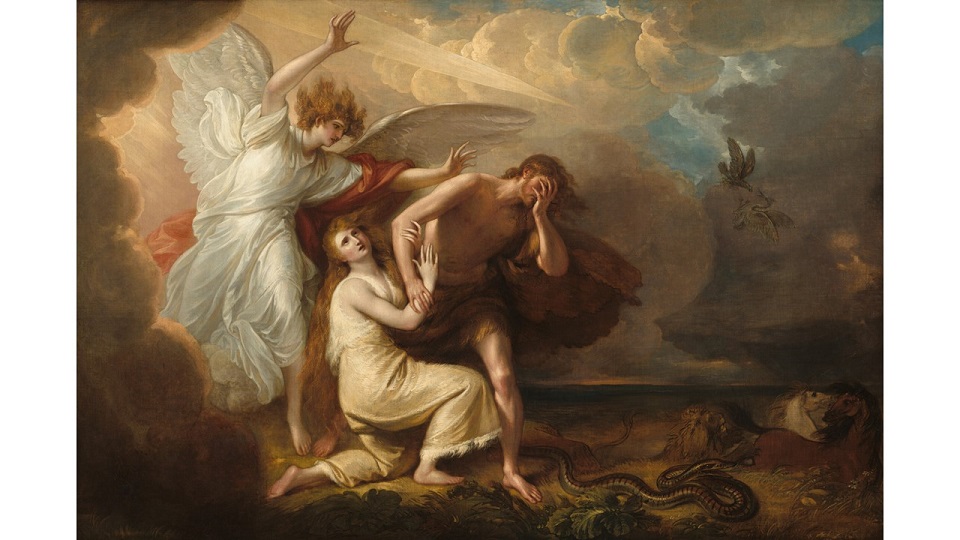
This Too Shall Pass
“Prophesy upon these bones, and say unto them,
O ye dry bones, hear the word of the Lord.”
—The Bible (KJV)
Go tell the glist’ning rocks upon the shore,
The moon shall call her waters back again.
This too shall pass, for it has passed before.
The stones endure, the crashing torrents wane.
Go tell the shriveled trees and dried up wells,
This too shall pass. Go speak of coming rain,
Promise this land’s long thirst shall soon be quelled,
And dormant seeds shall burst upon the plain.
Go tell the dried-up bones that lie in wait,
This too shall pass. They do not wait in vain,
For breath returns and longing shall abate,
New flesh shall form, new blood run in their veins.
Go tell my people cast adrift, outcast,
This pain they shall outlast: this too shall pass.
Otherness
“And out of the ground the LORD God formed every beast
of the field, and every fowl of the air… but for Adam there
was not found an help meet for him.” —The Bible (KJV)
From out the ground He made each beast, the words
The Master poet spoke took form in bones
And flesh. He shaped with care the oxen, birds,
Fish of the sea. And yet man stood alone.
For he, like them, was made at first complete.
He’d had no taste of longing, till a sleep
Like death stole over him, and his heartbeat
Was stilled and from his side came She, the deep
Who called to deep. She was not made apart,
Distinct in earth and form. No, she was made
From bone of bones and flesh of flesh. And heart
Spoke unto heart, each naked, unafraid.
And in this school of human love, they learned
Of Otherness and what it meant to yearn.
Justin Dasher is an emerging poet from Pueblo, Colorado. He studied philosophy at the University of Colorado, Boulder and currently serves with the Chaplain’s office at the United States Military Academy. He writes poetry on his Substack, Spaces in Between.


















These are both extraordinarily beautiful, Justin! I was captivated by your imaginative, expansive thoughts on these profound stories. You expand on Ezekiel’s apostrophe to the dry bones with apostrophes to rocks and trees and wells. You relate the dry bones to the drought of the land, and several times you work in a lovely refrain of “this too shall pass”. And in “Otherness”, you’ve made a meaningful statement about the difference between the creation of humanity and that of animals: “She, the deep that called to deep” — a beautiful echo, I think of a psalm, as well as the creation of the world. And I love how you’ve related that the Creator is the “Master poet”.
Grateful for your careful reading Cynthia! It is from Psalm 42!
Justin, these are two beautifully wrought poems that Cynthia so wonderfully assessed. I have always been fascinated by the dry bones rising again and the creation story.
Roy, thank you the kind words!
*for the kind words… I proofread my poems at least haha.
Justin, your study of philosophy comes through in both poems.
Cheryl, thank you for reading!
These two wonderful, hopeful poems made absolutely beautiful reading. Thank you Justin.
Thank you, Norma! Glad that you enjoyed them.
I agree with Cynthia that these poems are both extraordinary. Love that you end your first poem with “this too shall pass”.
Your poetry has “emerged” as beautifully as a butterfly. Thank you for it.
Thank you JD! Glad to hear you enjoyed them!
Both are good Bible sonnets, unexpected in treatment and message. “This Too Shall Pass” presents a cascade of events to which the title refers. In the octet, these are simply natural things–tides under the influence of the moon, drought eventually relieved by rain. First quatrain in the sestet deals with something more profound (the possibility of human resurrection envisioned by Ezekiel), while in the closing couplet there’s a message that could have been heard by Jews at many points in their history. It might refer to present times, when many have returned to the land of Israel, though the promised ingathering of all has yet to occur. Seems comforting as anti-Semitism rises abroad, and war continues in the Middle East.
For some reason, I loved both of these poems. I think it was the adept fusion of thought and language. The subtlety is obvious. May this churn keep turning fresh milk into rich butter.
Thank you for the kind words!
Justin,
I am impressed at how you’ve skillfully placed the phrase “this too shall pass” into the sonnet at just the right moments to serve as a hinge that holds the poem together with an almost musical repetition while also facilitating the transition in visuals from waves, to wilderness, to the perished, and then the persecuted.
In “Otherness”, I like how you’ve used human longing for marital love to illustrate our longing for God. I’ve long been fascinated with how the Adam’s experience of having his wife pulled from a wound in his side as he slept on the ground foreshadowed the day when Christ’s Church would be born our of the wound in his side as he lay under the earth.
D.R., thank you for reading! I love that image as well, the phrase used for sleep in the Genesis passage is used elsewhere for death. Then after he is ‘asleep,’ Eve, the bride, is taken from his side. On the Cross, Christ dies, and it says that at his side are Mary and the disciple John (which I take to be an image of the Church.) It’s a beautiful allusion to the Bride of Christ.
I was particularly enamoured with ‘Otherness’, modernised and accessible.
If only the religious elements at daily assembly and in class at school had been like this…
Thanks for the reads, Justin.
Thank you Paul!
The comments immediately preceding this one of mine have reminded me to praise the profound beauty of your “Otherness,” Justin. Rarely does a sonnet so well re-tell a Biblical story. Here we read the Genesis account of the creation of woman, embellished by allusions to Ezekiel and a Psalm, as Cynthia noticed above. In addition, there is “heart speaking to heart,” or “cor ad cor loquitur,” quoting Augustine and Francis de Sales on the emotional nature of the spiritual life, in a motto most recently recalled as that of John Henry Newman. All this compares the otherness of man and woman to the otherness of creature and Creator, while asserting the closeness of the common human nature belonging to Adam and Eve, by referring to God making her from him. That is, as you imply, an otherness seeking return to original completeness, which can only be achieved in the union of love. It is difficult to find words to praise the sonnet accomplishing so much.
Margaret, thank you! I appreciate how detailed your reading is (and that you picked up on the cor ad cor loquitur, Newman was my confirmation saint.) ‘An otherness seeking return to original completeness’ is a beautiful way to phrase it.