



.
Again
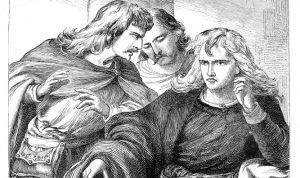
Sir Charles Hallé plays Beethoven’s “Appassionata”
Sonata for Henri–Montan Berton and Luigi
Cherubini, Paris, ca. 1835
The two composers sat at rapt attention,
listening to Beethoven’s “Appassionata,”
and when Hallé had struck the final chord,
a moment’s silence ended with “Again.”
Hallé obliged, repeating the entire
sonata while his listeners’ ears and minds
attended closely. When he’d finished playing,
again was heard the terse request, “Again.”
The work itself elicited no mention,
nothing concerning what sort of sonata
the piece was. This response was untoward:
both of these taciturn, ungracious men
were too absorbed, for the sonata’s fire
had strayed beyond the furthest boundary lines
that either could imagine. Thus, the paying
of thanks would have to wait—for both these men.
Could there have been a bit of apprehension
occasioning this reccezzione ingrata
from those distinguished quasi–mutes? For bored
they surely weren’t. How many times “Again”
might have been spoken when they heard expire
the frenzied final coda, never signs
of weariness displaying, ever saying—
Berton and Cherubini both—“Again.”
.
.
.
Julian D. Woodruff, who contributes poetry frequently to the Society of Classical Poets, writes poetry and short fiction for children and adults. He recently finished 2020-2021, a poetry collection. A selection of his work can be read at Parody Poetry, Lighten Up Online, Carmina Magazine, and Reedsy.

















This is an amazing rhyme scheme that dawned on me after reading into the third verse. I have no idea how you found the quote and the event, but it was intriguing to consider this moment in time and as a music lover, to wish I had been there given the calls by the audience for “again.”
As I recall, Roy, Halle reoorts the incident in his memoires. (Not the most trustworthy source for a historian, but suitable, I hope, for a poem.) Like you, I should liked to be there, maybe lurking behind a curtain.
The music says, “Again!” More than once. Granted the video here plays only the third movement, but the distinguished composer critics understood the overall effect, and the end is naturally where they might have wished for more of the emotional fire they were too taciturn and ungracious to express to the disappointed but most obliging performer.
Intriguing rhyme scheme, Julian, in which you use all letters that name musical notes: abcDefgD, with capital D being a refrain where rhyme sound and rhyme word repeat. You keep the same rhyme sounds in all stanzas, but alter the rhyme word of the refrain in the middle one, criticizing the untoward response of listening men. Nice touch.
One similar scheme comes to mind from Petrarch, who used abcdefg in every stanza (I forget how many) of a unique poem from the Canzoniere. There is no rhyme within each stanza, and one must listen for it in other stanzas. He may be following a Provencal pattern there, but I was never able to find a like poem. I’ve thought of using the technique myself, but can’t recall if I’ve actually produced a poem with it.
Thank you for your close reading and attentive analysis, Margaret. It hadn’t occurred to me that with the recurrent line endings (your D) I was drawing an 8-line stanza into relationship with a diatonic scale: there are comparable possibilities involving other scales, and perhaps chords, that I’ll have to look into.
Yes! Yes! Yes! Absolutely, explore that–please. That’s good stuff. I’d hasten to add that I believe your ear latched on to what maybe your mind was not as latched on to. And instinct counts!
This is right up the path of an enormous set of possibilities.
This is a very well-written poem, Julian, on a fascinating theme — not Beethoven’s Appassionata itself but the effect it has on two lesser composers who are apparently hearing this astonishing piece of music for the first time.
Although you post the third movement, I really rather believe that it is the first movement — the allegro — that is most radical and ground-breaking. I infer that it is this first movement allegro that the composers are listening to.
This seems a historically strange meeting because they don’t actually discuss the piece — at least not within the hearing of the poet. So what you do in this poem is remarkable — you spotlight a piece of music that is not described except obliquely (“the sonata’s fire had strayed beyond the furthest boundary lines that either could imagine”) .and you spotlight a reaction that is not actually barticulated. I’ve never seen a poem do such a thing and I’m astonished that you pull it off.
What is also so interesting here is the anticipation — we know that eventually these listening composers will be ready to talk about what must have seemed to them the most radically modern piece of music to ever come out of Vienna. But that conversation will take place out of the reader’s earshot. But the “again” and “again” gives us a hint of these composers’ stunned reaction. The Appasionata is incredibly technically difficult, and the very nature of the music — structurally, harmonically — is so outside the realm of what music normally sounded like at that time. It must have excited and utterly baffled them. You present this so subtly and so well.
I should mention that Beethoven’s Appassionata happens to be my favorite of all piano sonatas by any composer — one I’ve attempted to play over the decades and invariably have had to give up on because it is too far beyond my skill level. Van Cliburn did a particularly good version. In fact, here it is.
https://youtu.be/TwbrDVk6NMY?si=bWp7Cjo8lwsKnKAM
Thank you, Brian, for your informed comments. The recording is actually Evan’s choice. And one should of course hear the entire sonata to appreciate its full effect (so thanks for supplying the link to VC’s recording; I didn’t know he’d done one) and the drift of the poem, because I intended the reader should suppose that H had played the entire sonata (which, as I recall, he reports doing); cf. line 5. You got my point about “again,” too: what were B and C to say until they’d had time to collect their wits? Even if both had some familiarity with B’s music (as at least C had) so much of it, especially on 1st hearing (and as you point out, the 2 had far less experience with B and the Viennese Classical style than we), sounds like a world unto itself, as presumably this sonata did. On its difficulty: I’m no pianist, but I think it must be right up there with the “Hammerklavier” Sonata as concerns technical demands: yet it is reported that Dorothea Ertmann sight-read it from B’s holograph ms.! (Maybe eith a few hints and a bit of coaching from B?)
The Appassionata Sonata ranks among my favorite pieces for piano, both to play and to listen to. While I wouldn’t charge people money to hear me play it, I can play the whole thing, and can attest to its technical difficulty as well as the sheer passion that comes through in its energy and harmonies – apropos of its nickname.
Your poem does a fantastic job of capturing what its effect must have been on those in a world to which it was completely new. Your narrative is incredibly skillful: by leaving out descriptions of the piece itself, you turn it into an “elephant in the room,” magnifying its impact on the narrative. Similarly, the laconic refrain, “again,” derives its power from what is not said – the powerful interior effect on the listeners’ emotions. This poem definitely exemplifies the concept of “less is more.”
Cherubini, incidentally, was one of the few living composers Beethoven admired. His music is much more restrained than Beethoven’s, but has its fiery moments. His Requiem and opera Medea I think are woefully neglected.
Thank you very much for your praise and close observations. Remarkable that you are a lawyer, an accomplished poet, and, it turns out, a better than decent pianist. (I could struggle through all the Beethoven violin sonatas but the Kreutzer, akin in spirit to the Appassionata in its 1st mvt; but the K was quite beyond me. See my comment on Dorothea Ertmann in my reply to B. Yapko, above.) I appreciate your reading of the laconic “again.” This, reported by Halle, seems quite characteristic of C–he could be economically savage in critcism; the believability of the report inspired the poem.
Yes, a good bit of C’s music is worth reviving–those that you mention (Medee was done recently, much too far away for me to get to), some of the chsacred music (incl. both requiems), various moments from the operas (the overture to Anacreon was a favorite of Weber’s, but few besides Toscanini have championed it), and even some of the chamber music (e.g., the Quintet).
Riccardo Muti is also a big proponent of Cherubini. Last year the CSO performed his Requiem in C minor, but alas I had to miss it. Muti has recorded all of Cherubini’s Masses. The Missa Solemnis in D is another great work, and I neglected to mention his string quartets, as well.
I also compose. Look up my YouTube channel if you ever have the chance.
His string chamber music was the topic of my thesis at Northwestern (1988). The slow mvt. of the 1st Quartet is quite original in approach, and the 3rd is altogether admirable. The thematic review in the finale of the 6th clearly shows C’s awareness of Beethoven (though it may have been written after the meeting with Halle, the exact date of which I’ve forgotten), and surely Berlioz (an adversary at the Conservatoire) as well (Harold en Italie, 1834, also with a thematic review in the finale).
Glad you’re a C aficionado! Try out his Credo, and the 4 symphonies of Mehul if you don’t know them.
I definitely know and enjoy the Méhul symphonies. #2 is my favorite (especially the opening movement). I also play his C minor piano sonata – a very tempestuous work.
Absolutely love the importation of classical music into classical poetry. Let me take the poem’s, “Again,” into another direction as in, I want more of these!
Beethoven’s work seemed to take a predictable arc regarding audience acceptance. Usually it was: anger & rejection, stunned-bitter–but-curious, oh-my-look-at-all-the-stuff-here-we-didn’t-get, and finally, we-love-it-and-loved-him-all-along.
I’m still smack dab in the middle of a Beethoven *thing.* Can’t get enough. Going from piece to piece as a new favorite every couple of months, but actually, to show you my degree of weirdness, the piece that still reigns supreme for me is Opus 130 with the original ending, the Grosse Fugue.
If I might, perhaps rudely, suggest an area of exploration– maybe play with varying the line lengths as one additional way to bring the feeling of the music over.
Loved it. Looking for more.