• Submit Poetry
  • Support SCP
  • About Us
  • Members
  • Join
Tuesday, May 12, 2026
Society of Classical Poets
  • Poems
    • Beauty
    • Culture
    • Satire
    • Humor
    • Children’s
    • Art
    • Ekphrastic
    • Epic
    • Epigrams and Proverbs
    • Human Rights in China
    • Music
    • Performing Arts
    • Riddles
    • Science
    • Song Lyrics
    • The Environment
    • The Raven
    • Found Poems
    • High School Poets
    • Terrorism
    • Covid-19
  • Poetry Forms
    • Sonnet
    • Haiku
    • Limerick
    • Villanelle
    • Rondeau
    • Pantoum
    • Sestina
    • Triolet
    • Acrostic
    • Alexandroid
    • Alliterative
    • Blank Verse
    • Chant Royal
    • Clerihew
    • Rhupunt
    • Rondeau Redoublé
    • Rondel
    • Rubaiyat
    • Sapphic Verse
    • Shape Poems
    • Terza Rima
  • Great Poets
    • Geoffrey Chaucer
    • Emily Dickinson
    • Homer
    • Henry Wadsworth Longfellow
    • Dante Alighieri
    • John Keats
    • John Milton
    • Edgar Allan Poe
    • William Shakespeare
    • William Wordsworth
    • William Blake
    • Robert Frost
  • Love Poems
  • Contests
  • SCP Academy
    • Educational
    • Teaching Classical Poetry—A Guide for Educators
    • Poetry Forms
    • The SCP Journal
    • Books
No Result
View All Result
Society of Classical Poets
  • Poems
    • Beauty
    • Culture
    • Satire
    • Humor
    • Children’s
    • Art
    • Ekphrastic
    • Epic
    • Epigrams and Proverbs
    • Human Rights in China
    • Music
    • Performing Arts
    • Riddles
    • Science
    • Song Lyrics
    • The Environment
    • The Raven
    • Found Poems
    • High School Poets
    • Terrorism
    • Covid-19
  • Poetry Forms
    • Sonnet
    • Haiku
    • Limerick
    • Villanelle
    • Rondeau
    • Pantoum
    • Sestina
    • Triolet
    • Acrostic
    • Alexandroid
    • Alliterative
    • Blank Verse
    • Chant Royal
    • Clerihew
    • Rhupunt
    • Rondeau Redoublé
    • Rondel
    • Rubaiyat
    • Sapphic Verse
    • Shape Poems
    • Terza Rima
  • Great Poets
    • Geoffrey Chaucer
    • Emily Dickinson
    • Homer
    • Henry Wadsworth Longfellow
    • Dante Alighieri
    • John Keats
    • John Milton
    • Edgar Allan Poe
    • William Shakespeare
    • William Wordsworth
    • William Blake
    • Robert Frost
  • Love Poems
  • Contests
  • SCP Academy
    • Educational
    • Teaching Classical Poetry—A Guide for Educators
    • Poetry Forms
    • The SCP Journal
    • Books
No Result
View All Result
Society of Classical Poets
No Result
View All Result
Home Poetry Culture

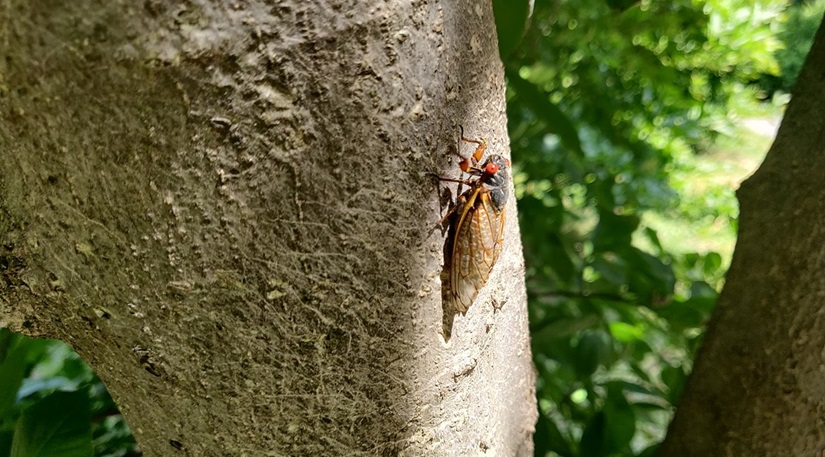
A Poem on ‘Cicada Fever’ in Springfield, Illinois, by Mary Jane Myers

June 18, 2024
in Culture, Poetry
A A
12
poems A Poem on 'Cicada Fever' in Springfield, Illinois, by Mary Jane Myers

.

Periodicity

Springfield, Illinois, May-June 2024

All our town has caught cicada fever.
Seven broods emerge, the selfsame time.
This fluke converts me to an awed believer
in nature’s odd propensity to rhyme.
So curious, insect cycles intersect
like a comet’s rare traverse across our sun.
Last seen 1803, this synced effect,
come 2245, concurs again.
God blesses all His creatures, the psalmist sings.
It’s plain to see, His loving circadian care,
but hard to comprehend hermetic things:
deep sequenced patterns, intricate equations.
And so my constant heartfelt whispered prayer,
to study, praise His cryptic ideations.

.

.

Mary Jane Myers resides in Springfield, Illinois. She is a retired JD/CPA tax specialist. Her debut short story collection Curious Affairs was published by Paul Dry Books in 2018.


ShareTweetPin
The Society of Classical Poets does not endorse any views expressed in individual poems or commentary.
Read Our Comments Policy Here

RandomPoems

2016 Poetry Competition
From the Society

Announcing the 2015 Competition Winners

February 1, 2015

  First Prize ($500): Reid McGrath Winning Poems: “Tares in the Wheat” “A Recurring Dream, Vanquished” “Retreating Snow” “Lamenting Our...

‘A Present Unclaimed’: A Christmas Poem by James A. Tweedie
Beauty

‘A Present Unclaimed’: A Christmas Poem by James A. Tweedie

December 25, 2024

. A Present Unclaimed Under the tree is a present unclaimed Paper and ribbon and bows, good to go. Who...

Next Post
‘Vintage Love’: A Poem by Gigi Ryan

'A Precious Wife Is Like Fine Wine' and Other Poetry by Martin Rizley

‘The Day the Roofers Came’ and Other Poems by Susan Jarvis Bryant

'The Day the Roofers Came' and Other Poems by Susan Jarvis Bryant

‘Some Words to Catholics about Bergoglio’: A Poem by Joseph S. Salemi

'Some Words to Catholics about Bergoglio': A Poem by Joseph S. Salemi

Comments 12

  1. Roy Eugene Peterson says:
    2 years ago

    I can imagine the amazing emergence of various cicada broods occurring simultaneously for the first time in two centuries and not emerging together for two more. The shock and awe is moderated in your poem by your wonderment and thoughtful consideration of God’s creatures.

    Reply
    • Mary Jane Myers says:
      2 years ago

      Dear Roy
      Thank you for your perceptive comment. While I love and admire cicada-kind (because I am fascinated by cyclical phenomena) I can’t stand individual cicadas, especially in large numbers. I’ll have to work on developing appreciation for each individual cicada!
      Most sincerely
      Mary Jane

      Reply
  2. Cynthia Erlandson says:
    2 years ago

    This is a beautiful sonnet on a mysterious natural phenomenon; it really needed to be written! Several phrases struck me as particularly profound: “in nature’s odd propensity to rhyme”; “His loving circadian care”; “deep sequenced patterns, intricate equations”; “cryptic ideations”.

    Reply
    • Mary Jane Myers says:
      2 years ago

      Cynthia
      Thank you for your kind comments. We are so lucky that we have experts explaining the complexity of natural phenomena to us. Otherwise, I would simply grimace in disgust when these insects descend on us!
      Sincerely Mary Jane

      Reply
  3. Jeff Kemper says:
    2 years ago

    As an insect enthusiast I am always fascinated with these creatures. I once wrote a story about a cicada nymph who wondered why he was suddenly digging upward. Thank you for this very beautiful tribute to one of God’s spectacular groups of living things. I was also struck precisely by the phrases Cynthia has noted.

    Reply
    • Mary Jane Myers says:
      2 years ago

      Dear Jeff
      Your story sounds delightful. It must be strange to be a cicada–asleep like Rip Van Winkle for many years–then emerging into a world significantly altered by technology. 17 years ago, when the 17-year cycle nymphs started their long sleep, the first I-phone had just been introduced and the CERN Large Hadron Collider was powered up for the first time. Of course, the cicadas are so busy singing and mating that they probably don’t notice any changes!

      Sincerely
      Mary Jane

      Reply
  4. Margaret Coats says:
    2 years ago

    By allowing the cicada (or many of them) to suggest the term “circadian,” Mary Jane, you open up a wealth of scientific and mathematical vocabulary for use in this contemplative poem. “Thou hast ordered all things by measure and number and weight” (Wisdom 11:21). Without sacrificing accentual meter, you do allow an extra syllable in several of the lines, and I think that would be most appropriate in the final line with “to study and praise.” As it stands, the mere comma instead of “and” makes the line read awkwardly, as if introducing “study-praise” to be a combination coinage with new meaning. Enjoyed it even more by supplying the “and” in my reading!

    Reply
    • Mary Jane Myers says:
      2 years ago

      Margaret
      Thank you for your careful reading and your excellent editorial suggestion. I had a great deal of difficulty with the final line–scribbled with my Blackwing, erased, scribbled again –my chaotic mind not tuned into the divine order of “measure and number and weight”!

      Most sincerely
      Mary Jane

      Reply
  5. Shamik Banerjee says:
    2 years ago

    A few days ago, I read “To a Cicada” by Martin Rizley, and now it’s your wonderful sonnet. I find myself unable to stop contemplating this magnificent creature. Nature indeed has “an odd propensity to rhyme.” I like the comet analogy to describe the periodicity of the occurrence of this creature. I love how the sonnet turns into your own contemplation of this phenomenon and, ultimately, the ways of God. Thank you, Mary Jane.

    Reply
    • Mary Jane Myers says:
      2 years ago

      Dear Shamik
      Thank you for your comments. Martin’s poem focuses on his delight in each individual cicada, his “songful friend.” I must admit, individual cicadas give me the creeps! one of my character flaws, I’m sure. But people like me appreciate nature in a different way–we love the patterns that give us an intuition of the divine.

      Most sincerely
      Mary Jane

      Reply
  6. C.B. Anderson says:
    2 years ago

    When I was growing up in Pennsylvania, I was stupidly taught to call cicadas locusts, and we called the molted husks they left on trees locust shells. I can remember a year when there were so many of them that when I went to visist my Aunt Ella in Princeton, NJ, every step I took on her driveway crushed half a dozen of the damn things underfoot. Being realistic about it, they are nothing more than another God-sent plague. The stridulent buzzing they put in my ears is still with me.

    Reply
    • Mary Jane Myers says:
      2 years ago

      Dear C.B.
      LOL! I agree with you. There’s something Biblically “ominous” about this phenomenon of millions of insects hatching and emerging as if from the underworld, and taking wing en masse. That stridulent buzzing seems to me like tinnitus on steroids. My expression must resemble the consternation of that woman in Munch’s The Scream–completely unhinged by something sinister. But others absolutely love these little Devonian creatures. And they are kinda cute, one at a time, perched on a fascinated seven-year-old child’s palm!

      Sincerely
      Mary Jane

      Reply

Leave a Reply Cancel reply

Your email address will not be published. Required fields are marked *

  1. Russel Winick on A Poem on the Zambian National Park Mosi-oa-Tunya, by Paul A. FreemanMay 12, 2026

    I love this poem, Paul, because of how well it describes and explains one of the most uniquely beautiful places…

  2. Susan Jarvis Bryant on ‘Spontaneous Conjugal Combustion’ and Other Poems by Susan Jarvis BryantMay 12, 2026

    Joe, I love your interpretation - as far as I'm concerned" a gold-digging young gigolo who attaches himself to a…

  3. Roy Eugene Peterson on National Poetry Month Limerick ChallengeMay 12, 2026

    Urszula, what an imaginative limerick! That is something Poe might have done! Sorry to be so late seeing this.

  4. Roy Eugene Peterson on National Poetry Month Limerick ChallengeMay 12, 2026

    Agreed, Urszula! Thank you for commenting.

  5. Joseph S. Salemi on ‘Spontaneous Conjugal Combustion’ and Other Poems by Susan Jarvis BryantMay 12, 2026

    When I was in the U.K. I heard that "poodle" could mean a henpecked or subservient husband, and by extension…

Subscribe to Daily Poems

Enter your email address to subscribe to this blog and receive notifications of new posts by email.

Join 1,593 other subscribers

Recent Poems

  • A Poem on Coach “Black Mike” Castronis from Athens Y Camp, by Alec Ream
  • A Poem on the Zambian National Park Mosi-oa-Tunya, by Paul A. Freeman
  • ‘Creation of Mom’: A Mother’s Day Poem by Roy E. Peterson
  • ‘Spontaneous Conjugal Combustion’ and Other Poems by Susan Jarvis Bryant
  • ‘The Man in the Moon Was a Very Round Man’: A Poem by Lauren V. Leon
  • ‘Fibromytrauma’: A Poem by Golan Shahar
  • ‘A Lonely Sliver’: A Poem by Katie Tencza
  • ‘Higher Gas Prices Are a Small Price to Pay’: An Iran War Poem by Mark F. Stone
  • ‘Always Ahead’: A Poem by Scharlie Meeuws
  • ‘Hamlet’s Lawyer’ and Other Poetry by Brian Yapko
  • ‘On An Old Photograph’: A Poem by Joseph S. Salemi
  • ‘Faust Foresees His End’: A Poem by Martin Briggs
  • ‘À la Carte’ and Other Poetry by C.B. Anderson
  • ‘Where the Sweet Bluebonnets Bloom’: A Poem by Roy E. Peterson
  • ‘The Waters’: A Poem by Margaret Brinton
  • ‘The Pinnacle of Poetry’ and Other Poems by Russel Winick
  • The First American Sonnets: An Essay on David Humphreys, by Margaret Coats
  • ‘The Holy Rollers on Poetry’: A Poem by Joseph S. Salemi
  • Sappho’s ‘Poem 1’ Translated by Bruce Phenix
  • ‘The Cautionary Tale of Phone Addicted Mimi’: A Poem by Paul A. Freeman
  • ‘Look Away’: A Poem for America’s 250th Anniversary, by Roger Crane
  • ‘Sunday Morning in Canada’: A Poem by Jeffrey Essmann
  • ‘Bean’: A Poem by Jan Mennite
  • ‘The Swan’s Song ’: A Poem for Shakespeare’s Birthday, by Susan Jarvis Bryant
  • ‘The Gravedigger’: A Poem by Marie Burdett
  • ‘Waiting for the Perfect Man’: A Poem by Janice Canerdy
  • ‘The George-A-Saurus’ and Other Poetry by Brian Yapko
  • ‘When Asked: What’s Your Favorite Season?’: A Poem by Paul Millan  
  • ‘The Last At-Bat of Lyndon Braun’: A Poem by Michael Pietrack
  • ‘The Perpetual Battle’ and Other Poetry by Adam Sedia

Categories

  • Acrostic
  • Alexandroid
  • Alliterative
  • Art
  • Best Poems
  • Blank Verse
  • Chant Royal
  • Classical Poets Live
  • Clerihew
  • Covid-19
  • Deconstructing Communism
  • Educational
  • Epic
  • Epigrams and Proverbs
  • Essays
    • Interviews with Poets
    • Poetry Reviews
  • Featured
  • From the Society
  • Great Poets
    • Dante Alighieri
    • Edgar Allan Poe
    • Emily Dickinson
    • Geoffrey Chaucer
    • Henry Wadsworth Longfellow
    • Homer
    • John Keats
    • John Milton
    • Robert Frost
    • William Blake
    • William Shakespeare
    • William Wordsworth
  • Human Rights in China
  • Limerick
  • Love Poems
  • Music
  • Pantoum
  • Performing Arts
  • Poetry
    • Beauty
    • Children's Poems
    • Culture
    • Ekphrastic
    • Found Poems
    • High School Poets
    • Humor
    • Riddles
  • Poetry Challenge
  • Poetry Contests
  • Poetry Forms
    • Curtal Sonnet
    • Haiku
  • Poetry Readings
  • Rhupunt
  • Rondeau
  • Rondeau Redoublé
  • Rondel
  • Rubaiyat
  • Sapphic Verse
  • Satire
  • Science
  • Sestina
  • Shape Poems
  • Short Stories
  • Song Lyrics
  • Sonnet
  • Symposium
  • Terrorism
  • Terza Rima
  • The Environment
  • Translation
  • Triolet
  • Video
  • Villanelle

Quick Links

  • About Us
  • Submit Poetry
  • Become a Member
  • Members List
  • Support the Society
  • Advertisement Placement
  • Comments Policy
  • Terms of Use

Welcome Back!

Login to your account below

Forgotten Password?

Retrieve your password

Please enter your username or email address to reset your password.

Log In
No Result
View All Result
  • Poems
    • Beauty
    • Culture
    • Satire
    • Humor
    • Children’s
    • Art
    • Ekphrastic
    • Epic
    • Epigrams and Proverbs
    • Human Rights in China
    • Music
    • Performing Arts
    • Riddles
    • Science
    • Song Lyrics
    • The Environment
    • The Raven
    • Found Poems
    • High School Poets
    • Terrorism
    • Covid-19
  • Poetry Forms
    • Sonnet
    • Haiku
    • Limerick
    • Villanelle
    • Rondeau
    • Pantoum
    • Sestina
    • Triolet
    • Acrostic
    • Alexandroid
    • Alliterative
    • Blank Verse
    • Chant Royal
    • Clerihew
    • Rhupunt
    • Rondeau Redoublé
    • Rondel
    • Rubaiyat
    • Sapphic Verse
    • Shape Poems
    • Terza Rima
  • Great Poets
    • Geoffrey Chaucer
    • Emily Dickinson
    • Homer
    • Henry Wadsworth Longfellow
    • Dante Alighieri
    • John Keats
    • John Milton
    • Edgar Allan Poe
    • William Shakespeare
    • William Wordsworth
    • William Blake
    • Robert Frost
  • Love Poems
  • Contests
  • SCP Academy
    • Educational
    • Teaching Classical Poetry—A Guide for Educators
    • Poetry Forms
    • The SCP Journal
    • Books

© 2025 SCP. WebDesign by CODEC Prime.