


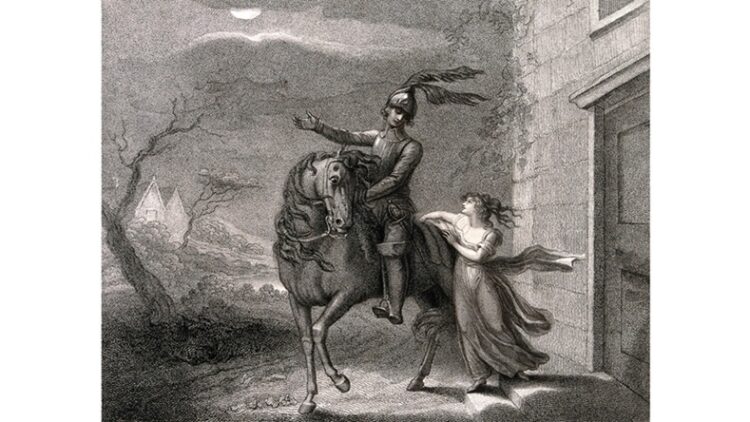
The Departure
His soulful eyes did look on life, and sorely did he weep.
He turned his head upon the gate. His heart hurt hard and deep.
He saw the door from hinges torn. He had to take this trip,
and leave behind the pegs, without a hawk’s or falcon’s grip,
and all his people too. He sighed with so much grief and care,
it was as if he had now fallen into black despair.
“Oh, Father, God, in Heaven, You, who are so true and high,
I now give thanks to You, although my foes do make me cry.”
His horse did shake its reins, as if it was the time to go,
to leave Bivar forever, while upon his right a crow
did caw. He had so far to go. It followed him along,
until he came to Burgos. On his left, it went—this song.
And so he shrugged his shoulders. Then in sadness shook his head.
So barren was the land he trod, he felt like he was dead.
“Oh, father, we are banished for forever from our land.
Oh, it has vanished from my sight, and all I see is sand.
Perhaps someday I shall return in honor once again
to look upon my town once more and see my own townsmen.
It’s possible, of course, I’ll never see, before I die,
Castile, or its stone-cast castles, rising to the sky.”
previously published in Oddball Magazine
Bruce Dale Wise is a poet and former English teacher currently residing in Texas.

















It was nice to see your poetic story that sent us back in time. Enjoyable to read.
Lennox
by Wilude Scabere
This is the thane attending on King Duncan…Is he young?
accompanying brave Macduff…Who else is he among?
He notes he can’t recall a night as stormy as this last;
it was unruly; chimney’s were blown down; night was hard passed.
Although he joins the court of King Macbeth, he’s soon convinced
of the usurper’s guilt; yet stays and speaks—his words now minced.
He tells Macbeth Macduff has fled, but when young Malcolm comes,
he leaves Macbeth for Malcolm’s army, as Macbeth succumbs.
Mr. Peterson possesses several qualities that can stand his poetry in time:
One, he writes a lot; a necessity, of course, for anyone attempting an epic. I do not say he is attempting an epic, but he continues on fervently in the poetic realms he pursues, writing thousands of poems in dozens of books.
Likewise, he possesses a strength to disregard what others may think, or say, about his work. To be a bard, amongst the tens of millions of writers writing today, one has to be tough, resilient; and that he is.
Another quality he has, is that he forges his own way, without incorporating too much of others’ prose or verse, unlike some of history’s well-known epicists and prose writers. he certainly carries the banner of rhyming.
So that I say Mr. Peterson is prepared to withstand the onslaught against rhyme, not as a knight of eld, but as an Army Attache, picking up murmurs of a muse he cannot refuse.
I was reminded of Lochinvar, by Sir Walter Scott.
A well-wrought archaic style to bring back to life the days of yore.
Thanks for the read, Bruce.
It is interesting that this balladic transmutation in iambic heptameters reminded Mr. Freeman of Walter Scott’s anapestic tetrameters in “Lochinvar”. Certainly, there is a similarity in their heroic aspects—the complete poem of Scott and the opening verses of the anonymous epicist; however, what seems fascinating to me is that Mr. Freeman suggests here is a “well-wrought, archaic style”, when there was no intention for such—whatsoever—just translation in the manner of Shakespeare.
Why I even came to El Cantar de mio Cid is because the writer’s verses were between fourteen and sixteen syllables. I’m not quite sure of the year when I wrote this poem, but it was less than a dozen years ago, yet not that recently. If it is true that this is written in a “well-wrought, archaic style”, then I am pleased that my ordinary written voice falls so easily into such a manner.
Bruce, “The Departure” sadly foregrounds forthcoming exile, while explaining and expanding the sorrow through nostalgia and patriotism and suggestions of all the purely personal emotion involved. Your repeated use of emphatic verb forms strengthens the overall feeling. You’ve done remarkably well with this universal theme.
Ms. Coats points out that this is a universal theme, from the Ancients to the Presents—agreed. Yet notice the differences between Modern English and Old Castilian. [Any mistakes in print are my own.]
De los so ojos tan fuertemiente llorando,
tornava la cabeça e estávalos catando.
Vío puertas abiertas e uços sin cañados,
alcándaras vazías sin pieles e sin mantos,
e sin falcones sin adtores mudados.
Sospiró mio Cid, ca mucho avié grandes cuidados;
fabló mio Cid bien e tan mesurado:
—¡Grado a ti, Señor, Padre que estás en alto!
¡Esto me an buelto mios enemigos malos!—
Allí piensan de aguijar, allí sueltan las riendas.
A la exida de Bivar ovieron la corneja diestra
e entrando a Burjos oviéronla siniestra.
Meció mio Cid los ombros engrameó la tiesta:
—¡Albricia, Álbar Fáñez, ca echados somos de tierra!—
I see that you seem to have added material at the end of the selection, though in the original there would have been more. Do you now emphasize the concluding “echados somos de tierra” in order to suggest possible return in the English addition? The tone remains solemn.
Huh? What has become of us? There is only so much we can tolerate that does not set our teeth to gnashing. The promise of toleration only makes us cringe and sets generation against generation. Wherefore art thou?
In terms of in-toleration, I am here, eight years ago:
Destruction of Long Island Statues: March 2018
by Cardiwel Ebuse
A statue of the Virgin Mary was beheaded at
the Church of Saint Gerard Majella in Port Jefferson.
A vandal also broke a hand, who knows the reason why;
but hatred roams across the land beneath the open sky.
The maker of the statue said that he would freely give
another to the congregation; love, it seems, still lives.
But earlier, a week before, some vandals sacrificed
another statue, this one of a life-size Jesus Christ
outside the shrine, Our Lady of the Island, Manorville.
It seems intolerance and hate will never have their fill.
Cardiwel Ebuse is a poet of the Catholic Church.
Thanks for this, Bruce. That last line is one to memorize. Theft or vandalism of outdoor statues at Catholic churches occurs periodically, but too often. The 2020 attempts to pull down statues of importance to Americans overall simply allowed the intolerance and hate to boil over visibly into the news, where reporting sometimes stoked further incidents.
Ms. Coats, it was just for comparison, no other reason.