• Submit Poetry
  • Support SCP
  • About Us
  • Members
  • Join
Saturday, July 18, 2026
Society of Classical Poets
  • Poems
    • Beauty
    • Culture
    • Satire
    • Humor
    • Children’s
    • Art
    • Ekphrastic
    • Epic
    • Epigrams and Proverbs
    • Human Rights in China
    • Music
    • Performing Arts
    • Riddles
    • Science
    • Song Lyrics
    • The Environment
    • The Raven
    • Found Poems
    • High School Poets
    • Terrorism
    • Covid-19
  • Poetry Forms
    • Sonnet
    • Haiku
    • Limerick
    • Villanelle
    • Rondeau
    • Pantoum
    • Sestina
    • Triolet
    • Acrostic
    • Alexandroid
    • Alliterative
    • Blank Verse
    • Chant Royal
    • Clerihew
    • Rhupunt
    • Rondeau Redoublé
    • Rondel
    • Rubaiyat
    • Sapphic Verse
    • Shape Poems
    • Terza Rima
  • Great Poets
    • Geoffrey Chaucer
    • Emily Dickinson
    • Homer
    • Henry Wadsworth Longfellow
    • Dante Alighieri
    • John Keats
    • John Milton
    • Edgar Allan Poe
    • William Shakespeare
    • William Wordsworth
    • William Blake
    • Robert Frost
  • Love Poems
  • Contests
  • SCP Academy
    • Educational
    • Teaching Classical Poetry—A Guide for Educators
    • Poetry Forms
    • The SCP Journal
    • Books
No Result
View All Result
Society of Classical Poets
  • Poems
    • Beauty
    • Culture
    • Satire
    • Humor
    • Children’s
    • Art
    • Ekphrastic
    • Epic
    • Epigrams and Proverbs
    • Human Rights in China
    • Music
    • Performing Arts
    • Riddles
    • Science
    • Song Lyrics
    • The Environment
    • The Raven
    • Found Poems
    • High School Poets
    • Terrorism
    • Covid-19
  • Poetry Forms
    • Sonnet
    • Haiku
    • Limerick
    • Villanelle
    • Rondeau
    • Pantoum
    • Sestina
    • Triolet
    • Acrostic
    • Alexandroid
    • Alliterative
    • Blank Verse
    • Chant Royal
    • Clerihew
    • Rhupunt
    • Rondeau Redoublé
    • Rondel
    • Rubaiyat
    • Sapphic Verse
    • Shape Poems
    • Terza Rima
  • Great Poets
    • Geoffrey Chaucer
    • Emily Dickinson
    • Homer
    • Henry Wadsworth Longfellow
    • Dante Alighieri
    • John Keats
    • John Milton
    • Edgar Allan Poe
    • William Shakespeare
    • William Wordsworth
    • William Blake
    • Robert Frost
  • Love Poems
  • Contests
  • SCP Academy
    • Educational
    • Teaching Classical Poetry—A Guide for Educators
    • Poetry Forms
    • The SCP Journal
    • Books
No Result
View All Result
Society of Classical Poets
No Result
View All Result
Home Poetry Beauty

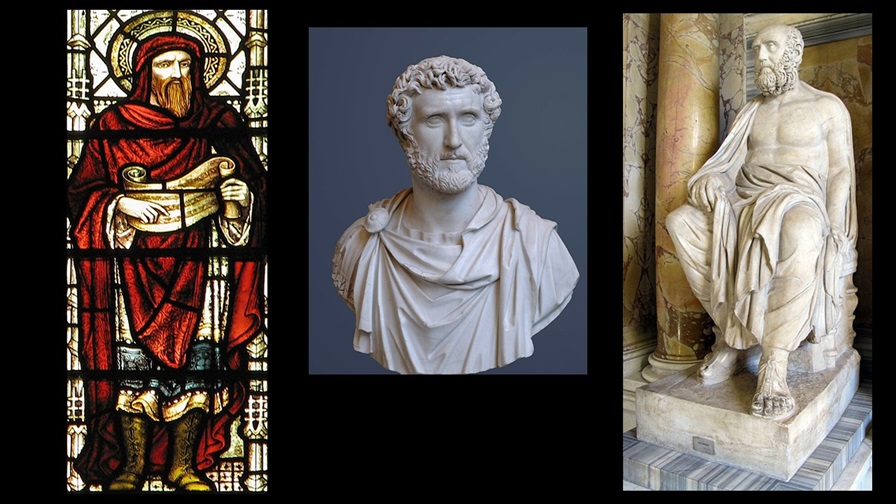
‘Apologies at Antoninus Pius’s Table, 155 A.D.’: A Poem by Christopher Fried

October 17, 2024
in Beauty, Culture, Poetry
A A
5
poems 'Apologies at Antoninus Pius’s Table, 155 A.D.': A Poem by Christopher Fried

.

Apologies at Antoninus Pius’s Table, 155 A.D.

.

I. Rome’s Glory

“Arriving at this feast, how proud I stand
that Rome endures to succor those who dwell
here in this citadel and those whose hands
till soil across the empire that reaps well.”

Sharp Aristides spoke to those who turned
to listen to his speech, and having viewed
the gathered gorging senators, he yearned
for more applause at higher amplitude.

Despite his wish for more, he had to deal
with what he got: a modicum of praise
for his didactic style, the strong appeal
to civic pride, and singular catchphrase.

“The Glory of Rome” to that proper group
was bingeing as before an acting troupe.

.

II.  God’s Glory

Responding to this scene with just a smile
at first, another speaker then approached
that satisfied reclining set, and while
he had no guile, these were the words he broached:

“Another Greek of fellow name expressed
to you great men some years ago that those
whom you call gods aren’t real to be addressed
but there is Jah, and his son, Christ, who rose.”

This Justin spoke despite a fleeting fear
of jeers that Athens’ Aristides faced
once in that court and witnessed to his peers,
despite their apathy, about God’s grace.

“Now, I to you may seem some jesting fool,
and yet there’s glory being my God’s tool.”

.

Poet’s Note: There were two Aristides who were contemporaneous. Per records, they both delivered orations in front of the Roman emperor. The first sonnet has the pagan Aelieus Aristides speaking. In the second sonnet, the second Aristides was also a “fellow Greek,” but of Athens, and was a known Christian apologist. He delivered an oration some years prior to Justin Martyr to the same court

.

.

Christopher Fried lives in Richmond, VA and works as an ocean shipping logistics analyst. His poetry collection All Aboard the Timesphere was published in 2013 by Kelsay Books. His novel Whole Lot of Hullabaloo: A Twenty-First Century Campus Phantasmagoria was published in 2020. Recently, he was an advisor on the 1980s science fiction film documentary In Search of Tomorrow (2022). His recent poetry has been published in Shot Glass Journal, Snakeskin, and Sparks of Calliope.


ShareTweetPin
The Society of Classical Poets does not endorse any views expressed in individual poems or commentary.
Read Our Comments Policy Here

RandomPoems

‘Songbirds Sing’ and Other Poetry by Debbie Johnson
Beauty

‘Songbirds Sing’ and Other Poetry by Debbie Johnson

March 12, 2017

  Songbirds Sing (Triolet Sonnet) As songbirds sing with joy of spring, unfolding blossoms show their hues. From my front...

‘Another Cakewalk’ and Other Poetry by Peter G. Epps
Culture

‘Another Cakewalk’ and Other Poetry by Peter G. Epps

November 28, 2017

  Another Cakewalk Mark Twain may not be safe to read, at least in public places, Because he gawks with...

Next Post
A Poem on Voter Fraud: ‘Red Skies’ and Others by Bruce Dale Wise

'The Waste Land: 2028': A Poem by Brian Yapko

Two Ballads on Abortion

'Mother Government': A Poem by Warren Bonham

‘Tattered’: A Poem by Venessa Lee-Estevez

'Tattered': A Poem by Venessa Lee-Estevez

Comments 5

  1. Roy Eugene Peterson says:
    2 years ago

    Both poems exhibit excellent rhyming words that are well-conceived and add immensely to the tone of the sonnets. The historical context of the notes really helped me understand what was occurring and when.

    Reply
    • Christopher Fried says:
      2 years ago

      Thanks Roy!

      Reply
  2. Margaret Coats says:
    2 years ago

    Good idea for a pair of sonnets, Christopher, and excellent conclusion to them re-phrasing one of Justin Martyr’s best-known quotes, in which he cites scriptural prophecy to say he and other Christians have turned swords into plowshares. Your first sonnet. “Rome’s Glory,” spoken by Aelius Aristides works up to this, with the pagan Aristides expressing pride in Roman agriculture. Its two middle quatrains about desire for praise are hilarious–so much like what we want for our own poems and what we actually get in response.

    One tiny thing should be fixed: Athens’ instead of Athen’s in “God’s Glory,” line 10. Our moderator can do it if you say so.

    Another is not necessarily incorrect, but I would much prefer “bingeing” to “binging” in the last line of “Rome’s Glory.” It’s clearer about what you mean, “indulging in a binge.” There is an archaic verb “to bing” meaning “to go,” but you don’t mean that, nor do you refer to using the online search engine “bing,” which I understand is spelled “bing-ing” with a hyphen to clarify. The spelling “bingeing” demands pronunciation with the /j/ sound.

    Reply
    • Christopher Fried says:
      2 years ago

      Thanks Margaret for the observations! I’m surprised that I hadn’t caught misplaced apostrophe with Athens’ during the final revision. Yes, I requested that to be corrected.

      Unless it’s for effect, I try to keep the language contemporaneous, even dealing with historical subjects. I’d probably had been reading something older when I reflexively used binging instead of bingeing as the later has become more common the last fifty years or so, at least in the States. I do like the look of bingeing on the page better, so I requested to adjust this as well.

      Reply
  3. Adam Sedia says:
    2 years ago

    Both sonnets display a wonderful complexity and subtlety of thought. The contrast between “glory” in the closing couplet of both was a masterful stroke. You make this little-discussed event come to life. I enjoyed these very much.

    Reply

Leave a Reply Cancel reply

Your email address will not be published. Required fields are marked *

  1. Gerard Maritato on ‘The Gold Star Mother’: A Poem by Gerard MaritatoJuly 18, 2026

    Thank you Cynthia. We have many tears for these boys and those who mourn them. Gerry

  2. Mike Bryant on ‘The 51st State’: A Poem by James SaleJuly 18, 2026

    James, I love this poem. I believe, however, that it would be far more advantageous for England, and for Texas,…

  3. Karen Rodgers on ‘The Gold Star Mother’: A Poem by Gerard MaritatoJuly 18, 2026

    Brilliant Gerard, brillant. I studied lietrature at University and made the mistake of choosing almost exclusively options from the 20th…

  4. Marguerite on ‘When the Phone Rings’ and Other Short Poems by Russel WinickJuly 18, 2026

    Amen on "Apologies!"

  5. Susan Jarvis Bryant on ‘My Pyjamas!’ and Other Poems by Susan Jarvis BryantJuly 18, 2026

    Jan, thank you very much for your encouraging comment. I'm so glad you enjoyed the poems and especially glad they…

Subscribe to Daily Poems

Enter your email address to subscribe to this blog and receive notifications of new posts by email.

Join 1,594 other subscribers

Recent Poems

  • Winners and Rankings of The Great American Poetry Competition
  • ‘The Gold Star Mother’: A Poem by Gerard Maritato
  • ‘An American Dash’: A Poem by Linda Ellis
  • ‘The Anonymous Soldier’: A Poem by Lucy Lind
  • ‘For Those We Never Meet’: A Poem by Aneesh Agarwal
  • ‘Ben Franklin’s Copper Fugio Cent’: A Poem by Geoffrey Smagacz
  • Three Brief Poems by Luxorius, Translated by Joseph S. Salemi
  • ‘The American Spirit’: A Poem by Dusty Grein
  • ‘The Ballad of Zebulon Pike’: A Poem by M.D. Skeen
  • ‘We Are the Ones’ and Other Poetry by Cheryl Corey
  • ‘My Pyjamas!’ and Other Poems by Susan Jarvis Bryant
  • ‘A Snowy Egret’: A Poem by Bruce Dale Wise
  • ‘The Swearing-in of Calvin Coolidge’: A Sonnet by Robert W. Crawford
  • ‘Ballad of the Sequoia’: A Poem by Lauren V. Leon
  • ‘The 51st State’: A Poem by James Sale
  • ‘La Uva’ (The Grape): A Poem by Michael Pietrack
  • ‘There’s Blood that Flows Within the Stripes’: A Poem by Lauren V. Leon
  • ‘Birdsong’: A Poem by Jeffrey Essmann
  • ‘The Melody That Lingers On’ and Other Poetry by John McPherson
  • ‘American Dreams’: A Poem by Adam Sedia
  • ‘An American Fabius’: A Poem by John Hernandez
  • ‘Vernal Clinic’ and Other Poetry by C.B. Anderson
  • ‘Omaha Beach’ and Other Poetry by Bradford Skow
  • ‘Music to Part the Veil’: A Poem by T.M. Moore
  • ‘A Gentleman’s Guide to Losing a War’ and Other Poetry by Arnon Peterson
  • ‘Black Shuck’: A Poem by Martin Briggs
  • ‘When the Last World War II Veteran Passes Away’: A Poem by N.S. Boone
  • ‘A Fallow Year at Worthy Farm’: A Poem by Paul A. Freeman
  • ‘Outstanding in Afghanistan’: A Poem by Jared S. Chang
  • ‘250 More’: A Poem by Miguel Moreno

Categories

  • Acrostic
  • Alexandroid
  • Alliterative
  • Art
  • Best Poems
  • Blank Verse
  • Chant Royal
  • Classical Poets Live
  • Clerihew
  • Covid-19
  • Deconstructing Communism
  • Educational
  • Epic
  • Epigrams and Proverbs
  • Essays
    • Interviews with Poets
    • Poetry Reviews
  • Featured
  • From the Society
  • Great Poets
    • Dante Alighieri
    • Edgar Allan Poe
    • Emily Dickinson
    • Geoffrey Chaucer
    • Henry Wadsworth Longfellow
    • Homer
    • John Keats
    • John Milton
    • Robert Frost
    • William Blake
    • William Shakespeare
    • William Wordsworth
  • Human Rights in China
  • Limerick
  • Love Poems
  • Music
  • Pantoum
  • Performing Arts
  • Poetry
    • Beauty
    • Children's Poems
    • Culture
    • Ekphrastic
    • Found Poems
    • High School Poets
    • Humor
    • Riddles
  • Poetry Challenge
  • Poetry Contests
  • Poetry Forms
    • Curtal Sonnet
    • Haiku
  • Poetry Readings
  • Rhupunt
  • Rondeau
  • Rondeau Redoublé
  • Rondel
  • Rubaiyat
  • Sapphic Verse
  • Satire
  • Science
  • Sestina
  • Shape Poems
  • Short Stories
  • Song Lyrics
  • Sonnet
  • Symposium
  • Terrorism
  • Terza Rima
  • The Environment
  • Translation
  • Triolet
  • Video
  • Villanelle

Quick Links

  • About Us
  • Submit Poetry
  • Become a Member
  • Members List
  • Support the Society
  • Advertisement Placement
  • Comments Policy
  • Terms of Use

Welcome Back!

Login to your account below

Forgotten Password?

Retrieve your password

Please enter your username or email address to reset your password.

Log In
No Result
View All Result
  • Poems
    • Beauty
    • Culture
    • Satire
    • Humor
    • Children’s
    • Art
    • Ekphrastic
    • Epic
    • Epigrams and Proverbs
    • Human Rights in China
    • Music
    • Performing Arts
    • Riddles
    • Science
    • Song Lyrics
    • The Environment
    • The Raven
    • Found Poems
    • High School Poets
    • Terrorism
    • Covid-19
  • Poetry Forms
    • Sonnet
    • Haiku
    • Limerick
    • Villanelle
    • Rondeau
    • Pantoum
    • Sestina
    • Triolet
    • Acrostic
    • Alexandroid
    • Alliterative
    • Blank Verse
    • Chant Royal
    • Clerihew
    • Rhupunt
    • Rondeau Redoublé
    • Rondel
    • Rubaiyat
    • Sapphic Verse
    • Shape Poems
    • Terza Rima
  • Great Poets
    • Geoffrey Chaucer
    • Emily Dickinson
    • Homer
    • Henry Wadsworth Longfellow
    • Dante Alighieri
    • John Keats
    • John Milton
    • Edgar Allan Poe
    • William Shakespeare
    • William Wordsworth
    • William Blake
    • Robert Frost
  • Love Poems
  • Contests
  • SCP Academy
    • Educational
    • Teaching Classical Poetry—A Guide for Educators
    • Poetry Forms
    • The SCP Journal
    • Books

© 2025 SCP. WebDesign by CODEC Prime.