• Submit Poetry
  • Support SCP
  • About Us
  • Members
  • Join
Tuesday, May 12, 2026
Society of Classical Poets
  • Poems
    • Beauty
    • Culture
    • Satire
    • Humor
    • Children’s
    • Art
    • Ekphrastic
    • Epic
    • Epigrams and Proverbs
    • Human Rights in China
    • Music
    • Performing Arts
    • Riddles
    • Science
    • Song Lyrics
    • The Environment
    • The Raven
    • Found Poems
    • High School Poets
    • Terrorism
    • Covid-19
  • Poetry Forms
    • Sonnet
    • Haiku
    • Limerick
    • Villanelle
    • Rondeau
    • Pantoum
    • Sestina
    • Triolet
    • Acrostic
    • Alexandroid
    • Alliterative
    • Blank Verse
    • Chant Royal
    • Clerihew
    • Rhupunt
    • Rondeau Redoublé
    • Rondel
    • Rubaiyat
    • Sapphic Verse
    • Shape Poems
    • Terza Rima
  • Great Poets
    • Geoffrey Chaucer
    • Emily Dickinson
    • Homer
    • Henry Wadsworth Longfellow
    • Dante Alighieri
    • John Keats
    • John Milton
    • Edgar Allan Poe
    • William Shakespeare
    • William Wordsworth
    • William Blake
    • Robert Frost
  • Love Poems
  • Contests
  • SCP Academy
    • Educational
    • Teaching Classical Poetry—A Guide for Educators
    • Poetry Forms
    • The SCP Journal
    • Books
No Result
View All Result
Society of Classical Poets
  • Poems
    • Beauty
    • Culture
    • Satire
    • Humor
    • Children’s
    • Art
    • Ekphrastic
    • Epic
    • Epigrams and Proverbs
    • Human Rights in China
    • Music
    • Performing Arts
    • Riddles
    • Science
    • Song Lyrics
    • The Environment
    • The Raven
    • Found Poems
    • High School Poets
    • Terrorism
    • Covid-19
  • Poetry Forms
    • Sonnet
    • Haiku
    • Limerick
    • Villanelle
    • Rondeau
    • Pantoum
    • Sestina
    • Triolet
    • Acrostic
    • Alexandroid
    • Alliterative
    • Blank Verse
    • Chant Royal
    • Clerihew
    • Rhupunt
    • Rondeau Redoublé
    • Rondel
    • Rubaiyat
    • Sapphic Verse
    • Shape Poems
    • Terza Rima
  • Great Poets
    • Geoffrey Chaucer
    • Emily Dickinson
    • Homer
    • Henry Wadsworth Longfellow
    • Dante Alighieri
    • John Keats
    • John Milton
    • Edgar Allan Poe
    • William Shakespeare
    • William Wordsworth
    • William Blake
    • Robert Frost
  • Love Poems
  • Contests
  • SCP Academy
    • Educational
    • Teaching Classical Poetry—A Guide for Educators
    • Poetry Forms
    • The SCP Journal
    • Books
No Result
View All Result
Society of Classical Poets
No Result
View All Result
Home Poetry Beauty

‘Ballroom Dancing’: A Sonnet Cycle by James A. Tweedie

June 16, 2019
in Beauty, Culture, Humor, Poetry
A A
7
poems 'Ballroom Dancing': A Sonnet Cycle by James A. Tweedie

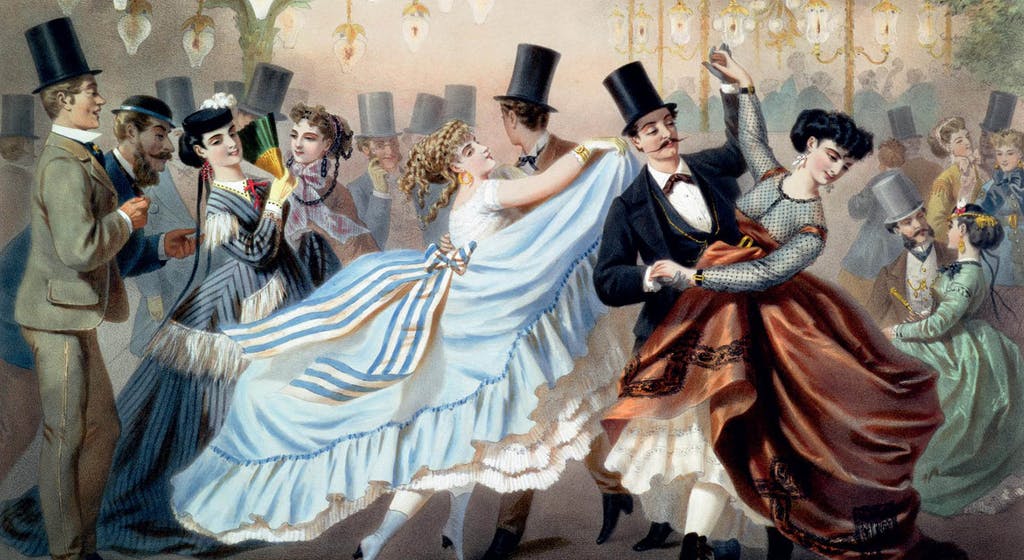
Note: Formal Ballroom Dance competition involves five specific dance forms. This sonnet cycle attempts to introduce and describe them. I have also composed and attached audio recordings of a Waltz and Tango as accompaniment.

Foxtrot

The Foxtrot is an easy dance to learn.
__Just hold your partner in a close embrace
__And walk in step with elegance and grace
__Until you pause and make a gliding turn.
In competition, tempos are quite slow,
__A basic two step without twirls or dips.
__In national and world championships
__The Foxtrot’s one of five that all must know.
For fun, a one-step Foxtrot adds a flare,
__With variations called the Baltimore,
__The Charleston, the Black Bottom, and more—
__With added kicks and flips for those who dare.
The Foxtrot, as with every ballroom dance,
Is a great way to celebrate romance.


Quickstep

The Quickstep is a fast-paced, ballroom dance
__Derived from Foxtrot and the Charleston.
__Although it seems spontaneously fun
__There’s not a single step that’s left to chance.
For everyone who does the Quickstep knows
__That with their partner they will have to learn
__To do a fishtail, lock, and quarter turn
__While skipping, pausing, gliding on their toes.
The music starts, the signal to begin,
__And then they dance. Somewhere along the way
__The better dancers add a cross chassé,
__A zig-zag, and a double reverse spin,
A tipsy to the right, a six-quick run,
A tipsy to the left, and then it’s done.


Waltz*

A Waltz danced in iambic meter? No way!
__For sonnets are duple, the waltz triple beat,
__Which creates a conflict as they each compete
__Like Zeus and Demeter to each win the day.
With simple and mincing steps dancers rotate
__While twirling and swirling around the dance floor.
__The slow, steady music inspires them to soar
__In ways that are both elegant and ornate.
With one-two-three, one-two-three onward they fly,
__Their feet seemingly never touching the ground,
__While spinning and twirling around and around
__Until the dance ends with a whisper and sigh.
The dancers all bow before saying “Good-night!”
And hand in hand travel home in the moonlight.

*Note: This poem has the form of an iambic pentameter sonnet (with feminine endings throughout—11 syllable lines) but the beat of the words is in triple meter as in a waltz (see line 9 for the explicit triple beat written out). The effect is both jarring and strangely amusing. If someone has a name for this rhythm, I’d love to know what it is.

https://classicalpoets.org/wp-content/uploads/2019/05/Waltz-mp3.mp3


Viennese Waltz

A second waltz is called the Viennese,
__A high-speed, lilting, dizzy, spinning, reel
__Once thought a scandal for its sex appeal,
__Condemned by prim and proper folks as “sleaze.”
For ne’er before had couples stood so close
__And, face-to-face, danced by themselves alone.
__The scandal was, of course, quite overblown,
__And waltzing soon had Europe on its toes.
The dance allows no sudden stops or dips,
__The dancers simply spin to left or right
__Transcircuiting the dancefloor with delight
__With hands on back and shoulder, not on hips!
Beginning waltzers find themselves hard put
To keep from stepping on their partner’s foot.


Tango

“To Tango,” as the saying goes, “takes two,”
__A truth which ought to be self-evident.
__For three—perhaps two women and one gent—
__Would get all tango-tangled and askew.
And Tango solos would, of course, be bleak,
__For Tango, as with every ballroom dance,
__Is all about the passion of romance,
__And, by yourself, you can’t dance cheek-to-cheek!
So, grab a partner, Tango if you dare,
__Enfolding one another in embrace
__While acting out together, face-to-face,
__A torrid, heart-felt, dance-floor love affair.
When Tango-ing it never is remiss
To end the dance with an impassioned kiss.


https://classicalpoets.org/wp-content/uploads/2019/06/Tango-short-version-mp3.mp3


James A. Tweedie is a recently retired pastor living in Long Beach, Washington. He likes to walk on the beach with his wife. He has written and self-published four novels and a collection of short stories. He has several hundred unpublished poems tucked away in drawers.

ShareTweetPin
The Society of Classical Poets does not endorse any views expressed in individual poems or commentary.
Read Our Comments Policy Here

RandomPoems

‘The Tundra Swan’: A Madrigal by Daniel Howard
Beauty

‘The Tundra Swan’: A Madrigal by Daniel Howard

March 19, 2025

. The Tundra Swan Its full and light and interfolding feathers __Number ten thousand plus, No wonder that the tundra...

A Poem on How Native Americans Were Swindled Out of Manhattan, by Mark Stellinga
Culture

A Poem on How Native Americans Were Swindled Out of Manhattan, by Mark Stellinga

March 15, 2024

. Native Americans Were Swindled Out of Manhattan in 1634 Knowing Eyes—an aging elder, born in Black Bear County Famed...

Next Post
‘I Spent My Youth with Byron and the Bard’ and Other Poetry by Caleb Winebrenner

'I Spent My Youth with Byron and the Bard' and Other Poetry by Caleb Winebrenner

‘Message in a Bottle’ and Other Poetry by Tony L. Damigo

'Message in a Bottle' and Other Poetry by Tony L. Damigo

‘In The Know’ by David Watt

'In The Know' by David Watt

Comments 7

  1. Sally Cook says:
    7 years ago

    Dear Mr.Tweedie,

    Your dance poems are delightfulexcursions into the art of dance — descriptive and full of fun. Only one seems somewhat awkward to me — that is “Waltz”. Perhaps it is only that you tried to pack so much into it in terms of meter and form, and it got away from you. In any case, I enjoyed the entire idea immensely..

    Reply
    • James A. Tweedie says:
      7 years ago

      Thank you, Sally. Did you read the explanatory note for the waltz poem? If not, please do.

      Reply
      • Sally Cook says:
        7 years ago

        Oh, yes – I did read it and it was very clear. It was very ambitions, but I just don’t think it worked. It could be you were trying to do too much in one short poem. I find that sometimes I end by re-writing several times; in my opinion, this may be one of those times for you.. I would like to see all sections of this unusual poem be on a level playing ground.
        Shall we dance?

        Reply
  2. Amy Foreman says:
    7 years ago

    Delightful, James! Your “Waltz” reminded me of a humorous song by Mason Williams, which, years ago, our children learned and performed for a local music club. In the song, Jonathan W. Aster, the master dancing man, finds a three-legged woman at the ball, and they enjoy a triple/duple/triple/duple “waltz.” You might get a smile out of William’s take on this juxtaposition: https://www.youtube.com/watch?v=tbyeZhF1_cY.

    Reply
  3. C.B. Anderson says:
    7 years ago

    I guess I’m just not in an ekphrastic mood, for I thought the whole sequence was a monumental waste of talent.

    Reply
    • James A. Tweedie says:
      7 years ago

      Thank you, C.B., for acknowledging the talent—wasted or no!

      Reply
  4. Monty says:
    7 years ago

    I don’t see how one commenter above could deem these poems to be “a waste of talent”; to me, they’re a realisation of talent, and they undeniably display talent.

    And as for another commenter’s groundless appraisal that ‘Waltz’ is “awkward”, and “it got away from you”; I’m perplexed that one can utter such words without a hint of explanation as to how/why they feel that to be the case. What’s more, even after reading the poem’s explanatory Note (11 syllables, etc) she still maintained her initial stance . . again with no explanation offered.

    I feel these to be an admirable sequence of poems: written by one for whom the subject-matter is obviously dearly held.

    Reply

Leave a Reply Cancel reply

Your email address will not be published. Required fields are marked *

  1. Roy Eugene Peterson on National Poetry Month Limerick ChallengeMay 12, 2026

    Urszula, what an imaginative limerick! That is something Poe might have done! Sorry to be so late seeing this.

  2. Roy Eugene Peterson on National Poetry Month Limerick ChallengeMay 12, 2026

    Agreed, Urszula! Thank you for commenting.

  3. Joseph S. Salemi on ‘Spontaneous Conjugal Combustion’ and Other Poems by Susan Jarvis BryantMay 12, 2026

    When I was in the U.K. I heard that "poodle" could mean a henpecked or subservient husband, and by extension…

  4. Susan Jarvis Bryant on ‘Spontaneous Conjugal Combustion’ and Other Poems by Susan Jarvis BryantMay 12, 2026

    Yael, it's always lovely to hear from you. I'm thrilled you enjoyed the poems. I did have people in mind…

  5. Susan Jarvis Bryant on ‘Spontaneous Conjugal Combustion’ and Other Poems by Susan Jarvis BryantMay 12, 2026

    James, I'm hoping you enjoyed the villanelle and it hasn't worried you too much. Mike often suffers for my art…

Subscribe to Daily Poems

Enter your email address to subscribe to this blog and receive notifications of new posts by email.

Join 1,593 other subscribers

Recent Poems

  • A Poem on Coach “Black Mike” Castronis from Athens Y Camp, by Alec Ream
  • A Poem on the Zambian National Park Mosi-oa-Tunya, by Paul A. Freeman
  • ‘Creation of Mom’: A Mother’s Day Poem by Roy E. Peterson
  • ‘Spontaneous Conjugal Combustion’ and Other Poems by Susan Jarvis Bryant
  • ‘The Man in the Moon Was a Very Round Man’: A Poem by Lauren V. Leon
  • ‘Fibromytrauma’: A Poem by Golan Shahar
  • ‘A Lonely Sliver’: A Poem by Katie Tencza
  • ‘Higher Gas Prices Are a Small Price to Pay’: An Iran War Poem by Mark F. Stone
  • ‘Always Ahead’: A Poem by Scharlie Meeuws
  • ‘Hamlet’s Lawyer’ and Other Poetry by Brian Yapko
  • ‘On An Old Photograph’: A Poem by Joseph S. Salemi
  • ‘Faust Foresees His End’: A Poem by Martin Briggs
  • ‘À la Carte’ and Other Poetry by C.B. Anderson
  • ‘Where the Sweet Bluebonnets Bloom’: A Poem by Roy E. Peterson
  • ‘The Waters’: A Poem by Margaret Brinton
  • ‘The Pinnacle of Poetry’ and Other Poems by Russel Winick
  • The First American Sonnets: An Essay on David Humphreys, by Margaret Coats
  • ‘The Holy Rollers on Poetry’: A Poem by Joseph S. Salemi
  • Sappho’s ‘Poem 1’ Translated by Bruce Phenix
  • ‘The Cautionary Tale of Phone Addicted Mimi’: A Poem by Paul A. Freeman
  • ‘Look Away’: A Poem for America’s 250th Anniversary, by Roger Crane
  • ‘Sunday Morning in Canada’: A Poem by Jeffrey Essmann
  • ‘Bean’: A Poem by Jan Mennite
  • ‘The Swan’s Song ’: A Poem for Shakespeare’s Birthday, by Susan Jarvis Bryant
  • ‘The Gravedigger’: A Poem by Marie Burdett
  • ‘Waiting for the Perfect Man’: A Poem by Janice Canerdy
  • ‘The George-A-Saurus’ and Other Poetry by Brian Yapko
  • ‘When Asked: What’s Your Favorite Season?’: A Poem by Paul Millan  
  • ‘The Last At-Bat of Lyndon Braun’: A Poem by Michael Pietrack
  • ‘The Perpetual Battle’ and Other Poetry by Adam Sedia

Categories

  • Acrostic
  • Alexandroid
  • Alliterative
  • Art
  • Best Poems
  • Blank Verse
  • Chant Royal
  • Classical Poets Live
  • Clerihew
  • Covid-19
  • Deconstructing Communism
  • Educational
  • Epic
  • Epigrams and Proverbs
  • Essays
    • Interviews with Poets
    • Poetry Reviews
  • Featured
  • From the Society
  • Great Poets
    • Dante Alighieri
    • Edgar Allan Poe
    • Emily Dickinson
    • Geoffrey Chaucer
    • Henry Wadsworth Longfellow
    • Homer
    • John Keats
    • John Milton
    • Robert Frost
    • William Blake
    • William Shakespeare
    • William Wordsworth
  • Human Rights in China
  • Limerick
  • Love Poems
  • Music
  • Pantoum
  • Performing Arts
  • Poetry
    • Beauty
    • Children's Poems
    • Culture
    • Ekphrastic
    • Found Poems
    • High School Poets
    • Humor
    • Riddles
  • Poetry Challenge
  • Poetry Contests
  • Poetry Forms
    • Curtal Sonnet
    • Haiku
  • Poetry Readings
  • Rhupunt
  • Rondeau
  • Rondeau Redoublé
  • Rondel
  • Rubaiyat
  • Sapphic Verse
  • Satire
  • Science
  • Sestina
  • Shape Poems
  • Short Stories
  • Song Lyrics
  • Sonnet
  • Symposium
  • Terrorism
  • Terza Rima
  • The Environment
  • Translation
  • Triolet
  • Video
  • Villanelle

Quick Links

  • About Us
  • Submit Poetry
  • Become a Member
  • Members List
  • Support the Society
  • Advertisement Placement
  • Comments Policy
  • Terms of Use

Welcome Back!

Login to your account below

Forgotten Password?

Retrieve your password

Please enter your username or email address to reset your password.

Log In
No Result
View All Result
  • Poems
    • Beauty
    • Culture
    • Satire
    • Humor
    • Children’s
    • Art
    • Ekphrastic
    • Epic
    • Epigrams and Proverbs
    • Human Rights in China
    • Music
    • Performing Arts
    • Riddles
    • Science
    • Song Lyrics
    • The Environment
    • The Raven
    • Found Poems
    • High School Poets
    • Terrorism
    • Covid-19
  • Poetry Forms
    • Sonnet
    • Haiku
    • Limerick
    • Villanelle
    • Rondeau
    • Pantoum
    • Sestina
    • Triolet
    • Acrostic
    • Alexandroid
    • Alliterative
    • Blank Verse
    • Chant Royal
    • Clerihew
    • Rhupunt
    • Rondeau Redoublé
    • Rondel
    • Rubaiyat
    • Sapphic Verse
    • Shape Poems
    • Terza Rima
  • Great Poets
    • Geoffrey Chaucer
    • Emily Dickinson
    • Homer
    • Henry Wadsworth Longfellow
    • Dante Alighieri
    • John Keats
    • John Milton
    • Edgar Allan Poe
    • William Shakespeare
    • William Wordsworth
    • William Blake
    • Robert Frost
  • Love Poems
  • Contests
  • SCP Academy
    • Educational
    • Teaching Classical Poetry—A Guide for Educators
    • Poetry Forms
    • The SCP Journal
    • Books

© 2025 SCP. WebDesign by CODEC Prime.